Published August 7, 2026
A buyer's guide to Chinese calligraphy: the five scripts, hanging scrolls and couplets, what actually drives value, and what to check before buying.
A calligraphy couplet hangs differently from a painting. You put the two panels either side of a doorway or a console table, and for the first week your eye keeps going to the gap between them rather than to the brushwork — because the pair is doing architectural work, framing something, before it does anything pictorial. Then one evening the light rakes across the paper and you see the dry drag at the end of a downstroke where the brush ran out of ink, and you understand that you are looking at a recording of about four seconds of somebody's arm.
Calligraphy is the form Chinese connoisseurs have always ranked above painting, and the form Western collectors buy last. This guide is for the collector who has decided to stop skipping it: what the scripts are, what formats you will actually be offered, what drives price, and where the traps are.
Why calligraphy sits at the top of the hierarchy
In the Chinese critical tradition, calligraphy is not decorative writing. It is the primary art, and painting borrows its vocabulary — the same brush, the same paper, the same idea that a line carries the character of the person who made it. Literati painters trained in calligraphy first and treated painting as an extension of it, which is why the inscriptions on a scholar's painting are not captions but part of the composition. Once you see the hierarchy, the logic of the whole tradition follows: the amateur scholar's claim to superiority over the professional painter rested on the brush, and the brush's purest test is writing.
The practical consequence for a collector is that quality judgements in calligraphy are made on grounds that feel abstract at first — rhythm, pressure, the handling of a turn, the relationship between characters and the empty paper around them. You do not need to read Chinese to start seeing these things, but you do need to look at a great deal of it before your eye is worth trusting. Museum collections are the cheapest training available.
The five scripts, in the order you will meet them
Chinese calligraphy is written in five canonical script types. They developed roughly in sequence but never replaced one another — a twentieth-century master might work in all five, choosing the script to suit the text and the occasion.
| Script | Chinese | Character | Where you meet it ||---|---|---|---|| Seal script | zhuanshu | Even-width lines, tall, symmetrical, archaic | Seals, formal titles, antiquarian works || Clerical script | lishu | Flattened, wide, with a flared closing stroke | Stele texts, plaques, deliberately grave inscriptions || Regular script | kaishu | Fully articulated, one stroke at a time | Sutras, formal transcriptions, most beginners' study || Running script | xingshu | Regular script written faster, strokes beginning to join | Letters, colophons, the majority of hanging scrolls || Cursive script | caoshu | Highly abbreviated, characters dissolving into gesture | Virtuoso display pieces, poems written at speed |
Running script is the workhorse of the collectible market. It is legible enough to be read, loose enough to show personality, and it is what most modern masters wrote when they wrote for other people. Cursive is where reputations are made and lost, because there is nowhere to hide. Seal and clerical script carry an antiquarian flavour — a modern artist choosing them is making a point about lineage, as Wu Changshuo did when he built his entire hand out of the ancient stone-drum script.
Our five scripts explained piece goes through the visual identification in more detail. For buying purposes, the thing to internalise is that the script is a choice, and a knowledgeable seller should be able to tell you why the artist made it.
The formats you will actually be offered
Format affects price as much as authorship does, because it dictates where the work can live.
- Hanging scroll. A single vertical panel, mounted on silk brocade with a wooden roller at the bottom. The default format for a display piece.
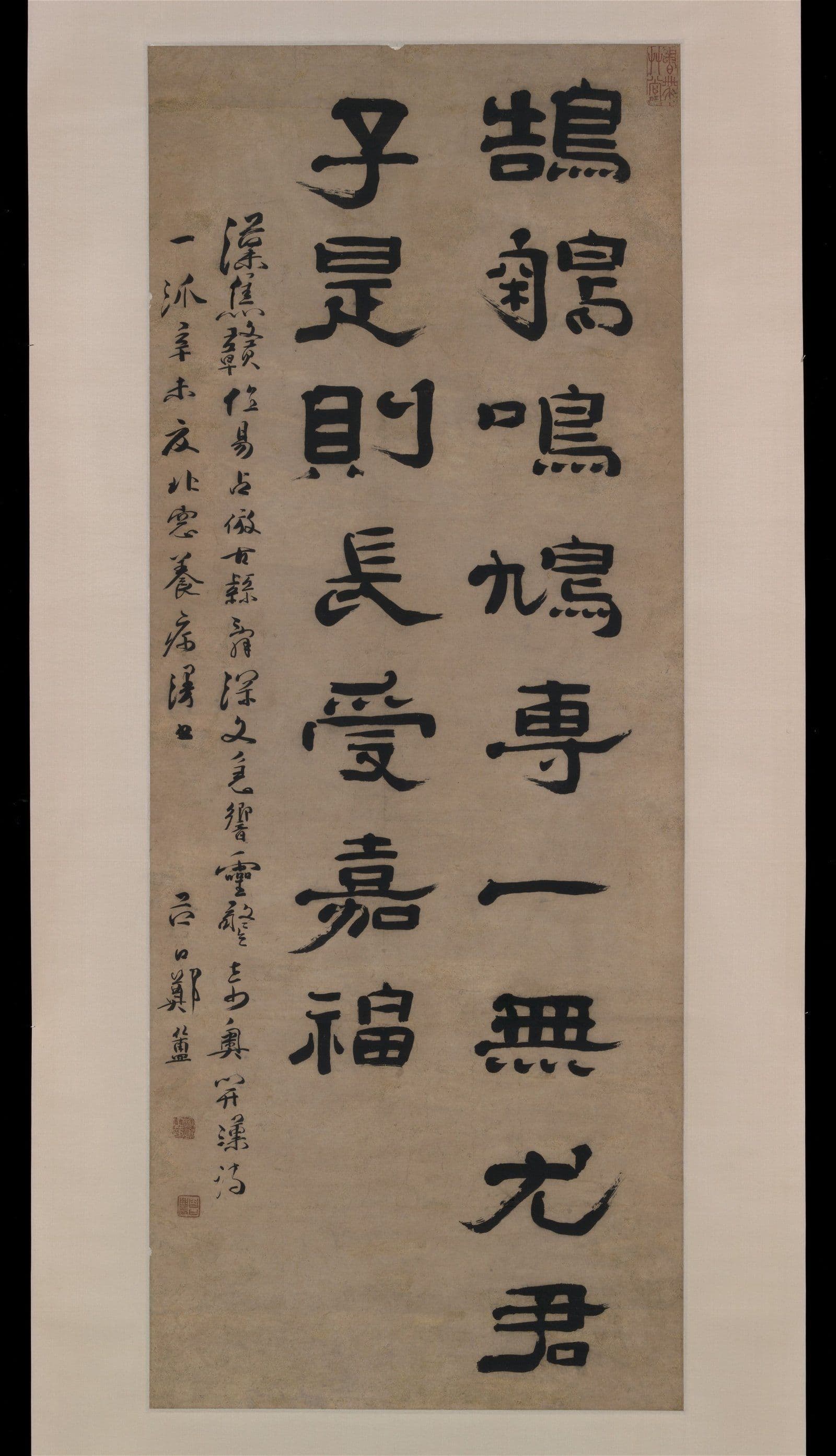
- Couplet. Two matching vertical panels carrying a two-line parallel verse, hung as a pair. Read the right-hand panel first. A split couplet — one panel offered alone — is worth far less than half the pair, and you should assume any single panel with a symmetrical composition was once half of something.
- Horizontal plaque or banner. A short phrase written large, meant to hang above a door or along a wall. Four characters is the classic length.
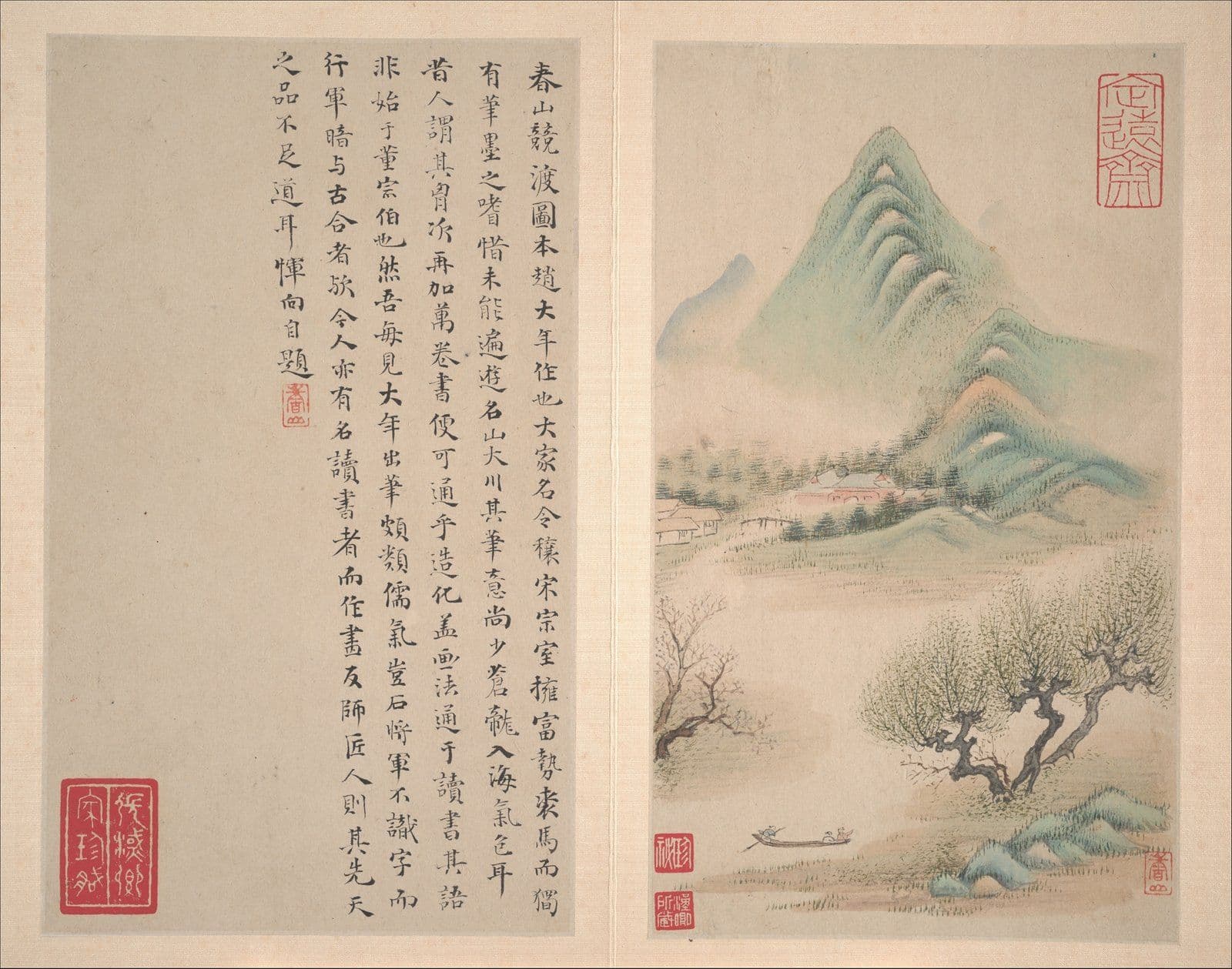
- Album leaf. Small, mounted in a folding album, often a set of transcribed poems or letters. Discussed alongside fans in our album leaves and fan paintings guide.
- Fan leaf. Written on the arc of a folding fan, later removed and mounted flat. The curve makes the column spacing difficult, so fan calligraphy is a display of control.
- Handscroll. Long, horizontal, meant to be unrolled a section at a time and read at arm's length rather than hung — a reading object, not a wall object.
Couplets and plaques are the easiest entry point for a Western interior, because they are architectural rather than pictorial and they tolerate being read as pattern. Zhang Daqian's calligraphy couplet is a good example of what the format does in a room — two verticals, generous margins, and the whole thing sitting still.
What drives the price
Six factors, roughly in order of weight.
Authorship. The single largest multiplier, and the reason forgery is endemic. A minor work by a major hand outsells a superb work by an unrecorded one.
The text and the occasion. Calligraphy is usually written for someone or about something. A piece inscribed to a named recipient who was himself notable, or written to mark an event, carries documentary weight that a generic transcription of a Tang poem does not. This is also where the risk sits: the dedication is the part a forger most wants to add.
Format and scale. Large hanging scrolls and complete couplets command more than album leaves and fragments, for straightforward reasons of presence.
Calligraphic quality. Within one artist's output, the market distinguishes sharply between a piece written with attention and one dashed off. Look for consistent energy from the first character to the last, and for a signature written in the same condition as the body — signatures that suddenly tighten up are a warning.
Condition. Paper and silk age badly in the wrong conditions. Foxing, water tide-lines, insect damage, and losses along old fold lines all discount heavily, and heavy retouching discounts further. Auction catalogues describe these in a compressed shorthand that is worth learning to decode before you bid.
Provenance and seals. Collector seals stamped by known owners build a chain of custody in ink. They are also faked. Read them as supporting evidence, never as proof — the same logic we apply to seals and collector marks on paintings.
Paper, mounting, and the things that quietly cost money
Most calligraphy is written on xuan paper, the absorbent paper usually sold in the West as rice paper. Unsized xuan drinks ink and spreads it, so every hesitation shows; sized xuan holds the line and forgives more. Silk behaves differently again, taking ink more reluctantly and ageing on a different schedule.
Mounting is the expensive part nobody budgets for. A Chinese scroll is a laminated object — the artwork is backed with further layers of paper and framed in silk borders — and that mounting has a working life. Old, brittle, or badly repaired mounts need to be redone by a specialist, a process called zhuangbiao, and it is neither quick nor cheap. Our guide to scroll mounting explains what remounting involves and when to leave well alone. When you are quoted a price for a scroll, ask when it was last remounted; a fresh mount on an old work often means the paper has already been through conservation.
Storage is the other quiet cost. Scrolls want to be rolled loosely, kept dark, kept dry, and unrolled occasionally rather than left hanging for years. Budget for a flat box or a scroll tube per piece, and for somewhere in the house that is neither the attic nor the bathroom wall.
Starting sensibly
Buy from someone who will put the attribution in writing. Insist on seeing the whole object unrolled, including the mount, the reverse of the ends, and any collector seals near the margins. Photograph the signature and the seals before you commit, because you will want to compare them later against reference material — the approach set out in our guide to reading Chinese artist signatures.
Then set expectations honestly. The market for modern and contemporary Chinese calligraphy is deep in Asia and thin in the West, which cuts both ways: you will find pieces in European and American sales that would be competitively bid in Hong Kong, and you will also find it harder to resell locally. Buy for the wall, not for the spread.
Among twentieth-century figures, Qi Gong is the natural starting point for a Western collector. He was a scholar, a poet, and a connoisseur of old painting and calligraphy as well as a practising calligrapher, and his hand is unusually legible and unusually consistent — which makes it a good eye-training reference, and, unfortunately, a heavily imitated one.
Common questions
Do I need to read Chinese to collect calligraphy?
No, but you need a reliable reading of each piece before you buy it. Ask the seller for a full translation of the text, the dedication, and the signature line, plus an identification of every seal. If they cannot supply that, the piece has not been catalogued properly and you are buying blind. Over time you will start recognising recurring characters and the artist's habitual way of writing his own name, which is the beginning of a usable eye.
Is calligraphy harder to authenticate than painting?
In general, yes. Painting gives an authenticator more variables — composition, pigment, subject handling, brush idiom — whereas calligraphy is line alone, so a skilled copyist has fewer things to get right. Copying was also a legitimate part of training for centuries, so old faithful copies exist in quantity and were not made to deceive. Our overview of how experts authenticate Chinese paintings covers the methods that transfer.
What should I check before hanging a scroll?
Confirm the mount is sound, particularly the top stave and the hanging cord, and that the roller ends are tight. Hang it out of direct sunlight and away from heating vents, and take it down after a few months rather than leaving it up permanently. Roll it loosely — a tight roll cracks the pigment and stresses the paper along the same lines every time.
Are couplets ever sold as single panels legitimately?
It happens, usually because a pair was split by inheritance or by a dealer trying to make two sales. It is not fraudulent to sell a single panel, but the price should reflect the loss. Ask directly whether the other half is known, and treat a vendor who is vague about it as a reason for caution.
Further reading
- Reading Chinese Painting Inscriptions — the structure of a signature line and what each part tells you.
- Silk vs Paper in Chinese Painting — how the two supports take ink, and how they age.
- How a Chinese Handscroll Is Meant to Be Viewed — the format that is read rather than hung.
- How to Display a Chinese Scroll Painting — light, rotation, and how long to leave a piece up.
Browse the collection
Calligraphy on paper is a subject we write about more often than we stock. What Kiln & Ink sells is limited-edition archival giclée reproductions of the twentieth-century Chinese ink masters — fifteen artists, printed on rice (xuan) paper or museum-grade cotton rag, hand-numbered, and issued with a Certificate of Authenticity.
Explore Further