Published July 22, 2026
The Stone Drums carry China's oldest surviving inscriptions. How Wu Changshuo rebuilt that script into modern art, and how to judge his couplets.
Picture Shanghai before dawn, sometime in the 1920s. An old man in his eighties grinds ink, weights a sheet of paper, and begins copying a text he first copied half a century earlier — ten short poems cut into stone more than two thousand years before he was born. Wu Changshuo (1844–1927) did this so many times, across so many decades, that the copies stopped being copies. They became the most recognizable calligraphy of early modern China.
This article explains what the Stone Drum inscriptions actually are, what Wu Changshuo did to them that no one had done before, and how a collector should look at his calligraphy — the formats, the tells, and the questions to ask before trusting an attribution.
Ten stones from the state of Qin
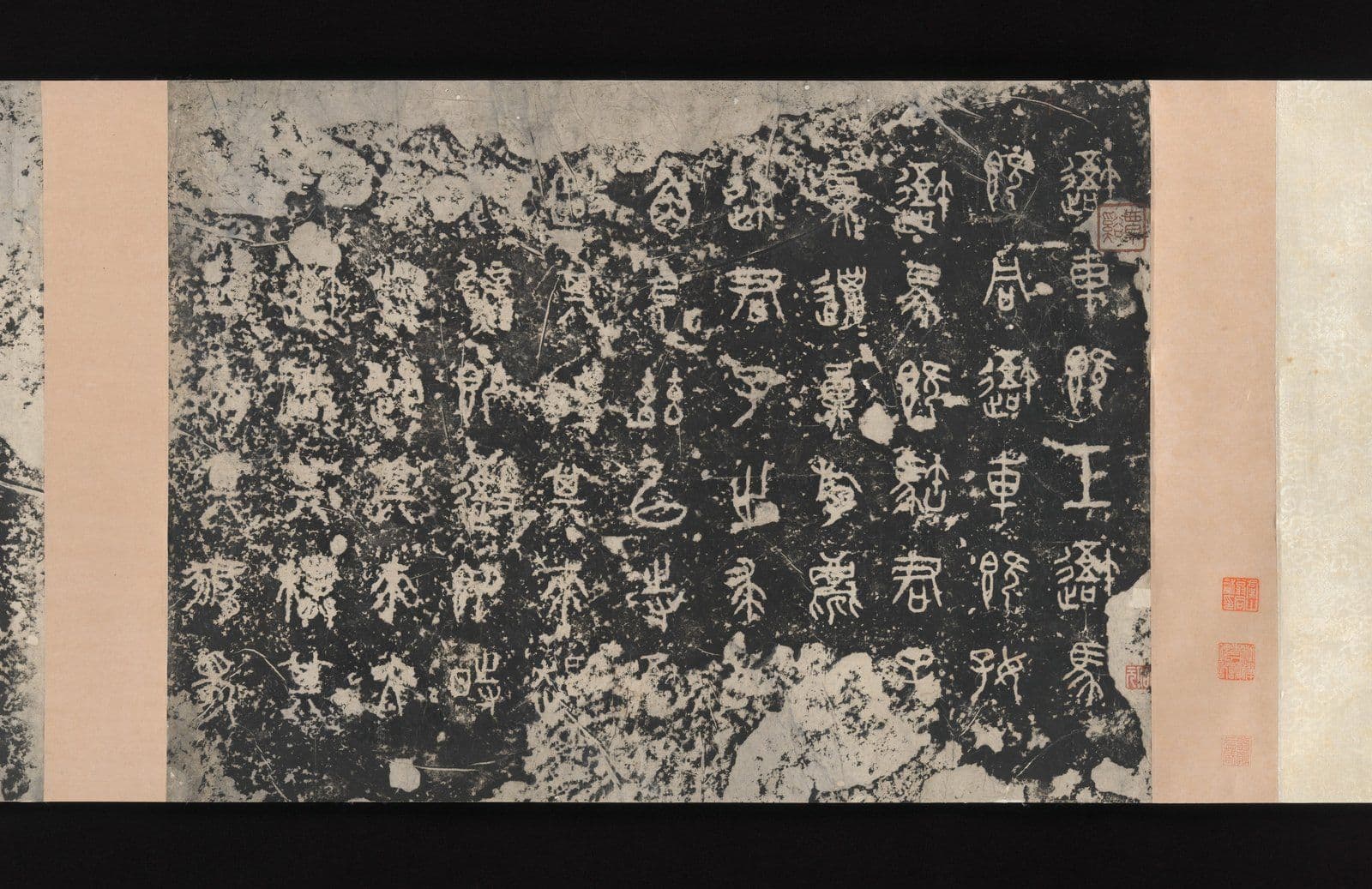
The Stone Drums are ten granite boulders, each roughly the shape and size of a squat drum, each carved with a poem describing royal hunting and fishing expeditions. They were made for the state of Qin — the same state that would later unify China — and are usually dated to the Eastern Zhou period, though scholars have argued for centuries about exactly which century within it. They are generally regarded as the oldest substantial stone inscriptions in China.
The script they carry is dazhuan, or great seal script: the rounded, even-pressure writing that predates the standardized small seal script of the Qin empire. If you want the fuller picture of where seal script sits in the family tree of Chinese writing, our guide to the five script types of Chinese calligraphy walks through the whole sequence; the short version is that stone drum script is the classic bridge between archaic bronze inscriptions and the seal script every later carver learned.
The drums themselves have led an eventful life. Rediscovered in the early Tang dynasty in the old Qin heartland of Shaanxi, they were celebrated almost immediately — the Tang writer Han Yu devoted a famous poem, "Song of the Stone Drums," to pleading for their preservation. They were carted between capitals as dynasties rose and fell, lost and recovered more than once; one drum is said to have spent years hollowed out for use as a grain mortar. Centuries of weathering wore many characters away, which is why early rubbings — some preserving readings the stones themselves have since lost — became treasures in their own right. The drums are now in the Palace Museum in Beijing.
For calligraphers of the nineteenth century, the Stone Drums were not a curiosity. They were a foundation text of the "stele school," the movement that turned away from elegant brush-written model books and toward the blunt authority of ancient carved stone. Into that movement walked a farm boy from Anji, Zhejiang.
A life that kept returning to one text
Wu Changshuo's youth gave little sign of a comfortable literary career. War scattered his family in his teens during the Taiping upheaval, and the years that followed were marked by loss and wandering. He rebuilt his life through the classic channels of a poor scholar: study, seal carving, and the patronage of better-connected collectors, who gave him access to the rubbings and antiquities a man of his means could never have owned.
He passed through the edges of an official career — he accepted a county magistracy late in life and resigned within about a month, an episode he memorialized with wry pride in a carved seal — but the real work had already found him. Somewhere in those early decades he began studying rubbings of the Stone Drum inscriptions seriously. He then kept studying them, more or less daily, for the rest of his life. In inscriptions written in old age he was still describing new things he had found in the same ten poems.
That persistence matters for collectors, because it means "Wu Changshuo stone drum calligraphy" is not one thing. The versions from his middle years sit relatively close to the source: careful structures, even lines, the student still visible. The versions from his seventies and eighties are something else entirely — and they are the reason his name leads this tradition.
What he changed: copying as transformation
Chinese art has a rich vocabulary for copying, and most of it is honorable — the tradition treats transcription of old models as training, homage, and dialogue rather than imitation for its own sake. We've written about that vocabulary in mo, lin, fang, zao: the copying tradition, and Wu Changshuo is perhaps its greatest modern case study. He spent fifty years inside one ancient text and came out the other side with something unmistakably his own.
Set a good rubbing of the original drums beside a late Wu Changshuo rendering and the differences are immediate:
- Symmetry becomes tilt. The original script is poised and balanced. Wu's characters lean — the right shoulder rides high, structures compress on one side and stretch on the other, and the whole column develops a forward momentum the stones never had.
- Even lines become weather. The ancient carvers cut lines of uniform width. Wu's brush opens wet and heavy, dries across a character, and finishes scratchy — a full ink cycle inside a few strokes.
- Restraint becomes pressure. His line is built on the centered brush tip, slow and round, with the density calligraphers call "metal-and-stone flavor" — the sense that the stroke was carved or cast rather than written.
Contemporaries recognized the result as a new script standing on an old one. Later critics sometimes simply call it "Wu's stone drums." It is one of the clearest examples in Chinese art of a rule worth remembering: in this tradition, radical originality tends to be earned through decades of apprenticeship to the past, not by rejecting it.
From stone to flower: the calligraphy inside the paintings
Wu Changshuo came to painting unusually late — seriously only in middle age, encouraged by the Shanghai painter Ren Yi (Ren Bonian). As the story is usually told, Ren told him to stop worrying about painterly technique and simply paint with the brush he already had: the seal-script brush. Whatever the exact words, that is visibly what happened.
His wisteria vines coil with the rounded, unbroken energy of great seal strokes. Plum branches fork with the blunt angularity of carved stone. Even his rock forms are built from the same slow, weighty line he used in calligraphy. This is the quality collectors mean by jinshi qi — epigraphic, "metal-and-stone" spirit — and it is the thread that ties his four arts (poetry, calligraphy, seal carving, painting) into one practice. We looked at the painting side of that story in Wu Changshuo's flower paintings and seal-carver's line; this is the engine room underneath it.
His standing among peers was unambiguous. The Xiling Seal Society in Hangzhou, the leading institution of seal carving, made him its first president. Qi Baishi — himself no minor figure — wrote that he would gladly have served as a "running dog" at the gates of three masters, and Wu Changshuo was the only modern name on the list. When Wu died in Shanghai in 1927, the epigraphic manner he built had become the dominant current of early twentieth-century brush art.
Collecting Wu Changshuo calligraphy
Wu Changshuo's calligraphy comes to market constantly, which is both the opportunity and the problem. A practical checklist:
- Know the formats. The classic collectible is the couplet — a matched pair of hanging scrolls in stone-drum-script — followed by single hanging scrolls, horizontal panels, fan faces, and album leaves. Couplets in his seal script were in demand during his lifetime and were produced in quantity; they are also the most copied.
- Judge the line before the shape. Imitators can learn the tilted structures; the slow, round, centered-tip line is far harder. Look for weight without wobble, dry passages that stay structural, and openings where wet ink pools naturally. Thin, hesitant, or evenly "drawn" lines are the most common giveaway.
- Read the inscription and date. His works typically carry a dedication, a signature, and often his age or a cyclical date — late works frequently state his age directly. Checking that a stated date, stated age, and stylistic period agree is a fast first screen; our guide to cyclical dates shows how to convert the two-character year.
- Weight the late work. Most collectors and most of the literature prize the final two decades, when the transformation of the stone drum script was complete. Earlier work is collected too, but it is judged by a different, quieter standard.
- Demand paper history. Given how heavily his name is copied, publication history, old collection seals, and credible provenance carry real weight. An unpublished, unprovenanced "late masterpiece" deserves skepticism no matter how good it looks at arm's length.
None of this substitutes for expertise — with a name this frequently faked, serious purchases justify serious authentication.
Common questions
What exactly are the Stone Drum inscriptions?
Ten drum-shaped granite boulders carved for the pre-imperial state of Qin, each bearing a poem about royal hunting and fishing expeditions, written in great seal script. They are usually dated to the Eastern Zhou period and are generally considered China's oldest substantial stone inscriptions. Rediscovered in the Tang dynasty, praised in poetry, damaged, lost, and recovered across the centuries, they are now kept in the Palace Museum, Beijing.
Is stone drum script the same as the seal script on Chinese seals?
Not quite. The drums are written in dazhuan (great seal script), the older, freer family of forms. The script standardized under the Qin empire — traditionally credited to the chancellor Li Si — is xiaozhuan (small seal script), more uniform and elongated, and it is the basis of most later seal carving. Wu Changshuo's originality lay partly in bringing the burlier great-seal forms back to the center of practice.
Did Wu Changshuo only write in seal script?
No. He left running-script letters and inscriptions with the same tilted energy as his seal script, and his painting inscriptions move fluidly between manners. But stone-drum-script is the core of his reputation, and it is what collectors usually mean by "a Wu Changshuo calligraphy."
How risky is buying a Wu Changshuo couplet?
Riskier than most names, because demand has been continuous since his lifetime and copies range from period imitations to modern productions. Buy against provenance and publication rather than eye alone, compare the line quality to museum-published late works, and treat bargains as warnings. The upside: because so much genuine material exists, patient collectors do get real opportunities.
Further reading
- How Experts Authenticate Chinese Paintings — the layered method — brush, seals, materials, provenance — applied to exactly this kind of attribution problem.
- Chinese Painting Seals and Collector Marks — how to read the seals on a work by a master who was, first of all, a seal carver.
- Qi Baishi's Insects and Grass Paintings — the next great name in the lineage that ran through Wu Changshuo's Shanghai.
Browse the collection
If you would rather live with these images than only read about them, the Kiln & Ink collection holds limited-edition archival giclée reproductions of the twentieth-century Chinese ink masters — hand-numbered, printed on rice paper, and issued with a Certificate of Authenticity.
Explore Further