Published July 13, 2026
The five scripts of Chinese calligraphy — seal, clerical, regular, running and cursive — and the stroke cues that tell each one apart at a glance.
Look at the writing on any two Chinese paintings side by side and you will often see what appear to be two different alphabets: one built from even, wiry lines bent into archaic symmetry, the other dashed off in connected loops that barely resemble characters at all. Both are Chinese. They are simply different scripts — and knowing which is which is one of the fastest skills a collector can acquire.
This guide walks through the five script families of Chinese calligraphy — seal, clerical, regular, running, and cursive — what each looks like, roughly when each emerged, and what the choice of script tells you when you meet it on a painting inscription, a seal, or a standalone work of calligraphy.
Why script matters to a collector
Chinese calligraphy is not decoration applied to writing; in the traditional hierarchy it ranks alongside or above painting itself, and every educated painter was a calligrapher first. The script an artist chooses is a deliberate register — the way a Western designer chooses between a Roman capital, a blackletter, and a handwritten note. It signals formality, archaism, personality, and lineage.
For the collector there are three practical payoffs. First, dating: each script has an earliest possible period, so a script identification gives you a hard boundary (a regular-script inscription cannot be pre-Han, for example — though later artists freely used all five, so a script gives you an earliest date, never a latest one). Second, reading inscriptions: knowing the script family tells you why an inscription looks the way it does and which parts will be hardest to decipher. Third, seals: nearly all carved seals on Chinese paintings use seal script, and recognizing its conventions is the first step to matching impressions against published references.
Seal script (zhuanshu): the archaic one
Seal script is the oldest family, descending from the inscriptions cast on Shang and Zhou bronzes and carved on stone. Its standardized form — small seal script — is traditionally associated with the Qin unification in the late third century BC, when the first emperor's administration regularized writing across the new empire.
You recognize it by line quality: strokes of almost perfectly even thickness, rounded entries and exits, bent into balanced, symmetrical, elongated structures. There is no visible speed in it — no flicks, no tapering — which gives it a hieratic, engraved character even when brushed.
By the time of the artists most collectors encounter, seal script was a scholarly revival choice, prized precisely for its archaism. Wu Changshuo, the dominant figure of the early twentieth-century Shanghai school, built his entire style on decades of copying the ancient Stone Drum inscriptions, and his seal-script calligraphy fed directly into the epigraphic strength of his painting line. When you see seal script on a modern work, you are seeing a claim of kinship with the oldest layer of the written tradition.
Where you will meet it: carved seals above all (the script is named for them), title inscriptions on frontispieces, and self-consciously archaic works of calligraphy.
Clerical script (lishu): the Han workhorse
Clerical script emerged as the practical writing of Qin and Han administration — faster to write than seal script — and became the monumental script of Han dynasty stone stelae. Its signature is the flattened, horizontally stretched character shape and the "silkworm head and wild-goose tail": a major horizontal stroke that begins with a rounded press and ends in a broad, upswept flare.
Clerical script reads as sturdy, ceremonial, and slightly antique — less remote than seal script, more formal than regular script. Like seal script, it never died: Qing dynasty scholars steeped in the "stele school" revived it with enormous energy, and many modern masters used clerical script for titles and formal inscriptions.
Where you will meet it: stele rubbings (a collecting field of its own), title pieces, and inscriptions where the writer wanted gravity without archaism.
Regular script (kaishu): the standard
Regular script is the fully mature standard script — each stroke discrete, each character built into a balanced square, written at deliberate speed. It took shape after the Han dynasty and reached its canonical peak in the Tang, whose master calligraphers set models that Chinese schoolchildren still copy today. It is the script of printed books, official documents, and disciplined practice.
On paintings, a fully regular-script inscription is relatively uncommon among the modern masters — most preferred the freer running script — so when you do see careful regular script, it often signals a formal occasion: a dedication to a respected recipient, a title, or a colophon written for the record. Precision matters here: in good regular script every stroke has an articulated entry, body, and exit, and the spacing between characters is as considered as the characters themselves.
Where you will meet it: colophons, formal dedications, and the small, neat characters of dates and signatures on more conservative works.
Running script (xingshu): the connoisseur's default
Running script is regular script in motion — strokes linked, corners softened, some elements abbreviated, but the character structures still legible. It is faster than regular script and slower than cursive, and it is by far the most common script on Chinese painting inscriptions: expressive enough to carry personality, legible enough to be read.
The most celebrated work in the entire calligraphic canon is a running-script text: Wang Xizhi's fourth-century Preface to the Orchid Pavilion Gathering, which survives only in copies and has functioned as the tradition's touchstone for over a millennium. Every later calligrapher positions themselves somewhere relative to that lineage.
For the collector, running script is where personal style lives. Because it balances freedom and structure, it is the script in which an artist's hand is most identifiable — which is why specialists lean so heavily on inscription calligraphy when vetting attributions. A painting in one artist's manner with an inscription in nobody's manner is a familiar warning sign, the calligraphic equivalent of the composition problems that betray copies of the literati masters.
Cursive script (caoshu): the wild one
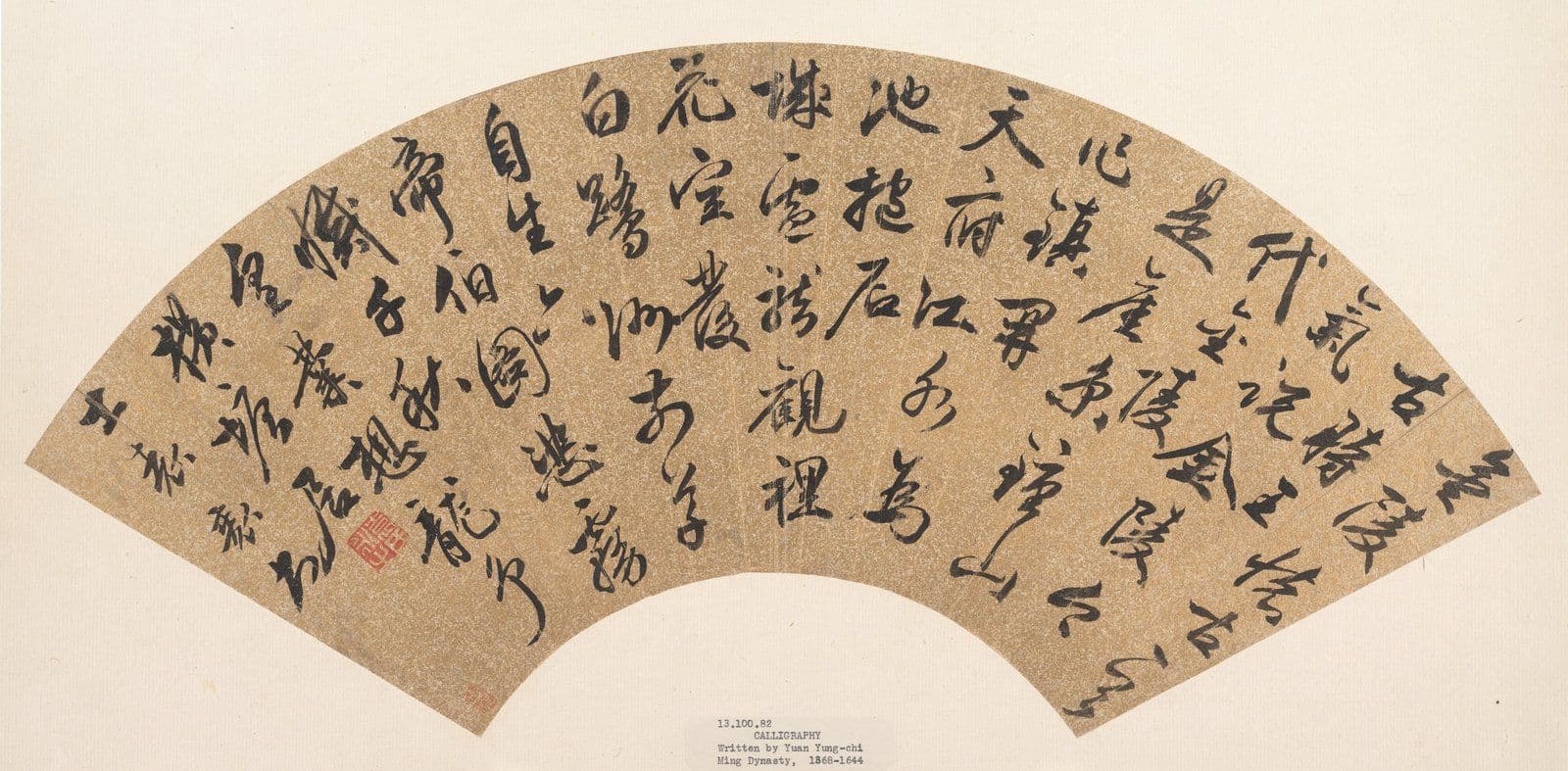
Cursive script abbreviates characters into flowing, often connected gestures — sometimes a whole column written in a continuous movement. Its early "draft cursive" form served Han dynasty scribes as rapid shorthand; its extreme form, the "wild cursive" associated with Tang masters like Zhang Xu and Huaisu, pushed abbreviation to the edge of legibility and became the tradition's great vehicle for uninhibited expression.
Cursive is the hardest script to read — educated Chinese readers often cannot decipher wild cursive without training — and the easiest to underestimate. Its abbreviations are conventional, not improvised: each shorthand form is codified, and a competent cursive writer is executing learned structures at speed, the way a jazz musician improvises inside a harmonic system. Incoherent, structureless "cursive" on a work attributed to a major name deserves the same skepticism as a slack brushstroke.
Where you will meet it: standalone calligraphy works above all, and inscriptions by artists who prided themselves on calligraphic bravura.
The five scripts at a glance
| Script | Chinese | Emerged | Look | Typical use on artworks ||---|---|---|---|---|| Seal | 篆书 | Bronze Age → standardized Qin | Even wiry lines, symmetrical, archaic | Seals, frontispieces, archaist works || Clerical | 隶书 | Qin–Han | Flat, wide, flared "goose-tail" strokes | Stele rubbings, formal titles || Regular | 楷书 | Post-Han, matured Tang | Discrete strokes, balanced squares | Colophons, formal dedications || Running | 行书 | Han onward, canonized 4th c. | Linked, fluent, still legible | Most painting inscriptions || Cursive | 草书 | Han (draft) → Tang (wild) | Abbreviated, connected, expressive | Standalone calligraphy, bravura inscriptions |
Common questions
Can the script alone date a Chinese artwork?
Only in one direction. Each script has an earliest period — regular script cannot appear on a genuinely pre-Han object, for instance — so a script identification sets a hard earliest boundary. But because later artists deliberately wrote in all five scripts, script alone never proves an early date. A seal-script inscription is as likely to be a twentieth-century archaist statement as anything ancient; dating rests on paper, ink, style, seals, and provenance together.
Which script is hardest to read?
Wild cursive, by a wide margin. Its abbreviations compress characters into codified gestures that even fluent readers need training to decipher. Running script is usually readable with patience; seal script is difficult for modern readers not because it is fast but because its character forms predate the modern standard. If an inscription defeats you, photograph it clearly and ask a specialist — the conventions are systematic, and experienced readers decode them quickly.
Why do seals use seal script?
Convention and practicality. The script was the prestige writing of early imperial China when the sealing tradition took shape, and its even line-weight and symmetrical structures suit carving into small square faces. The association became self-reinforcing: by the literati era, cutting seals in seal script was itself a scholarly art, and a painter's seals were expected to show antiquarian learning. That is why matching seal impressions against published compendia is standard practice in authentication.
Did the five scripts evolve one from another?
Broadly yes, in the order seal → clerical → regular, with running and cursive developing alongside as faster registers rather than replacements. But the key point for collectors is that no script ever became extinct. All five remained living options for every later calligrapher, chosen for tone the way a composer chooses a key.
Further reading
- How to Read the Inscription on a Chinese Painting — the structure of signatures, dates, and dedications the scripts are used to write.
- Reading Collector Seals on Chinese Paintings — seal script in its native habitat, and what layered seals tell you about provenance.
- Literati Painting vs Court Painting: Two Traditions, Two Markets — why calligraphic quality sits at the heart of the scholar-painting tradition.
- The Six Principles of Chinese Painting — the classical framework that treats brush vitality in painting and writing as one skill.
Browse the collection
For the works themselves, Kiln & Ink issues limited-edition archival giclée reproductions of the modern ink masters — printed on rice paper, hand-numbered, and issued with a Certificate of Authenticity.
Explore Further