Published July 14, 2026
How specialists authenticate a Chinese painting: brushwork against the secure corpus, the calligraphy test, what seals prove, and materials dating.
When a specialist unrolls a Chinese painting attributed to a famous name, the first minutes are usually silent. They are not admiring it. They are comparing it — stroke by stroke, character by character — against a mental library of works whose status is secure. Authentication in Chinese painting is not a machine test or a signature check; it is a layered argument, built from independent kinds of evidence that each have known failure modes.
This article walks through that method: what the expert eye actually weighs, in what order, why no single test settles the question, and what a private collector can realistically do before paying for an attribution.
Why Chinese paintings are uniquely hard to authenticate
Start with an uncomfortable fact: copying sits inside the tradition itself. For centuries, Chinese painters trained by copying old masters — faithful tracing and freehand imitation were both standard pedagogy, and skilled copies were made, collected, and honestly labeled as copies. Time then does its work: labels drift, honest copies acquire ambitious attributions, and a work "in the manner of" a Song master becomes, three centuries later, "a Song master." A large share of contested paintings are not modern frauds at all but old, good, misattributed pictures.
Add deliberate forgery, which also has centuries of history and occasional genius-level practitioners. The most famous modern example is Zhang Daqian, one of the great twentieth-century painters in his own right, whose imitations of early masters were convincing enough that major museums have held them — and in some cases debated them for decades. A field in which the best forger is also one of the best painters keeps its experts humble.
Finally, the physical evidence is less decisive than newcomers expect. Old paper and silk can be harvested from minor period works; ink is carbon and resists dating at useful precision; and remounting — a normal, recurring event in a scroll's life, as our guide to mounting explains — strips away physical context each time. So the argument has to be assembled from many directions at once.
The expert's checklist, layer by layer
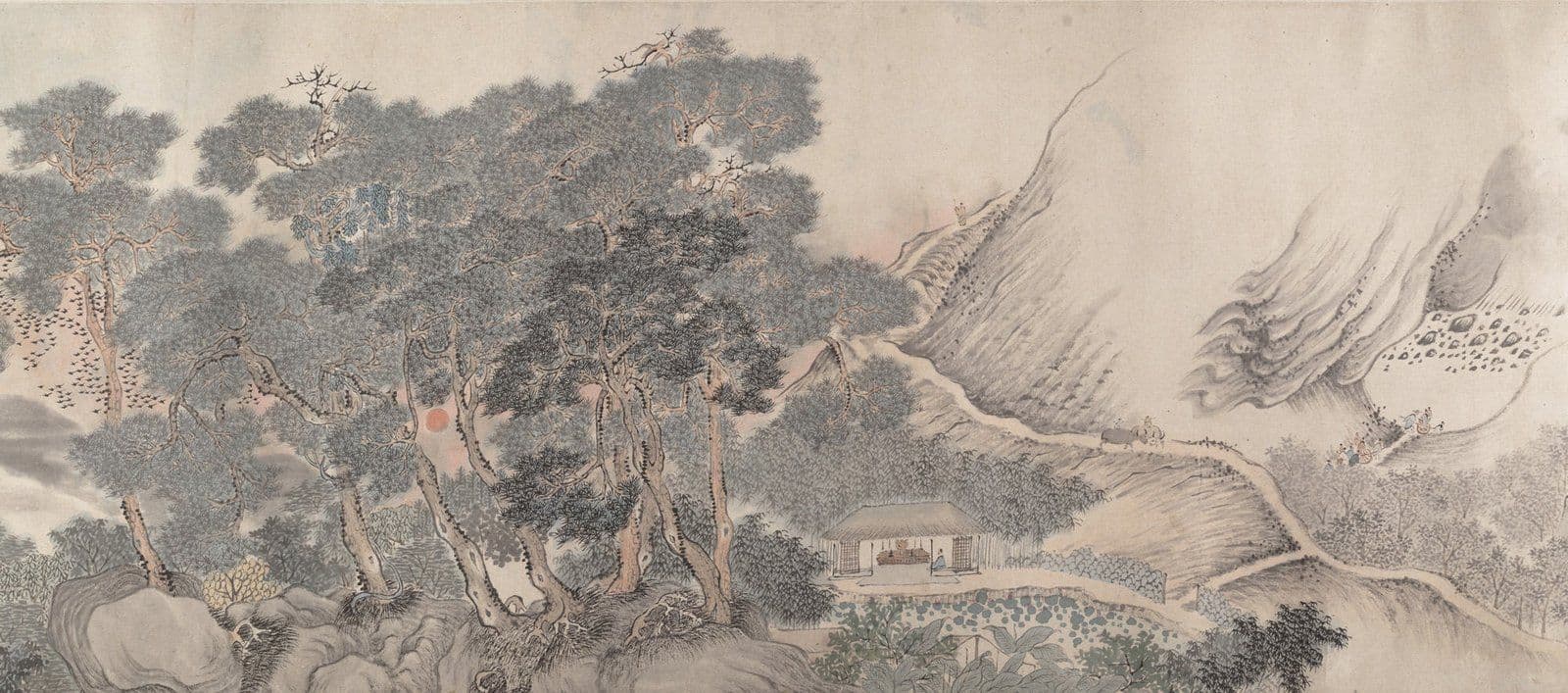
Brush manner against the secure corpus. The foundation is style: does the way this painting is drawn match works whose attribution is beyond serious doubt? Specialists compare structural habits — how rocks are textured, how a tree branches, how washes are layered, the tempo and pressure of line — because these are the hardest things to imitate at full speed. A copyist can reproduce a composition; reproducing another hand's speed is far harder, and slowed-down, careful line has a deadness trained eyes catch. This is also where period style constrains: every era has conventions, and a painting that mixes habits from different centuries indicts itself.
The inscription's calligraphy. Most Chinese paintings carry writing — an inscription, a signature, a date — and many specialists consider the calligraphy harder to fake than the image. Writing is the most automatic movement a painter makes; imitating someone else's handwriting convincingly, at length, in brush and ink, defeats most forgers. The expert compares the writing against securely dated examples of the artist's hand, alert to the fact that hands evolve — a match to the wrong decade is itself a problem. If you cannot yet read an inscription's structure, start with our decoder for the writing on a Chinese painting; recognizing the script styles themselves is a separate, learnable skill.
Seals — the artist's and the collectors'. Seal impressions can be checked against published compendia of recorded seals, and mismatches are evidence. But seals are the most misunderstood layer: a genuine seal proves less than people hope, because real seals outlive their owners and have been applied to false works, and fine seal forgeries exist. Collector seals — the accumulated red impressions of past owners — function differently: they are provenance stamped onto the object, and a coherent chain of recorded collectors' seals materially strengthens a painting's case. Our guide to reading collector seals covers the major types and how imperial collection seals, in particular, move value.
Materials and mounting. Paper, silk, ink, and pigments are checked for consistency with the claimed date — sometimes by eye and experience, sometimes by laboratory analysis. Science here works asymmetrically: finding a pigment first synthesized in the nineteenth century in a "Ming" painting is decisive disproof, but period-correct materials prove only that the materials are old, not that the famous hand used them. Mounting evidence works the same way — old remounts, title strips by known figures, and colophons attached over centuries all add or subtract weight without ever quite closing the case.
Provenance and publication history. Where has this painting been? Chinese connoisseurship left an unusual paper trail: catalogs of great collections, imperial inventories (the Qing court's painting catalog, the Shiqu baoji, is the most cited), exhibition records, and reproduction in earlier publications. A painting that can be traced through recorded collections carries a presumption a newly surfaced work never gets. "Fresh to the market with no history" is where the highest caution belongs.
What the auction house language actually claims
The trade compresses all of the above into the wording of a lot description, and the ladder of phrases is standardized enough to read like a code. "By" the artist is the house's full commitment; "attributed to" signals probable but not certain; "studio of," "school of," "manner of," and "after" each step further from the master's own hand, with prices falling accordingly. The estimate usually tells you what the specialists concluded more honestly than the headline name does.
Two practical corollaries. First, when a major house offers a big name at a small estimate, the wording — not the name — is the message. Second, consensus can shift: paintings get promoted and demoted as scholarship advances, which is why serious buyers care about which experts, and when, stood behind an attribution.
What a private collector can actually do
You will not out-connoisseur a lifetime specialist, and you do not need to. Your job is process.
Insist on history. Prefer works with documented provenance — prior sales at reputable houses, exhibition or publication records, recorded collector seals — over undocumented discoveries, however seductive. Most expensive mistakes in this field begin with a beautiful orphan and a good story.
Compare before you love. Put the work next to published, securely attributed examples from the same claimed period of the artist's life. Even an amateur eye can catch a mismatch of energy between a labored copy and a fluent original once the two are side by side.
Buy the opinion before the object. For a significant purchase, a specialist's written opinion costs a fraction of the painting and is the cheapest insurance available. For twentieth-century masters, be aware that family members and dedicated committees also issue opinions, with track records that vary — treat any single voice, even an authoritative one, as one layer of the argument, not the verdict.
Accept residual uncertainty. Even at the top of the field, some attributions remain openly debated for decades. The realistic goal is not certainty; it is a preponderance of independent evidence — style, writing, seals, materials, history — all pointing the same way, at a price that reflects how much of that evidence exists.
Common questions
Why can't carbon dating settle whether a Chinese painting is genuine?
Radiocarbon dating works poorly here for two reasons. Precision: for objects only a few centuries old, the technique's margin of error spans exactly the periods being argued about. Relevance: dating the paper or silk only tells you the age of the material, and forgers have long harvested old paper and silk from minor period works. Science can disprove (a modern pigment in an "old" painting is fatal) but rarely prove authorship — that remains connoisseurship's job.
Are seals reliable proof that a painting is genuine?
No single seal is. Genuine seals survived their owners and were sometimes applied to spurious works; skilled seal forgeries also exist. What carries real weight is coherence: seals that match recorded impressions, appear in plausible positions, sit correctly under or over the ink where sequence matters, and belong to a provenance chain that agrees with the painting's supposed history. Seals corroborate an attribution built on style and calligraphy — they cannot rescue one.
What is the single strongest indicator experts rely on?
Most specialists privately weight the calligraphy heaviest. Handwriting is the most habitual, least conscious movement an artist makes, and sustaining a convincing imitation of another person's hand across a full inscription is beyond most forgers — even excellent ones who can mimic the imagery. That is why a painting whose picture convinces but whose inscription hesitates is treated as guilty until proven otherwise.
Should I buy an unattributed or "school of" painting instead?
Often, yes — it is one of the smartest corners of the market. Honest period paintings without big-name claims are priced on quality rather than on a famous signature, which removes most of the forgery premium and most of the forgery risk. Connoisseurs have always collected fine anonymous Song, Ming, and Qing pictures; the tradition's depth does not depend on a handful of names, and neither does the pleasure of living with it. The divide between literati and court painting is a more useful lens for quality than any signature.
Further reading
- The Five Scripts of Chinese Calligraphy — script literacy, the fastest upgrade to your own eye.
- How to Buy Chinese Art at Auction — the attribution ladder, estimates, and premium math in practice.
- Literati Painting vs Court Painting: Two Traditions, Two Markets — a quality lens that outlasts any signature.
Browse our collection
Every print at Kiln & Ink is published with clear sourcing and attribution — browse the full collection.
From the Kiln & Ink collection: Calligraphy Couplet, an archival giclée edition after Zhang Daqian, hand-numbered on xuan paper with a certificate of authenticity.
Explore Further