Published June 2, 2026
How to display a Chinese scroll painting at home — lighting, climate, hanging hardware, rotation, and the practical disciplines that preserve a scroll across decades.
A Chinese hanging scroll arrives rolled in a wooden box, often with a silk wrapper, sometimes with an old auction tag still tied to the cord. The first impulse for a new collector is to unroll it across the dining table and admire it under the kitchen lights. The second impulse, after a beat, is to wonder whether that was a mistake. This article is the practical answer for collectors who have brought home their first or second scroll painting and want to display it without compromising the work over time — the lighting, the hanging hardware, the climate considerations, the rotation discipline, and the small handling routines that separate a healthy thirty-year-old scroll from a five-year-old one with avoidable damage.
What a scroll painting actually is, in display terms
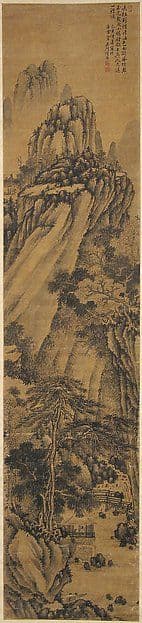
A Chinese hanging scroll, or lifu, is engineered around the assumption that it will spend most of its life rolled and stored, and only part of its life hanging on a wall. The painting itself — silk or paper — is mounted onto a cloth-covered backing through zhuangbiao, the traditional silk-mounting craft. The mount carries a top stave (tianggan) for hanging and a bottom roller (digan) that gives the scroll its weight and helps it hang straight. The decorative silk borders, the yan (eye-strip) at the top, and the cord and tassels are all functional as well as decorative. Treating the scroll as a "framed painting that happens to be rollable" misses the point — the mounting is a structural system designed for cyclical rolling and unrolling, and the display practices that preserve it are the ones that respect that cycle.
For collectors who want to understand the underlying craft before settling into a display routine, the zhuangbiao mounting tradition reads underneath the choices below. The mounting is the part of the work most often damaged by inexperienced display, and the part most expensive to remount when damage is discovered later.
Lighting: lux, duration, and angle
Light is the single largest accumulated stressor on a scroll painting on display. Pigments fade, silk yellows, and mounting paste can crack under sustained light, and the damage is cumulative — the scroll does not "recover" overnight. The practical discipline for collectors is to manage three variables together: lux level at the painting surface, hours per day of exposure, and spectral quality of the light source.
A working target is 50 lux at the painting surface for sustained display, with peak excursions to 100 lux during direct viewing. That is dim by ordinary residential standards — a typical living-room reading lamp puts 200-400 lux on a book — which is the first surprise many collectors encounter. The compensating strategy is to keep ambient room lighting low, position the scroll on a wall that does not catch direct sun at any hour, and use a single dimmable spot for viewing rather than overhead lighting that washes the work continuously.
Direct sunlight at any duration is the most damaging condition. A scroll hanging in a south-facing window for two hours of afternoon sun in summer can sustain visible fading within a single year. The discipline is to choose a display wall the sun does not reach, not to rely on UV-filtering window film as the primary defence.
Climate: humidity, temperature, and the silk you cannot see
Scrolls are sensitive to humidity in two directions. Low humidity below 40% causes the silk mount and paper to brittle, the mounting paste to crack, and the scroll to become resistant to rolling. High humidity above 65% invites mould, particularly on the back of the mount where airflow is poorest, and accelerates foxing on paper and silk alike.
The working range is 45-60% relative humidity, with temperature kept stable in the 18-22°C range. Stability matters more than the exact target — a scroll cycling between 35% and 70% humidity across a year sustains accumulated stress that a scroll held at a steady 55% does not, even at the same average value. Collectors in climates with extreme seasonal variation benefit from a small dehumidifier or humidifier in the display room, run on a humidistat that holds the target steady, more than from any single-point intervention.
Hanging hardware: the cord, the wall hook, and the back-of-mount discipline
The traditional hanging method uses the painting's own cord, knotted through the eye-strip at the top of the mount, and looped over a single hook driven into the wall above the painting. The hook should be set so that the cord drops straight without rubbing on the wall surface, and the bottom roller should hang free of any obstruction. Two-hook hangs — the kind common in Western framed-art display — should be avoided because they introduce lateral tension on the eye-strip and accelerate failure of the silk binding.
A small but consequential discipline: do not hammer a nail through the painting's cord or the mount itself. Some inherited scrolls arrive with old nail holes through the upper border because a previous owner used a brad rather than a hook. Those holes do not heal, and they read as a provenance issue when the scroll is eventually appraised. The cord is the load-bearing element; the wall is the structure to attach to.
Rotation: why scrolls were designed to be put away
The traditional Chinese practice is to display a scroll for a defined viewing season — a particular festival, a guest's visit, a month tied to the painting's subject — and then to roll it carefully and return it to its box. This is not an antiquarian eccentricity; it is the structural reason scrolls have survived in good condition across centuries while equivalent-age Western oil paintings on the wall have not.
The working discipline for a collector is to rotate the displayed scroll roughly every 60-90 days, returning the displayed work to storage and replacing it with another piece from the collection. The displayed scroll then rests, the storage scroll gets its viewing season, and the cumulative light and climate exposure stays manageable across the collection as a whole. Collectors with a single scroll should still rotate, by displaying for a season and storing for an equal season — a scroll lit for 365 days a year is depreciating faster than its collection value compounds.
Storage between viewing seasons
Storage is half of display in scroll terms. A correctly rolled scroll, in its original wooden box (hezi), wrapped in its silk cloth, kept on a shelf at stable humidity and temperature, will outlast the same scroll hanging year-round by a wide margin. The rolling itself matters: the scroll should be rolled around its bottom roller with even tension, not tightly squeezed, and the cord wrapped around the rolled scroll in its traditional pattern rather than knotted improvised.
Cardboard or modern cardboard-substitute boxes are acceptable short-term substitutes when the original wooden box is missing, but acid-free archival cardboard rather than the kraft-cardboard kind. Mothballs and naphthalene products should be kept well clear of scrolls — the chemical residue interacts with silk and pigment over years.
Common mistakes a new collector should avoid
A short list of practices that look reasonable and are not:
Framing a scroll behind glass. This destroys the scroll's structural design and the framing process itself often damages the mount. Scrolls hang as scrolls.
Permanent display year-round under track lighting. Even at low lux, the cumulative dose is the problem. Rotate.
Storing rolled in a plastic tube. Plastic does not breathe; condensation collects inside and invites mould. Wooden box or archival cardboard only.
Tape repairs. Pressure-sensitive tape on a torn corner or a curled mount edge sets in within months and damages the silk under it. Professional remounting is the correct path for any structural issue.
Cleaning with a damp cloth. A scroll is not wiped clean. Surface dust is removed with a soft sable brush, gently, in one direction. Anything more involved goes to a conservator.
Common questions
How long can I leave one scroll on display before I should put it away?
The working practice is 60-90 days for a typical collection rotation, with the upper end appropriate for scrolls on a low-light wall away from any direct sun. Scrolls of particularly fragile silk or known light sensitivity should rotate at the shorter end of that range. The decision is not "is it visibly fading yet" — by the time fading is visible, the damage is years deep.
Can I use UV-filtering picture lights and just leave the scroll up year-round?
UV filtration helps but does not solve the problem. Visible-spectrum light also fades pigments and yellows silk, particularly the blue and red ranges. The discipline is to manage the lux dose and the duration as a combined budget across the year, not to count on a filter as a permission to skip rotation.
What humidity range matters for storage, separate from display?
Storage benefits from the same 45-60% range, with the same emphasis on stability rather than exact target. A storage shelf in a humid kitchen-adjacent room is a worse location than a stable closet on an interior wall, even if the closet runs slightly drier than the spec target.
Is there a meaningful difference between displaying on a brick wall versus a drywall surface?
Brick and stone walls hold their temperature against the room's heating and cooling cycles, which means the air immediately next to the scroll cycles humidity more than the room average. Drywall on an interior partition stays closer to room conditions and is generally the better display surface for a scroll. Exterior walls — brick, stone or drywall — are the worst because they cool against the night air and condense moisture against the back of the mount.
Should I have my scrolls professionally remounted before displaying them?
Only if the existing mount is structurally compromised — visible tears, severe warping, mounting paste failure. A sound antique mount is part of the work's value and should be preserved. A compromised mount risks damaging the painting during normal handling and benefits from remounting by a qualified conservator. The distinction is conservation, not refurbishment for appearance.
Further reading
The zhuangbiao mounting tradition covers the underlying craft and explains why mount-conscious display practices matter.
For collectors building broader knowledge of inscriptions and seals on the works they display, the collector seals and inscriptions guide reads alongside.
The literati versus court painting framework gives context for the subject matter and conventions that shape how a particular scroll wants to be presented.
A scroll painting rewards the collector who treats display as a discipline rather than as a one-time installation. The practices above — light management, climate stability, traditional hanging hardware, and a rotation cycle that respects the scroll's design — compound across decades of ownership. The collection that the next generation inherits in good condition is the one that was displayed thoughtfully across the years it was held.
Explore Further