Published July 15, 2026
Album leaves and fan paintings are the intimate, affordable formats of Chinese painting. What they are, how they were remounted, and what to check before buying.
An album of Chinese paintings opens like a book and is meant to be read like one: in the hand, at a table, one leaf at a time, at whatever pace the holder chooses. Turn a leaf and a full composition arrives — a landscape, a branch of blossom, a poem in running script — scaled to the span of your two hands. It is the most intimate way the tradition ever devised for living with painting, and at auction it remains, leaf for leaf, one of the most accessible.
This article covers the two small formats of Chinese painting — album leaves and fan paintings — what they are, how they were made and remounted, why the same artist's work costs less in these forms than on a hanging scroll, and what to check before buying one.
The four formats, and where the small ones fit
Chinese paintings on paper and silk come in four principal formats. The hanging scroll (lizhou) is the vertical wall format most people picture first; the handscroll (shoujuan) unrolls horizontally, an arm's length at a time. Below them in scale sit the two formats this article is about:
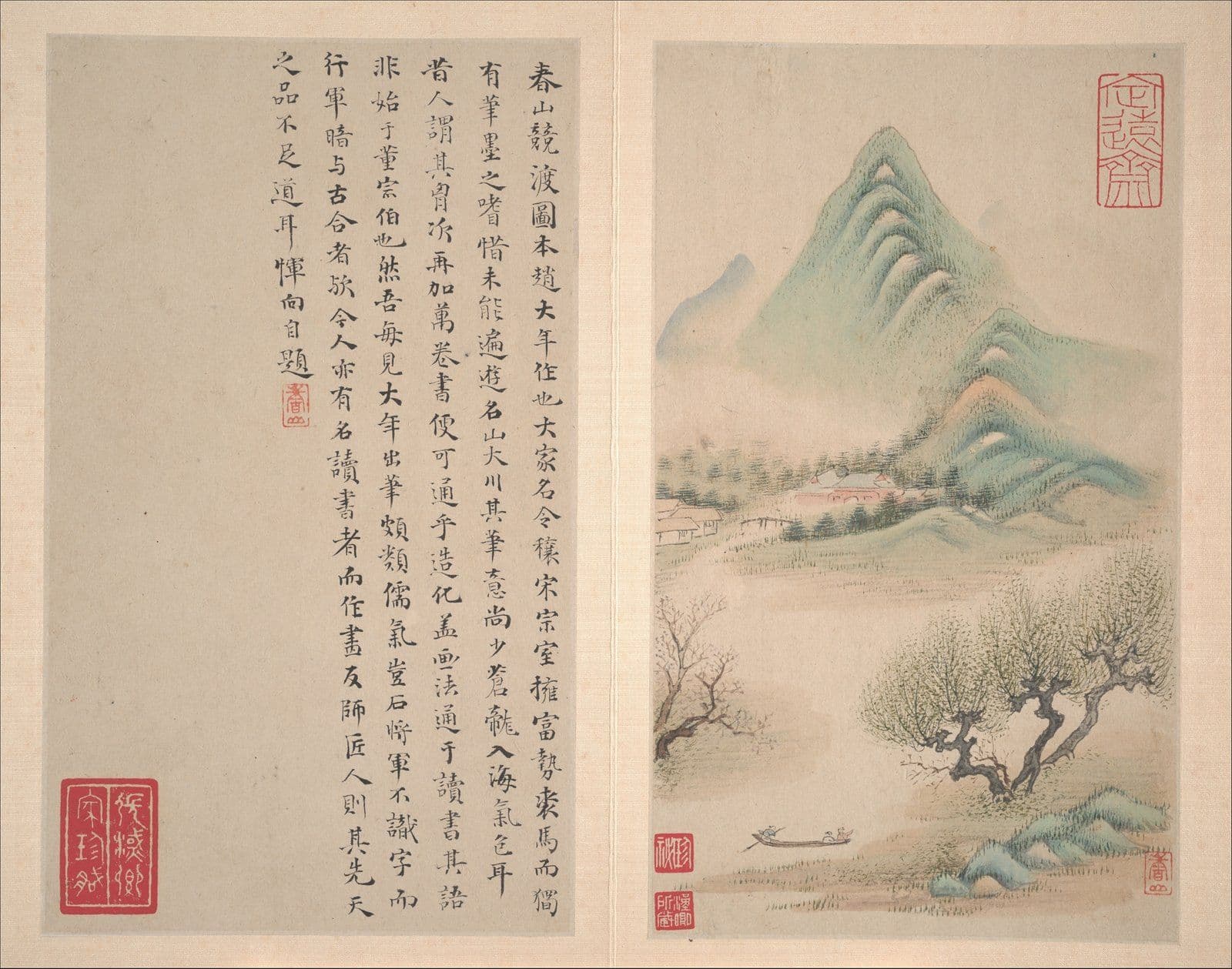
- The album leaf (ceye): a small painting — commonly somewhere in the range of twenty to forty centimeters on a side — mounted into an album that opens leaf by leaf. Albums typically hold sets: eight, ten, or twelve leaves on a shared theme, sometimes pairing each painting with a facing leaf of calligraphy.
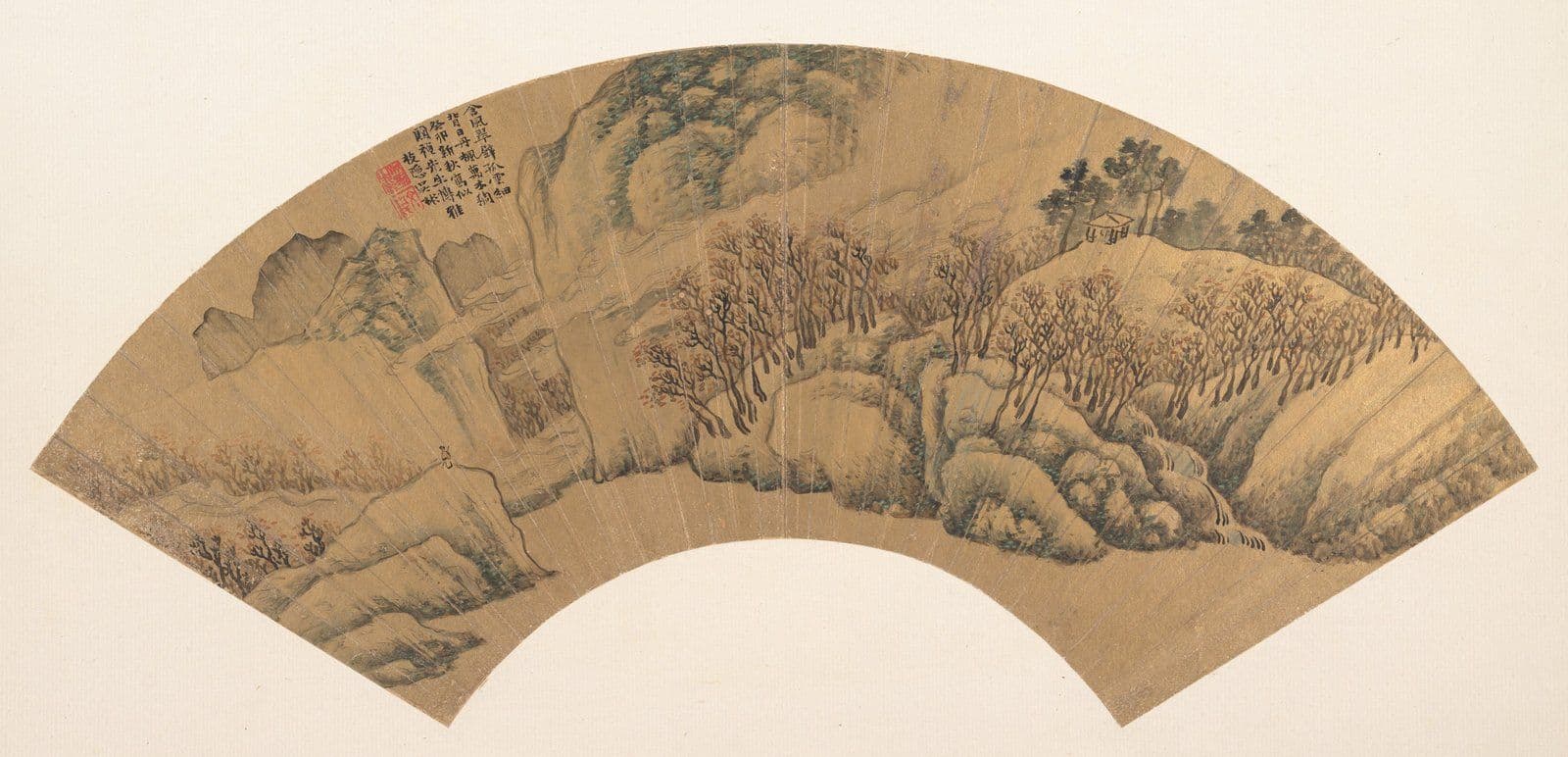
- The fan painting (shanmian): a painting made on — or in the shape of — a fan face. Two types matter: the round fan (tuanshan), a rigid silk fan associated with the Song court tradition, and the folding fan (zheshan), the pleated arc-shaped format that, by the usual account, entered China from East Asian neighbors and became fashionable among Ming literati.
The formats interconvert, and this is worth understanding before you read auction catalogues. Many surviving Song paintings that are today mounted as album leaves began life as round fan faces; the silk was later trimmed and remounted flat for preservation. Folding fans, likewise, were often painted, used, then dismantled — the painted face carefully removed from its ribs and mounted flat as an album leaf, which is why so many pieces carry the description "folding fan mounted as an album leaf." A fan in an album has usually survived precisely because someone decided its painting outranked its function. The Met's Azure Cliff with Red Maples (dated 1603) is a typical example: a gold-flecked folding-fan landscape that has spent centuries as an album page.
Mounting is its own craft — the same wet-paste-and-backing-paper trade that produces hanging scrolls, covered in our guide to zhuangbiao, the mounting of Chinese paintings — and remounting is a normal, repeated event in the long life of these objects. An old leaf in a newer album is the rule, not a red flag.
Why literati loved the fan
The folding fan occupied a special social role from the Ming period onward. It was portable art: carried in the sleeve, opened in company, given as a gift. Painting a fan for someone — a friend, a patron, a departing colleague — was a standard gesture of literati courtesy, usually completed with a dedication naming the recipient and a signature and seal. Fan shops sold blank faces, often on gold or gold-flecked paper, ready for an afternoon's painting.
Three consequences follow for today's collector:
Fans are personal documents. The dedications on fan paintings record real relationships — who knew whom, who owed whom a favor — and a fan inscribed to a documented figure gains historical interest and provenance weight. Learning to read the inscription on a Chinese painting pays off disproportionately in this format, because fans carry dedications more often than almost anything else.
Fans are compositional puzzles. The arc-shaped field bends every straight line and crowds the painter into a wedge. Watching how an artist solves it — how a landscape settles into the curve, how a branch follows the sweep — is one of the pleasures of the format, and one of the tests of quality. A composition that fights the arc was painted by someone thinking of a rectangle.
Fans were made in quantity. A sociable, fashionable format produced in bulk means survival in bulk: fan paintings by or attributed to well-known names circulate constantly at auction. That supply is exactly why prices sit where they do — and why attribution discipline matters as much here as anywhere.
The same social logic runs through album leaves. Albums were collaborative and occasional: a set of leaves painted for a birthday, a farewell, a collector's request; group albums where several friends each contributed a leaf. The modern masters kept all of these habits alive — Qi Baishi, Zhang Daqian, and their contemporaries painted fans and album leaves throughout their careers, so the formats span the tradition's entire price range, from Song rarities to twentieth-century works that change hands every season.
The value logic: same hand, smaller field
The plain market fact: as a rule, an album leaf or fan painting by a given artist trades well below a full hanging scroll by the same hand. The reasons are structural, and knowing them tells you what you are actually buying.
Scale and wall presence drive the top of the market — the monumental statement pieces that anchor evening sales are hanging scrolls, not leaves. Supply runs the other way: sociable formats produced in quantity are simply more available. And single leaves are often orphans — separated from broken-up albums — which trims their value relative to intact sets, since a complete album documented as such is worth more than the sum of its scattered pages.
None of this makes the small formats lesser art. A leaf from a master's album received the same hand, the same brush discipline, and often more invention per square inch than a formulaic large commission; the intimacy of the format rewards close looking in a way wall-scale work does not. What it makes them is the sensible entry point: the place where a genuine work by a serious name intersects with a first-collection budget. The mechanics of buying — estimates, premiums, condition reports, attribution language — are the same as anywhere in the field, and our first-time bidder's playbook for Chinese art auctions applies without modification. The taste education is the same too: the values that make a leaf good are the values of the literati tradition compressed into a smaller field.
Condition: what to check in the small formats
Condition problems in albums and fans are specific and legible once you know where to look.
On folding-fan faces: the folds are the story. Look for rib shadows (parallel bands of wear or discoloration where the face once sat on the fan's skeleton), pigment loss and paper fatigue along each crease, and splits starting at the outer edge of the folds. Gold and gold-flecked papers show abrasion. Some fold evidence is honest biography — the object was used — but structural splits and heavy retouching along creases are real deductions.
On round-fan silk: silk browns with age and grows brittle. Check for consolidation, patched losses, and overpainting at the edges where old trimming occurred.
On album leaves: foxing (scattered brown spots), water staining, worm tracks, and transfer offsetting from the facing page are the classics. On any remounted leaf, look at where the painting meets the new margin — trimming of the image edge, or of seals and inscriptions that once sat there, is the costly kind of surgery.
On albums as objects: count the leaves against the catalogue and the theme's logic (eight and twelve are common set sizes), check whether the sequence and any facing calligraphy are intact, and treat collector seals across leaves as part of the documentation. An intact album with its colophons is a small archive; value it as one.
Display, if you choose to frame a leaf or fan rather than keep it in album form, follows the same conservation logic as any work on paper or silk: flat mounting, UV-filtering glazing, no direct sun, and rotation out of light — the same rules covered in how to display a Chinese scroll painting, scaled down.
Common questions
Are album leaves original paintings or reproductions?
Original paintings. An album leaf is a first-hand work by the artist, made at small scale — not a print or copy of a larger picture. (Printed reproduction albums do exist and are honestly sold as such; the distinction is the same as anywhere in the market.) The small formats were how Chinese painters worked for intimate audiences, the way a Western artist might work on paper rather than canvas.
Why are fan paintings so much cheaper than hanging scrolls?
Supply and wall presence, mostly. Fans were a sociable format produced in great numbers, so more survive and circulate; and the auction market's top prices follow large-scale statement works that command a wall. The artist's hand is the same. For a collector who cares about brushwork more than square footage, that gap is an opportunity rather than a defect.
Should I take a fan painting off its ribs to frame it?
If it is still a functional folding fan, think carefully — and take conservation advice first. Historically, faces were removed and mounted flat to preserve the painting, and a professionally flattened and mounted fan face is stable and displayable. But dismantling is one-way surgery on an intact object, and an untrained attempt can split the face along every fold. If the fan is already mounted as a leaf, that decision was made long ago; frame or album-keep it as it is.
What is a complete album worth versus scattered leaves?
More than the sum of its parts, as a rule. An intact album preserves the set's program — the theme across leaves, facing calligraphy, colophons, collector seals — which is documentation and art at once. Once an album is broken up, each orphan leaf keeps its quality but loses its context, and the market prices that loss. If you ever own an intact album, resist the dealer's arithmetic that it is "worth more split."
Are modern masters' fan paintings a good entry point?
They are one of the classic ones. Twentieth-century names painted fans and leaves in quantity, so genuine works circulate at accessible levels relative to the same artists' scrolls — with the standard caveat that famous names attract optimistic attributions in every format, so provenance and specialist review matter at any price.
Further reading
- How to Collect Chinese Art: A Practical Roadmap — the wider framework for building a collection the small formats fit into.
- Reading the Seals on Chinese Paintings — collector seals are half the documentation on old leaves.
- What Is Xuan Paper? The "Rice Paper" of Chinese Painting — the material that determines how leaves age and fox.
- How Experts Authenticate Chinese Paintings — the layered argument behind any attribution you pay for.
Browse our collection
Modern hand-painted works and museum-grade prints in the classic formats, each honestly described and clearly attributed — browse the gallery.
From the Kiln & Ink collection: Gourd, an archival giclée edition after Qi Baishi, hand-numbered on xuan paper with a certificate of authenticity.
Explore Further