Wu Guanzhong
吴冠中
About the Artist
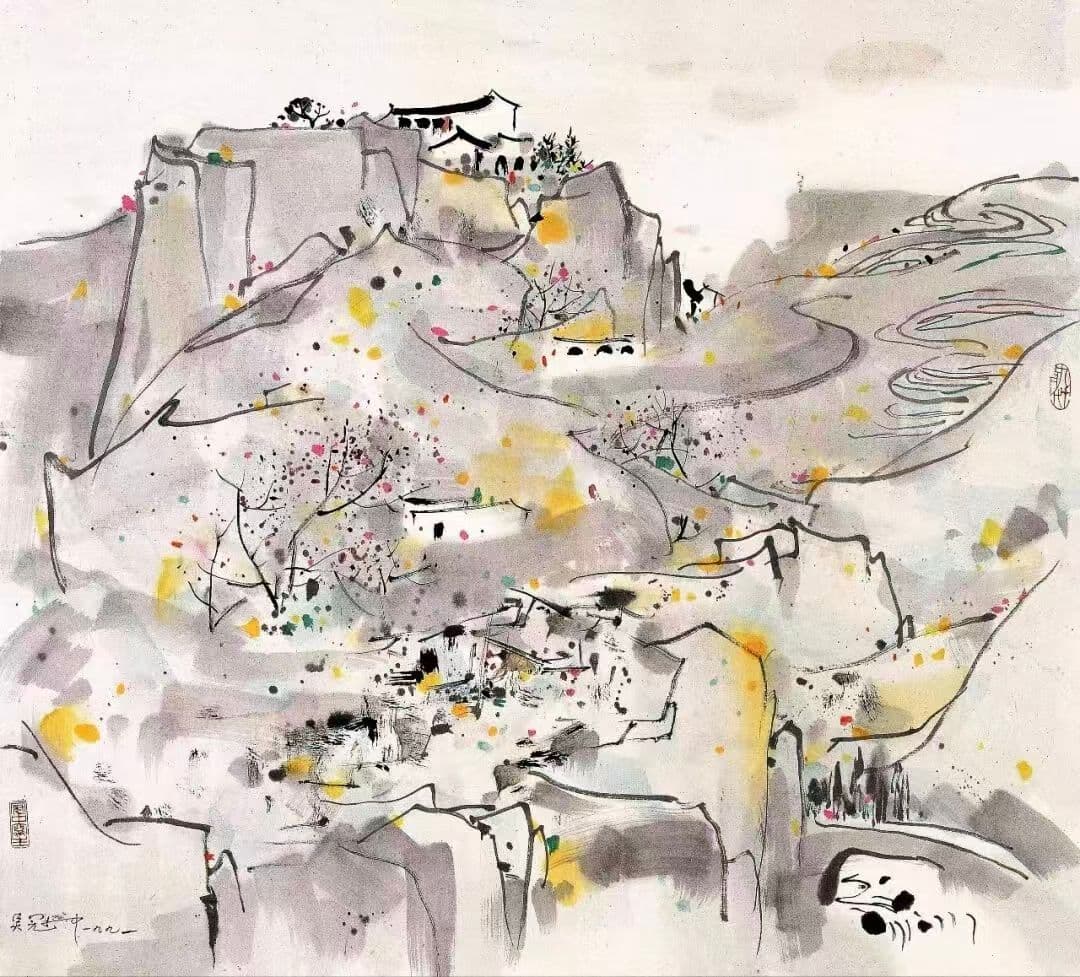
Wu Guanzhong (1919–2010) spent his career answering one question: what should a Chinese painting look like after the twentieth century. His answer — abstraction built from Chinese line and Western structure — made him one of the most collected modern Chinese artists.
Training. Born in Yixing, Jiangsu, he studied at the Hangzhou National Academy of Art under Lin Fengmian and Pan Tianshou, then went to Paris in 1947 to study at the École nationale supérieure des Beaux-Arts. He returned to China in 1950 and taught for the rest of his life, most notably at the Central Academy of Fine Arts and Tsinghua.
Two media, one language. Wu worked in oil and in ink simultaneously and refused to treat them as separate careers. Oil gave him mass and colour; ink gave him line and interval. The mature works apply the logic of one medium to the other, which is why his ink paintings feel structural and his oils feel calligraphic.
Signature motifs. Jiangnan water towns with white walls and black roof tiles; lotus ponds reduced to a scatter of dots and sweeping stems; pines, banyans and vines that turn into pure linear rhythm. Once you have seen a few, the vocabulary is unmistakable.
The formal-beauty argument. Wu argued publicly, and at some personal cost, that form and beauty are legitimate subjects in their own right. That position shaped a generation of Chinese art education and is inseparable from how his work is read today.
Generosity as legacy. He donated large groups of works to public museums in China and Singapore rather than releasing them to the market — one reason major pieces appear at auction relatively rarely, and why they perform strongly when they do.
How to read a Wu Guanzhong. Look at the intervals rather than the objects: the distance between dots, the length of an unbroken line, the ratio of empty paper to mark. His compositions are held together by spacing, and the best works feel taut rather than busy.
At Kiln & Ink we issue archival giclée editions after Wu Guanzhong on rice paper, hand-numbered with a certificate of authenticity, for collectors who want the line and rhythm on their wall rather than in a catalogue.
“Wu Guanzhong (1919–2010): the painter who taught Chinese ink to speak in line, rhythm and abstraction, moving freely between oil and ink for six decades.”
Works Available
8 works

Printmaking
By the Taihu Lake
$599$799

Printmaking
A Small View of Jiangnan
$599$799

Printmaking
Jiangnan Water Town
$599$799

Printmaking
Jiangnan Scenery
$599$799

Printmaking
Boats
$599$799

Printmaking
Winter Day
$599$799

Printmaking
Winter
$599$799

Printmaking
Spring
$599$799