Published July 18, 2026
How a Chinese handscroll is meant to be viewed - section by section, right to left - and how to read the frontispiece, colophons and collector seals.
A Chinese handscroll is a painting you cannot see. Not all at once, anyway — and that is the design, not a limitation. Fully opened, a scroll might run several meters; in use, it was never fully opened. The viewer unrolled an arm's span at a time, rolling up the passage already seen, so the painting arrived as a sequence — closer to the experience of reading, or of traveling, than of standing before a framed picture on a wall.
This guide explains how the format works: the anatomy of a handscroll from wrapper to end colophon, the viewing ritual it was built for, why later owners kept writing on it, and what to look at — and look out for — when you encounter one as a collector.
What a handscroll is
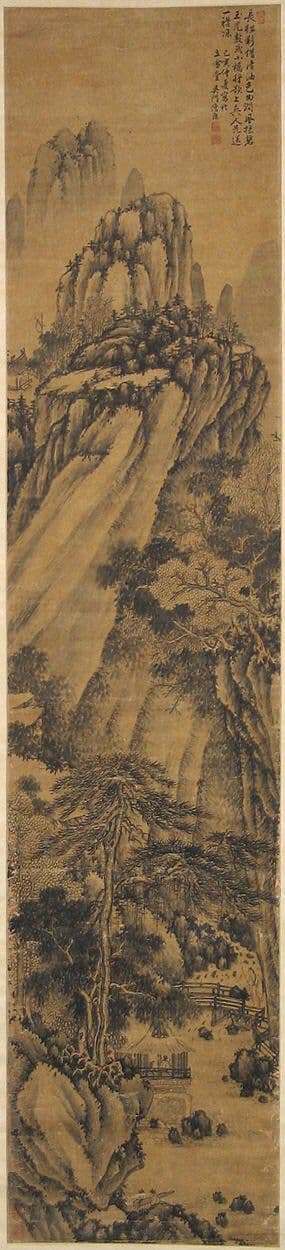
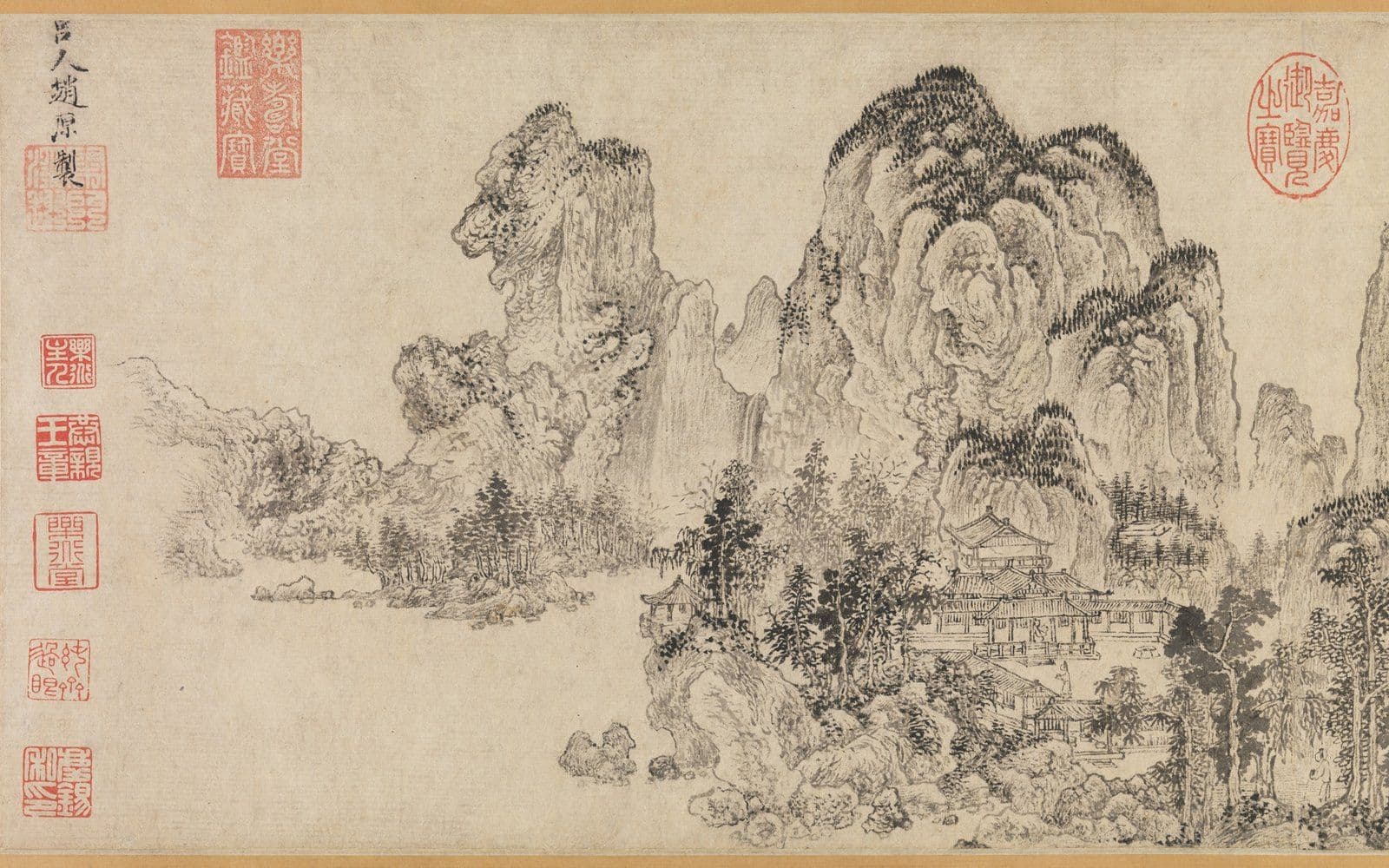
The handscroll (shoujuan) is the horizontal scroll format of Chinese painting and calligraphy — a long strip of silk or paper mounted on a paper backing, wound around a wooden roller at its left end. It is one of the family of classical formats, alongside the vertical hanging scroll made for display, and the album leaves and fans made for the lap and the hand.
The division of labor among formats matters. A hanging scroll is semi-public: hung in a hall for a season, seen by guests, then rotated. A handscroll is private. It lived rolled up in a box on a shelf, and it was taken down for an occasion: a friend visiting, a rainy afternoon, a moment worth marking. Viewing one was an act you did, with your hands, at a table — not a thing you glanced at in passing.
That intimacy shaped what painters put on handscrolls: journeys down rivers, the four seasons in sequence, city panoramas, narrative cycles — subjects with a beginning, a middle, and an end, composed to be discovered section by section rather than absorbed in one glance.
The anatomy, from right to left
A classical handscroll is a built object with a standard sequence of parts. Moving in viewing order:
- Outer wrapper and title strip — the scroll travels rolled, often wrapped in brocade, with a small label identifying the work while shelved.
- Frontispiece (yinshou) — an opening panel, frequently bearing the work's title written large by a distinguished calligrapher, sometimes centuries after the painting was made.
- The painting (or calligraphy) proper — the main image, which may itself be structured in episodes.
- Colophons (tiba) — sheets joined after the painting where owners, friends, and later admirers added comments, poems, and appraisals, each dated and signed.
- End roller — the wooden stave the whole assembly winds onto, with the final colophon panels closest to it.
Everything reads right to left, in the direction of classical Chinese text. The painting's "beginning" is its rightmost edge; a river journey flows leftward; and when a scroll is reproduced as a single long image in a book, remember you are seeing it backwards in time — flattened into a panorama no original viewer ever saw.
The viewing ritual
The classical method is simple and worth reproducing with any good reproduction: reveal a shoulder-width section, read it fully, then move on — rolling up what you have seen as you expose what comes next. The painting becomes a moving window. Composition that seems oddly episodic in a flattened reproduction snaps into sense at this pace: painters placed rests and transitions — a bank of mist, an empty stretch of water, a bridge — precisely where one viewing section gives way to the next.
The great narrative scrolls are built entirely on this logic. Along the River During the Qingming Festival, the Northern Song city panorama by Zhang Zeduan, moves from quiet countryside to teeming urban bridge to palace gates as a structured crescendo; the twelfth-century blue-green landscape A Thousand Li of Rivers and Mountains, painted by the prodigy Wang Ximeng, alternates peaks and water in paced movements. Neither was meant to be a mural. Each is a duration — the reason modern writers keep reaching for comparisons to cinema and to music when describing the format.
Handling explains one more physical fact: handscrolls show horizontal creasing more than any other format, because centuries of rolling and unrolling fatigue the silk and paper. Conservators expect it; buyers should too.
Why everyone wrote on it
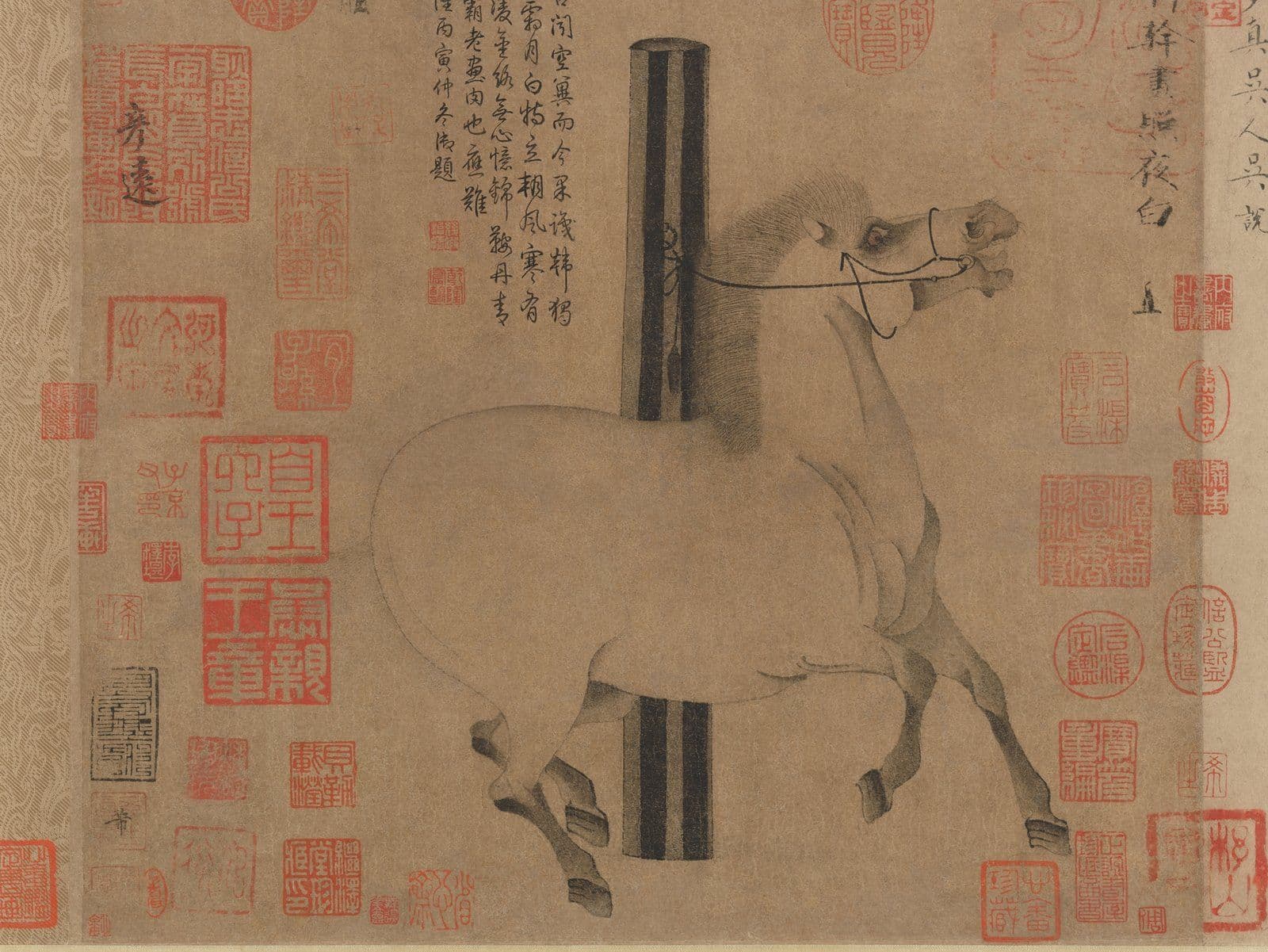
To modern eyes the strangest feature of a handscroll is that the painting may be a minority of its length. The colophon sections grow over time: each generation of owners and their circles added inscriptions — appreciation, scholarship, poems answering the image, records of when and where the scroll was seen. Great scrolls accumulated dozens of such entries, plus collector seals stamped by every serious owner through the centuries.
This is not graffiti; it is the scroll's own archive. A dated colophon by an identifiable scholar pins the object in place and time; a sequence of famous collectors' seals traces its chain of custody dynasty by dynasty. Connoisseurs read this apparatus as closely as the painting — our guides to reading inscriptions on Chinese paintings and to collector seals cover the decoding in detail. The scripts themselves carry information too, since a colophon's calligraphic style is part of how specialists date and weigh it.
For authentication, the apparatus cuts both ways. Colophons and seals are evidence, but they were also forged, transplanted, and recombined — a genuine colophon can be remounted onto a lesser painting, and famous seals were copied. Specialists therefore test whether painting, colophons, seals, and mounting history agree with each other, which is exactly the layered method described in our guide to how experts authenticate Chinese paintings.
The handscroll for collectors today
Handscrolls by canonical names are museum territory, but the format itself is not out of reach. Ming and Qing handscrolls by lesser or anonymous literati painters — landscapes, botanical studies, calligraphy — appear regularly at auction, and the format's demands (length, condition complexity, remounting history) mean they often sell below equivalent hanging scrolls. For a collector, that is an opportunity with homework attached.
The homework: condition and completeness. Unroll — or have the specialist unroll — the entire scroll. Check for horizontal cracking, staining, and patched losses along the full length, not just the painting; confirm the frontispiece and colophons described in the catalog are present; and treat the mounting itself as historical evidence, since a scroll remounted recently has had precisely the moments of greatest risk — and greatest opportunity for substitution — in its recent past. The traditional remounting craft is a discipline of its own, described in our piece on zhuangbiao mounting.
Stored well — rolled, boxed, flat, in stable humidity — a handscroll is among the most durable painting formats ever devised. It asks only what it always asked: to be taken out on purpose, opened slowly, and read.
Common questions
Which direction does a handscroll read?
Right to left, always — the direction of classical Chinese writing. The rightmost edge is the beginning: the title frontispiece comes first, then the painting from its right edge, then the colophons. When viewing a digitized scroll online, scroll toward the left to move forward through the work.
How much of a handscroll should be open at once?
Historically, about an arm's span — roughly the width of the table and the reach of the viewer. The composition is paced for it. Museums today often display scrolls fully opened in long cases, which shows everything and betrays the rhythm; it is a reasonable compromise, not the native experience.
Are the writings and seals on a scroll part of its value?
Centrally. Dated colophons by identifiable scholars and seals of known collectors are provenance built into the object — they can multiply a scroll's importance independent of the painting's quality. But because they were also forged and transplanted, they are weighed, not counted: the apparatus must be internally consistent and consistent with the painting it frames.
Is it safe to handle an old handscroll?
With clean dry hands, a clear table, and patience, careful handling is how these objects survived — but unrolling is the moment of maximum risk for a fatigued scroll, and old creases can crack open. If a scroll is stiff, cockled, or flaking, stop and consult a conservator who works on East Asian paper and silk. Never force a tight roll, and never hang or pin open a handscroll as if it were a mural.
Further reading
- Album Leaves and Fan Paintings: The Affordable Formats of Chinese Painting — the small formats, and why they are the classic entry point.
- How to Display a Chinese Scroll Painting — the hanging scroll's rules of rotation, light, and rest.
- Chinese Calligraphy's Five Scripts, Explained — the script literacy that makes colophons start talking.
- Provenance for Chinese Art: Reading the Paper Trail — how ownership history is documented and weighed.
Browse the collection
If you would rather live with these images than only read about them, the Kiln & Ink collection holds limited-edition archival giclée reproductions of the twentieth-century Chinese ink masters — hand-numbered, printed on rice paper, and issued with a Certificate of Authenticity.
Explore Further