Published April 13, 2026
Chinese signature identification step by step: where the artist signs, how to read the name and the red seal beside it, and how conventions changed after 1911.
Every Chinese painting that has been authenticated carries a signature and at least one seal. The signature names the artist; the seals authenticate. The combination is what places the work in time and pins it to a specific hand. Reading this convention is the most useful single skill in Chinese painting connoisseurship — both because it lets you verify a work, and because the conventions themselves shifted distinctively across the late Qing, Republic, and post-1949 eras, so the signature style alone often dates a painting.
The standard signature-and-seal block
A typical late-imperial or twentieth-century Chinese painting carries, in the upper-right or lower-left corner of the work:
First: an inscription (题款) — usually a brief poem, a date, a dedication to a patron, or a comment on the subject. This may run several lines.
Second: the artist's signature (落款) — the artist's name, often a literary alias rather than the legal name. Written in calligraphic regular or running script.
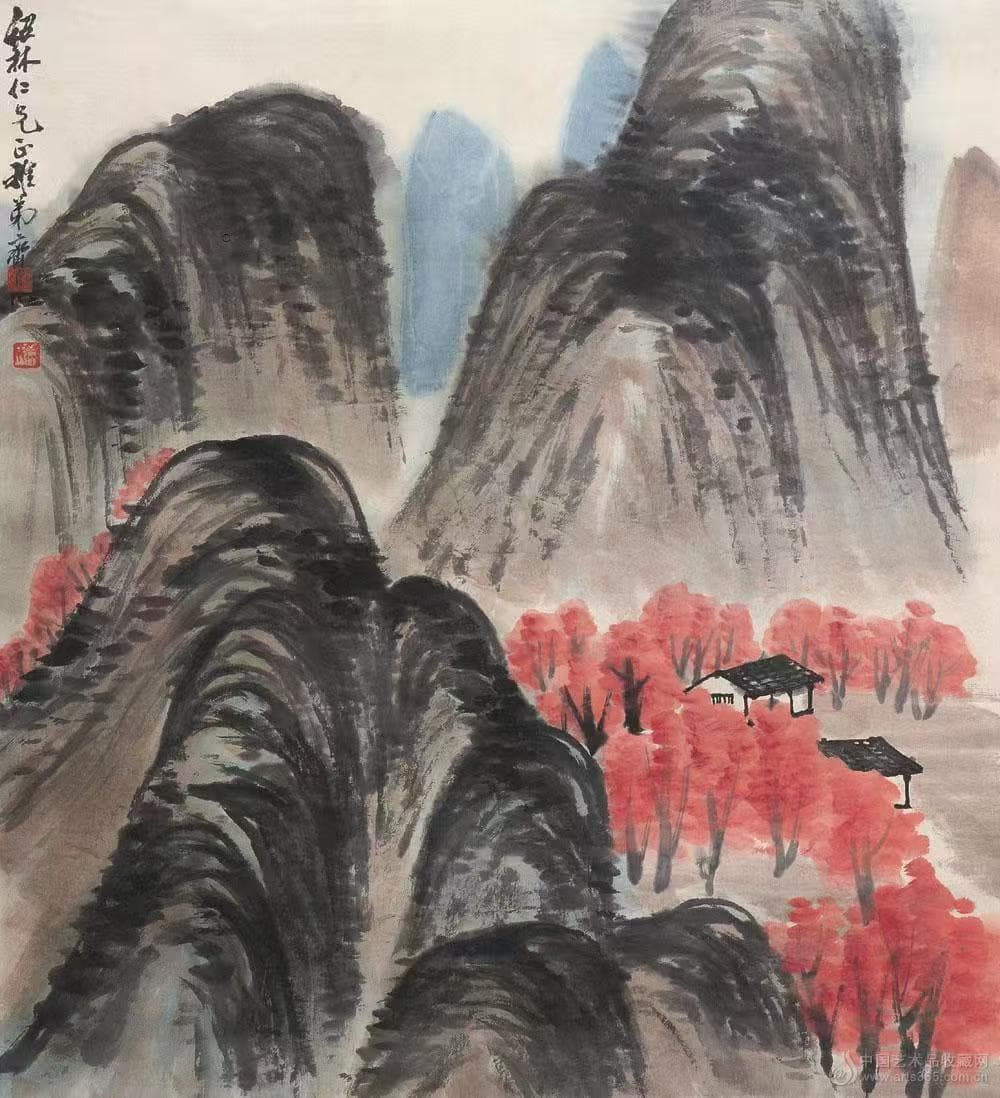
Third: one or more seals (印章) — square or rectangular red impressions, in stylised seal script. Usually two: a name seal (姓名印) and an alias seal (字号印) or studio seal (室名印).
The combination — inscription, signature, seals — is referred to collectively as 落款 ("the dropped block") and is a complete authenticating unit. Genuine Chinese paintings have all three components in correct calligraphic and seal style; reproductions and forgeries often miss one or get the conventions wrong.
Why aliases not legal names
Chinese painters historically signed with literary aliases (字 zì or 号 hào) rather than their legal names. A single painter often had multiple aliases, used at different stages of life or for different studios. Qi Baishi, for example, signed variously as 白石老人, 木居士, and a dozen others across his career. Each alias is associated with a specific period of his work; the alias itself dates the painting within his career.
This convention matters for authentication because forgers often get the alias wrong for the date — using a late-period alias on what is supposed to be an early-period work, for example. Catalogue raisonnés of major painters list which aliases were used in which years, and this is one of the primary cross-checks used by auction-house specialists.
Late Qing (1860–1912) signature style
Late-Qing signatures tend to be longer and more elaborate than later twentieth-century signatures. The inscription portion is often a substantial poem or dedication; the signature is in regular script (楷书) with careful stroke formation; seals are typically large and prominent, with the name seal as the larger and the alias seal as smaller.
Late-Qing painters who carried imperial recognition often added a studio name (室名) seal alongside the personal seals. Wu Changshuo and Pu Hua, working at the very end of the Qing, used elaborate three- or four-seal blocks on major works.
Republic of China (1912–1949) signature style
Republican-era signatures tighten. Inscriptions become shorter — often just a four-character poem or a single dedication phrase. Signatures move toward running script (行书), faster and more gestural. The number of seals reduces, typically to two: a name seal and an alias seal.
This is the era of the great twentieth-century master painters — Qi Baishi, Xu Beihong, Zhang Daqian, Wu Guanzhong's early career, Lin Fengmian's mature work. Their signature styles are individually distinctive and well documented; any reasonably-priced reference book or museum catalogue will let you compare a signature against verified examples.
Republican-era seals are typically smaller than late-Qing seals, more square in proportion, and carved in seal-script (篆书) of various stylistic schools. Master painters often had their seals carved by friends who were themselves seal-script masters — Wu Changshuo carved seals for many of his contemporaries, and Qi Baishi was himself a celebrated seal carver as well as painter.
Post-1949 signature style
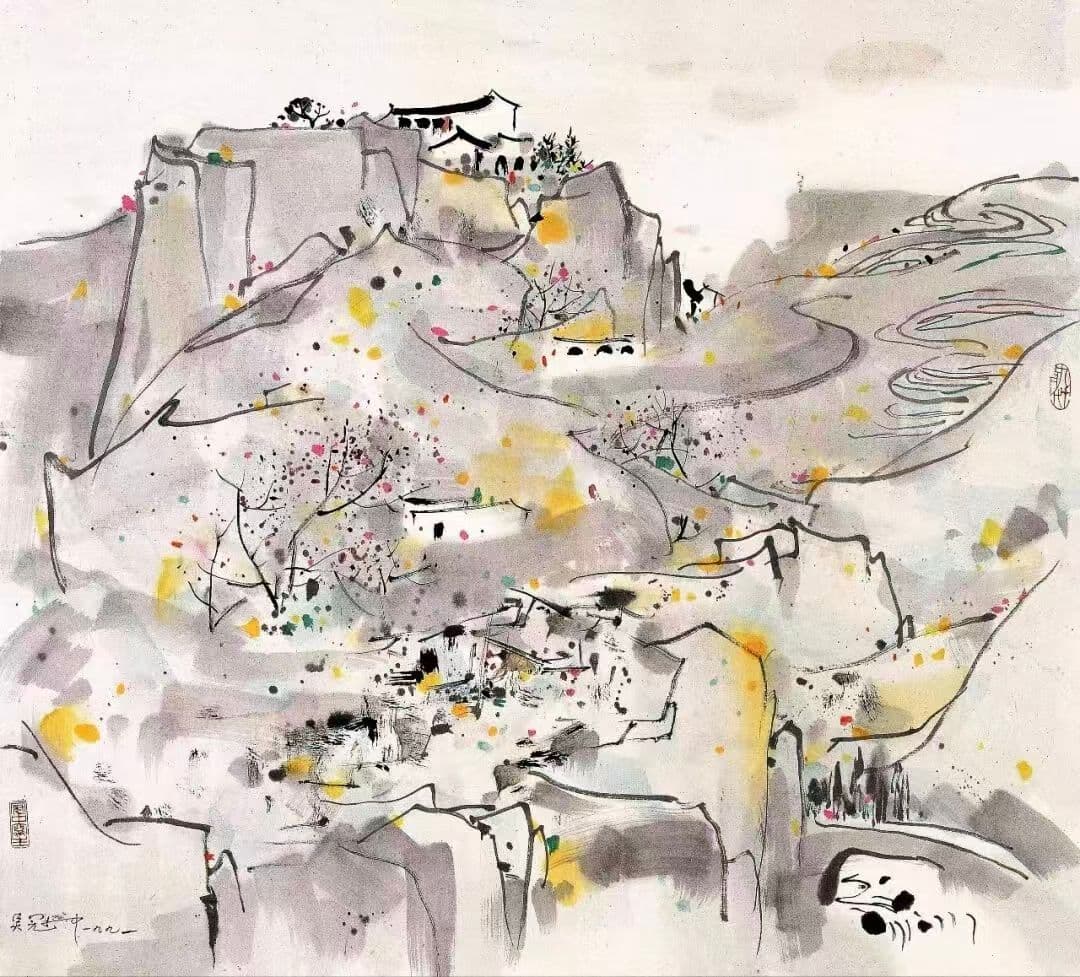
Post-1949 signatures are often shorter still — sometimes just a name and a single seal. Inscriptions become rare except on commissioned work. Wu Guanzhong's mature signatures are typically a single line of running script with one square seal beneath.
Seal carving in this period took two paths. Surviving pre-1949 painters continued using their existing seals. Post-1949 painters often had seals carved in a more modernist style, with the seal script intentionally simplified. The visual difference between a pre-1949 and a post-1949 seal is usually obvious to a trained eye — the older seals have more visual complexity, the newer ones more graphic clarity.
How forgers fail at signatures
The four most common ways a signature reveals a forgery:
First, the signature style does not match the dated period. Forger uses a 1960s seal style on what is supposed to be a 1930s painting.
Second, the calligraphy is too even. Real signatures by trained painters have rhythm and weight variation; forged signatures tend to look traced or printed.
Third, the seal impression is too clean. Real seal impressions vary slightly in red density and edge clarity — the stamp picks up ink unevenly and lifts at slightly different angles each time. Forged seals (especially those reproduced photographically) are too uniform across repeated impressions.
Fourth, the alias does not match documented usage. Forger uses an alias the painter is known to have stopped using in 1925 on a painting dated 1930.
Major auction houses use catalogue raisonnés to cross-check all four of these. For any painting you are seriously considering, the catalogue raisonné check is the standard authentication step.
Living with these conventions
Understanding the signature-and-seal convention transforms how you look at a Chinese painting. The signature block stops being a decorative footnote and becomes a third compositional element — placed deliberately, in the right corner for the work, reading both as authentication and as part of the painting's visual rhythm. Many late-period Qi Baishi paintings have signature blocks that are genuinely the strongest part of the composition. Once you can read them, you will see this everywhere.
The most efficient way to develop the eye is to spend time with high-resolution images of authenticated works. The Kiln & Ink collection includes prints of the major twentieth-century masters reproduced at full archival quality, with the signature blocks visible and inspectable. After a hundred or so signatures across the major painters, the diagnostic patterns become obvious — and the same patterns transfer directly to the seals you will see on Chinese porcelain and Yixing teapots.
From the Kiln & Ink collection: Four Screens, an archival giclée edition after Qi Baishi, hand-numbered on xuan paper with a certificate of authenticity.
Explore Further