Published May 21, 2026
Chinese painting mounting (装裱) is the layered silk-and-paper system behind every scroll — and a bad remount can erase a painting's value overnight.
When you unroll a Chinese hanging scroll for the first time, the painting itself is the smallest part of what you are holding. Above and below it sit broad silk borders. Behind it, several layers of paper press the work flat. A thin wooden stave at the top and a heavier roller at the bottom carry the weight. The whole assembly — close to two metres long for a typical hanging scroll — exists so the small painted area at its centre can survive being rolled, unrolled, hung, and stored for centuries.
This article walks through what every layer of a Chinese painting mount does, why poor mounting silently destroys value, and how to assess a scroll's mount before you commit to buying or restoring it. Most of what follows will be visible to you even if you have never handled a scroll before — once you know what to look at.
The anatomy of a Chinese painting mount
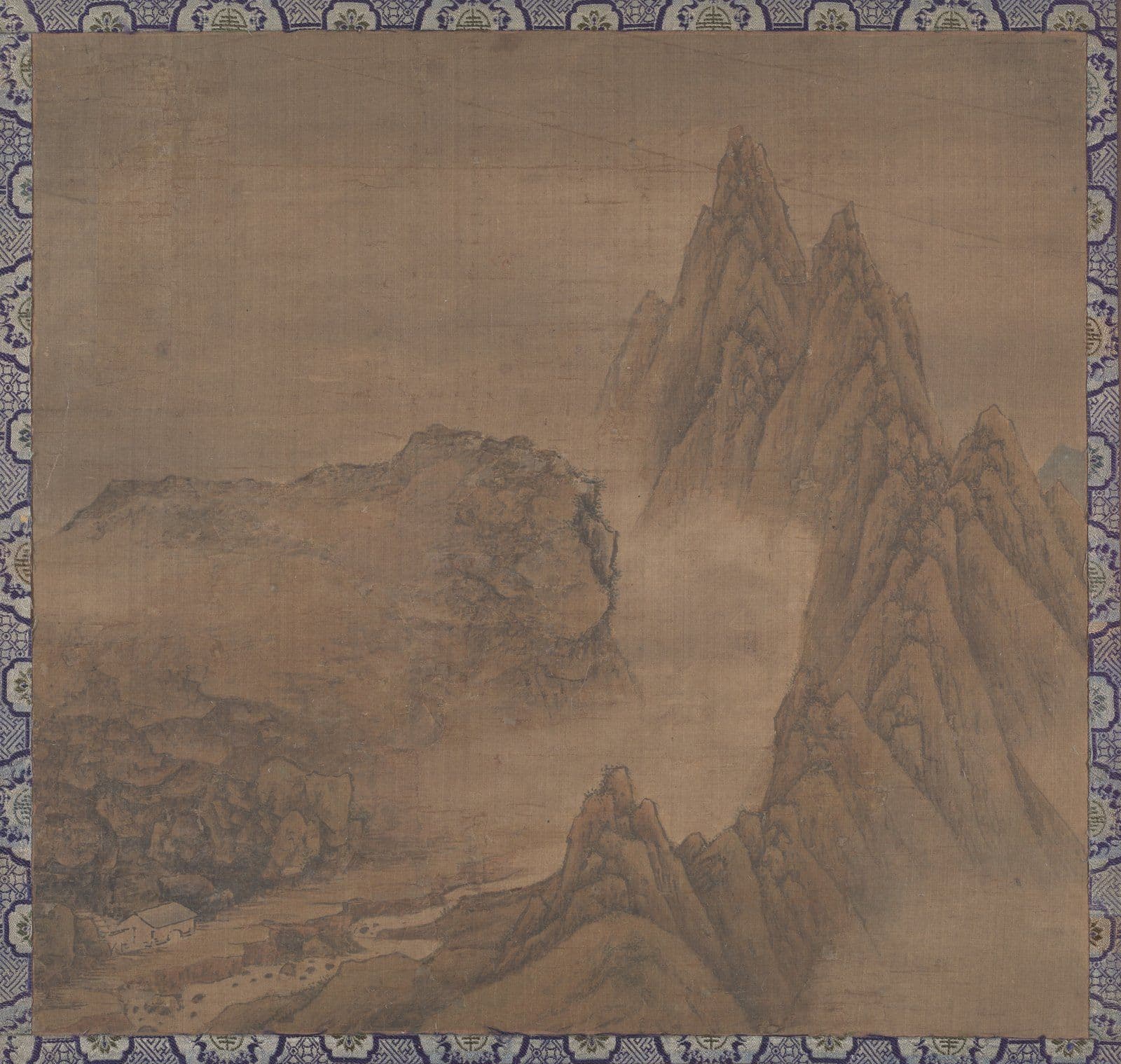
Chinese mounting (装裱, zhuangbiao) is a craft tradition with continuous evidence reaching back over a thousand years. Three formats dominate what reaches the Western market: hanging scrolls (挂轴, guazhou), hand scrolls (手卷, shoujuan), and album leaves (册页, ceye). Each has its own structure, but the underlying logic is the same — flexible silk and paper enclose a fragile painted surface, supported by hardwood at the ends so the work can be rolled away when not on view.
A standard hanging-scroll mount has roughly these elements, from top to bottom:
| Element | Chinese term | Function ||---|---|---|| Top stave | 天杆 (tiangan) | Thin wooden bar; suspension point || Hanging cord | 绦带 (taodai) | Silk braid for hanging || Upper silk panel | 天头 (tiantou, "sky") | Visual breathing room above the painting || Decorative strips | 惊燕 (jingyan, "startled swallows") | Two narrow ribbons that once moved in the breeze || Inner silk border | 隔水 (geshui, "water gap") | Frames the painting; usually a contrasting tone || Painting | 画心 (huaxin, "heart of the painting") | The original work || Lower silk panel | 地头 (ditou, "earth") | Counterweight below the painting || Bottom roller | 地杆 (digan) | Heavier; weights the scroll flat || End knobs | 轴头 (zhoutou) | Decorative caps on the bottom roller |
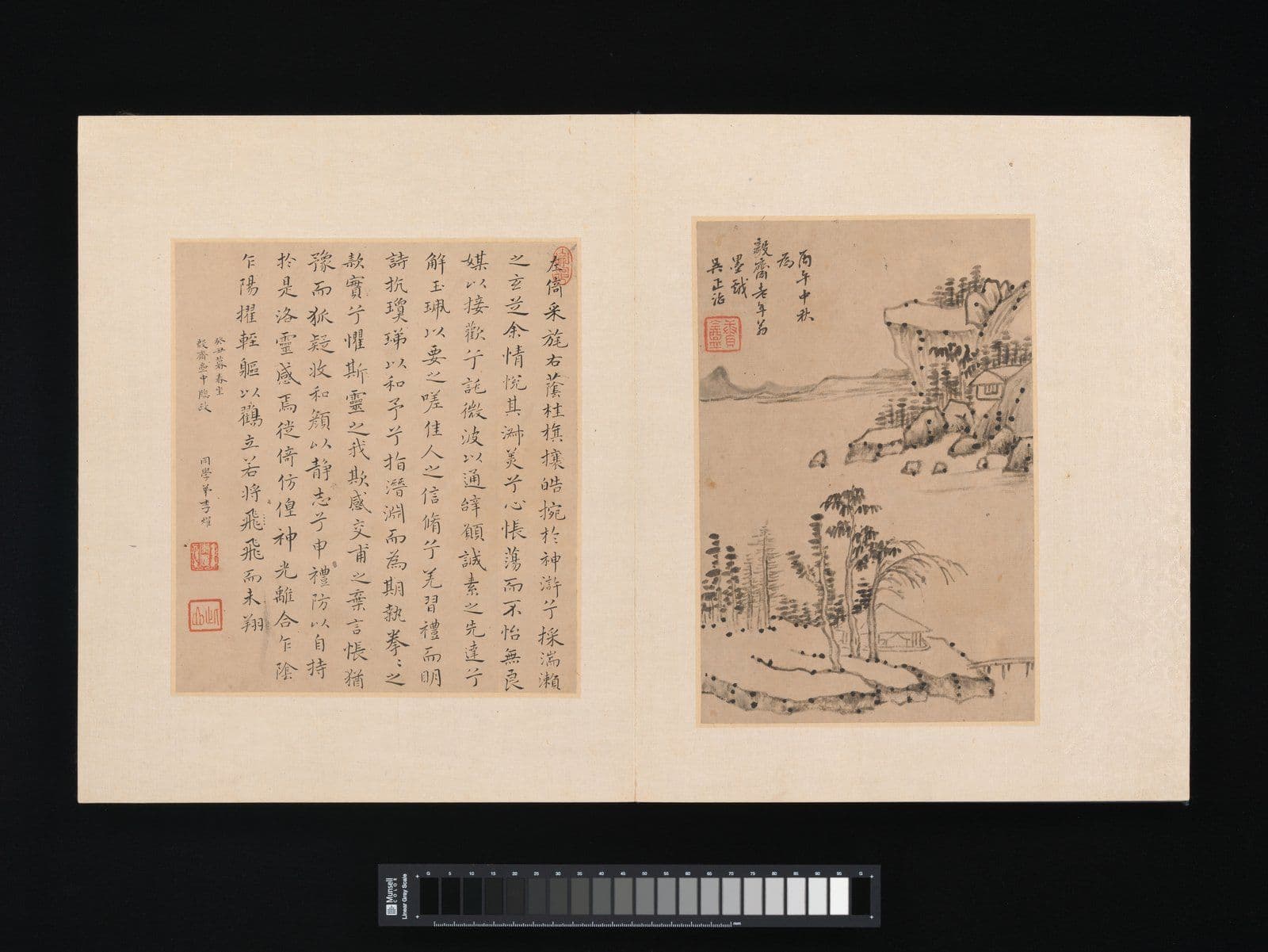
Behind all of this sit two to four backing layers of paper, attached with wheat-starch paste, that give the scroll its body. Hand scrolls work on the same principle laid horizontally, with title sections and blank colophon papers added at either end for later collectors and viewers to inscribe.
The proportions are not arbitrary. The relative sizes of tiantou (sky) and ditou (earth), the colour of the silks, the weight of the bottom roller — all of these decisions are made by a mounter (装裱师, zhuangbiao shi) in response to the painting at the centre. A subtle landscape gets quiet, muted silks. A bold flower-and-bird painting may carry darker, richer borders. Done well, the mount frames without competing.
Mounting is preservation, not decoration
It is easy for a Western viewer to read the silk borders as ornament and move on. They are not ornament. They are the structural reason the painting at the centre has survived.
Chinese painting paper is thin — often xuan paper (宣纸), made from the bark of the Pteroceltis tree, sometimes with rice straw or other fibres added. (Xuan paper sits alongside brush, ink, and inkstone in the tradition's material kit.) On its own, this paper has almost no resistance to handling. Lift a sheet by the corner and it flexes, creases, and tears. The mounting solves that by lining the painting with several layers of stronger paper, then bordering it with silk that distributes the stress of rolling and unrolling away from the painted surface.
The other side of preservation is reversibility. Traditional mounters use wheat-starch paste, applied thin, because it can be softened with water and removed. A scroll mounted with traditional paste can, in principle, be taken apart again — silk borders removed, backings lifted off, painting freed — and remounted with fresh materials. Major Chinese paintings have been through this process several times across their lives. A Yuan-period painting in a museum today may carry its third or fourth mount; the painting itself is original, but the silks and backings can be early Qing, late Qing, and twentieth-century in turn.
This is why an aged mount is not, by itself, bad news for a serious painting. It is normal. Remounting is part of the painting's life cycle.
Warning signs of a bad mount or remount
The problem is not aged mounts; the problem is bad mounts. A poorly executed remount can damage a painting more than a century of careful storage. The signs to look for fall into a small number of categories.
Adhesive choices. The single most damaging modern shortcut is synthetic glue — PVA (white craft glue), rice paste with added preservatives, or worst of all, dry-mount tissue with heat-activated adhesive. These bonds are not reversible. A future conservator cannot remove them without destroying the painting surface. A faint plastic sheen at the painting edges, or a scroll that feels unusually stiff and boardy when handled, both point to a synthetic remount.
Backing problems. Look at the back of the scroll. A traditional mount shows several layers of paper, slightly visible at the edges, with a soft hand-burnished finish. A poorly remounted scroll may show a single thick paper, machine-coated, or a fabric backing glued flat. Both indicate a shortcut.
Silk that fights the painting. The mounter's job is to choose borders that frame without competing. Watch for colours that are too bright, too saturated, or stylistically wrong for the period — synthetic-dye orange around a Ming landscape, electric purple around an ink-only album leaf. These choices usually mean the painting was remounted by someone treating the silk as decoration rather than as preservation.
Cropping or trimming. This is the most damaging error. When a painting is remounted, the existing margins are normally preserved. If a mounter trims even half a centimetre of margin to make a piece fit a standard silk panel, signatures, seals, and inscriptions can be lost — and with them, much of the painting's documented history. Compare the inner edge of the silk borders to the painted area; if any collector seals appear cut through, the painting has been retrimmed.
Wrinkles and undulations. A well-mounted scroll lies flat when unrolled and rolls back into an even cylinder. Persistent wrinkles, especially diagonal ones, or visible undulations across the painting surface usually mean the backing layers were mismatched in tension when applied. Over time this can crack the painted surface itself.
Adhesive bleed. Look at the front of the painting at the inner border. A thin yellow or brown line where the silk meets the painted area is a sign that glue has been applied too wet or too close to the painting edge. This bleed is permanent and often progressive — it darkens with time and humidity exposure.
How mounting affects market value
Two paintings of similar quality can trade at very different prices because of their mounts. The principle is straightforward: a good mount preserves optionality, a bad mount removes it.
A finely executed traditional mount — silk borders period-appropriate, paper backings clean and even, paste reversible — signals that the painting has been handled by people who knew its value. Auction catalogues note this in language like "in original mount" or "later mount in fine silk". Both can be acceptable; what raises questions is "remounted, condition compromised by previous restoration."
A bad mount, conversely, can require a full remount as the first conservation step a serious collector will pay for — often several thousand dollars, sometimes more for major works. That cost is implicitly priced into the auction value of the painting in its current state. Worse, if the bad mount has trimmed signatures, eroded inscriptions, or destroyed colophons, the lost provenance cannot be recovered no matter how skilled the next mounter. The painting's market position is permanently smaller.
Some markets care more about this than others. A late-Qing decorative painting bought at a regional sale will be priced for what it is, mount included. A serious Ming or earlier work, or a piece with significant inscriptions, will be examined by specialists who place heavy weight on mount condition — both for what it tells them about the painting's care history and for what it predicts about future conservation costs.
When (and whether) to remount
Most paintings should not be remounted in the hands of a private collector. The decision belongs in a workshop, not in a living room. But the question of whether a piece needs remounting is one a collector can usefully think about, with three considerations in mind.
The first is condition. If the mount is dirty but structurally sound — no active flaking, no foxing migrating into the painting area, no separation of the painting from its first backing — it can usually be left in place. Cleaning a Chinese painting in mount is a specialist task but not a structural intervention.
The second is reversibility. Any remount should be done by a workshop that uses wheat-starch paste, traditional paper backings, and silks compatible in weight and weave with the original. Conservation studios attached to major museums train mounters in this tradition. Independent workshops vary widely in quality; a reference from a museum conservator or an established dealer is the safest way in.
The third is documentation. Before any work begins, the painting should be fully photographed, with high-resolution images of every silk border, every seal, every inscription, and every margin. Painting conservation has good and bad outcomes, and the photographic record is what protects the collector if questions later arise about what was removed, repaired, or replaced. A painting connected to the literati tradition behind Xie He's six principles — a serious work rather than a decorative piece — should never be remounted casually. The painting may have survived four centuries because its previous mounts were treated with respect. The next mount is the collector's chance to extend that record, or to break it.
Common questions
Why are some Chinese paintings mounted with very wide silk borders and others with narrow ones?
The proportions reflect the period of the mount and the painting's intended viewing context. Hanging scrolls intended for formal halls — temple settings, scholar's studios, ceremonial display — tend to have generous tiantou (top silk) so the painting reads at a distance. Smaller domestic scrolls, intended to be viewed close up by one or two people, often have tighter borders. A mount with unusually wide silk panels for the size of the painting may be a re-mount that adjusted proportions to fit a different display setting.
Should I unroll my Chinese painting to display it permanently?
No. The tradition treats paintings as objects to be viewed in rotation. A painting unrolled for months or years suffers from light damage, humidity stress on the silks, and gradual cracking at the points where the painting meets the backing. Most serious collectors rotate paintings in and out of display every few weeks to a few months. When stored, a scroll is rolled around its bottom roller, wrapped in cotton cloth, and kept flat in a tightly closed paulownia or similar wood box.
Can I tell the age of a painting from the age of its mount?
Not directly. The mount tells you when it was last remounted, not when the painting was made. A painting in visibly aged silk is usually old, but the reverse is unreliable — a fifteenth-century painting in clean modern silk has simply been remounted recently. The painting itself, its paper, ink, and seals, are the reliable evidence of its age.
What is the difference between a mount and a frame?
A frame is a Western convention — a rigid box, often wood and glass, that encloses a work and is not changed across its life. A Chinese mount is integral to the painting, made of the same paper-and-silk material family, and is expected to be replaced as it ages. Trying to "frame" a Chinese scroll — gluing it to board, installing it under glass permanently — destroys the rolling structure and accelerates damage.
Further reading
How to read collector seals on Chinese paintings — the layered red seals that mounting preserves or trims
Chinese ink painting vs Western watercolor — the material side: paper, ink, brush, and why they need the mount they get
Xie He's six principles of Chinese painting — the aesthetic frame within which a mount succeeds or fails
Reading the marks on Chinese porcelain — a parallel literacy for the other major Chinese collecting category
Browse our ink paintings
Modern hand-painted ink works in the literati tradition, mounted by craftsmen trained in the traditional method — every piece arrives ready to hang, with documentation of its mount construction.
Explore Further