Published July 11, 2026
How to read and translate a Chinese painting inscription: find the signature, decode the cyclical date and dedication, and read the seals, no Chinese needed.
Look at almost any Chinese painting and you will find writing on it — a column or two of characters tucked beside a branch, or a dense block of text filling the sky above a mountain. Western paintings hide their documentation on the back of the canvas; Chinese paintings wear it on the front. That writing is not a caption. It is a structured record of who painted the work, when, where, for whom, and sometimes why — followed, in older works, by the responses of the people who owned and admired it over the centuries.
You do not need to read Chinese to extract real information from an inscription. The writing follows conventions so stable that, once you know the anatomy, you can locate the signature, the date, and the dedication, and know exactly what to ask a specialist to confirm. This guide walks through that anatomy piece by piece.
The anatomy of an inscription
The artist's own inscription is called the kuan (款) or luokuan (落款) — literally the "dropped" or placed signature block. A full one contains up to five elements, usually in this order:
- A title or poem. Longer inscriptions often open with a few lines of verse — the artist's own or a quotation — or a short note on the subject. In the literati tradition, poem, calligraphy, and image were considered one art, so the text is part of the composition, not an addition to it.
- The occasion or place. Phrases recording where the work was painted ("at the such-and-such studio") or the circumstance ("on an autumn night after rain").
- The date. Usually given in the traditional cyclical system — more on this below.
- The dedication. If the painting was made for someone, their name appears with a courtesy formula.
- The signature. The artist's name — very often not the name you know them by — followed by words like hua (画, "painted") or xie (写, "wrote/sketched").
The inscription is read the traditional way: characters run top to bottom in columns, and the columns proceed from right to left. The signature therefore sits at the bottom of the leftmost column of the artist's inscription, with the artist's seals stamped immediately below or beside it.
Everything else written on the work — appreciations added by friends, collectors, and later connoisseurs — belongs to a different category called tiba (题跋), or colophons. On handscrolls these accumulate on separate sheets mounted after the painting; on hanging scrolls they may appear on the mounting borders or above the image. Colophons are one reason a Chinese painting's mounting is treated as part of the object: remounting a scroll carelessly can discard centuries of ownership history.
Decoding the date: the sixty-year cycle
Most inscriptions date the work with two characters from the ganzhi (干支) system — the cycle of ten heavenly stems and twelve earthly branches that combine into sixty year-names before repeating. Jiazi (甲子) opens the cycle; guihai (癸亥) closes it. The practical consequence for a collector: a cyclical date alone pins the year only within a repeating sixty-year wheel, so renxu (壬戌) could be 1862, 1922, or 1982.
The ambiguity is almost always resolvable. You know the artist's lifespan, so only one or two candidates are possible; and inscriptions frequently add the artist's age ("at seventy-three") or a seasonal note ("early spring") that narrows it further. Twentieth-century masters continued using cyclical dates out of tradition — Qi Baishi, Zhang Daqian, and their contemporaries rarely wrote Western years. When an inscription's stated age and cyclical year disagree with the artist's documented biography, treat the work with suspicion: this simple arithmetic check catches a surprising number of careless forgeries.
Names are the hard part — and the most useful
The signature seldom matches the textbook name. A traditional artist carried multiple names: the birth name (名, ming), a courtesy name (字, zi), and one or more art names or studio names (号, hao) adopted at different life stages. Qi Baishi's "Baishi" ("white stone") is a hao, not his birth name; many artists signed different periods of their careers with different hao, which is why reference works list them chronologically.
This is genuinely useful for dating and authentication. If an artist adopted a particular studio name only in his sixties, a painting signed with that name but dated — by cycle or by style — to his thirties is announcing its own problem. Matching the signature form, the calligraphy of the signature, and the seals beneath it against documented examples is the core of identifying Chinese artist signatures, and it is where specialist references earn their keep.
The dedication line rewards attention too. Formulas such as yazheng (雅正, "for your refined correction") or qingshang (清赏, "for your pure enjoyment") follow the recipient's courtesy name. A documented recipient — a known scholar, official, or fellow artist — can anchor a work's provenance more firmly than any later certificate, because the social connection can be checked against both people's biographies.
Seals: the punctuation of the system
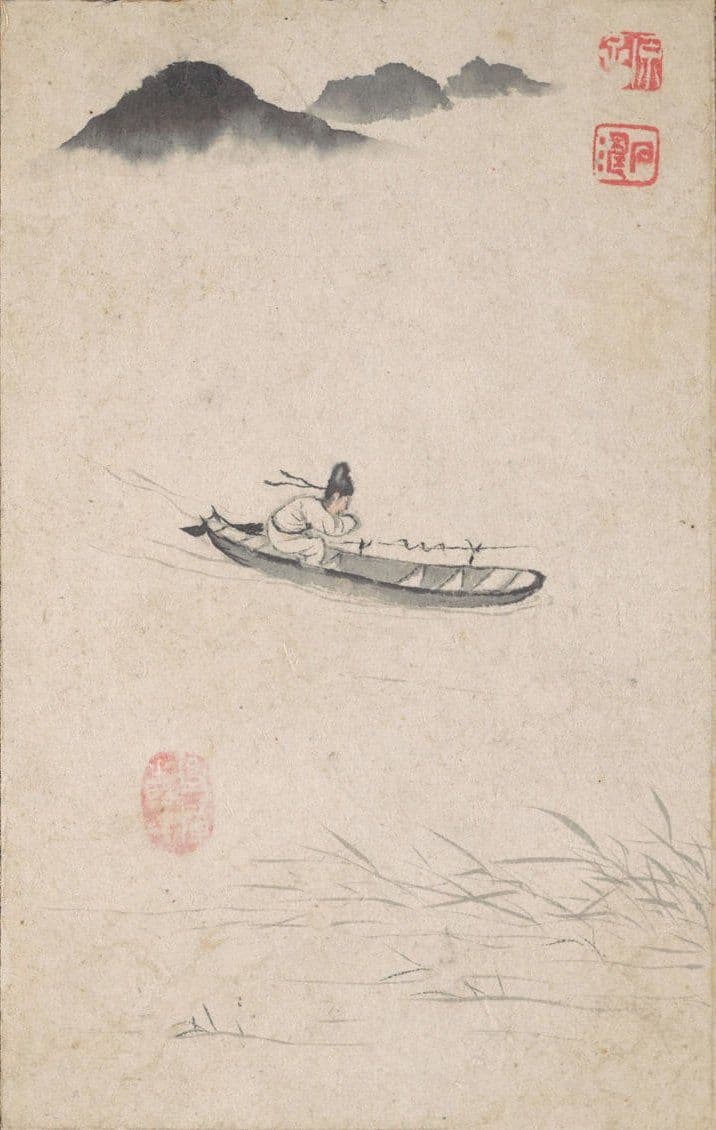
Seals complete the inscription. The artist's own seals normally sit under the signature — often a pair, one carved in relief (red characters, zhuwen 朱文) and one in intaglio (white characters against red, baiwen 白文), giving name and hao. A third kind, the "leisure seal" (闲章), carries a motto or studio name and often anchors a lower corner or the opening of a scroll. Everything stamped by later owners — the accumulating red squares that can crowd an old masterpiece — is collector seals, a parallel record of ownership that we cover separately in reading collector seals on Chinese paintings.
For quick orientation on any work: find the leftmost column of the artist's text, drop to its foot for the signature, and expect the artist's seals immediately after. Red squares elsewhere on the sheet are, with few exceptions, other people's voices.
A worked reading order for the non-reader
Faced with an inscribed painting and no Chinese, work through this sequence:
- Locate the artist's block. Usually the visually integrated text near the image, ending in a column with seals directly beneath.
- Count the columns and note the layout. A two-character-plus-signature short kuan versus a long poetic inscription changes what information can be present.
- Photograph the signature column and seals straight-on. These are what a specialist needs first — the same discipline as photographing a porcelain mark for authentication.
- Look for the cyclical date characters near the end of the text, often just before the signature, and note any age statement.
- Separate artist seals from collector seals by position: under the signature versus scattered on borders, corners, and mounting.
- Ask targeted questions. "Is this signature form consistent with the stated date?" gets a far more useful answer than "is this real?"
A reader who does nothing more than this reliably extracts the who, when, and for-whom skeleton of a work — and, just as important, notices when the skeleton doesn't hang together.
Common questions
Is the writing on a Chinese painting always by the artist?
No, and this is the first distinction to make. The artist's own inscription (kuan) is integrated with the image and ends with the signature and seals. Colophons (tiba) by admirers, friends, and later collectors were added over the work's lifetime — on mounting sections of handscrolls, on borders, or occasionally on the painting surface itself. On famous old works, the colophons can outweigh the painting in sheer text. Colophons by notable figures add historical value and provenance; they are also, inevitably, imitated by forgers, so a starry colophon should be verified with the same care as the painting.
Does more writing mean a better or more valuable painting?
Not by itself. A long inscription with a good poem in fine calligraphy raises a literati work's interest, because text, calligraphy, and image were judged as one performance. But plenty of masterpieces carry only a short signature, and plenty of weak paintings carry long inscriptions. Where text genuinely adds value is documentation: dates, dedications to identifiable people, and credible colophons all thicken the work's paper trail.
Can an inscription be genuine while the painting is not — or vice versa?
Yes, both happen. Forgers have added fake inscriptions and signatures to genuine but anonymous old paintings to upgrade them, and have painted new images to sit under genuine calligraphy or beside genuine colophons transplanted during remounting. This is why specialists insist on reading inscription, seals, paper, style, and mounting as one interlocking system rather than authenticating any element alone.
What does it mean when the date, age, and signature don't line up?
It means stop. Cross-checking the cyclical year against the artist's stated age and known biography is basic due diligence; a mismatch signals either a forgery or, occasionally, an honest later copy of a lost original. Either way, the painting needs expert review before money changes hands.
Further reading
- Reading Chinese Painting Seals — a closer look at the carved half of the signature system.
- Literati Painting vs Court Painting — why the scholar tradition made writing part of the picture.
- How to Display a Chinese Scroll Painting — living with the object once you can read it.
Browse the collection
If you would rather live with these images than only read about them, the Kiln & Ink collection holds limited-edition archival giclée reproductions of the twentieth-century Chinese ink masters — hand-numbered, printed on rice paper, and issued with a Certificate of Authenticity.
Explore Further