Published August 14, 2026
Xingshu, the Chinese running script, explained: how it sits between kaishu and caoshu, the three canonical works, and how to judge one piece.
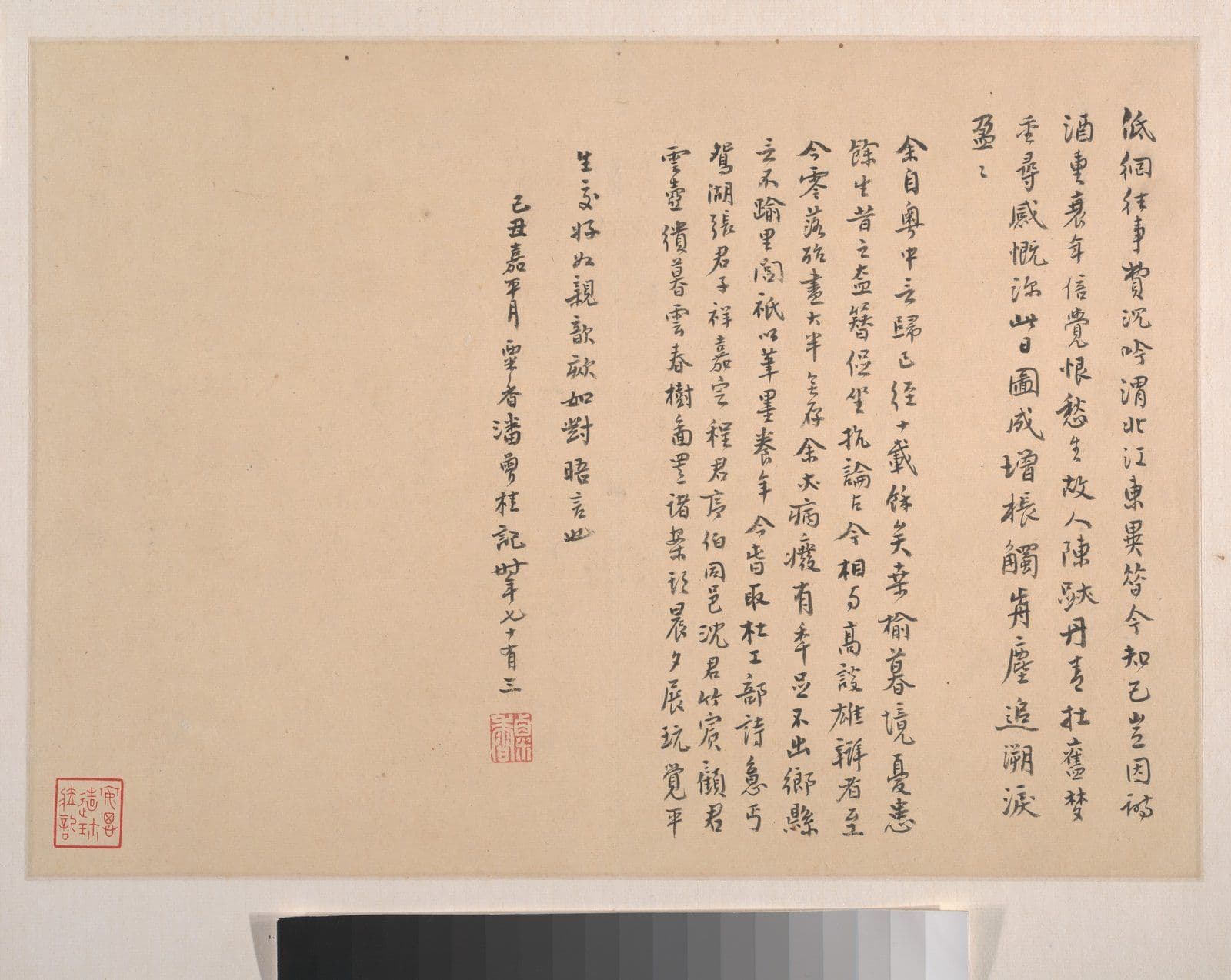
Hold a Chinese hanging scroll up to the light and read the inscription in the upper corner. Nine times out of ten the characters are neither the upright, evenly spaced forms of a printed page nor the dissolved loops of full cursive. Strokes are shortened. Two or three of them fuse into a single movement. A hair-thin thread of ink runs from the end of one character to the beginning of the next, then breaks. That is running script — xingshu — and it is the hand in which most of the Chinese writing a collector actually encounters was set down.
This guide explains where running script sits among the other scripts, what the brush is doing to produce it, which works define the tradition, and what to look at when you are judging a piece in front of you.
Where running script sits
Calligraphy in China is conventionally taught as five scripts. They are not a single line of descent — the later ones did not simply replace the earlier ones, and all five remain in use today, chosen for occasion rather than for period.
| Script | Romanised | Character shapes | Relative speed | Legible to a reader of modern Chinese? ||---|---|---|---|---|| Seal | zhuanshu | Archaic, symmetrical, even line width | Slowest | Often not || Clerical | lishu | Broad, flattened, flared closing strokes | Slow | Mostly yes || Regular | kaishu | Upright, every stroke separate and complete | Moderate | Yes || Running | xingshu | Abbreviated, strokes partly joined | Fast | Yes, with practice || Cursive | caoshu | Radically abbreviated, characters merged | Fastest | Often not |
The single most common misunderstanding is that running script is simply regular script written quickly. It is not. Speed is a consequence, not a definition. Running script has its own conventions for which strokes may be merged, which may be dropped, and which must survive — conventions a literate reader absorbs the way an English reader absorbs cursive handwriting. A regular-script character rushed by an untrained hand produces a mess. A running-script character produces a form other people can read, because the abbreviations are shared.
If you want the wider frame first, our overview of the five scripts of Chinese calligraphy sets each one against the others and explains when a calligrapher chooses which.
What the brush is actually doing
Three mechanical changes separate running script from the standard hand.
Strokes merge. In regular script the brush lifts clear of the paper at the end of every stroke. In running script it often does not. The dot-and-horizontal that open a character may be written as one continuous gesture with a change of direction in the middle rather than as two separate marks. The number of visible strokes drops, sometimes by half, while the character's skeleton stays recognisable.
Connecting threads appear. When the brush leaves the paper while still moving, it drags a thinning tail of ink behind it — qiansi, "drawn silk". These threads are the most immediately visible signature of the script. They are not decoration and they are not accidents to be tidied up. They are the visible record of the brush's path through the air between two strokes, which is why calligraphers treat them as evidence of whether a hand was in control.
Structure loosens but survives. Components may lean, compress, or shift relative to one another to accommodate the speed. What they may not do is dissolve. The moment a character's structure can no longer be reconstructed by a reader, the writing has crossed into cursive — the territory covered in our guide to cursive script and its three historical stages.
That boundary is genuinely a spectrum, and the tradition has names for the two halves of it. Xingkai leans toward the regular hand: mostly separated characters, restrained threads, easy reading. Xingcao leans toward cursive: heavier merging, longer connections, more demand on the reader. A single scroll can move between the two, and in the hands of a good calligrapher that movement is deliberate — it is how emphasis and pacing are built into a text that has no punctuation.
The three works the tradition is built on
Running script has an unusually concentrated canon. Three works are conventionally named as its high points, and virtually every serious calligrapher has copied all three.
The first is the Preface to the Poems Composed at the Orchid Pavilion, written by Wang Xizhi (traditionally dated 303–361) after a gathering of friends in 353 at Shanyin, in present-day Shaoxing. Wang wrote it as a draft, corrections and all, and by long-standing account could never reproduce its quality when he tried to write it out cleanly afterwards. The original has not survived. What exists are tracing copies and stone-engraved versions made in later centuries, which is why the piece is studied through a family of related versions rather than a single object.
The second is Yan Zhenqing's Draft of a Requiem for My Nephew, written in the eighth century after the deaths of his nephew and brother in a rebellion. It is a working draft: the brush accelerates, the ink runs dry and is reloaded mid-column, whole phrases are struck through. Its standing rests precisely on that rawness — it is the case the tradition points to when it argues that calligraphy records a state of mind rather than illustrating one.
The third is Su Shi's Cold Food Observance, written in the eleventh century during his exile at Huangzhou. The characters grow steadily larger and heavier as the text moves through the poem, so that the writing enacts the poem's descent.
The pattern in all three is worth noticing before you look at anything on the market. None was composed as a display piece. All three are drafts or private texts. Running script is the script of letters, drafts, colophons and inscriptions — writing done for a purpose other than being admired — and the tradition's highest examples come from exactly that category.
What to check when you are judging a piece
Reading calligraphy as a collector is a different activity from reading it as a scholar. These are the checks that carry the most weight.
- Does the line have a beginning and an end? Look at where the brush enters the paper and where it leaves. In competent work the entry is deliberate — the tip is set down, turned, then moved — and the exit is resolved. Weak work shows strokes that simply appear and simply stop.
- Are the connecting threads doing structural work? A thread should sit on the path the brush would logically take between two strokes. Threads that wander, or that appear everywhere at uniform thickness, usually mean the writer added them for effect.
- Is the ink varied? A brush loaded once and written until dry leaves a visible gradient across several characters, then a fresh dark reload. Uniform blackness throughout a long text suggests frequent redipping and a cautious hand — or a reproduction.
- Does the column breathe? Character sizes should vary. A column of near-identical sizes is usually a copyist's tell, because copying suppresses the rhythm that produced the sizes in the first place.
- Is the seal consistent with the signature? Seal impressions and their placement are their own subject, treated in our guide to reading seals and collector marks on Chinese works.
Among twentieth-century masters, Qi Gong is the most useful reference point for a beginning eye. His hand is a disciplined xingkai: clear structure, restrained connections, consistent internal spacing. Because his forms are legible and his rhythm is regular, he is easier to read than the classical drafts, and comparing an unfamiliar piece against a well-known hand is one of the few judgements a newer collector can make with confidence.
Where you meet running script
Beyond calligraphy sold as calligraphy, running script turns up in three places a collector of paintings will meet constantly.
Painting inscriptions are the most common. The poem, dedication or date written into the upper register of a scroll is almost always in running script — it is fast enough to belong to the same session as the painting and legible enough to be read. Our guide to reading the inscription on a Chinese painting covers how those inscriptions are structured.
Colophons are the second. A work that passed through several collections may carry commentary added by later owners on the mounting itself, and those additions are typically in running script.
Letters are the third. Correspondence between scholars was written in this hand, and because letters were kept, catalogued and eventually engraved into stone as models, a substantial part of the surviving classical corpus is simply mail.
Common questions
Is running script harder to write than regular script?
Yes, though not in the way people expect. The individual characters are simpler, because strokes have been merged or dropped. What is harder is that speed removes the option to correct. In regular script a slightly thin stroke can be strengthened on a second pass; in running script the brush has already moved on, and every hesitation shows as a blot or a wobble in the line. This is why students are taught the regular hand first — not because it is easier to read, but because it builds the control that running script spends.
Can I learn to read running script without reading Chinese?
Not really, but you can learn to judge it without reading it, and that is the skill that matters at a viewing. Line quality, ink variation, the logic of the connecting threads and the rhythm of a column are all visible to an eye trained by comparison rather than by literacy. Collectors who cannot read a character routinely make sound judgements about brush control, and then rely on a specialist for content and attribution.
Why do so many famous examples look like rough drafts?
Because they are. The tradition takes the view that a text written for its own purpose records the writer more honestly than one written to be looked at. Corrections, struck-through characters and ink that runs dry mid-column are not flaws in these works; they are the evidence that the writing happened in real time, once.
How does running script relate to clerical script?
They belong to different lines of development. Clerical script, the broad flattened hand of the Han period, is a formal script with its own decorative closing strokes; it is slow to write and was never the everyday hand of the literati in later centuries. Our guide to clerical script and its flared stroke endings sets out how it works and where it is still used today.
Further reading
- The Five Scripts of Chinese Calligraphy — the overview this guide is a spoke of.
- Seal Script (Zhuanshu) — the oldest of the five, and the one still used for seals.
- Qi Gong: A Collector's Guide — a twentieth-century running hand examined in detail.
- The Four Treasures of the Scholar's Studio — brush, ink, paper and inkstone, and how each one shapes the line.
Browse the collection
Calligraphy is a subject we write about more often than one we stock. What Kiln & Ink sells is paper: limited-edition archival giclée reproductions of the twentieth-century Chinese ink masters, each printed on rice paper or museum-grade cotton rag, hand-numbered, and issued with a Certificate of Authenticity.
Explore Further