Published August 8, 2026
Zhuanshu explained: great and small seal script, why carved seals kept the oldest Chinese hand alive, and how to read the red square on a painting.
Turn a Chinese painting over to the lower left corner and you will usually find a small red square. The characters inside it rarely look like the characters in the inscription above — they are longer, more symmetrical, drawn with lines of almost even thickness, and often folded into shapes that fill the square edge to edge. That is seal script, and the reason it looks unfamiliar is that it stopped being an everyday hand roughly two thousand years ago and has been living in seals ever since.
This guide covers what seal script is, why it survived in one narrow place after being replaced everywhere else, how it is built, and what a collector can actually do with it when a red impression is the only thing standing between them and a name.
Where seal script sits among the five scripts
Chinese calligraphy is conventionally sorted into five standard scripts, and seal script — zhuanshu — is the oldest of them still in regular use. It came before clerical script, before the running and cursive hands, and before the regular script that Chinese is printed in today. If you want the whole family laid out side by side, the five scripts explained is the place to start; this article goes down into one of them.
Seal script is usually split in two.
Great seal script (dazhuan) is the loose term for the older, less regularised forms — the characters cast into ritual bronzes and cut into stone before the empire was unified. Their proportions vary, the same character can appear in several shapes, and the line often carries the texture of the material it was made in. The Stone Drum inscriptions, cut into ten drum-shaped boulders and among the most studied early stone texts in China, belong to this side of the family.
Small seal script (xiaozhuan) is what most people mean when they say seal script. It is the regularised version that came out of the Qin unification, when the writing of the different states was brought into one system; tradition credits the chancellor Li Si with setting the standard. Characters became consistent in shape, vertically elongated, and symmetrical around a centre line.
Clerical script replaced it as the working hand within a few centuries, for the reason working hands always win: it was faster. Seal script did not disappear so much as retire into ceremonial use — inscriptions, title headings on steles, and above all seals.
Why the seal kept it
Three things kept seal script alive in one square inch of stone after it lost every other job.
It suits the tool. Seal script's line is even in width from beginning to end, its turns are rounded rather than angled, and its structure is close to symmetrical. That is a very good description of what a blade can cut cleanly into hard stone. Clerical and regular script depend on the brush swelling and thinning, on pressure changes that a knife reproduces awkwardly.
It fills a square. Because seal characters are elastic — a stroke can be stretched, folded, or bent to occupy space without becoming a different character — a carver can make two, four, or six characters sit inside a square with even density. That elasticity is why seal-script compositions look designed rather than merely written.
It carries authority. By the time seals became a literati art rather than a bureaucratic necessity, seal script already read as ancient. Using it signalled learning. A scholar who cut his own seals was demonstrating that he could read bronze and stone inscriptions, not just write letters.
Seal carving as a self-conscious art — zhuanke — matured under the Ming and Qing, when painters and calligraphers began cutting their own stones instead of commissioning craftsmen. That is the moment the seal stopped being a signature device and became part of the picture.
How a seal-script character is built
Four features do most of the work, and you can check all four on an impression without reading a single character.
| Feature | What you are looking at ||---|---|| Line width | Even from start to finish, with no obvious swelling at the turns || Stroke ends | Blunt and closed rather than tapered to a point || Turns | Curved or squared with a continuous line, not broken into separate strokes || Proportion | Taller than wide in small seal script; less regular in the older forms |
Written with a brush, seal script is produced with the tip held at the centre of the stroke and the entry and exit of each line concealed inside it. The result is a line that looks extruded rather than drawn. This is why a calligrapher's seal-script practice tends to show up in their painting: the discipline of a centred, even line is the same discipline that produces a strong contour in ink. Wu Changshuo's lifelong study of the Stone Drum inscriptions is the clearest case — decades of copying that one archaic text reshaped his calligraphy, and then his flower painting.
The other structural point worth knowing: seal script has more variant forms than later scripts. The same character may legitimately appear in several shapes depending on which ancient source the carver was following. This is a feature, not an error, and it is one reason seals resist casual reading.
Reading a seal on a painting
Start with the colour of the ground rather than the characters.
- Relief (zhuwen) — the characters print red, the ground prints white. The carver cut away everything except the strokes.
- Intaglio (baiwen) — the characters print white, the ground prints red. The carver cut the strokes out.
An artist commonly uses one of each, and the pairing is often stable across a working period, which makes it a useful consistency check.
Then work out what kind of seal it is. Four categories cover most of what appears on paintings:
- Name seals — the artist's given name, style name, or art name. Usually near the signature.
- Studio or hall seals — the name of a studio, often ending in zhai, tang, or xuan.
- Leisure seals — a phrase, a line of poetry, a motto. Placed for compositional balance as much as for meaning, often at a lower corner or along an edge.
- Collector seals — added by later owners. These are not the artist's and should never be read as such.
Reading order is normally right column top to bottom, then left column top to bottom. Be aware that some four-character seals are arranged to be read in a circle instead, which changes the order of the middle two characters — if a reading produces nonsense, try the other arrangement before concluding anything.
What a seal can and cannot tell you is worth being blunt about. A seal is a physical object that outlives its owner, can be inherited, borrowed, copied, or forged, and appears on far more works than its owner ever painted. It is corroborating evidence, not proof. Treat it the way you would treat an artist's signature: as one line of an argument that needs the paper, the ink, the line quality, and the provenance to agree with it. Reading the seals on a Chinese painting goes further into how the impressions are placed and what the placement implies.
The stones, and why they matter to a reader
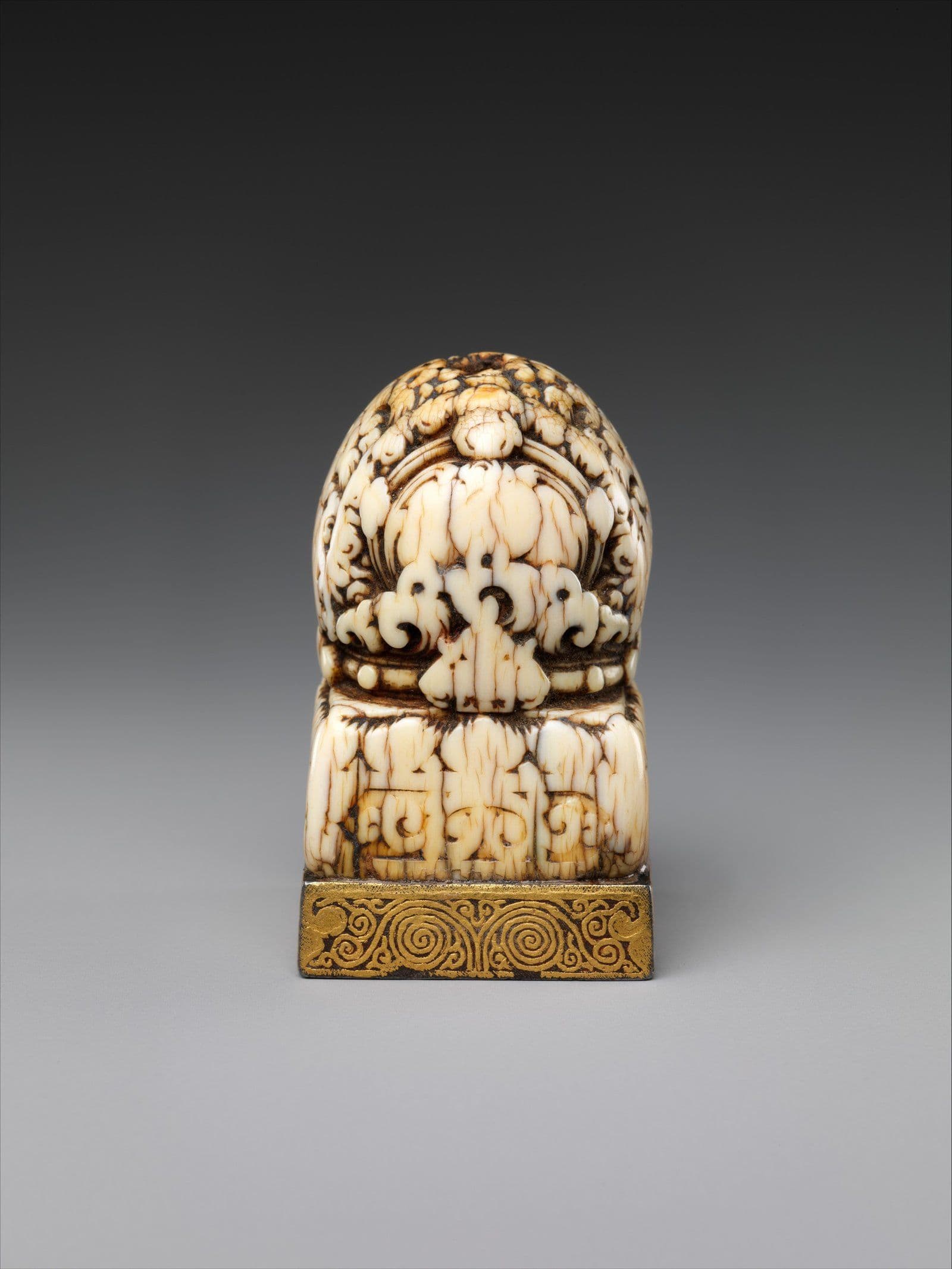
Seal stones are soft enough to cut with a hand-held blade, and the classic sources are few. Shoushan stone from Fujian, Qingtian from Zhejiang, Changhua from Zhejiang — including the red-flecked chicken-blood variety — and Balin from Inner Mongolia are the names that recur.
For a collector reading impressions rather than buying stones, the practical consequence is texture. A soft stone takes a clean, slightly irregular line that shows where the blade entered and left. A design produced mechanically tends to be too even — the strokes have no variation, the corners are identical, and the whole impression looks printed rather than pressed. That is not a decisive test on its own, but an impression that looks machine-perfect on a work claimed to be early is worth a second look.
Seal culture also has institutions. The Xiling Seal Society in Hangzhou, founded at the start of the twentieth century and led by Wu Changshuo as its first president, remains the reference point for the discipline, and its published seal albums are where most serious comparison work still starts.
Common questions
Do I need to read Chinese to use seals?
No, though it helps. Most of what a seal tells you at the level that matters — relief or intaglio, how many characters, how they are arranged, how the line was cut, where on the sheet it sits — is visual. For the characters themselves, photograph the impression straight on in even light and compare it against published seal albums for the artist, or ask a specialist. Attempting a reading from a phone photo taken at an angle is how misreadings start.
Why do some paintings have a dozen seals?
Because collectors added their own. A work that passed through several notable collections accumulates their marks, and in some traditions that accumulation was regarded as an honour rather than a defacement. Collector seals can be genuinely useful for reconstructing ownership history, but they are also the easiest thing to fake on a work of otherwise modest quality — a crowd of impressive-looking seals on a weak painting is a warning, not a recommendation.
Is seal script still written today?
Yes, as a calligraphic and carving discipline rather than a practical hand. Contemporary calligraphers study and write it, seals are still cut in it, and it appears on formal headings and inscriptions. Nobody writes a letter in it.
If a seal matches a published example exactly, is the work genuine?
Not by itself. An exact match tells you the impression is consistent with a known seal; it does not tell you the impression was made at the same time as the painting, or by the same hand. Forgers work from the same published albums you do. Weigh a seal match alongside the brushwork, the paper or silk, the mounting, and the ownership record before it changes your conclusion.
Further reading
- Collecting Chinese Calligraphy — how calligraphy is bought, and what drives price in a field where content and hand both count.
- How to Read a Chinese Painting Inscription — the text beside the seal, and what it commits the artist to.
- Chinese Painting Seals and Collector Marks — the seals that were added after the artist put the brush down.
- Chinese Rubbings and Stone Inscriptions — the tradition that kept archaic scripts in circulation for calligraphers to study.
Browse the collection
Seal script is a subject we write about rather than one we stock; we do not sell carved seals or original calligraphy. What Kiln & Ink sells is paper — limited-edition archival giclée reproductions of the twentieth-century Chinese ink masters, printed on xuan paper or museum-grade cotton rag, hand-numbered, and issued with a Certificate of Authenticity. Several of those masters, Wu Changshuo among them, came to painting through the seal, and it shows in the line: Two Jade Blossoms in Cold Grace is drawn with the same centred, even stroke that seal script trains.
Explore Further