Published November 1, 2026
Swatow ware explained: the Zhangzhou kilns behind the name, local cobalt, sand-grit bases, rice-yellow panels, and how to tell Ming export from a copy.
Pick up a late Ming export dish by the rim and turn it over. The base is not smooth. Sand and grit are fused into the glaze-free clay, in places thick enough to grate a fingertip, and the foot ring has been cut with a knife in three or four quick strokes. No Jingdezhen potter would have let a piece leave the kiln like that. It came from Fujian, from the Zhangzhou kilns, and the trade has called it Swatow ware for four hundred years.
This guide walks you through the name and why it points at the wrong place, what the Zhangzhou kilns made and for whom, the materials that make the ware recognisable, the four tests that separate it from kraak porcelain, the century in which it rose and collapsed, and what to check before you buy a dish that has spent time in the sea.
A name that points at the wrong place
Shantou, written Swatow in older romanisation, is a port in Guangdong. It is not a kiln site, and it never was. European dealers in the nineteenth century met these dishes in Southeast Asia and Japan, asked where they came from, and wrote down the port of shipment. The label stuck. In Japan the enamelled type was catalogued as gosu akae, a name borrowed from the cobalt pigment rather than from any place of manufacture.
The archaeological answer came in the twentieth century. Surveys and excavations in Zhangzhou prefecture, in Fujian, most famously at the Dongkou kiln in Pinghe county, found kiln waste that matched the export dishes sherd for sherd: the same coarse body, the same local cobalt, the same sand-grit base. The wares had travelled overland to the coast and been shipped south.
So two names describe one body of material. Swatow ware is the trade name, Zhangzhou ware the archaeological one, and both cover roughly the years between 1570 and 1650, with a little spill at either end.
What the Zhangzhou kilns made
The output was export-driven, which shapes the repertoire. Large dishes from about thirty to fifty centimetres across dominate, because that is what the Dutch and Japanese markets wanted for display and for the table. Beyond those: deep bowls, jars with and without covers, double-gourd bottles, boxes, brush pots, and the kendi, a pouring vessel with a spout set directly into the shoulder, made for Muslim customers in island Southeast Asia.
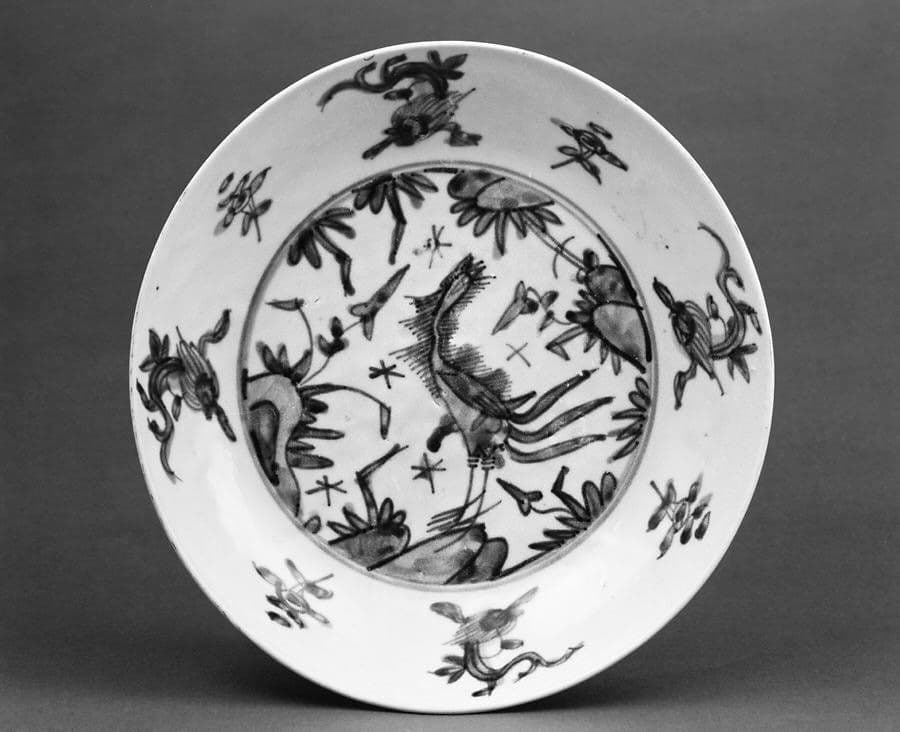
Decoration falls into two families. The blue-and-white is painted in underglaze cobalt, usually in panels reserved on the rim and a central roundel, with phoenix, qilin, peony, lotus, deer and auspicious emblems. The polychrome adds red and green enamels over the glaze, sometimes with turquoise, in the same panel scheme. A third family, much sought after in Japan, is glazed in a cream to rice-yellow tone with the panels left reserved and painted in blue or enamel.
The painting is the giveaway. It is fast. A leaf is two strokes, a bird is four, and the brush leaves the clay before the gesture is finished. The best pieces are lively and slightly reckless; the worst are careless. Almost none are tight.
Clay, cobalt and sand
The body is coarse and greyish-white, with visible impurities and a slightly sandy texture when you rub an unglazed area. It was fired lower than Jingdezhen porcelain, which is why the glaze often fails to fit: expect pinholes, crawling, and patches where the glaze has pulled away from the rim.
The cobalt was local, a raw ore rather than the refined material used for imperial wares. It reads grey-blue rather than sapphire, sinks into the glaze, and leaves dark, slightly blurred spots where the pigment was thick. The history of that pigment is traced in cobalt and its sources, and Zhangzhou sits at the cheap end of it.
Then there is the sand. Pieces were set on sand in the kiln, or stacked with sand between them, and the grains fused into the base. On a genuine dish the sand is embedded in the clay, the clay around each grain is stained, and the foot ring shows knife cuts that follow the sand rather than avoiding it. This is the single most diagnostic feature of the ware, and the hardest to reproduce convincingly.
Four tests that separate Swatow from kraak
Both are late Ming export porcelain, both were shipped by the Dutch, and both are blue-and-white. They are not the same product, and the differences are consistent.
- The base. Sand-grit fused into the clay, uneven and coarse. Kraak bases are smooth, carefully finished and usually glazed except for a clean foot ring.
- The hand. Kraak is painted to a repeat formula, with radiating panels and a vocabulary of stylised flowers copied across thousands of pieces. Swatow painting is improvised, faster, and visibly uneven in density.
- The blue. Local cobalt reads grey and sinks into the glaze, with dark spots. Jingdezhen cobalt on kraak is brighter, more even, and sits higher.
- The body. Swatow is thickly potted, heavy in the hand, and rings dull. Kraak is thinner and rings clearer.
A fifth signal is form. Kendi, very large panelled dishes and covered jars with lion knops are export shapes that appear in the Zhangzhou repertoire and rarely in kraak. If you are weighing a dish against the kraak literature, kraak marks and characteristics is the right comparison to make.
From Wanli boom to the 1661 evacuation
The ware exists because three markets opened at once. Spanish galleons began carrying Chinese porcelain from Manila to the Americas in the 1570s. Japanese demand rose sharply after 1600, fed by the tea ceremony and by the taste for Chinese things among the warrior class. And from 1602 the Dutch East India Company began shipping porcelain to Europe in bulk, buying whatever the kilns could supply.
For about forty years the Zhangzhou kilns supplied it. Then the market closed. The Ming-Qing transition disrupted the routes, and the coastal evacuation of 1661, which cleared the Fujian coast to deny support to Zheng Chenggong's forces, emptied the hinterland the kilns depended on. Production stopped. By the time Europeans came back for more, Jingdezhen had resumed and the Fujian kilns were finished.
The wares survived only in the places that had imported them, which is why the best groups are still found in Japan, Indonesia and the Netherlands, and why the kiln sites were only identified in the twentieth century.
The Japanese taste for rice-yellow
The cream-glazed panelled dishes found their most devoted audience in Japan. The glaze reads warm against lacquer, the reserved panels keep the painting legible in low light, and the slightly irregular potting suited a tea room better than the crisp symmetry of kraak. Japanese collectors bought them in quantity in the twentieth century, and many of the finest surviving examples are still there, in old collections with boxes and papers.
For a buyer this matters practically. A rice-yellow dish with a Japanese wood box, a old inventory slip, or a documented tea-room provenance is worth more than the same dish without one, and the condition is usually better, because it was kept indoors rather than excavated. Look for crisp panel edges, an even cream tone, and enamel that has not flaked at the rim.
What to check before you buy
- The rim. These were cargo and table ware. Chips, fritting and small losses are normal and should be priced in. A crack is not normal.
- Glaze surface. Marine pieces can have dull, etched glaze where salt has attacked it. Burial pieces show iron staining and root marks. Both are acceptable; neither should be described as pristine.
- Restoration. Dishes are routinely cut down at the rim and re-polished, and riveted or glued repairs are common. Look at the rim under ultraviolet light. The general checklist is in condition and damage.
- The sand. Modern copies glue sand onto a smooth base. On a genuine piece the grains are sunk into the clay and the clay is stained around them. Pick at one grain with a fingernail and see what happens.
- Printing. The Zhangzhou kilns were revived in the late twentieth century, and revival wares often carry printed or transferred outlines under the glaze. A printed line is uniform in thickness; a brushed line is not.
- The body. A hard, bright white, high-fired body is modern. The old body is coarse, slightly grey, and softer at a fresh break.
- The foot ring. Knife-cut, uneven, and often stained. A perfectly turned foot on a piece with sand on it is a contradiction. Dating a foot rim sets out what the tool marks should look like.
What the market pays
Swatow is one of the few areas of Chinese porcelain where a beginner can still buy a genuine sixteenth-century object for a modest sum. Blue-and-white dishes are the entry point and are plentiful. Large rice-yellow panelled dishes, pieces with crisp and confident painting, and complete kendi sit higher. Imperial porcelain this is not, and prices should never approach it.
Condition dominates everything else, more than in most collecting fields, because so much of the material was recovered from the sea or the ground. Provenance helps: an old Japanese collection, a documented wreck, a published group. The word shipwreck on a label, with nothing behind it, should be treated as decoration.
Common questions
Is Swatow ware the same as Zhangzhou ware?
Yes, in practice. Swatow is the older trade name, taken from the port where export pieces were shipped and sold. Zhangzhou ware is the modern archaeological term for the same material, named after the prefecture in Fujian where the kilns have been excavated. Dealers still use Swatow because buyers recognise it.
Why is it called Swatow if it was made in Fujian?
Because nineteenth-century dealers named export porcelain after the port they bought it in rather than the place it was made. Shantou was a major shipping point for goods moving south along the coast. The name was fixed in European and Japanese catalogues long before anyone excavated the kilns.
How old is Swatow ware?
Most of it was made between about 1570 and 1650, in the late Ming. A small number of pieces fall slightly outside that window, but the classic output belongs to the Wanli, Tianqi and Chongzhen reigns. Production ended abruptly with the coastal evacuation of 1661 and did not resume.
Are there modern copies?
Many. The Zhangzhou kilns were revived in the late twentieth century, and both revival wares and deliberate fakes circulate. The reliable tests are the sand, which is glued rather than fused on copies, the printed outline under the glaze, and a body that is too white and too hard for the period.
Further reading
- Chinese Armorial Export Porcelain — the eighteenth-century export trade that replaced this material in European hands, and how its commissions worked.
- Rose Medallion and Canton Export Porcelain — the nineteenth-century export wares most often confused with earlier Chinese porcelain by new collectors.
- Chinese Art Export Rules and Cultural Relics — what the Chinese rules say about moving excavated and exported material across borders.
- Blue and White Porcelain: A Collector's Guide — the mainstream tradition against which this export ware should be judged.
Browse the collection
Swatow ware is a subject we write about rather than one we stock. Our reproduction programme covers the twentieth-century Chinese ink masters, published as limited-edition archival giclée prints, hand-numbered with a Certificate of Authenticity. Browse the collection to see how those works are made and described.
Explore Further