Published October 31, 2026
Chinese bamboo carving explained: the Jiading and Jinling workshops, the liuqing technique, how bamboo ages, four tests, and where stained fakes come from.
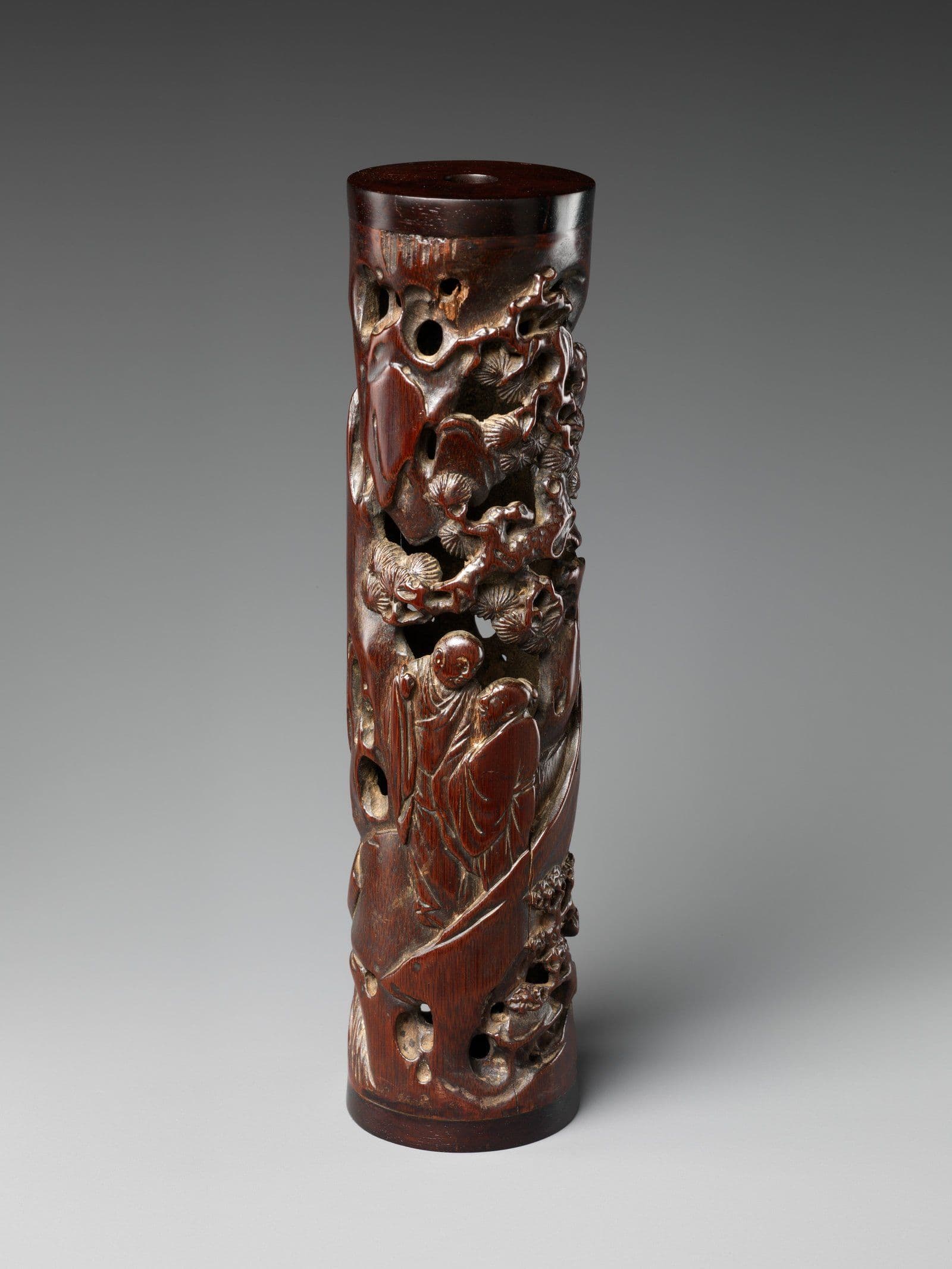
An incense holder the height of a coffee cup, cut from a section of bamboo root. Put it on the table and the first thing you notice is the colour: not the pale straw of new bamboo but a deep amber that goes almost red where hands have held it. Then the carving resolves — a ledge of rock, three scholars around a table, a pine whose needles were cut with a knife fine enough to leave the tips standing. Turn it over. The base is rough, the grain still visible, and a crack runs a third of the way up one side, stopping exactly where a knot in the wood stopped it.
That crack is not damage in the way a chip in porcelain is damage. It is the material telling you what it is. Bamboo moves, splits and darkens, and every one of those behaviours is evidence.
This guide walks you through what Chinese bamboo carving actually is, the two workshops that defined it, the technique that keeps the green skin, how the material ages, four tests to run before you buy, and where the fakes come from.
What bamboo carving is, and what it is not
Zhuke (竹刻) covers a family of objects cut from a grass that behaves like hardwood. The material is almost always moso bamboo, a timber species that grows to a useful diameter in a few years, which is why the craft could be both cheap and widely practised.
Two parts of the plant are used, and they behave differently. The culm — the straight wall of the stem — gives flat panels for brush pots, wrist rests and arm rests, where the carver works a shallow curved surface. The root, a dense mass of nodules and short fibres, gives blocks deep enough for figures and incense holders. Root pieces are heavier in the hand and much harder to fake convincingly, because the internal structure is chaotic and no two are alike.
The objects themselves are the furniture of the scholar's studio: brush pots, wrist rests, incense holders, seal boxes, and the small standing figures cut from root. What it is not is furniture carving or architectural woodwork, both of which use different timbers, different tools and a different economics. The dividing line is scale and intent: zhuke is made to be held.
Two workshops: Jiading and Jinling
The craft as collectors know it begins in the late sixteenth century, in two places about three hundred kilometres apart, with two opposed temperaments.
Jiading, now a district of Shanghai, produced the Zhu family — Zhu He, his son Zhu Ying and his grandson Zhu Zhizheng, known together as the three Zhu of Jiading. Their manner is deep. They cut relief high enough to cast shadows, carved landscapes and figures in the round, and treated a brush pot as a stage. The style persisted for generations and became the mainstream of the craft: when a later carver wanted to show skill, he carved deep.
Jinling, the old name for Nanjing, produced Pu Cheng, whose manner is the opposite. He worked shallow, followed the shape the bamboo already had, and left large areas untouched so that a single branch or a single figure carried the design. The phrase attached to him — dapu bu zhuo, "the great uncarved block" — is a Taoist tag applied to a carving technique, and it describes an aesthetic of restraint rather than of labour.
For a collector the distinction matters because it predicts what you should be looking at. On a Jiading piece, examine the depth: are the undercuts clean, is there a consistent light direction, does the background fall away in planes. On a Jinling piece, examine the economy: how few cuts were used, whether the untouched surface is doing compositional work, whether the carving respects the grain.
Liuqing: the technique that keeps the skin
One technique needs separate treatment because it is the most misread. Liuqing (留青) means "retained green": the outer skin of the bamboo is left in place and carved down to different depths, so the skin forms the design and the paler inner fibre forms the ground. Over decades the skin darkens faster than the exposed fibre, and the image lifts off the surface without any pigment at all.
The technique is associated with Zhang Xihuang, active at the end of the Ming, and it demands a different kind of precision from relief carving. There is no room to correct: the design is the difference in depth between two layers that are a fraction of a millimetre apart. A liuqing panel that has aged properly reads as a brown image on a honey ground, with the transitions soft because the skin itself has worn.
This is also the technique most often reproduced badly. A modern liuqing piece usually shows a hard, uniform brown against a bleached white ground, because the skin was stained rather than aged. Look at the boundary between image and ground: on an old piece it is irregular and slightly feathered, because the carver's blade followed the fibre.
Reading a carving: what the composition tells you
A brush pot is a cylinder, which means the carver had to solve a problem no painter faces: the scene has no edge. The good solution is tongjing, a continuous view that runs around the wall so that turning the piece advances the narrative, with no obvious place where the design begins.
Look for how the carver handled three things. The joint, or node, is a hard ring of denser fibre that cannot be cut away; a competent carver turns it into a ground line, the edge of a terrace, or the top of a wall, while a careless one cuts through it and the ring reappears as a scar in the middle of a figure. The grain is a set of parallel fibres that read as water, rain or rock texture if they are aligned with the subject and as noise if they are not. And the reserve, the untouched panel where a poem or a signature sits, should be placed where the eye needs rest rather than wherever space was left.
Turn the piece slowly through a full circle. If the composition only works from one angle, it was designed as a picture and cut onto a tube.
How bamboo ages
Bamboo is a composite of long fibres in a soft matrix, and it is hygroscopic: it takes on and gives off moisture with the seasons. Four consequences follow, and all of them are things to look for.
- Colour. New bamboo is pale yellow. Handling and light turn it amber, then a red-brown, and the change is deepest where fingers rest. A piece that is uniformly dark all over, including the recesses, has been treated rather than used.
- Cracks. Bamboo splits along the fibre, never across it. A crack that runs with the grain and stops at a node is normal age. A crack that crosses the grain, or one that has been filled and coloured, is a repair.
- Shrinkage. Old pieces are slightly smaller and slightly oval in section, because the wall has lost moisture unevenly. A perfectly round, perfectly flat-sided antique brush pot is a suspicious object.
- Insect damage. The bamboo borer leaves a fine flour and small round exit holes, usually in the softer inner wall. Check the inside of a brush pot, not the outside.
Patina is the sum of these. It cannot be applied in a workshop, and it is the single most reliable indicator on a bamboo piece, which is why the fakers spend their effort there.
Four tests before you buy
Work in this order and you will eliminate most problems in ten minutes.
- Look at the recesses first. Dirt, colour and wear accumulate in the deepest cuts. If the high points are dark and the recesses are clean and pale, the surface has been stained from outside.
- Read the tool marks. Old carving was done with knives and gouges that leave facets meeting at slight angles, and the carver changed direction to follow the grain. Modern work, especially copied work, shows uniform scrape marks from a rotary tool and edges that are too even.
- Check the crack logic. Every crack should follow the fibre and stop at a node or at the point where the wall thickens. A crack that ignores the structure has been cut in.
- Turn it over. The base of a bamboo piece was finished with a few strokes and then left alone, so it should look older than the carving above it. A base that has been freshly flattened, or one that sits slightly too proud, has been re-cut to hide a split or a maker's mark.
Then put the piece down and look at the signature. Inscriptions were often added later, and a good carving with a forged name is a common object. Buy the object, not the name.
Where the fakes come from
Three routes, in order of frequency.
Staining is the cheapest: new bamboo is boiled in tea, painted with permanganate, or buried, then rubbed with wax. It produces colour but not wear, and the tell is that the darkness sits in the grain rather than on the raised surfaces.
Recarving is more serious. A plain old bamboo tube — there are thousands, since bamboo was the cheap material of every stationer — is carved now and sold as a Ming piece. The material is genuinely old, so the patina test passes and only the tool marks give it away.
Marriage and alteration are the subtlest. A damaged figure has its broken section recut into a different subject; a signed base is transplanted onto a better body; a large piece is cut down to a saleable size. Look for inconsistencies in the carving's finish — a highly finished front with a crude back is a warning.
What the market looks like
Supply is the constraint. Bamboo is fragile, and the survival rate for anything four hundred years old is low, so signed Ming and early Qing pieces appear rarely and are priced as museum-adjacent objects. Most of what circulates is nineteenth-century, and most of that is unsigned workshop production of real quality.
That middle ground is where a collector should begin. A clean nineteenth-century brush pot or wrist rest with good patina, competent carving and no repairs is a genuine antique, costs a fraction of a signed piece, and teaches the hand what old bamboo feels like.
The top of the market is driven by names and by provenance, and it is thin enough that auction results are unreliable as price guides. The bottom is flooded with stained modern work sold as antique. Between those two, the honest middle is wide.
Common questions
Is bamboo carving Chinese or Japanese?
Both traditions exist and they are distinct. Chinese zhuke is a scholar's-desk craft, tied to the literati studio and to named workshops in Jiading and Jinling. Japanese bamboo work, particularly the basket traditions, belongs to a different lineage of tea practice and should be judged by its own standards rather than as an imitation.
How can I tell old bamboo from stained new bamboo?
Look at where wear accumulates. Old pieces are darker on the raised surfaces that hands and cloth reach, and paler in the recesses. Stained pieces are darker in the recesses, where the liquid pooled, and uniform on the high points. A ten-power loupe on one carved edge usually settles it.
Does a crack ruin a bamboo piece?
Not necessarily. A stable crack that follows the fibre and stops at a node is normal and does not affect value much. A crack that is still moving, that crosses the grain, or that has been filled with coloured wax is a different matter, and it should reduce what you pay.
What should a first bamboo purchase be?
A nineteenth-century brush pot or wrist rest with honest patina and no repairs. Avoid signed pieces, avoid figures, and avoid anything with a fresh, uniform surface. One good object teaches more than five doubtful ones, and the entry price for the honest middle is not high.
Further reading
- Chinese jade carving — the hardstone tradition, where the same question of following the material is answered with a different toolkit.
- Chinese carved lacquer — the other great relief-carving tradition, useful as a control when judging depth and finish.
- Scholar's rocks, gongshi — the aesthetic of the uncarved that Pu Cheng's shallow manner was answering.
- Chinese seal carving — the small-format cousin of zhuke, and the best place to learn to read a knife cut.
- The Chinese brush, maobi — what the pots were made to hold, and why their proportions are what they are.
Browse the collection
Kiln & Ink does not stock bamboo: the reproductions here are archival giclée prints of twentieth-century Chinese ink painting. But the desk the carvings sat on is the same desk the paintings came from, and the works in our collection are mounted and hand-numbered in a way that would not look out of place beside a good brush pot.
Explore Further