Published July 31, 2026
The four treasures of the study explained: brush, ink, paper and inkstone, where the best of each came from, and what each one does to a brushstroke.
Before a single line of a Chinese painting or a piece of calligraphy exists, four things sit on the desk: a brush, a stick of ink, a sheet of paper, and a stone to grind the ink on. The Chinese call them the four treasures of the study — wenfang sibao — and they are not incidental supplies. The character of a finished work is decided as much by which brush, which ink, and which paper the artist reached for as by the hand that held them.
This guide walks through each of the four, what makes a good one, and how each shapes the marks you see — because understanding the tools is one of the quietest but most reliable ways to read, and to judge, Chinese painting and calligraphy.
The brush
The brush (bi) is a bundle of animal hair set into a hollow handle, usually bamboo. What matters most is the hair, because it decides how the brush holds ink and springs back under the hand.
Brushes are commonly grouped by stiffness. Soft brushes, often made from goat hair, hold a great deal of ink and give broad, wet, yielding strokes; they suit washes and the fluid lines of much ink painting. Stiff brushes, traditionally made from weasel or other firm hair (collectors call these "wolf-hair" brushes, though no wolf is involved), snap back sharply and give crisp, controlled lines, favored for fine detail and certain calligraphic scripts. Between them sit mixed brushes that combine a stiff core with a soft outer sleeve, balancing spring and ink capacity.
A good brush is judged on four old criteria: a sharp point that comes together cleanly when wet, an even shape, a full and rounded body, and enough resilience to recover after each stroke. Huzhou, in Zhejiang province, is the region most famous for fine brush-making, and "Hu brushes" remain a benchmark name. When you look at a painting, the width, wetness, and elasticity of the line all begin here — a trembling dry line and a swelling wet one may come from the same hand and different brushes.
The ink
Chinese ink for the studio is not the bottled liquid of everyday writing but a solid stick, ground with water on the inkstone each time it is used. The stick is made from fine soot bound with animal glue, molded, dried, and often decorated.
The soot comes from two main sources, and the difference is visible in the work. Pine-soot ink, made by burning resinous pine, tends toward a matte, cooler black. Oil-soot ink, made from the lampblack of burning oils, tends to be denser and glossier, with a warmer sheen. The quality of the glue, the fineness of the soot, and the aging of the stick all affect how the ink flows, how black it reads, and how it holds up over centuries. Huizhou, in Anhui province, is the historic center of fine ink-making, and "Hui ink" is the celebrated name.
Grinding ink is itself part of the practice: the artist adds a little water and works the stick in circles on the stone until the ink reaches the desired thickness, from a pale grey wash to a saturated black. Because tone is controlled at the stone, a single grinding session can supply the full range of greys a monochrome painting depends on — which is why so much Chinese painting achieves depth with black alone.
The paper
Paper (zhi) is where ink and intention meet, and no material changes the result more. The paper most associated with painting and calligraphy is xuan paper, named for the Xuancheng region of Anhui, made largely from the bark of the blue sandalwood tree together with straw fibers. It is prized for its absorbency, its soft strength, and its longevity — good xuan paper resists yellowing and insect damage far better than ordinary paper, which is why old works on it survive at all.
The crucial distinction for a viewer is between raw and sized paper. Raw ("unsized") xuan is highly absorbent: ink sinks and spreads on contact, giving soft, bleeding edges and the feathered halos of spontaneous ink painting. Sized ("cooked") xuan has been treated so it absorbs less, holding a crisp edge and allowing fine, controlled line and detailed color work. An artist chooses one or the other before the first stroke, and you can often tell which was used by looking at how the ink behaves at the edges of a line — a hard clean edge versus a soft diffused one.
Silk is the other classic support, with its own behavior, and the choice between silk and paper carries its own history and consequences for how a work reads and ages. The point for a collector is simple: the surface is not neutral. It is an active partner in every mark.
The inkstone
The inkstone (yan) is the one of the four treasures most often collected as an object in its own right, because a fine old stone is durable, beautiful, and personal to the scholar who used it. Its job is to hold a little water and let the ink stick be ground into smooth, usable ink without scratching or wasting it.
A good stone is fine-grained and slightly firm — smooth enough to grind evenly, with enough "bite" to break down the ink stick, and dense enough to keep the ground ink from drying too fast. Two sources stand above the rest in reputation: Duan stones, from the Duanzhou area of Guangdong, and She stones, from the Shezhou region of Anhui. Fine examples were carved with reservoirs, borders, and decorative reliefs, and the best were as much treasured possessions as tools.
Because inkstones survive well, they are an accessible entry point into this field for collectors, and they anchor the studio as a physical place. When you see a scholar's desk reconstructed in a museum, the inkstone is usually its center of gravity.
How the four work together
Here is the division of labor at a glance:
| Treasure | Chinese | What it controls | Celebrated source ||---|---|---|---|| Brush (bi) | 筆 | Shape and energy of the mark | Hu brushes, Huzhou || Ink stick (mo) | 墨 | Color of the black and its permanence | Hui ink, Huizhou || Paper (zhi) | 紙 | How the mark spreads, holds, and lasts | Xuan paper, Xuancheng || Inkstone (yan) | 硯 | How smoothly ink grinds and how dark | Duan and She stones |
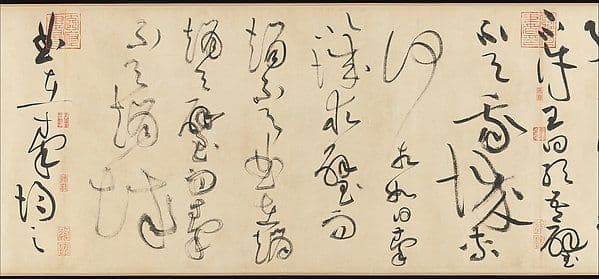
Put the four back on one desk and the logic is clear. The ink stick supplies the pigment; the stone controls how much and how dark; the brush decides the shape and energy of the mark; the paper or silk decides how that mark spreads, holds, and lasts. Change any one and the work changes. A stiff brush on sized paper with dense oil-soot ink gives sharp, controlled calligraphy; a soft brush on raw xuan with a paler grinding gives the bleeding, atmospheric washes of spontaneous ink painting.
This is why connoisseurs pay attention to materials when they look at, and authenticate, Chinese art. The behavior of ink on paper, the resilience of a line, the way tone builds — these are physical facts that a knowledgeable eye reads directly, and they are hard to fake convincingly. Learning the four treasures is not antiquarian trivia; it is learning the grammar of everything hanging on the wall.
Common questions
What exactly are the "four treasures of the study"?
They are the brush, the ink stick, the paper, and the inkstone — in Chinese, wenfang sibao, the four essential tools of the scholar's studio for writing and painting. The grouping is old and standard, and each has celebrated regional sources: Hu brushes from Huzhou, Hui ink from Huizhou, xuan paper from Xuancheng, and Duan and She inkstones. Together they define the material tradition behind Chinese calligraphy and painting.
Why grind an ink stick instead of using bottled ink?
Grinding lets the artist control the ink's thickness and tone precisely, from a pale grey wash to a saturated black, mixing fresh for each session. Solid ink sticks also keep better over long periods and, in fine grades, produce a richer, more stable black than ordinary liquid ink. The grinding itself is part of the discipline, a moment of preparation before painting or writing begins.
How does the paper change a painting?
Enormously. Raw, absorbent xuan paper lets ink sink and spread, giving soft, bleeding edges and atmospheric washes; sized xuan resists absorption, allowing crisp lines and fine detail. An artist chooses the surface before starting, and you can often read which was used from how the ink behaves at the edges of a stroke. The support is an active partner, not a neutral backing.
Which inkstones are most prized?
Duan stones from Guangdong and She stones from Anhui are the two most celebrated sources, valued for a fine, even grinding surface and, in the best examples, beautiful stone and carving. Because inkstones are durable, antique ones are widely collected in their own right and make an accessible entry into scholar's-studio objects.
Further reading
- Mineral Pigments in Chinese Painting — the colors that join ink on the same absorbent papers.
- Silk vs. Paper in Chinese Paintings — how the two classic supports change what you see.
- The Five Scripts of Chinese Calligraphy — the writing these tools were made to serve.
- Mounting a Chinese Painting (Zhuangbiao) — what happens to the finished sheet after the studio.
Browse the collection
If you would rather live with these images than only read about them, the Kiln & Ink collection holds limited-edition archival giclée reproductions of the twentieth-century Chinese ink masters — hand-numbered, printed on rice paper, and issued with a Certificate of Authenticity.
Explore Further