Published November 2, 2026
Mogu, China's boneless painting: how form is built without an outline, the Xu family invention, Yun Shouping's revival, and four tests for the real thing.
Take a Yun Shouping peony and look at the edge of a petal. There is no line there. The boundary is made by the place where the wash stopped — a slightly darker rim where pigment gathered as the water dried — and if you tilt the paper to the light the texture of the silk continues under the colour without interruption. Behind that pink there may be a pale underlayer, and in the deepest part of a fold a second tone has been dropped in while the first was still wet and allowed to spread where it wanted.
Everything that distinguishes boneless painting is in that edge. The shape was not drawn and then filled. It was made by water stopping.
This guide walks you through what boneless painting actually is and what the term does and does not cover, how a mogu petal is built out of water rather than line, the Northern Song painter credited with the method, Yun Shouping's seventeenth-century revival, the Guangdong variant that pushed it further, and the tests that separate a real mogu painting from a tinted drawing.
What boneless means
The Chinese term is mogu, "no bone". Bone, gu, is not a metaphor for strength here. In painting criticism it means the structural skeleton of a form — the ink outline that carries the shape — and it is the subject of the second of the Six Principles, the one that pairs bone with brushwork. To paint without bone is to give up that outline and let colour alone define the form.
Two things follow, and both are routinely misunderstood.
First, mogu is a technique, not a subject or a school. It can be applied to a flower, a bird, a figure or a mountain. What makes a painting mogu is the absence of a contour, not the presence of a peony.
Second, it is not the same as loose or sketchy painting. A free xieyi flower still has a bone: the brush lays down a loaded stroke whose shape is the petal. Mogu removes even that. The painter does not draw the petal and does not write it either; he deposits a pool of colour and manages where it stops. If the distinction between the two freehand manners is unfamiliar, our guide to xieyi and gongbi sets out what each demands of the hand.
How a petal is built
The technical precondition is a ground that will not drink. Mogu is painted on sized paper or on silk, because an unsized sheet pulls the wash sideways into a blur and the edge — the whole point — disappears.
On that ground the painter works in layers. A pale base tone goes down first, sometimes so thin it is barely visible. While it is still damp a stronger tone is dropped into the area that should be deepest, and the two meet without a boundary, the pigment migrating into the wet patch. A third pass may add a cooler or warmer note at the fold. The final edge is the dried perimeter of the last wash, marked by a faint tide-line where pigment concentrated as the water retreated.
Colour choice changes the result. Mineral pigments — azurite, malachite, cinnabar — sit on the surface of the silk and granulate, so the wash has a body and a visible grain. Vegetable colours — indigo, gamboge, safflower — are transparent and stain rather than sit, so the layers read as depth instead of as sediment. Many mogu paintings use both, and the difference between them is the fastest way to tell a hand-painted surface from a printed one. Our guide to mineral pigments goes through the palette in detail.
Sometimes the colour is reinforced from the back of the silk. Held to the light, a good mogu flower will show a second, softer shape behind the first.
A name from the Northern Song
The method is credited to Xu Chongsi, a painter of the tenth and eleventh centuries and the grandson of Xu Xi, the Southern Tang master whose unconstrained manner was set against the courtly, meticulously outlined style of Huang Quan and his sons. The contrast between the two — one wild, one rich — became one of the founding oppositions of Chinese flower painting.
Xu Chongsi is said to have dropped his grandfather's ink outline and laid colour directly, and the criticism that he had no bone is where the name comes from. It was not meant kindly.
The honest qualification is that no surviving painting can be attached to him with confidence. The attribution rests on texts written later, and the earliest works now called mogu date from centuries afterwards. What can be said is that by the Song the idea of a flower painted without a contour existed and was controversial, which tells you something about how firmly the outline was regarded as the guarantor of a painting's seriousness.
Yun Shouping and the Changzhou school
The painter who made mogu respectable was Yun Shouping, 1633 to 1690, from Wujin in Jiangsu. He was a landscape painter first, and the story — recorded by his contemporaries rather than invented later — is that he conceded the first place in landscape to Wang Hui, his friend and the dominant orthodox master of the age, and turned to flowers instead.
What he produced was a body of flower painting in which the colour is laid on in thin, wet, repeated washes with almost no ink at all. The petals have no outline, the leaves are built from overlapping pools of green and blue-green, and the whole surface has a softness that reads at first as watercolour. It is not watercolour: the layering is slower, the pigment is Chinese, and the structure underneath is the traditional one of branch, leaf and bloom.
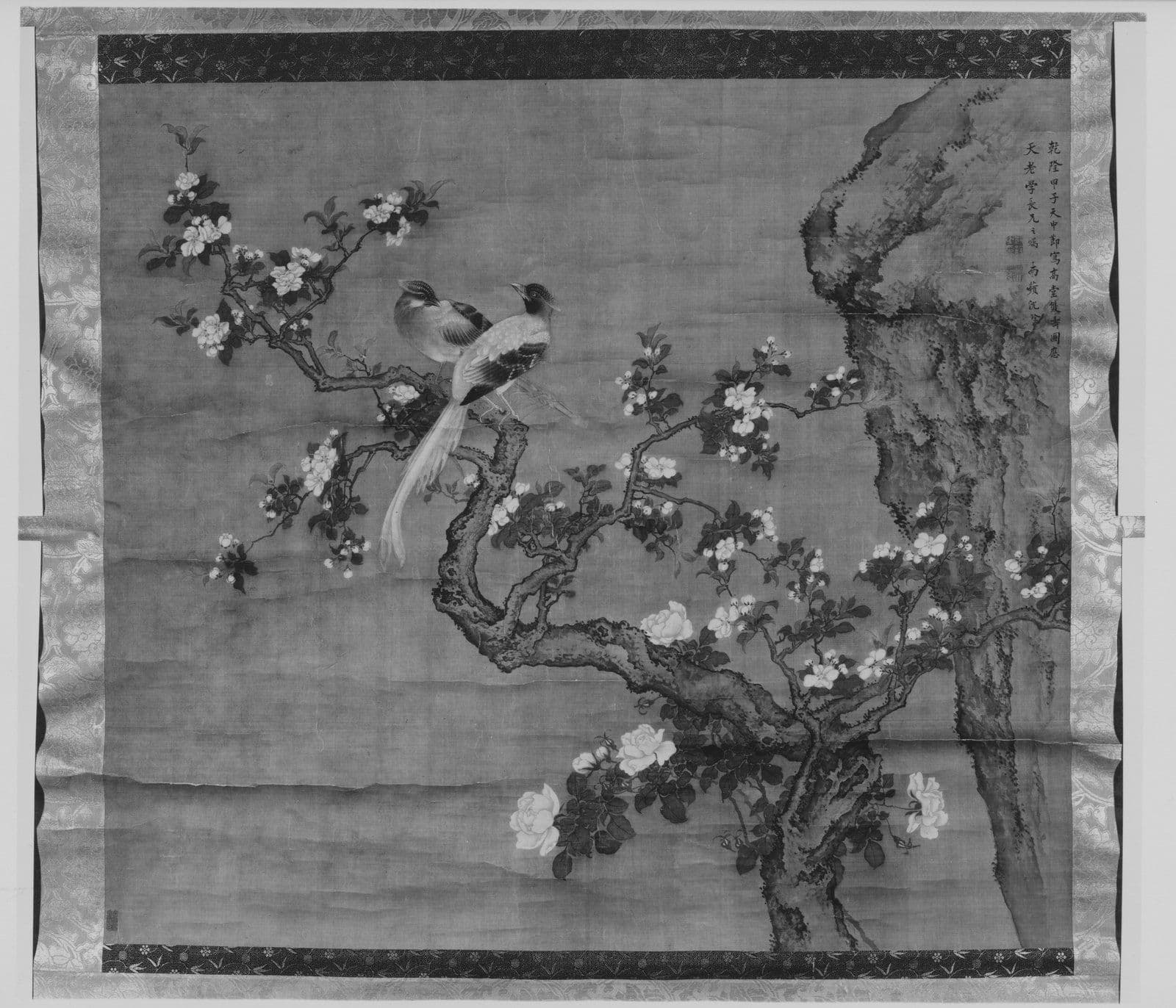
The manner was taken up by his family and followers and became known as the Changzhou school. It was admired at court, widely copied in the eighteenth century, and it is the reason the phrase "boneless flower painting" is more or less synonymous with Qing court taste in the popular imagination. If you want the broader history of the genre he worked in, our guide to bird-and-flower painting covers the traditions he was revising.
Bumping water, bumping powder
In the nineteenth century the technique took a different turn in Guangdong. Ju Chao and his cousin Ju Lian, working in the Pearl River delta, developed a method known as zhuang shui zhuang fen, "bumping water, bumping powder".
The move is simple and the result is not. Water is dropped into a wet patch of colour, and as it dries it pushes pigment outwards to the rim, leaving a pale centre and a dark, crisp border. White pigment is dropped in the same way, so that a flower can carry an opaque highlight sitting inside a transparent wash without either being painted over the other. The surfaces that come out of this are juicy, mottled and slightly unpredictable, and they look nothing like Yun Shouping's quiet gradations.
Ju Lian taught, and among his students were Gao Jianfu and Chen Shuren, who went on to found the Lingnan school and to argue for a modernised Chinese painting. So the boneless technique runs straight into twentieth-century Chinese art through a back door, as a craft method rather than a scholarly one.
Boneless landscape, and what it is not
The technique was also applied to mountains, and here the attribution is even more shadowy. Boneless landscape is traditionally traced to Zhang Sengyou, a sixth-century painter of the Liang court, of whom nothing survives. Dong Qichang, writing and painting a thousand years later, made landscapes in that manner and named Zhang Sengyou as the source — which tells us more about Dong's idea of art history than about the Liang dynasty.
What those landscapes do show is the technique's logic at large scale: forms built from stacked colour washes, with the ridges emerging from where the tones meet rather than from a drawn edge.
It is worth separating this from splashed ink and splashed colour, the twentieth-century method in which pigment is thrown or poured and allowed to run. The two share a willingness to let liquid decide, but splashing gives up control of the edge entirely, while mogu is a controlled technique in which the painter decides precisely where each pool will stop.
Four tests before you buy
- Find the edge and look at it closely. A mogu edge is a dried perimeter with a faint darker line where pigment settled. If the boundary is uniform in tone and hard, you are looking at colour filled inside a drawn shape.
- Look for the outline underneath. Many mogu paintings have a pale draft or a light ink guide, and that is normal. What must not be there is an ink contour that defines the silhouette. If you can trace a continuous line around the flower, it is outline-and-fill, not mogu.
- Check the depth across a single petal. Genuine work is layered, so the tone deepens towards the base of the petal and thins at the tip. An even, flat colour across the whole shape suggests a print or a weak hand.
- Hold it to the light. Colour applied on the reverse shows as a second soft shape behind the front. It is one of the quiet signatures of the technique and one of the harder things to fake convincingly.
Condition matters more than usual with this material. Mineral washes sit on the surface of silk and flake along folds, and a mogu painting that has been rolled tightly will show loss in exactly the places where the colour was thickest. Repainting those losses is common, and it is worth knowing what a retouched petal looks like before you pay for one.
Common questions
Is mogu the same as watercolour?
No, although the two look alike at a glance. Mogu is painted on sized paper or silk with Chinese pigments, built up in thin layers, and sits inside a tradition of brushwork and mounting that watercolour does not share. Watercolour is painted on absorbent paper and relies on the paper's own texture. The resemblance is real, the materials and the logic are not. Our comparison of Chinese ink painting and watercolour sets out the differences.
Who invented boneless painting?
The method is credited to Xu Chongsi, a painter of the late tenth and early eleventh century, grandson of Xu Xi. The attribution comes from later texts rather than from surviving works, so it is best treated as a traditional ascription. The name itself began as criticism: he was said to paint without bone.
Why did Yun Shouping stop painting landscapes?
By his own account, and by the account of his contemporaries, he conceded the first place in landscape to Wang Hui and chose flowers instead. The decision was practical as much as aesthetic — the orthodox landscape field was crowded with painters working in the manner of the Yuan masters, and flower painting without outlines was a field he could occupy.
How can you tell a real mogu painting from a tinted drawing?
Look at the edge of a petal. In mogu the boundary is a dried perimeter where the wash stopped, with a slightly darker rim; in a tinted drawing the boundary is a drawn line with colour inside it. Then check the layering, which deepens towards the base of each petal, and hold the sheet to the light to see whether colour was applied on the reverse.
Further reading
- Yu Feian and the gongbi bird-and-flower tradition — the meticulous method mogu was defined against, and the twentieth-century painter who kept it alive.
- The Six Principles of Chinese painting — where the idea of bone comes from, and why losing it was an argument.
- Chinese brushes and the maobi — what the tool can and cannot do, which explains why mogu needed a different approach to the hand.
- Chinese painting copies and the mo-lin tradition — why a technique this reproducible attracted so many followers, and how to read the difference between a copy and a forgery.
Browse the collection
Boneless painting is a subject we write about rather than one we stock: the technique belongs to the silk-and-colour tradition, and what Kiln & Ink publishes is archival giclée reproduction of twentieth-century Chinese ink painting, where the brush is doing the work. The two are worth holding side by side anyway, because the comparison teaches you what a line is for. Browse the collection to see what the ink masters do with an edge they have drawn, and the artists we work with.
Explore Further