Published August 15, 2026
Regular script (kaishu) explained: the strokes that define it, how it grew out of clerical script, the four masters who fixed it, and how to judge a hand.
Regular Script (Kaishu): How the Standard Hand Works
Nearly every printed Chinese character you have ever seen is wearing a Tang-dynasty cut of clothes. The standard typefaces descend from kaishu — regular script — the hand codified by Tang calligraphers roughly thirteen centuries ago, and when a Chinese schoolchild picks up a pen, or a foreign student opens a first workbook, kaishu is what they are given. It is the script the whole writing system treats as neutral, which is precisely what makes it the hardest test of a calligrapher: there is nowhere to hide.
This guide completes the tour of the five script families. It covers what "regular" actually means at the level of the stroke, how the hand emerged from clerical script, the Tang masters whose model works still set the standard, and how to judge a regular-script work when one is in front of you.
What "regular" means at the level of the stroke
In regular script, every stroke is a complete, separate event. It begins with a deliberate placing of the tip, travels under control, and ends with an articulated finish — a pause, a press, a lifted hook. Strokes are written in a fixed order, they do not link to each other, and nothing is abbreviated. Each character sits balanced inside an invisible square, its density distributed so that no corner starves and no corner crowds.
Teachers have summarized the toolkit for centuries through the character yong (永, "eternity"), which is traditionally said to contain the eight fundamental stroke types in a single graph — dot, horizontal, vertical, hook, and the family of rising and falling diagonals. Master those eight motions and you have the vocabulary; regular script is the discipline of never slurring them.
The contrast defines the other hands. In running script, strokes begin to connect and simplify; in cursive, whole characters compress into abbreviations. Regular script is the reference plane those abbreviations depart from — which is why it is learned first, and why calligraphers say you can hear a writer's regular script underneath their cursive.
Out of clerical: where the hand came from
Kaishu is the youngest of the five script families. Its parent is clerical script, the flattened administrative hand of the Han dynasty, with its silkworm-head entries and flaring wave strokes. In the late Han and the Three Kingdoms period that followed, the flare began to calm down: strokes squared off, the wave contracted, and a more compact, upright structure emerged. The name attached to this early stage is Zhong Yao, the third-century statesman whose small regular-script works — transmitted through later copies — became foundational models.
Wang Xizhi and the calligraphers of the fourth century carried the small regular hand to maturity alongside their more famous running and cursive work. In the Northern dynasties, a parallel tradition of carved regular script developed on epitaphs and Buddhist steles — the angular, chisel-edged manner now called weibei, which Qing-dynasty epigraphers would later revive as an antidote to over-refinement.
Then the Tang standardized it. A unified empire that recruited officials by written examination, cut its laws and sutras into stone, and ran a court academy of calligraphy needed one legible, teachable, testable hand — and regular script was fixed as that hand. The Tang appetite for method is the reason the script's rules feel legislated rather than evolved: to a real degree, they were.
The four masters and the model works
Chinese tradition groups four calligraphers as the great masters of regular script — three from the Tang, one from the Yuan. A collector will meet them constantly, because their model works remain the copybooks every student begins from.
| Master | Dates | A model work | The flavour ||---|---|---|---|| Ouyang Xun | 557–641 | Inscription on the Sweet Wine Spring at Jiucheng Palace (632) | Severe, tall, precision under tension || Yan Zhenqing | 709–785 | Duobao Pagoda Stele (752), and the broader late manner | Broad, muscular, frontal || Liu Gongquan | 778–865 | Mysterious Tower Stele (841) | Taut, pared, bony || Zhao Mengfu | 1254–1322 | Temple steles and sutra transcriptions | Fluent, rounded, closest to running script |
The traditional tag "Yan's sinew, Liu's bone" catches the difference between the two most influential Tang manners: Yan Zhenqing's forms swell with contained muscle, Liu Gongquan's are stripped to tensile frame.
Note what these model works physically are: stones. Tang regular script survives overwhelmingly as engraved steles, which means collectors encounter it through ink rubbings taken from the stones, and through the printed copybooks made from those rubbings. Ink-written originals by the Tang masters are essentially museum objects; the rubbing tradition is where the collecting happens, and generations of recutting separate a fine early rubbing from a late commercial one.
Small regular script: the intimate end
At the other end of the scale from the monumental stele sits xiaokai — small regular script, written at a few millimetres per character. This was the hand of sutra copying, examination essays, letters, colophons and album leaves: the working fine hand of the educated world. Ming and Qing examination culture pushed it toward extreme evenness — a hand so uniform it approaches print — which examiners rewarded and later critics scorned as bureaucratic.
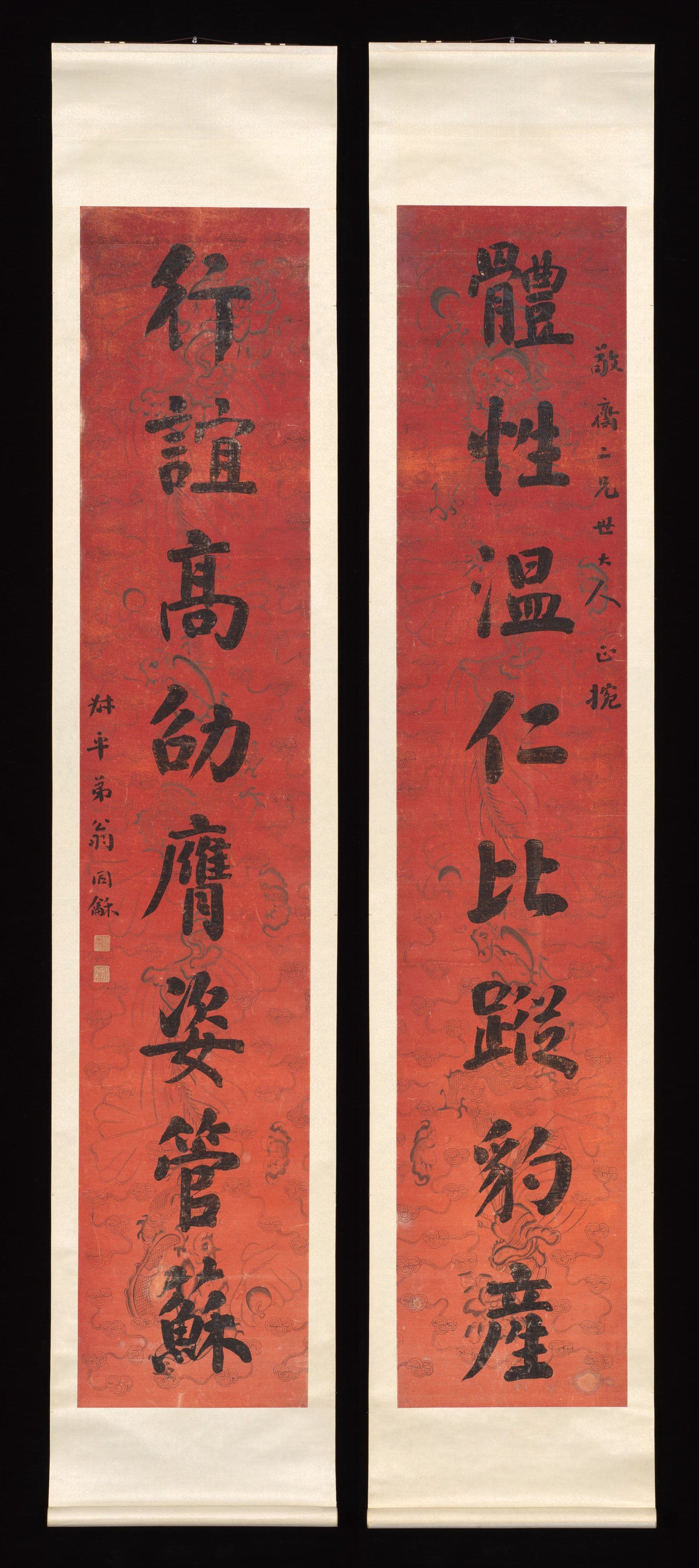
Small regular is also where a collector most often actually buys kaishu today: sutra sheets, album leaves, fan faces and couplets appear in the market far more often than major stele rubbings. The couplet deserves a special word — a pair of matched vertical lines, written large for a doorway or a wall, it is the format in which regular and near-regular script most often survives in private hands, and the format where structural weakness shows fastest, since a couplet offers a dozen characters and no landscape to hide behind.
Among the moderns, the regular-leaning hand of Qi Gong — slender, upright, structurally exact — shows how a living personal style can grow out of the script's discipline rather than against it. His example makes a useful point for buyers: the great modern hands are not imitations of Tang models but arguments with them, and knowing the models is what lets you follow the argument.
Judging a regular-script hand
Regular script is slow, and slowness is exposure. In cursive, speed can flatter a mediocre hand; in regular script every hesitation, wobble and patched stroke is on the record. That makes it, for connoisseurs, the severest audit of basic control — and it tells you what to look for.
Look for live strokes rather than drawn outlines: a written stroke has directional energy, entry and exit; a traced or printed one is inert. Look for consistency — repeated characters and repeated stroke types should behave like the same hand throughout. Look for structure that takes small risks and resolves them: living regular script balances asymmetries, while dead-even, typewriter regularity usually signals a production hand or a traced sheet. Ink tone should vary subtly as the brush loads and empties, even in this most controlled script.
For rubbings, the questions shift to the object: the paper, the ink surface, and how many generations of recutting stand between the stone and your sheet. For written works, the surrounding apparatus — inscription, dedication, seals — should agree with the hand. The general checklist in the guide to collecting Chinese calligraphy applies here with full force.
Common questions
Is regular script the oldest Chinese script?
No — the opposite. Of the five script families it is the last to mature: seal script belongs to the bronze-and-stone antiquity of the first millennium BCE, clerical script to the Han bureaucracy, and regular script only settles into its lasting form between the third and seventh centuries CE. Its dominance since then is what makes it feel timeless.
Why do beginners start with regular script?
Because it is the reference plane. Every stroke is explicit, every structure fully spelled out, so the student builds control with nothing hidden by speed or abbreviation. Running and cursive script are systematic departures from regular forms — learn the forms first and the departures make sense; skip them and cursive becomes scribble.
What is the difference between regular and running script?
Linkage and economy. Regular script writes every stroke discretely with articulated entries and exits; running script lets the brush stay on the paper between strokes, simplifying and connecting as it goes. Running script is faster and more personal; regular script is more legible and more exposed. Most educated hands historically lived in between, drifting toward one pole or the other with the occasion.
Can you collect Tang-dynasty regular script?
Not as ink originals, realistically — those are museum objects. What the market offers is the rubbing tradition: sheets and bound albums taken from the engraved steles, graded by age and by how close their source stone was to the original cutting. Beyond rubbings, collectors buy later and modern masters' regular script — couplets, album leaves, sutra-style sheets — where the connoisseurship is of the living hand rather than the stone.
Further reading
- Seal Script (Zhuanshu): Reading the Oldest Hand — the ancient end of the five-script story.
- Cursive Script (Caoshu): Control at Speed — the opposite pole, where abbreviation is the discipline.
- Qi Gong: A Collector's Guide to the Calligrapher — a modern master whose hand grew out of regular-script discipline.
Browse the collection
Calligraphy in our roster is paper of a deliberate kind: limited-edition archival giclée reproductions of twentieth-century Chinese masters, hand-numbered and issued with a Certificate of Authenticity — including Qi Gong's Mist Shining in the Sun, with the full roster at the collection.
Explore Further