Published August 3, 2026
A collector's guide to Zhang Daqian: the Dunhuang years, the splashed-ink landscapes, how to read his seals, and how to tell an edition from a painting.
Put two paintings signed Zhang Daqian side by side and you may struggle to believe one hand made both. One is a meticulous blue-and-green landscape with mineral pigment laid down in flat, jewel-like planes, every rock outlined. The other is a sheet of ink and colour poured across the paper, a temple roof surfacing out of the wash almost as an afterthought. Both are characteristic. Neither is a mistake.
This guide is for the collector who keeps meeting the name and wants a working map: what Zhang Daqian actually painted at each stage of a long career, how to read the signature and seals that come with a work, where the reproductions sit, and what to check before you commit money.
A career built in three countries
Zhang Daqian (1899–1983) was born in Sichuan and trained in the traditional way — by copying. He absorbed the Ming and Qing masters so completely that his imitations, particularly after Shitao, circulated in the market and fooled serious connoisseurs. That period is the foundation of everything that follows: he did not arrive at freedom through ignorance of the tradition, but through unusual fluency in it.
The early 1940s changed his palette. He spent an extended period at the Dunhuang Buddhist cave complex in Gansu, copying wall paintings with a team of assistants. The cave murals are figure-heavy, built on strong outline and saturated mineral colour, and they pulled him away from literati monochrome toward something older and more decorative. Work from and after those years tends to be tighter, more coloured, and more figural.
He left mainland China in 1949 and spent the rest of his life abroad — years in South America, then California, then finally Taipei, where he built the studio and garden he died in. The late work is what most Western buyers now recognise: large splashed-ink and splashed-colour landscapes, semi-abstract, with recognisable motifs anchoring the poured pigment. His deteriorating eyesight is usually cited as one reason the method suited him. It also arrived at the right cultural moment, and he knew it — his 1956 meeting with Picasso in the south of France was widely reported and did his international reputation no harm.
The periods, and how to tell them apart
| Phase | What it looks like | Common subjects ||---|---|---|| Early / imitative | Close study of earlier masters; controlled brushwork; the "voice" is borrowed on purpose | Landscapes after Shitao and Bada Shanren, literati themes || Dunhuang and after | Strong outline, mineral blues and greens, gold, figures rendered with Tang-derived proportions | Buddhist figures, beauties, blue-and-green landscape || Middle, in exile | Traditional formats executed with great polish for an international audience | Lotus, landscapes, calligraphy couplets || Late splashed ink and colour | Poured, tilted, semi-abstract washes with small representational anchors | Mountains in mist, abstracted valleys, lotus |
The categories overlap. He painted lotus his whole life and painted classical landscapes long after the splashed work began; a late date does not guarantee an abstract picture. What the table is good for is the reverse test — a heavily poured, semi-abstract sheet dated to the 1930s should stop you immediately. If you want the technical detail of how the pouring was controlled, we covered it separately in Zhang Daqian's splashed ink techniques, and the cave years in the Dunhuang period.
Reading the signature, seals and studio names
Zhang Daqian signed and sealed heavily, which is useful and dangerous in equal measure. Useful, because there is a lot to compare against. Dangerous, because forgers know exactly which seals to reach for.
A few names you will meet on his works and in catalogue entries:
- Zhang Yuan (張爰) — his given name, used in signatures and seals.
- Daqian jushi (大千居士) — "the lay Buddhist Daqian," a reference to the brief period he spent as a monk, which is where the name Daqian comes from.
- Dafeng Tang (大風堂) — the studio name shared with his elder brother Zhang Shanzi, a painter of tigers. A Dafeng Tang seal is a studio mark, not a date.
Beyond these, he used a large personal repertoire of studio names, sobriquets and mood seals, some of which he adopted for only a few years. That is genuinely useful: a seal he is not recorded as using until late in life, on a picture dated to the 1930s, is a contradiction the seller has to explain. Published seal catalogues exist for exactly this purpose, and any serious offer should be checkable against one.
Treat seals as one line of evidence among several. Impressions were made from carved stone; a genuine seal can print unevenly depending on paste, pressure and paper, so small differences are not automatically damning, and a suspiciously perfect match to a published impression is not automatically reassuring. Read the inscription alongside them — the wording, the dedication, the cyclical date, and whether the calligraphy moves at the same speed as the painting. Our guide to seals and collector marks goes through the vocabulary in detail.
Formats, and what each asks of a room
Period and subject get most of the attention, but format decides whether you can actually live with a work, and it is worth thinking about before you fall in love with an image.
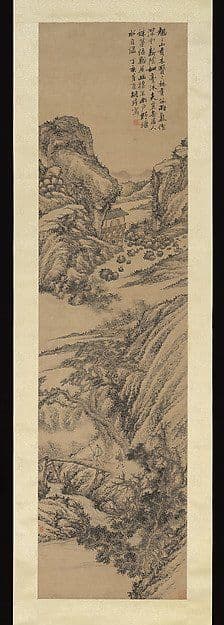
Hanging scrolls are the default for landscape and figure subjects. They are vertical, often tall, and were made to be hung for a season and then rolled away — which is why the tradition has no equivalent of the permanently displayed oil painting. A tall scroll needs a wall with height and, ideally, low light.
Handscrolls are horizontal and were never meant to be seen all at once. They are unrolled arm's length by arm's length on a table, and framing one flat behind glass, as sometimes happens in the West, destroys the sequence the painter composed.
Album leaves are small, usually mounted in sets, and are the most forgiving format for a modern interior. They also tend to be the most affordable entry point to any established name, because size drives price hard.
Fans and fan-shaped leaves carry their own conventions — the composition has to work on a curve, and a folding fan that was actually mounted and used will show wear along the folds.
Couplets — two matching vertical panels of calligraphy — hang as a pair and need symmetrical wall space to make sense.
Whatever the format, the practical constraints are the same: keep ink and colour on paper away from direct sunlight, avoid damp exterior walls, and rotate what is on display rather than leaving one work up for years.
Originals, copies, and the reproductions in between
Zhang Daqian is one of the most forged names in Chinese art, and the reasons are structural. He produced a large body of work over six decades; he worked in several distinct manners, so a fake does not have to match one narrow style; he was himself a virtuoso copyist, which muddies the water further; and demand has been strong for long enough to make forgery worth the effort.
There is also a large and entirely legitimate category between original and fake: reproductions. Collotypes, lithographs, later giclée prints and published album plates all exist, some issued during his lifetime, many after. A good reproduction of a famous composition, framed and behind glass, can read convincingly as a painting from across a room. Under a loupe it usually does not: printed images resolve into a dot or rosette structure, the ink sits on the surface rather than sinking into the fibre, and the paper edges are cut rather than deckled.
None of this makes reproductions dishonest. They are dishonest only when described as something else. The tradition of learning by copying is old and respectable in Chinese painting — we wrote about it in the copying tradition — and a clearly labelled modern print of a Zhang Daqian composition, priced as a print, is a reasonable way to live with an image you love. In our own catalogue that is exactly how a work such as Blue and Green Landscape is described: a faithful modern edition, marked as one.
What the market rewards
Zhang Daqian has sat at or near the top of the global Chinese art market for years, and prices at that level are driven by a short list of factors:
- Period. Large late splashed-ink and splashed-colour landscapes and major Dunhuang-influenced figure paintings are the categories that set records.
- Scale and format. Big hanging scrolls and multi-panel screens outperform small album leaves of the same date.
- Provenance. Works with an unbroken line back to an exhibition, a published catalogue, or a known collection carry a premium that is really an insurance premium.
- Condition. Ink and colour on paper is vulnerable to light, damp and clumsy remounting. Foxing, trimmed margins and heavy retouching all cost.
If you are buying at auction rather than from a dealer, the condition report and the provenance paragraph deserve more of your attention than the estimate.
Common questions
Is every Zhang Daqian painting with a seal genuine?
No. Seals are the easiest element to reproduce and among the first things a forger gets right. A seal that matches a published impression tells you the forger had access to a good photograph. Authentication rests on the whole object — brushwork, paper, mounting, inscription, seals and provenance considered together, ideally by someone who handles the material regularly.
Why do his paintings look so different from each other?
Because he worked deliberately in several traditions across a sixty-year career, and because the Dunhuang years and the late splashed-ink method were genuine breaks in method, not gradual drifts. Range is characteristic of him rather than evidence against a work.
Was Zhang Daqian really a forger?
He made works in the manner of earlier masters, especially Shitao, that entered the market as period paintings. How much of that was mischief, how much homage, and how much commerce is still argued over. What is not argued is the skill involved, and that his fluency in the old styles shaped everything he did afterwards.
What should a first-time buyer start with?
Start with clearly described editions and prints, where what you are buying is unambiguous, and spend the learning time on looking. Handle as much as you can at previews and museum shows before you commit to an expensive original.
Further reading
- How experts authenticate Chinese paintings — the sequence a specialist actually follows.
- How to read a Chinese painting inscription — dates, dedications and what they commit the painter to.
- Chinese painting mineral pigments — the blues and greens behind his post-Dunhuang palette.
- How to buy Chinese art at auction — the questions worth asking before you bid.
Browse our ink paintings
Modern hand-finished editions after the twentieth-century masters, each one described for exactly what it is. See the collection.
Explore Further