Published July 21, 2026
Chinese painting treated copying as mastery. What mo, lin and fang mean, why museums display copies proudly, and where tradition ends and forgery starts.
Read the label next to a Chinese painting in a major museum and you will keep meeting a strange phrase: "after Wang Xizhi," "attributed to Gu Kaizhi," "in the manner of Ni Zan." Some of the most famous works of Chinese art — objects reproduced in every survey book — are, by their own labels, copies. A Western collector trained on the cult of the original can find this disorienting: is the field full of fakes?
It is not. It is full of copies, and the tradition itself distinguishes carefully between kinds of copying — some of them honorable, one of them pedagogical, and only one fraudulent. This article gives you the working vocabulary, explains why copying sat at the heart of Chinese art education for fifteen centuries, and shows where the legitimate tradition ends and forgery begins.
Four words for "copy"
Chinese connoisseurship separates copying into modes, and the terms do real work in catalogs and scholarship.
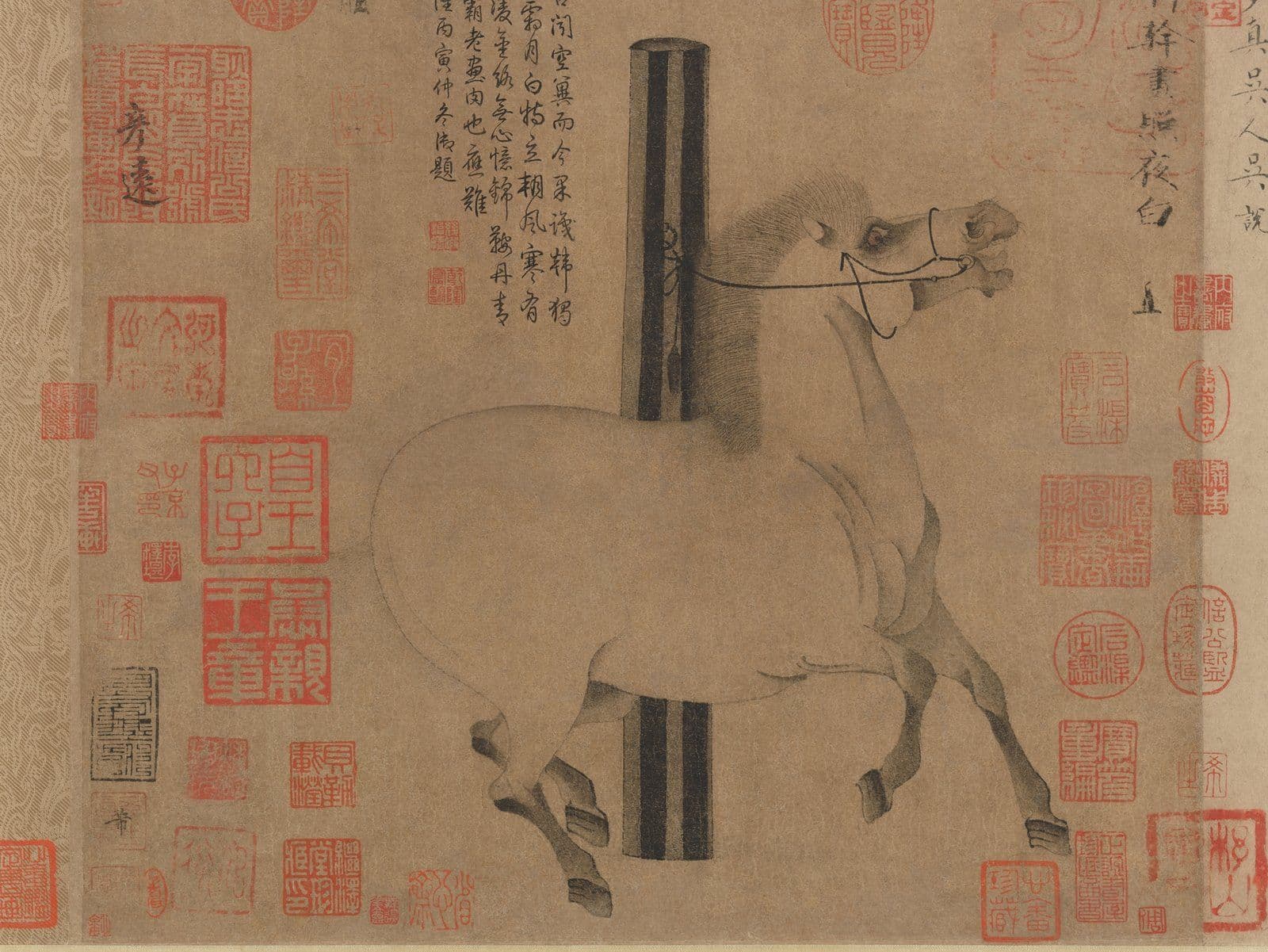
Mo (摹) — the tracing copy. The copyist works directly over the original, or over a transmitted outline, reproducing it stroke by stroke. Tracing copies aim at fidelity, and the best of them are astonishing: made with fine outlines then filled with ink, they preserve compositions whose originals vanished centuries ago.
Lin (临) — the freehand copy. The copyist sets the original beside fresh paper and copies by eye. A lin copy transmits composition and brush order but inevitably carries the copyist's own hand — which is the point. It was the standard training method: you learned painting and calligraphy by copying models, the way a music student learns repertoire.
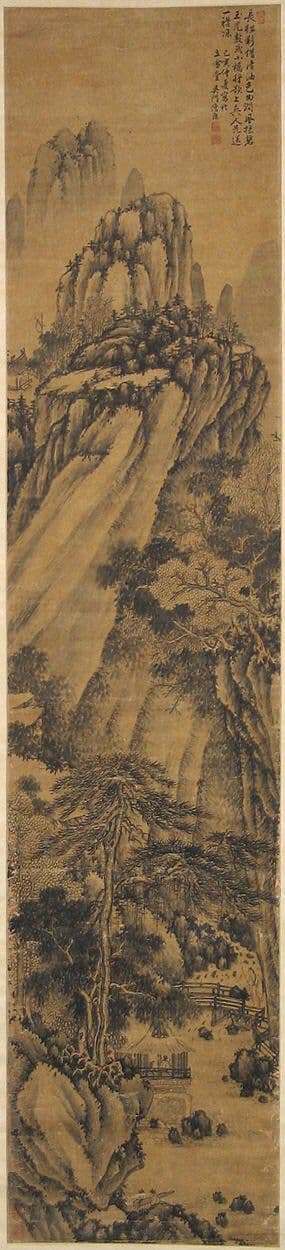
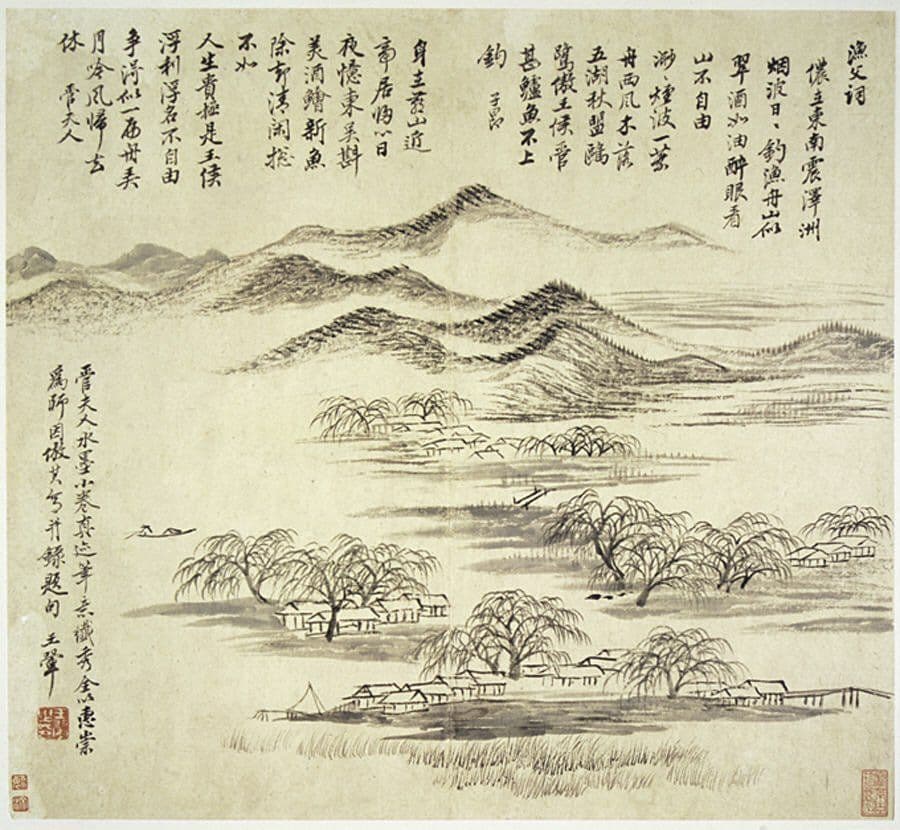
Fang (仿) — "in the manner of." Here the artist is not reproducing a specific work at all, but composing freely in an earlier master's style, and saying so — the inscription typically reads "fang Ni Zan" or "in the manner of Huang Gongwang." A fang work is an original painting in dialogue with the past, closer to a jazz standard than to a photocopy. From the Ming onward, a large share of serious literati painting is openly fang.
Zao (造) — fabrication. The made-to-deceive object: a new painting carrying a false signature, forged seals, artificial aging, and a fictitious pedigree. This, alone among the four, is what English means by "fake."
The system's logic is intent and disclosure. Mo preserves, lin teaches, fang converses — all three declare themselves. Zao lies.
Why copying was a virtue, not a vice
The sixth of Xie He's famous six principles of painting — the sixth-century checklist that organized Chinese art criticism for the next millennium — is usually translated "transmission by copying." Copying the ancients was not a concession; it was listed among the defining activities of a painter. Our guide to Xie He's six principles covers the full list; what matters here is that the tradition built reproduction into its definition of competence.
The practice had a preservation function that is easy to underestimate. Silk and paper are mortal; dynasties burn. Some cornerstone works of the canon survive only as early copies. The "Admonitions of the Instructress" scroll in the British Museum, attributed to Gu Kaizhi, is widely considered a copy made centuries after the fourth-century original. Wang Xizhi's "Orchid Pavilion Preface," the most celebrated piece of calligraphy in Chinese history, is lost — tradition says buried with a Tang emperor who loved it too much — and is known today through Tang-court tracing copies. Nobody calls these objects fakes. They are the transmission working as designed.
Copying also structured the master-student relationship. A painter's early album leaves after old masters were a curriculum vitae in the literal sense: proof of lineage studied and absorbed. When collectors today encounter a Qing album inscribed "copied after" ten different Song and Yuan masters, they are looking at a demonstration of education, made for an audience that could grade it.
Where homage ends and forgery begins
The boundary is crossed not by the copying but by the claim. A lin copy becomes a forgery the moment someone adds the original master's signature and seals and offers it as his hand. And because signatures, seals, and colophons are physically separable acts — added in ink and paste on top of the painting — Chinese forgery is often a matter of editing: a genuine old anonymous painting acquires a great name's signature; a modest fang work has its honest inscription trimmed away in remounting; genuine seals are transferred, or carved anew from published impressions. How seals work as evidence, and how they are faked, is covered in our guide to reading collector seals.
The tradition's most famous boundary-crosser makes the stakes vivid. Zhang Daqian, among the great twentieth-century painters, was also among the great forgers — his fabrications of the seventeenth-century master Shitao entered major museum collections and, in some cases, hang there still. His career, examined in our article on Zhang Daqian the forger, is the zao mode executed with lin-level training and fang-level fluency — which is precisely why it worked. The lesson for collectors is not that everything is suspect; it is that connoisseurship must argue from the object, because paperwork and reputation can be manufactured.
Authentication in this field is therefore a layered argument — brush habits, materials, seals, inscriptions, mounting, provenance — rather than a single test, and the layers are weighed differently for a painting that presents itself as an original than for one that presents itself as a copy. Our walkthrough of how experts authenticate Chinese paintings sets out the full method.
What the vocabulary means for buyers
Auction catalogs encode all of this in a ladder of attribution language, and the rungs are worth memorizing. "By" the artist is a full attribution. "Attributed to" signals substantial but not conclusive evidence. "Studio of" means made in the master's workshop, possibly under his eye. "Manner of" and "after" describe later works in the style of, or copying, the master — legitimate objects, priced accordingly. The ladder is not fine print; it is the price structure. A "manner of" landscape can be a beautiful, honest, centuries-old painting worth a fraction of a full attribution, and for many collectors that is exactly the opportunity: real age, real quality, real connection to a canonical style, without the seven-figure contest.
Three practical habits follow. First, read the inscription before the signature: honest copies usually say what they are, and a trimmed or suspiciously terse inscription on an ambitious composition is itself evidence. Second, price the object in front of you, not the name attached to it — a strong lin copy by a known later hand can outvalue a weak original. Third, when a work is offered as an early copy of a lost masterpiece, remember that early copies have their own forgery problem: faking a Tang copy is easier than faking a Jin original, and the David-vase logic of anchoring by dated, documented objects applies here too.
Common questions
Is a "fang" painting considered an original work?
Yes. A fang work is an original composition executed in the declared style of an earlier master, and the tradition treats it as the artist's own painting — the homage is the subject. Major Ming and Qing masters produced much of their most admired work in fang mode. It is attributed to, signed by, and priced as the copyist-artist, not the model.
Why do museums display copies so prominently?
Because for several foundational works, copies are all that survives — and early tracing copies made within a century or two of a lost original are the closest the world can get to it. Objects like the Tang-court copies of Wang Xizhi's calligraphy carry enormous art-historical weight precisely because the transmission chain is documented and the copying was done with preservation-grade fidelity.
How can I tell an honest copy from a forgery?
Start with disclosure: honest copies generally declare themselves in the inscription ("copied after," "in the manner of"), while forgeries claim to be the master's hand. Then test the claim against the object — brush habits, seals, materials, mounting, provenance — the same layered examination used for any attribution. Be most cautious when a work's story does the persuading: manufactured pedigrees are the forger's core skill.
Does the copying tradition make Chinese paintings riskier to buy than Western art?
The risk is different rather than greater. Western art has its own forgery industry; Chinese painting has a longer and more institutionalized copying culture, which means more honest copies in circulation and a vocabulary evolved to sort them. A buyer who learns the mo/lin/fang/zao distinctions and reads catalog language carefully is better armed than most. The serious risks concentrate at the top of the market, where full attributions to famous names are contested.
Further reading
- How to Identify Chinese Artist Signatures — the signature and inscription habits that anchor attribution.
- How to Buy Chinese Art at Auction — the attribution ladder in commercial practice.
- Chinese Cyclical Dates Explained — dating inscriptions on originals and copies alike.
- How to Spot Fake Chinese Porcelain Marks — the same disclosure-versus-deception logic, applied to porcelain.
Browse the collection
For the works themselves, Kiln & Ink issues limited-edition archival giclée reproductions of the modern ink masters — printed on rice paper, hand-numbered, and issued with a Certificate of Authenticity.
Explore Further