Published July 17, 2026
In 1941 Zhang Daqian left fame behind for the Mogao caves at Dunhuang. What he copied there, the controversy that followed, and how it changed his color.
By 1941, Zhang Daqian had very little left to prove as an ink painter. He was in his early forties, famous across China, selling everything he painted, and admired — not always approvingly — as the man who could imitate the great seventeenth-century individualist Shitao well enough to fool serious collectors. Then he left it all behind, travelled to the desert edge of Gansu province in China's far northwest, and spent roughly the next two and a half years living beside the Mogao caves at Dunhuang, copying Buddhist wall paintings by lamplight.
This article looks at what Zhang actually did at Dunhuang, why the trip permanently changed his palette and his figure painting, how the controversy around his methods still shadows his reputation, and what a collector should look for when the Dunhuang influence is claimed for a work.
Why the most fashionable painter in China went to the desert
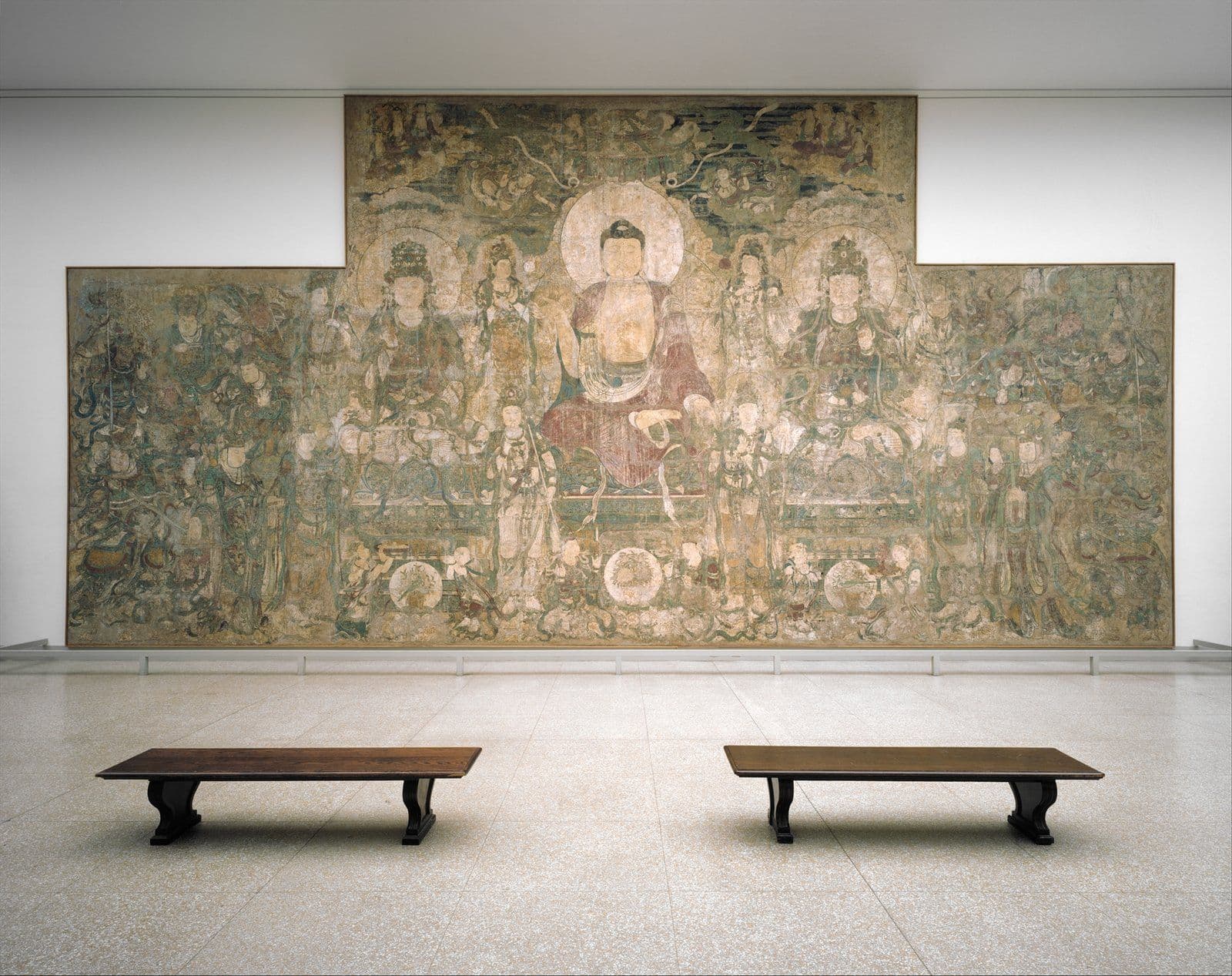
Dunhuang sits on the old Silk Road, where caravan routes entered China from Central Asia. Between roughly the fourth and fourteenth centuries, monks, merchants, and local families paid for hundreds of cave shrines to be cut into a cliff face outside the town and painted floor to ceiling with Buddhist imagery — paradise scenes, jataka tales, processions of donors, and attendant bodhisattvas by the thousand.
For most of the centuries that followed, this was a remote pilgrimage site, not an art destination. That began to change in the early twentieth century, when foreign expeditions carried off manuscripts and paintings and Chinese scholars started to argue that Dunhuang held the missing early history of Chinese painting. Nearly everything a connoisseur in the 1930s could see of pre-Song painting survived as later copies or attributions. The cave walls were different: original pigment, original line, laid down by working painters of the Tang dynasty and earlier, still in place.
That was the draw for Zhang. His training, like that of every literati-tradition painter, ran backwards through copies of copies — Ming and Qing versions of Song and Yuan compositions. Dunhuang offered the thing itself. He financed the expedition himself, at a cost that by his own later accounts left him heavily in debt, and brought assistants including Tibetan Buddhist painter-monks, whose monastery training in mural technique and mineral pigment preparation was far closer to Tang practice than anything available in Shanghai or Chengdu.
What copying a cave wall actually involved
The word "copying" undersells the labor. The caves are dim, the walls irregular, and many of the finest paintings sit high on the wall or across ceilings. Zhang and his assistants worked with scaffolding and lamps, matching wall paintings at or near full size onto prepared cloth and paper. The Tibetan monks ground and mixed mineral pigments — azurite blues, malachite greens, cinnabar reds, white lead, and gold — because the murals themselves were painted with mineral color, and vegetable-based studio pigments simply could not reproduce their weight and saturation.
Zhang treated the site systematically as well as artistically. He numbered the caves he worked through — one of several numbering systems applied to Mogao in that era — and kept notes on dynastic sequence, iconography, and condition. By most accounts he completed well over two hundred copies, ranging from single standing bodhisattvas to wall-scale paradise compositions several meters across.
When the copies were exhibited in wartime China in the mid-1940s, the effect on audiences was considerable. Most viewers, including most painters, had never seen Tang figure painting at this scale or intensity. The exhibitions helped push the newly founded research institute at Dunhuang into public consciousness and made the caves part of the story modern Chinese art was telling about itself.
The palette that came back from the caves
The clearest before-and-after in Zhang's own work is color and figure drawing.
| | Before Dunhuang (1920s–30s) | After Dunhuang (mid-1940s on) ||---|---|---|| Palette | Ink-led, washes of light vegetable color in the Ming-Qing literati manner | Heavy mineral color: azurite, malachite, vermilion, gold, often on toned or gold-flecked grounds || Figures | Elegant, thin-lined scholar figures and slender beauties in the tradition of late-Ming masters | Full-bodied Tang-style ladies and bodhisattva-derived figures, round faces, sweeping robe lines drawn with real pressure || Scale | Intimate album leaves, hanging scrolls | Increasing confidence at mural-like scale || Line | Refined, sometimes deliberately archaistic | Broader, more muscular contour line learned from wall painting |
None of this replaced his literati repertoire — he painted lotuses and landscapes to the end of his life — but it added a register that very few painters of his generation possessed. The heavy mineral blues and greens in particular became a permanent part of his equipment. When, in his sixties, failing eyesight pushed him toward the abstracted splashed-ink and splashed-color style that now defines his auction market, the colors he poured were the Dunhuang colors: azurite and malachite handled in bulk, pooled and tilted rather than brushed.
It is worth saying plainly that this turn toward color and professional figure painting ran against the grain of literati taste, which had spent centuries ranking ink above color and amateur expression above workshop craft. Zhang was, in effect, siding with the court and workshop tradition that literati critics had long condescended to — and arguing, with his own hand, that it was the older and grander lineage.
The controversy that never quite went away
Zhang's time at Dunhuang also produced the most serious and lasting criticism of his career. Some cave walls at Mogao carry more than one layer of painting: later dynasties sometimes plastered over earlier murals and painted afresh. Zhang was accused of removing sections of outer, later mural layers in order to expose earlier paintings beneath — irreversible damage, if so, to paintings that had survived a thousand years.
How much damage was done, under whose hands, and with what authorization has been argued about ever since; accounts from the period conflict, and Zhang's defenders have pointed to already-broken surfaces and to the general absence of oversight at the site in those years. This guide takes no position the sources cannot support. What can be said is that the accusation followed him for the rest of his life, that it colored his relationship with the mainland scholarly establishment, and that any modern account of the Dunhuang episode that leaves it out is incomplete.
Reading the Dunhuang influence — and vetting it
For a collector, "Dunhuang period" and "Dunhuang influence" are phrases that raise prices, so they deserve scrutiny. A few practical points.
First, the dated cave copies themselves are mostly accounted for: large groups remain in public institutions, including a substantial body of copies now in museum collections in China and Taiwan. Privately held copies exist, but a wall-scale Dunhuang copy appearing at market with thin history deserves the same skepticism as any major attribution — and the same layered vetting of brush, inscription, seals, and provenance that experts apply to Chinese paintings generally.
Second, the influence is easier to verify than the copies. A mid-1940s Tang-style beauty with mineral color and confident robe-line is exactly what Zhang's post-Dunhuang studio work looks like; the subject and palette are themselves period evidence, though never sufficient alone.
Third, because Zhang is one of the most forged painters of the twentieth century — a fate he invited by forging others so well — the standard checks matter more, not less, for Dunhuang-flavored works. Inscriptions and dates should be read carefully against his known movements, since his wartime whereabouts are unusually well documented.
Common questions
How long was Zhang Daqian at Dunhuang?
He arrived in 1941 and stayed until 1943 — roughly two and a half years, with interruptions for supply trips and travel. The expedition was self-funded, involved a working team rather than a lone artist, and by his own account consumed a fortune; he reportedly spent years afterward paying off the debts.
How many copies did he make there?
By most published counts, well over two hundred, ranging from details and single figures to full-wall compositions. Large groups of the copies are held in public collections today, and the copies were exhibited to great effect in China in the mid-1940s, before the founding of the People's Republic.
Did Zhang Daqian really damage the murals?
He was accused of stripping later mural layers to expose earlier paintings beneath, and the criticism has never fully gone away. Contemporary accounts conflict, the site was essentially unregulated at the time, and scholars still disagree about the extent of his responsibility. A fair summary: the controversy is real and documented; its precise scope is not settled.
Why do the Dunhuang years matter to his splashed-color work?
Because the palette carried over. The azurite blues and malachite greens he learned to grind and lay in bulk at the caves are the same mineral colors that pool across his late splashed-color landscapes. Many scholars also credit Dunhuang with the confidence at scale — big surfaces, big color decisions — that the late abstractions demand.
Further reading
- Huang Binhong's Black Landscapes: Reading the Dense Late Style — a contemporary who also transformed late, through accumulated ink rather than mineral color.
- Fu Baoshi's Rain Landscapes: The Bao Shi Cun Brush Method — another wartime reinvention, worked out in Sichuan in the same years.
- Li Keran's Red Mountains: Reading the Revolutionary Landscape — a different answer to the same question: what color can do that ink cannot.
- How to Read the Inscription on a Chinese Painting — dates, dedications, and signatures, the first checks on any attributed work.
Explore Zhang Daqian at Kiln & Ink
Hand-painted homages in the tradition of the modern masters, honestly described and faithfully attributed — see the works inspired by Zhang Daqian in our artist rooms.
From the Kiln & Ink collection: Lotuses in Five Colors, an archival giclée edition after Zhang Daqian, hand-numbered on xuan paper with a certificate of authenticity.
Explore Further