Published November 1, 2026
Xie Zhiliu (1910–1997): his Dunhuang years, the seven-man authentication group, the luomo lotus, and how to weigh his attributions and spot forged colophons.
Turn a hanging scroll face down on a padded table and the first thing an experienced dealer looks for is not the painting. It is the strip of silk at the lower left, where a previous owner's colophon may sit in small, fast running script. If the hand is Xie Zhiliu's, the piece has already been through the most patient eye of the twentieth century. Xie (1910–1997) wrote thousands of such inscriptions, on paintings now in the Shanghai Museum and on pieces that changed hands three times in a decade because of one sentence he wrote.
This guide walks you through what makes him worth knowing: how a Changzhou painter with no academy training became the central figure of Chinese connoisseurship, what Dunhuang taught him about dating, how the seven-man authentication group worked, and how to weigh a Xie attribution or a Xie painting before you pay for one.
From Wujin to the museum bench
Xie Zhiliu was born in 1910 in Wujin, in Changzhou, Jiangsu, into a family of modest means and strong literary habits. His elder brother Xie Yucen was a poet and calligrapher with a wide circle of friends, and it was through him that the young Xie entered the private collections of the region. He never attended an art academy. His education was a decade of looking at paintings on other people's tables, and copying them.
Two early attachments shaped him. The first was Chen Hongshou, whose figure drawing and decorative line he studied closely. The second was the Song academy, whose bird-and-flower painting he copied in fine line and mineral colour. By the 1940s he was painting seriously and reading attributions for dealers and collectors in Shanghai, where he settled and worked with the Shanghai Museum for the rest of his life. The double life matters: he judged paintings as a man who knew, physically, how a brush behaves when it turns.
Dunhuang, 1942
In 1942 Xie travelled to Dunhuang with Zhang Daqian. Zhang was there to copy the murals; Xie was there to record them. He numbered caves, transcribed inscriptions, noted donors and dates, and tried to put the wall paintings into a sequence. The notes became the Record of Dunhuang Art, still cited by scholars working on the caves. The Dunhuang period is usually told through Zhang's copies; the documentary half of the expedition belongs to Xie.
What he took away was a method. A chronology built on wall painting is a chronology built on style, because the caves carry few reliable dates and almost no colophons. Once you have watched figure painting change from Tang to Song across a hundred walls, you stop treating an inscription as the first question. You ask what the sleeve does at the wrist, how the drapery turns, where the colour sits. Documents can be added later. A sequence of forms cannot be faked backwards.
The seven-man group
In 1983 the ministry responsible for cultural relics formed a national authentication group for painting and calligraphy. It had seven members: Xie Zhiliu, Qi Gong, Xu Bangda, Yang Renkai, Liu Jiuan, Fu Xinian and Xie Chensheng. For roughly eight years they worked through museum storerooms across the country, examining tens of thousands of works, most of which had never been published.
The published result, the Illustrated Catalogue of Chinese Painting and Calligraphy, runs to more than twenty volumes and is still quoted in sale catalogues. Its method is worth understanding. Each piece was judged on brushwork first, with silk, paper, seals and colophons used as corroboration rather than proof. Where the seven disagreed, the disagreement was recorded. That is why the catalogue is trusted: it preserves doubt instead of resolving it by seniority, and a reader can see which pieces were accepted unanimously and which were not.
The instinct to judge by eye rather than by paper was shared by the collector-painters of his circle, notably Wu Hufan, whose attributions were argued in exactly the same terms. The difference is that Xie outlived his colleagues and kept working into the 1990s, so his late inscriptions sit on objects that entered collections long after the group had finished its survey.
The attributions that are still argued over
Xie was willing to defend a difficult attribution in print. His long essay on the Four Poems scroll in the Liaoning Provincial Museum argues that the calligraphy is Zhang Xu's own hand, against scholars who placed it several centuries later. Other members of the group were not persuaded, and the question remains open in Chinese scholarship.
He took the same line on the Spring Outing scroll in the Palace Museum, defending its traditional attribution to Zhan Ziqian and its Sui date against those who read it as a Tang work. Both arguments rest on one premise: that brushwork carries a period accent a later hand cannot reproduce, even a very good later hand. This is the strength and the limit of his method. Where a painting is well preserved and the brushwork is abundant, his judgement has held up. Where a work is damaged, heavily restored or reduced to a fragment, the argument has less to stand on, and later scholars have sometimes moved away from him.
The painter: gongbi first, then luomo
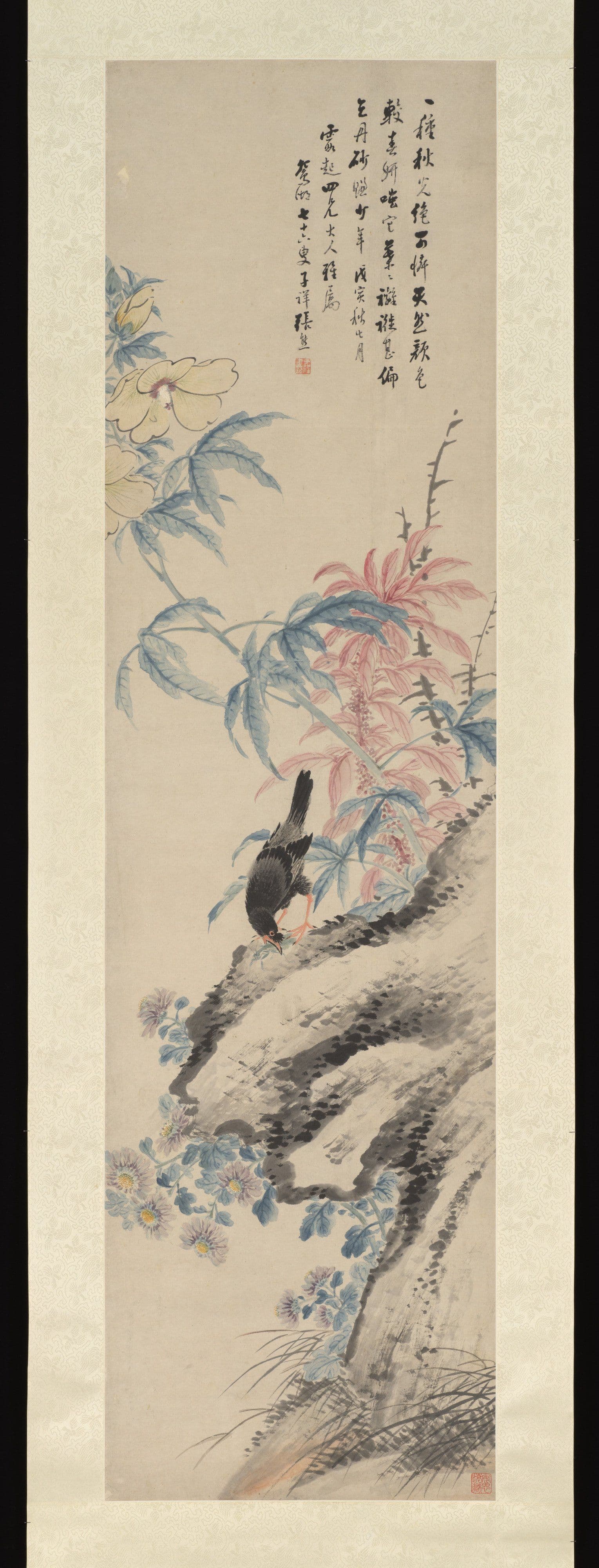
Xie's early paintings are meticulous bird-and-flower work in the Song manner: thin outlines, mineral greens and whites, a single branch placed with care. They are easy to like and hard to fake, because the line has to be confident at speed and there is nowhere to hide a hesitant wrist.
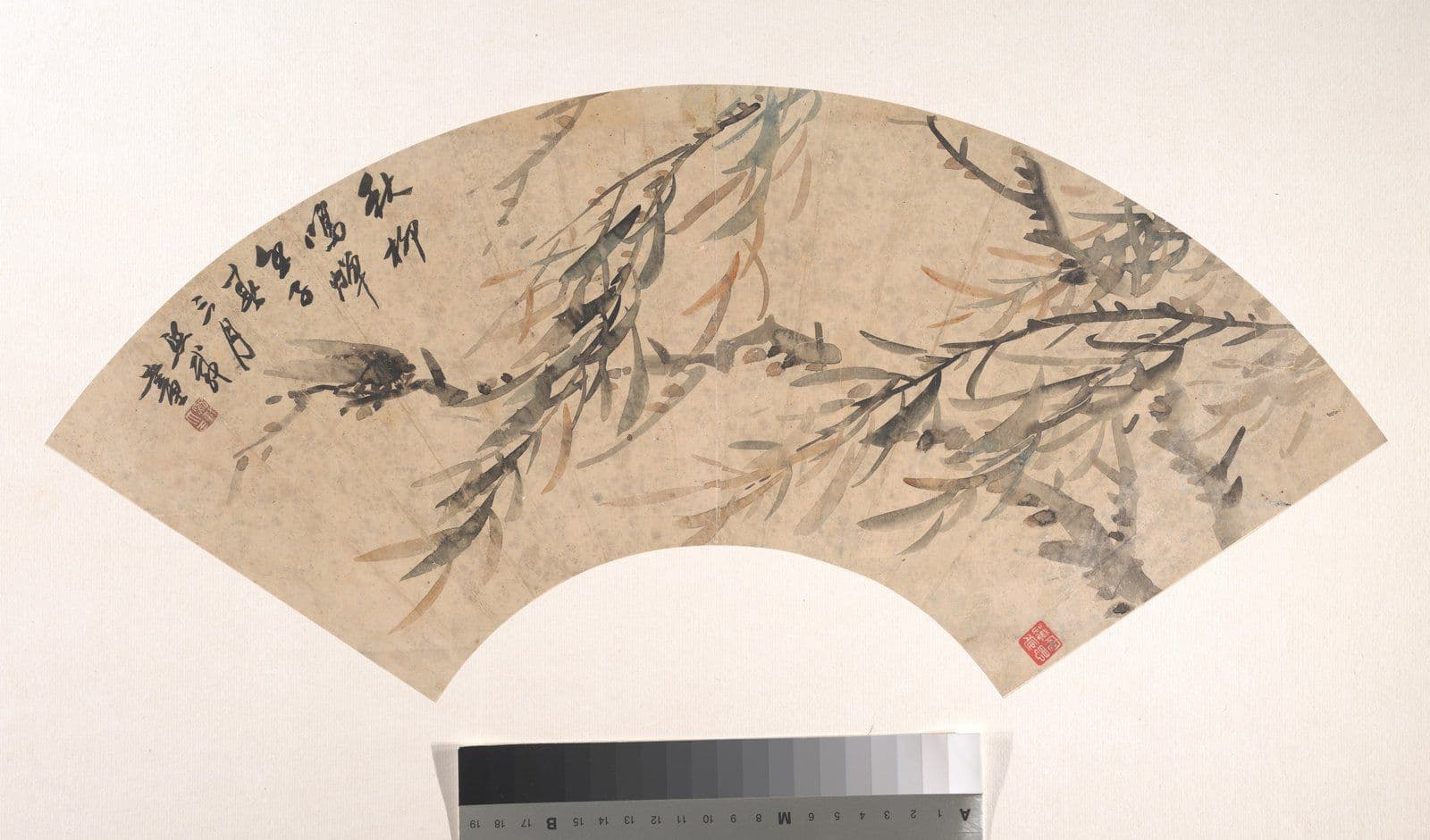
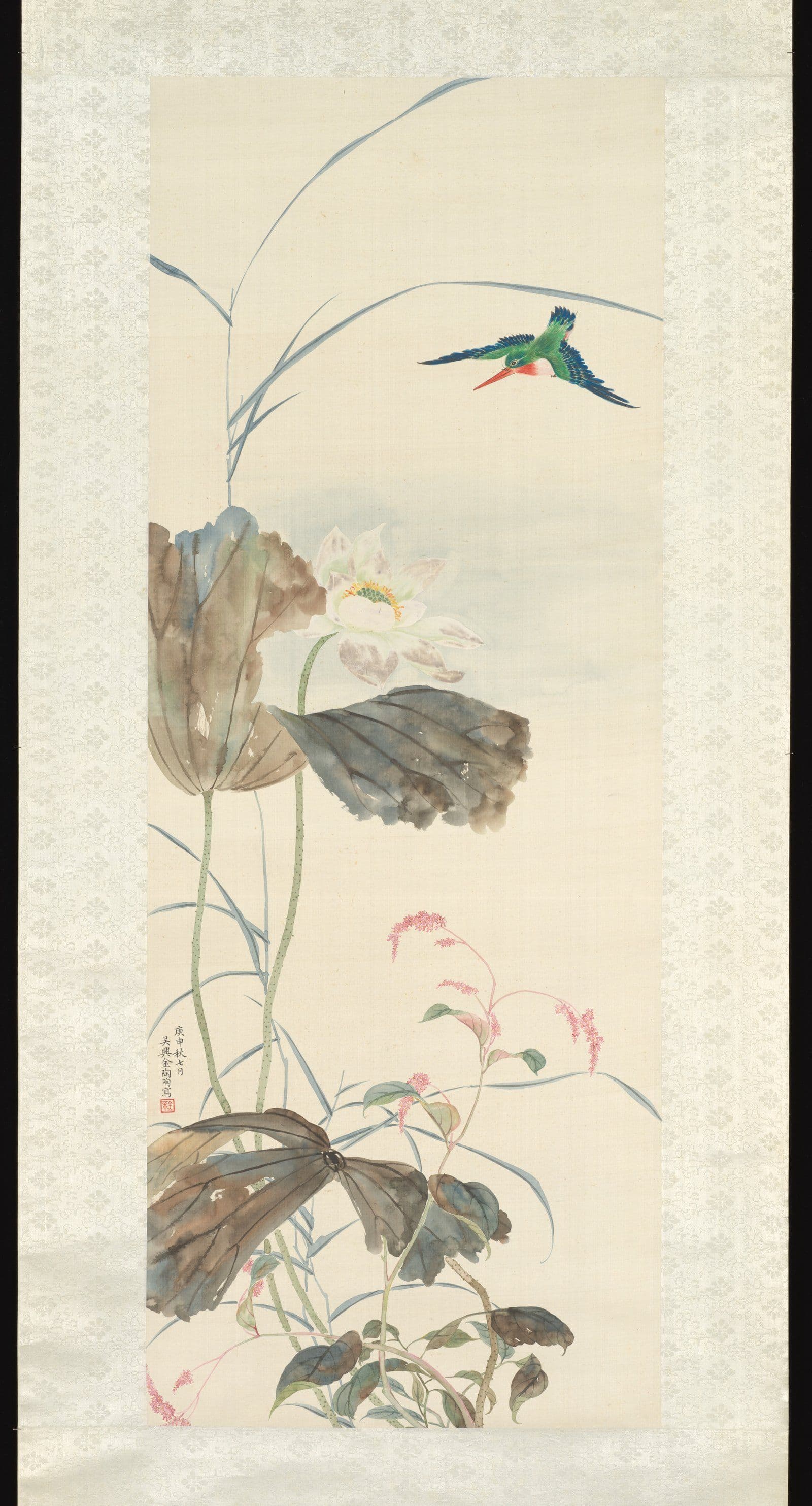
From the 1950s he became interested in Xu Xi, the Southern Tang painter credited with the luomo method, and in what the method actually was. Luomo means dropping ink: the ink is laid first, wet, and colour is washed over it before it dries, so that pigment and ink fuse instead of sitting in separate layers. The outline stops being a boundary and becomes a soft edge. He wrote about the technique and then spent thirty years painting it, mostly lotus, camellia and plum.
The practical consequence is simple. Hold a late Xie flower painting at arm's length and it reads almost as monochrome. Move closer and colour appears inside the ink, not on top of it. That single observation separates his mature work from most copies, and it is the first thing to look for under a raking light.
Calligraphy, colophons and the forged sentence
His running and cursive script derives from the Tang cursive masters, fast and slightly tilted, with thin strokes that keep their tension. Because a Xie colophon raises the value of someone else's painting, the commonest forgery in his market is not a fake Xie painting. It is a fake Xie sentence added to a genuine but ordinary work.
Four things expose it. A later inscription sits on the surface of the mounting silk, and the ink behaves differently over the weave than it does on paper. His inscriptions are usually dated, and the date has to agree with the seal and with the handwriting of that decade. A colophon written directly on the painting's own silk, in the same ink tone as the painting, needs an explanation. And the content gives it away: a connoisseur names what he actually sees, including the flaws, while a forger names what sells.
What to check before you buy
- Brushwork at speed. Look at the fastest strokes, not the slowest. A copyist can control a slow line and loses nerve in a quick one.
- Colour inside the ink. In mature work the pigment sits in the wet ink. Repainting sits on top and reads flat under raking light.
- Silk and paper. He used both, and the supports of the 1940s differ from those of the 1980s. The ageing should match the date in the inscription.
- Seals across decades. He used different seals at different periods and some were recut. A late seal on an early date is a warning rather than a detail. The general vocabulary is set out in reading artist signatures.
- The colophon's logic. Does the inscription describe the painting in front of you, damage included, or does it describe a better painting.
- Restoration. Heavy repainting around a lotus leaf destroys exactly the transition that identifies the hand.
- The common fake. A competent Shanghai studio copy of the 1980s or 1990s with an invented inscription, or a genuine album leaf with a colophon added later to lift the price.
What the market pays
Xie painted prolifically, taught many students and lived into his eighties, so supply is not scarce. Prices sit well below those of his friend Zhang Daqian, whose best works trade an order of magnitude higher, and the gap is a supply story rather than a quality judgement. Mid-size hanging scrolls and album leaves are the accessible end. Early gongbi bird-and-flower and large luomo lotus panels are where the serious money goes, and where condition matters most.
Two habits are worth having. Buy the painting, not the inscription, because a colophon can be added but cannot be removed. And when a Xie colophon appears on another artist's work, price the painting as that artist's work first, then add a modest premium for the inscription.
Common questions
Was Xie Zhiliu a painter or a connoisseur?
Both, and the order matters. He trained as a painter, spent his life looking at paintings, and treated connoisseurship as an extension of painting rather than a separate science. That is why his attributions are argued from brushwork rather than from documents, and why painters tend to trust him more than archivists do.
Why do his colophons raise a price so much?
A colophon is a second opinion from a recognised authority, written on the object and impossible to separate from it. In a market where provenance is thin, that is worth more than a certificate. It also means the inscription is the part most likely to be forged, so the premium should follow verification rather than precede it.
What is luomo and why does it matter?
Luomo, literally dropping ink, is a technique in which ink is laid wet and colour washed into it before it dries, so pigment and ink fuse. Xie revived it from early descriptions of the Southern Tang painter Xu Xi. For a buyer it matters because the fusion is difficult to imitate and easy to see under a raking light.
Have his attributions held up?
Mostly, and unevenly. Where the brushwork is intact his judgements have generally been accepted; where a work is damaged or heavily restored, later scholarship has sometimes moved away from him. The useful habit is to read his reasoning rather than his verdict, since the reasoning tells you how much weight the object can carry.
Further reading
- Chinese Painting Copies: Mo, Lin and Fang — the three traditional ways a Chinese painting can be a copy, which is the vocabulary every attribution argument uses.
- Calligraphy Fakes and Tracing Copies — how traced and freehand forgeries are made, which is what to look for in a colophon.
- Chinese Painting Seals and Collector Marks — reading the seals that surround an inscription and the collectors who owned the piece before you.
- Zhang Daqian's Seals and Signatures — the friend and rival whose authentication problems are the closest parallel to Xie's own.
Browse the collection
Xie Zhiliu is a subject we write about rather than one we stock. The twentieth-century masters in our reproduction programme, from Qi Baishi to the Shanghai painters who worked alongside him, are published as limited-edition archival giclée prints, hand-numbered with a Certificate of Authenticity. Browse the collection to see how that brushwork reads at full scale.
Explore Further