Published October 30, 2026
Chinese brush pots: bamboo, hardwood and porcelain bitong, the Jiading and Jinling schools, three tests for age, the market and how to stop bamboo splitting.
A bamboo brush pot gives up most of its evidence at the base. Turn it upside down and you see a recessed foot ring, lathe marks in concentric rings, and a rim worn thin where it has stood on a desk for two centuries. The inside is usually dull and stained at the bottom, because brushes went in wet. The outside may be carved with a whole landscape of pavilions and pines, and yet the part that dates it is the part nobody photographs.
This guide walks you through what a bitong is and when it appeared, the materials that matter and what each one tells you, how Jiading and Jinling carving differ, the tests that separate a seventeenth-century pot from a modern one, the porcelain and lacquer alternatives, what the market actually pays, and how to keep bamboo from splitting on a shelf.
What a bitong is
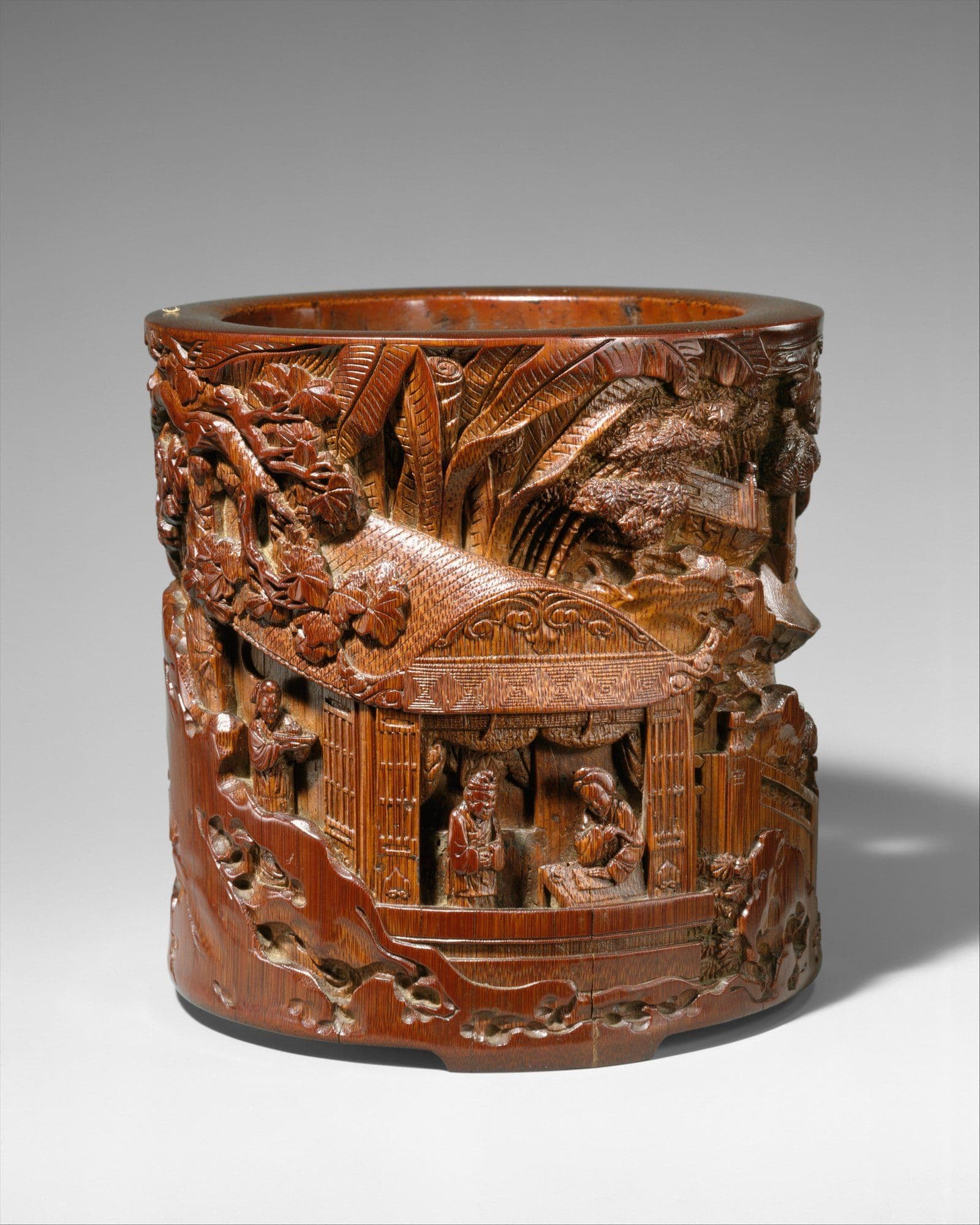
Bitong, "brush pot", is a cylinder open at the top, closed at the base, with no lid and no divisions. Brushes stand in it bristle-up, which keeps the hair from deforming and lets the tips dry. That single practical requirement fixes the form: a wall thick enough to hold weight, a base heavy enough not to tip, and a height that lets the shafts lean against the rim rather than disappear inside.
The usual size is between ten and sixteen centimetres high and five to nine across, which suits brushes with handles of twenty centimetres or more. Larger pots exist, some of them thirty centimetres tall, and they were made as display objects rather than working ones. The form is a latecomer in Chinese furniture terms: before the Ming, brushes were laid flat on a stand or hung from a rack, and the standing pot becomes common only from the late sixteenth century, when desks grew crowded and literati taste turned towards objects that could be handled.
The materials that matter
Bamboo is the default, and the reason is mechanical. It is a hollow tube already, so a section of a mature culm gives a wall of even thickness with almost no preparation, and its surface takes carving beautifully across the grain. The best pots use aged culm, dried for years before cutting, because green bamboo moves and splits as it dries.
Hardwoods come next. Huanghuali and zitan were turned on a lathe into plain cylinders with a crisp foot ring, the beauty carried entirely by the grain and the silhouette. Boxwood allowed finer, denser carving than bamboo and was used for figure subjects. Burl veneer over a wood core gave a mottled surface that needed no carving at all, and it is the category most often repaired.
Porcelain, lacquer, soapstone, jade, ivory and cloisonné all appear. Each has its own chronology and its own failure modes, and the collector who learns bamboo first will read the others faster, because bamboo teaches you to look at wear.
Two carving schools
Jiading, now a district of Shanghai, produced the school that defines the category. The Zhu family worked there across three generations in the sixteenth and seventeenth centuries, and their manner is deep relief: landscape and figures cut back into the wall, sometimes two or three levels deep, with the ground hollowed away so the carving stands proud. On the best pieces the carving follows the natural curvature of the culm, and the rim is left plain so the hand can hold it.
Nanjing produced the counter-argument. Pu Zhongqian, working at much the same moment, carved sparingly, using the shape of the bamboo or the markings of a root and cutting only enough to release the image. His manner is often called qian ke, "shallow carving", and it depends on restraint: a few cuts, a branch, a figure suggested rather than described.
Later pots sit between the two. Eighteenth-century work tends to be tighter and more pictorial; nineteenth-century work repeats Jiading formulas with less depth; twentieth-century studio carving revives the deep manner with modern tools and often signs the base.
Three tests for age
- The patina sits where hands go. Bamboo darkens through handling, from pale straw to amber and then to a deep reddish brown. On a genuine pot the polish is on the raised carving, the rim and the foot, while recesses stay dull and slightly dusty. Applied colour is usually uniform, or darker in the recesses where a dye was wiped in.
- The base tells the truth. Look for a recessed foot ring with lathe marks, wear on the outer edge of the foot, and a base disc set into the culm rather than glued on. Bamboo shrinks across its width as it ages, so an old base often shows a fine gap or a hairline crack at the join.
- The interior is unfinished. The inside of a working pot is rougher than the outside, stained near the bottom by ink and water, and sometimes lined with paper. A pot whose interior is as polished as its exterior has been restored, or made for sale rather than use.
Two more checks are worth the effort. Smell the inside: acid and tea staining leave a sour note that does not fade. And look at the carving under raking light for tool marks that cut across older patina, the signature of a plain antique pot re-carved in the twentieth century, which is the most common deception in this market.
The late Ming moment
The bitong arrives with a change in how desks were arranged. Ming literati writing on the scholar's desk gathered a set of objects around the brush: the brush itself, the inkstone, the ink stick, the water pot, the seal and the rest. The four treasures of the studio name only the essentials, but the desk in a late Ming painting carries a dozen things, and the brush pot is one of them.
The form peaks early. The decades around 1600 produced the carving that later collectors looked back to, and the Jiading workshops supplied a market of officials, merchants and monks. The Qing kept the form and softened the invention: more inscription, more finish, less risk. By the nineteenth century the pot was standard furniture on any desk that aspired to learning, and by the twentieth it was an export object, made in quantity for a Western market that wanted "the scholar's studio" as a set.
Porcelain, lacquer and the rest
Porcelain pots belong mostly to the seventeenth century and after. The transition-period wares of the 1620s to 1680s, painted in underglaze blue or in wucai enamels with narrative scenes, are the ones collectors look for, and they share the dating habits of blue and white generally: an unglazed base ring, kiln grit, a recessed centre, and reign marks that are often apocryphal rather than absent.
Carved lacquer pots were made in the Ming and Qing, cut through layers of cinnabar to a ground of a different colour, and they are heavy in the hand in a way bamboo never is. The dating logic is set out in the guide to carved lacquer, and it applies here without modification.
What the market pays for
Prices divide by authorship, exactly as they do for painting. A signed Jiading pot from the Zhu family is a museum object and appears at auction rarely; an unsigned seventeenth-century bamboo pot with good carving is a serious purchase; an eighteenth or nineteenth-century pot in sound condition is the entry point for most collectors, and a plain huanghuali or zitan cylinder is priced more as furniture than as carving.
The most common mistake is buying the carving rather than the object. Deep relief is impressive in a photograph, and modern Suzhou and Jiading workshops produce it well, with aged bamboo and convincing tool marks. Buy the wear, the base and the interior, and treat the carving as the last question rather than the first. Paperwork matters here as much as anywhere: the provenance documents that support a serious attribution are the same ones that support a painting.
Cracks, humidity and handling
Bamboo is a grass, and it moves with the weather. It takes up moisture from the air, swells across its width and shrinks again, which is why old pots so often carry a vertical crack through the wall. A stable crack along the grain is a condition issue, not a fault, and it should be left alone; filling it with wax or glue does more harm than good.
Keep pots at a steady humidity, somewhere near half saturation, away from radiators, sunny windows and air-conditioning vents. Wax sparingly, with a microcrystalline furniture wax, and never oil: oil darkens bamboo permanently and holds dust in the carving. Do not store brushes wet inside a pot, since standing water at the base is what rots the foot. Porcelain wants the opposite treatment, dry and unstacked, with rims padded.
Common questions
When was the Chinese brush pot invented?
The form becomes common in the late sixteenth century, in the Wanli period, and the earliest securely dated examples are from that moment. Earlier brushes were laid flat or suspended, so a standing pot had no purpose. Claims of Song or Yuan bitong appear in dealer descriptions but are not supported by surviving evidence.
How can you tell a bamboo brush pot from a wood one?
Look at the grain and the inside. Bamboo shows a fine longitudinal fibre with occasional nodes and a wall of even thickness, and the interior shows the smooth bore of the culm. Wood shows end grain at the base, a solid core, and a different resonance when tapped. Many "bamboo" pots sold cheaply are wood stained and carved to imitate it.
Are signed brush pots worth more?
Yes, when the signature is right. A mark or inscription naming a Jiading carver changes the object from anonymous craft to attributed work, and the price gap is wide. But signatures were added later as readily as they were carved, so a name on the base needs the carving to support it, and the patina to support both.
Should a brush pot be used or displayed?
Either, with care. A sound nineteenth-century pot will hold brushes without harm if the brushes are dry and the pot is kept out of direct sun. A seventeenth-century piece with deep carving should be displayed and left empty, since the weight of a full pot of brushes leans on the rim and the carving, and both are the parts most easily broken.
Further reading
- Chinese brush making — how maobi are assembled and why the handle length determines the pot.
- Huanghuali and zitan furniture — the two woods most often turned into plain cylinders, and how to tell them apart.
- Chinese inkstones — the other object on the desk that is bought for its stone rather than its carving.
- How to collect Chinese art — where scholars' objects sit in a collection that begins with paintings.
Browse the collection
Kiln & Ink publishes limited-edition archival giclée reproductions of twentieth-century Chinese ink masters, hand-numbered and issued with a Certificate of Authenticity. We do not stock scholars' objects, but the collection is where the painting those pots were made to serve begins, and bamboo appears there as a subject in its own right in the brushwork of bamboo.
Explore Further