Published November 2, 2026
Cheng Shifa (1921-2007): the Yunnan trips, the Cheng family manner, his debt to Chen Hongshou, the flower-and-figure fusion, and how to spot a weak copy.
A Cheng Shifa woman does not stand quite straight. The neck runs a little long, the shoulders slope more than anatomy allows, and the hands are drawn large and flat, the fingers spread like a fan. Follow the edge of a sleeve and the line thins, thickens and doubles back within a few centimetres, never settling into the single confident contour a nineteenth-century figure painter would have used. The face is smaller than the head that carries it, the features gathered high, and the figure sits inside a wreath of leaves and blossom that seems to have grown up around her rather than been arranged behind her.
That combination — deliberate distortion, restless line, flowers crowding the sitter — is what collectors mean when they say a painting is by Cheng Shifa rather than merely of his period. It is also the hardest thing to fake.
This guide walks you through who Cheng Shifa was and what he did before he was a painter of women, why the Yunnan journeys of the 1950s gave him a subject he never abandoned, what the Cheng family manner consists of at the level of the brush, how his figures relate to the nineteenth-century Shanghai masters he studied, what the market for his work looks like, and what to check before you buy a sheet.
The painter before the paintings
Cheng Shifa was born in 1921 in Jinshan, then a county on the southern edge of Shanghai, and trained at the Shanghai Academy of Fine Arts. That institution taught Western drawing alongside Chinese painting, and the mixture shows in his work: he could construct a figure in the round when he wanted to, and he mostly chose not to.
The 1950s are the part of his career that gets skipped, and they are the part that explains everything else. Like many Shanghai artists of his generation he worked in lianhuanhua, the palm-sized illustrated storybooks printed cheaply and read by millions, and he was good at it. The format imposed conditions a painter would not otherwise accept: a fixed small page, a narrative that had to be legible at a glance, dozens of drawings a month, and no room for a passage of virtuoso brushwork to carry a weak composition.
Working at that pace teaches speed, and it teaches clarity. It also teaches you to draw a figure that reads at four centimetres high, which means the silhouette has to be right and the internal detail can be summary. Cheng Shifa's later paintings keep that habit. The figure is stated in a few decisive moves and the space around it is left alone.
Yunnan, 1957
In 1957 Cheng Shifa travelled to Yunnan, in the far south-west, and the trip fixed his subject for the rest of his life. He was not the only artist drawn there in that decade — the south-western minorities were a favoured subject for painters asked to look at the new country — but he was the one who came back with a vocabulary rather than a set of illustrations.
What he found was a population whose dress, hair and ornament were unlike anything in the Jiangnan repertoire: Dai women in the tropical south, with tight bodices, long skirts, coiled hair and silver, standing among palms and banana leaves rather than willows and scholar's rocks. For a painter trained on the classical figure this was a subject with no inherited solution. Nobody had painted it, so there was no correct way to do it, and the conventions of the beautiful-woman picture — sloping shoulders, tiny mouth, garden setting — simply did not apply.
He returned to the subject for the rest of his career. The Yunnan pictures are the backbone of the oeuvre and the largest single group in the market, and their dating is one of the practical problems of collecting him: he painted Dai women in the 1960s, in the 1980s and in the 1990s, and the manner changes while the subject does not.
The Cheng family manner
By the 1970s critics and dealers were using the phrase Cheng family manner, chengjia yang, for his personal idiom. It is worth breaking down, because the phrase is usually used as a compliment rather than a description.
The line is wiry and it is never still. His contour is drawn with the brush held fairly upright, at a consistent thin gauge, and it changes direction constantly. Where a nineteenth-century master would sweep one long arc down a sleeve, Cheng Shifa breaks the same passage into three or four segments with a slight change of pressure at each turn.
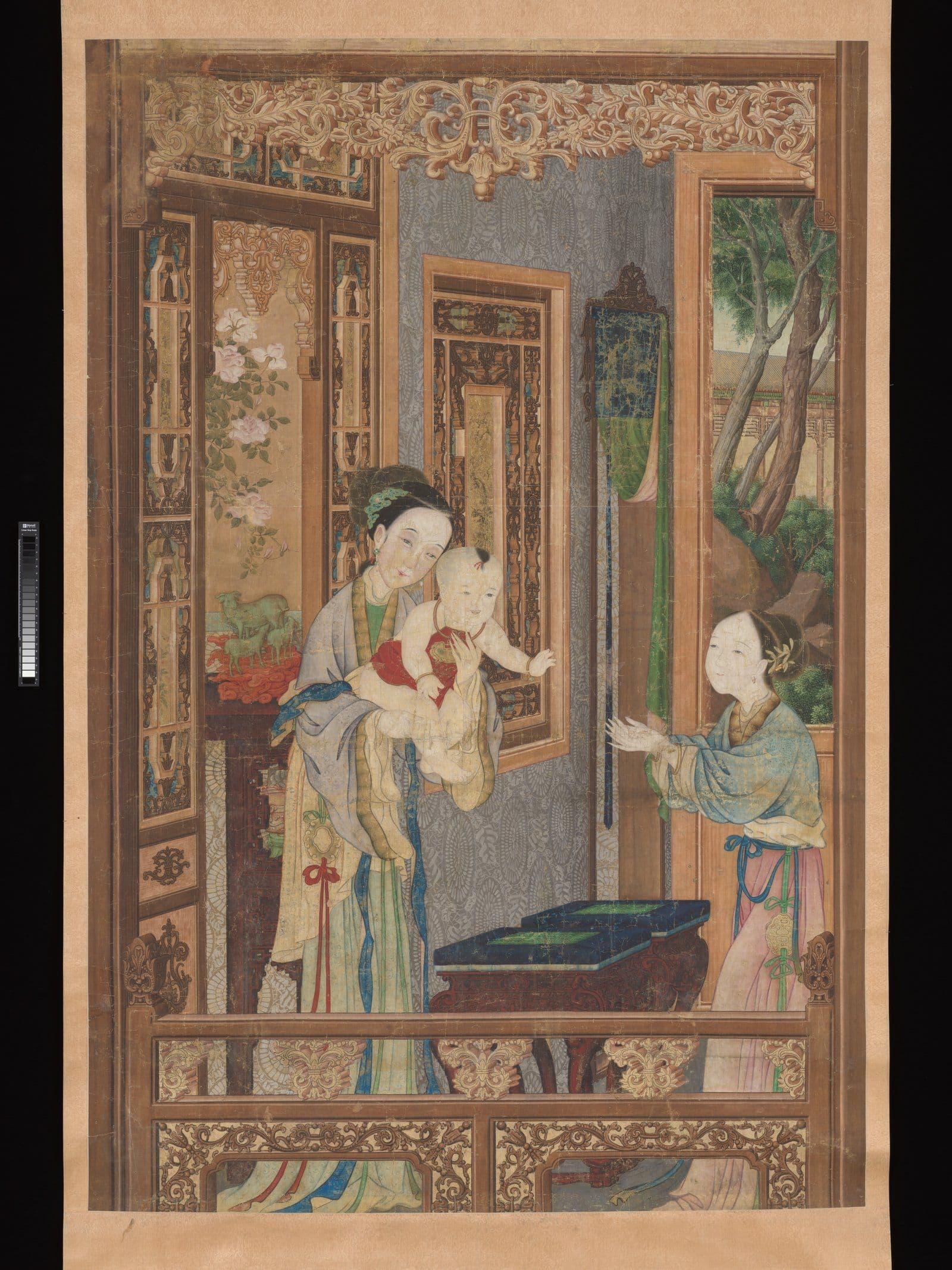
The figure is distorted on purpose. The proportions are wrong in a consistent direction: elongated necks, small heads set high, broad flat hands, feet reduced to a suggestion. This is neither incompetence nor decoration. The distortion pulls the figure towards the decorative and away from the portrait, which is why his women read as types rather than individuals.
Colour is flat and it sits inside the line. He laid in washes that stay within the contour instead of modelling form, so a sleeve is one tone with a second tone at the fold rather than a graded passage. The palette runs warm — vermilion, ochre, a mineral green — against a cooler ground.
The result is closer to folk decoration than to literati painting, which is exactly why the literati establishment took a while to accept him.
Flowers around the figure
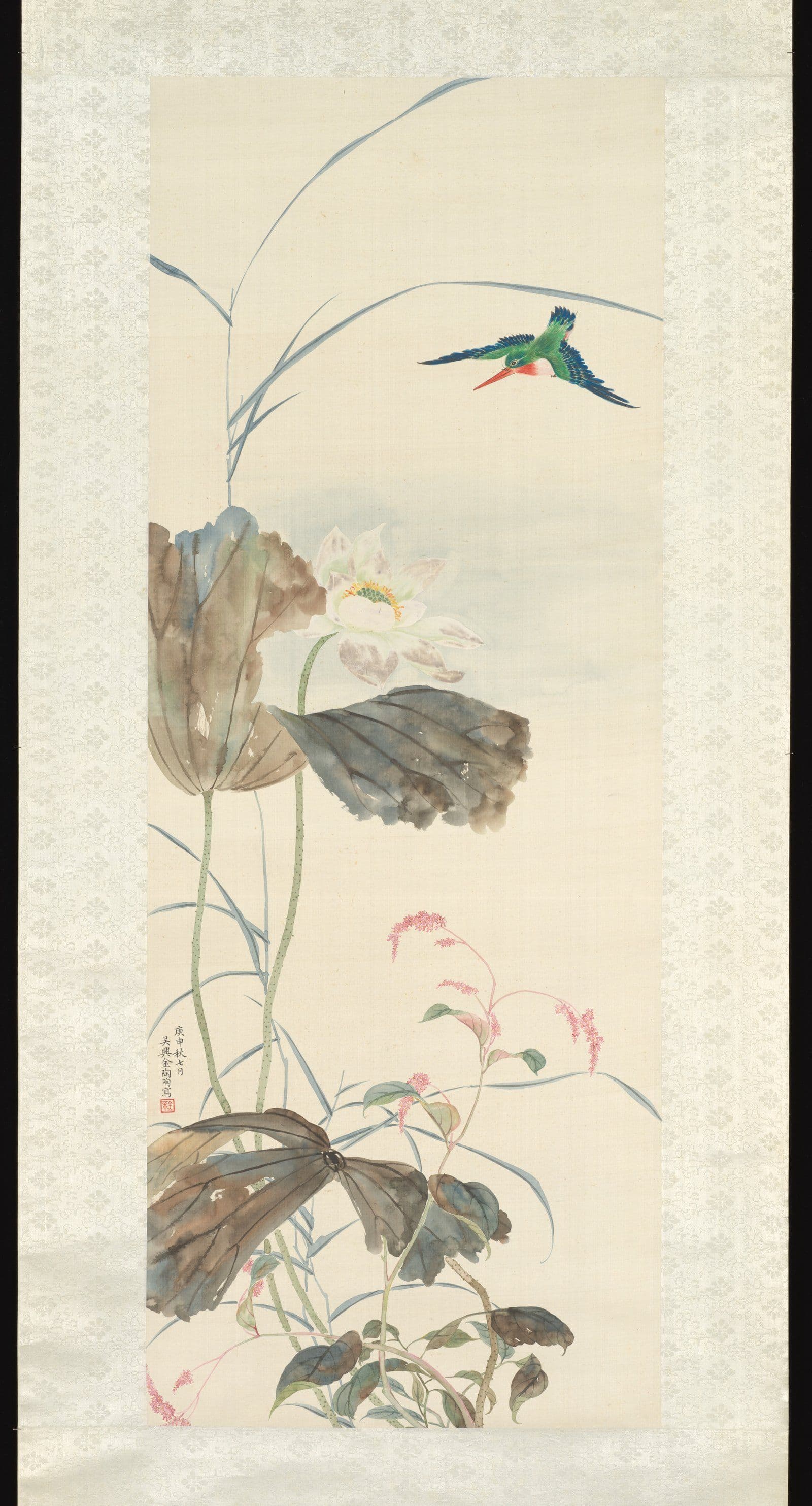
The most recognisable feature of a Cheng Shifa painting is not the woman but what surrounds her. Blossom, lotus, banana leaf, bamboo and bulbous pots crowd the edges of the composition, often entering from a corner and sometimes closing over the figure's head.
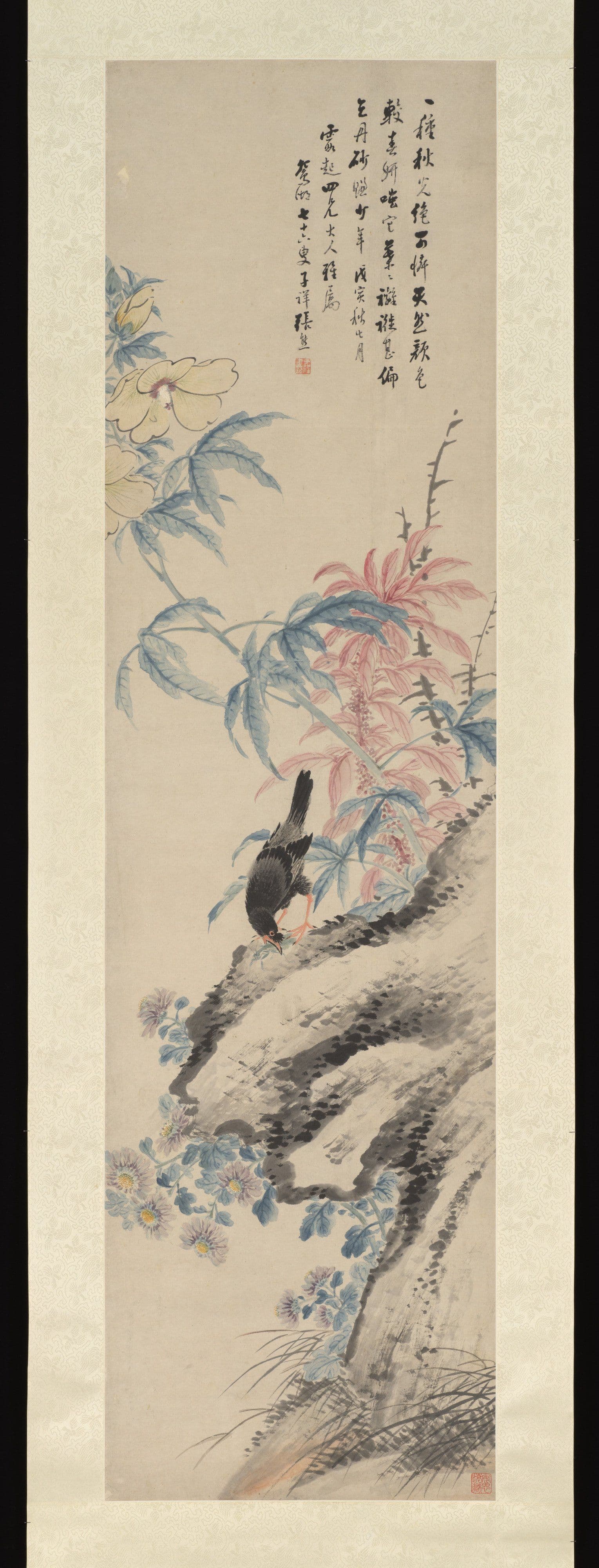
This is where his training in bird-and-flower painting shows, and it is the element that ties him to the Shanghai school rather than to the academic figure tradition. Ren Bonian had already mixed figures with flowers and birds on the same sheet, and the precedent mattered to him. Cheng Shifa pushed the mixture further: in late works the flowers stop being a setting and become a pattern the figure is embedded in, so that a woman and a peony are drawn with the same kind of line at the same scale.
For a buyer this matters because the flowers are where quality is most visible. The leaves are painted wet and fast, and the joins between one tone and the next are where a good hand shows and a poor one collapses into mud.
Reading the line: four tests
Connoisseurship of twentieth-century Chinese painting comes down to the brush, and Cheng Shifa gives you four things to look at.
- Look for the change of gear inside a stroke. A genuine line alters pressure two or three times across a ten-centimetre passage. A copy keeps an even tone and an even width, because copying a line is easier than re-deciding it.
- Check the distortion for consistency. In his work the neck is long and the head small everywhere, in every period. In imitations the distortion is applied to the face — the famous small features — while the body reverts to normal proportions.
- Watch the wet joins in the foliage. His leaves are laid in while the ground is still damp, so the boundary between two tones is soft and slightly ragged. A forger working dry gets a hard, clean edge.
- Read the inscription as a drawing. The calligraphy should have the same spring as the picture. He wrote a loose, fast running script; a careful formal inscription above a rapid painting is a mismatch worth pursuing.
Then the paperwork. Signatures and seals are the weakest part of most forgeries, and the checks are the same as for any modern Chinese painter — the seal impression, the way the name is written, the relation between the date given and the manner of the painting. Our guide to reading artist signatures and seals sets out the order of the examination.
The market and what to check
Cheng Shifa's market is Chinese. The great majority of his work trades in the mainland rooms and in Hong Kong, and the Western market for him is thin: a few sheets in London and New York sales, usually Yunnan subjects, usually the larger and more decorative compositions. Buyers arriving from Western twentieth-century art often assume he is cheaper than he is, because his name carries less weight in that context.
Provenance does most of the work. A reproduction in a 1980s or 1990s Chinese survey, an exhibition label, a documented sale from the artist's family or studio — any of these is worth more than an opinion, because the fakes are numerous and some of them are good.
Condition needs attention for a reason specific to him. He used thin paper and generous water, and the flat washes sit near the surface. Sheets that have been mounted and remounted lose the crispness of the line edges, and a washed-out Cheng Shifa is usually a condition problem rather than a weak painting.
Be sceptical, finally, of the too-tidy late work. His last paintings are loose to the point of sketchiness, and the market has learned to read looseness as lateness. A very finished late Cheng Shifa deserves a second look.
Common questions
Was Cheng Shifa a figure painter or a flower painter?
Both, and the two cannot be separated. He trained as a figure painter and spent years in narrative illustration, but he painted bird-and-flower subjects throughout his career and used them as the setting for his figures. In the late work the flowers occupy as much of the sheet as the woman, and are drawn with the same brush at the same speed.
Why are Cheng Shifa's figures out of proportion?
The distortion is deliberate and consistent. Elongated necks, small heads and large flat hands pull the figure away from portraiture and towards decoration, which suited a subject — Dai women in festival dress — that he wanted to present as a type rather than an individual. The manner descends from Chen Hongshou, the seventeenth-century figure painter whose exaggerated figures he studied closely.
Did Cheng Shifa paint anything besides Yunnan subjects?
Yes. He painted Shanghai and Jiangnan scenes, historical and literary figures, and a large body of flower-and-bird work. But the Yunnan material is the largest group, the most consistently sought after, and the easiest to date by manner, so it dominates both the literature and the market.
How do you tell a Cheng Shifa copy from an original?
Start with the line. Genuine work changes pressure inside a single stroke and distorts the whole figure consistently; copies keep an even line and apply the distortion only to the face. Then the wet joins in the foliage, which a dry copy cannot reproduce, and finally the inscription, which should show the same speed as the painting.
Further reading
- Xie Zhiliu: the connoisseur as painter — another Shanghai painter whose line carries the evidence, and a collector's eye applied to his own tradition.
- Lin Fengmian's opera figures — a near-contemporary answer to the same problem of modernising the Chinese figure, reached from the opposite direction.
- Copies and the mo-lin tradition — why copying was a discipline before it became a fraud, and what that means for authentication.
- Huang Zhou's donkeys and Xinjiang figures — the other great mid-century painter of minority subjects, and a very different solution.
Browse the collection
Cheng Shifa is a painter we write about rather than one we publish. The closest company in the catalogue is Huang Zhou, his exact contemporary and the other twentieth-century master who went out to the minority regions and came back with a subject. If you are drawn to the period more broadly, the collection gathers archival giclée reproductions of the twentieth-century Chinese ink masters, hand-numbered and issued with a Certificate of Authenticity.
Explore Further