Published July 24, 2026
Chinese painting pigments compared: mineral stone colours and their vegetal alternatives, how azurite and cinnabar age, and what pigment says about date.
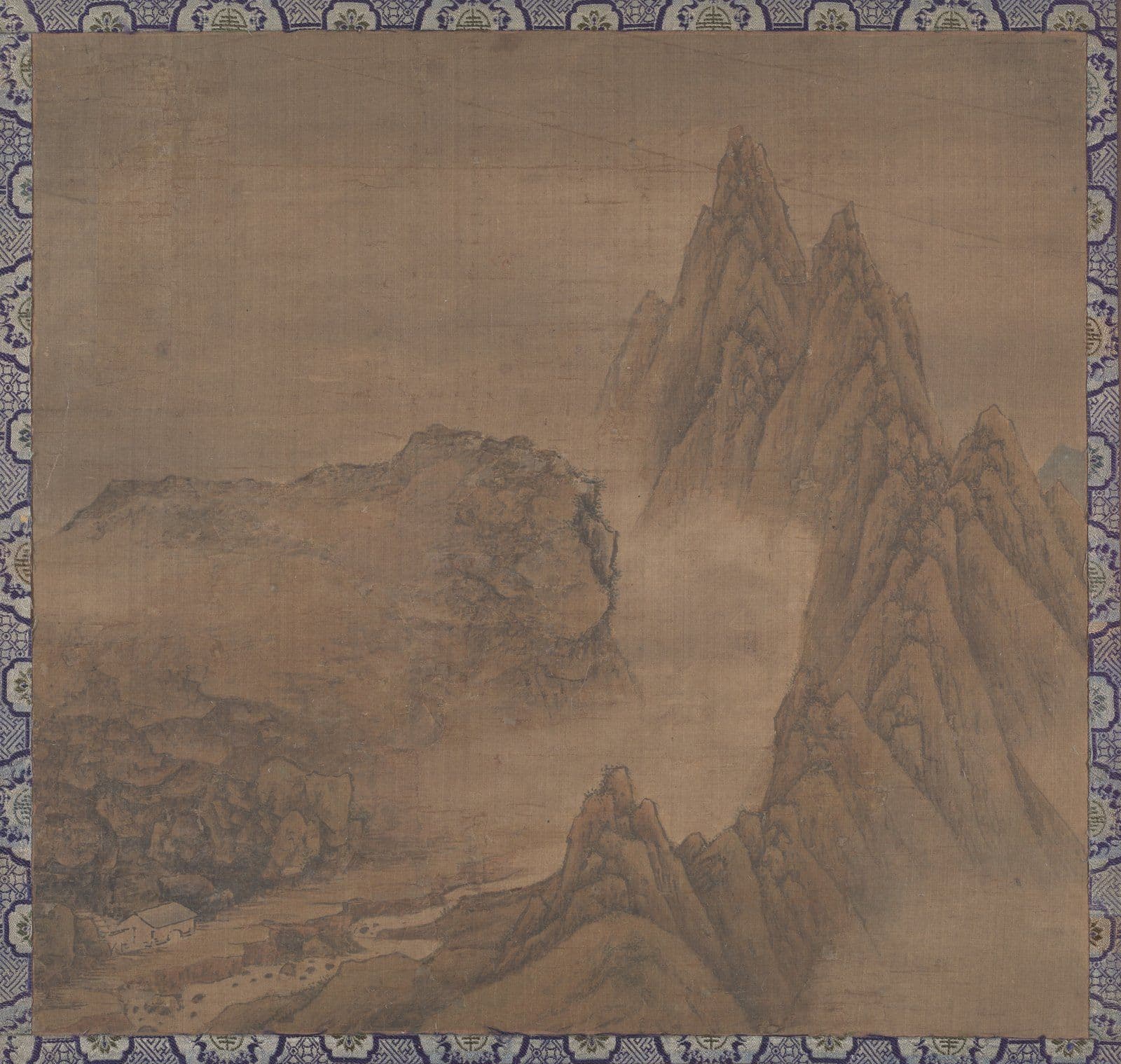
Look closely at a "blue-and-green" landscape and you will see something ink alone cannot do: dense, opaque blue mountains and malachite-green slopes that sit on the surface with a faint mineral grain, catching light like crushed stone. That is exactly what they are. The color came out of the ground — azurite, malachite, cinnabar — and was ground, washed, and bound with glue before it ever touched silk or paper.
This guide explains what traditional Chinese painting colors are actually made of, how mineral "stone colors" differ from vegetal "water colors," and what the pigments on a painting can tell a collector about its age and condition. Pigment is one of the few parts of a painting that can be tested against physics, which is why it matters as much to authentication as brushwork does.
Two families: stone colors and water colors
Traditional Chinese painters divided their palette into two broad groups. Stone colors (石色, shí sè) are opaque mineral pigments ground from rocks and ores. Water colors (水色, shuǐ sè) are translucent dyes and pigments derived from plants and organic sources. The distinction is not academic — it governs how a color is applied, how it ages, and how it reads on the surface.
Mineral colors are opaque and physical. They are built up in layers, often over an ink underdrawing, and they cover what is beneath them. Because the particles are heavy, they need a binder — traditionally animal-skin glue (胶, jiāo) — to hold them to the support. Water colors are transparent and are used in washes and glazes; they stain the silk or paper rather than sit on top of it, and they let the tone beneath show through. This translucent, staining behavior is the part of the palette that most resembles Western watercolor, though the comparison only goes so far — a point the discussion of Chinese ink painting versus watercolor draws out. Most finished paintings use both: mineral color for the passages meant to hold and glow, water color for atmosphere, shadow, and blending.
The three cornerstones: azurite, malachite, cinnabar
Azurite (石青, shíqīng) is the classic blue: a basic copper carbonate mineral, ground and then levigated — repeatedly settled in water — so the pigment separates into grades by particle size. Coarser particles give a deeper, more saturated blue; finer particles give paler, softer blues. Painters graded these as "first blue," "second blue," "third blue," and chose among them the way a colorist chooses values. Azurite is the blue that builds the mountains in the blue-and-green landscape tradition.
Malachite (石绿, shílǜ) is its green sibling — also a basic copper carbonate, geologically close enough to azurite that the two ores are often found together. It is levigated and graded the same way, from a strong dark green down to pale mint. In practice azurite and malachite are the paired workhorses of the mineral palette, blue above and green below in a hundred variations of hill and river.
Cinnabar (朱砂, zhūshā) is the red: mercuric sulfide, the source of vermilion. Natural cinnabar was ground for a warm, dense scarlet used for robes, blossoms, seal-paste red, and the collector's red seals themselves. A refined bright vermilion was also produced, and the family of reds shades from orange-scarlet to a deeper blood-red depending on grade and source.
Around these three sit other minerals and metals: orpiment, an arsenic-sulfide yellow; lead white, a basic lead carbonate used for opaque whites and to lighten other colors; and gold, applied as a paint (泥金, nijin) or leaf for outlines and highlights. The mineral pigments Zhang Daqian absorbed while copying the cave murals at Dunhuang came from exactly this family, and they reshaped his palette for the rest of his life, as the account of his Dunhuang period explains.
Against the stone colors, the water colors do the quiet work: indigo (花青, huaqing), a vegetal blue used for foliage and cool washes; gamboge (藤黄, tenghuang), a translucent resin yellow; and organic reds such as safflower rouge for delicate blossoms. These are the colors that read as transparent glaze rather than solid field — and they are also the colors most likely to fade.
How pigments age — and what that tells you
Pigment is where time leaves fingerprints, and reading them is part of judging any old painting.
Mineral colors are generally the most stable, which is why a good blue-and-green landscape can still blaze centuries later. But stability is not permanence. Thickly applied mineral passages depend on their glue binder; when the glue ages and weakens, heavy azurite or malachite can flake, craze, or lift — a condition problem you can see as loss along the edges of a colored area, and one that the remounting every old painting undergoes may stabilize or, if done badly, worsen. Under some conditions azurite can alter chemically over long spans of time, and malachite's tone can shift; treat any dramatic color change as something to examine rather than assume.
Two aging behaviors are worth knowing by name. Lead white can darken. Over time, and especially in polluted or sulfur-rich air, a lead-white passage can convert to grey or black — so a face, a robe, or a highlight that now looks smudged and dark may simply be aged lead white rather than dirt or damage. Cinnabar and vermilion can also darken with prolonged light exposure, the bright scarlet turning duller or blackish in patches. Neither change is a flaw in the painting so much as a record of its chemistry and its life.
The water colors tell the opposite story: they fade. Organic reds and, to a lesser degree, indigo lose intensity under light, so a painting that has hung for generations often reads cooler and quieter than it did when new. When you see a work whose colors are improbably fresh for its claimed age — no fading in the reds, no shift in the whites — that freshness is itself a question worth asking. Understanding these condition signals feeds directly into the harder problem of how experts authenticate Chinese paintings.
Pigments as evidence: dating and authentication
Because a pigment is a physical material with a history, its presence can contradict a painting's claimed date. This is the single most useful thing the palette offers the collector.
The traditional Chinese palette was remarkably stable for many centuries — the same minerals, the same plant dyes, refined but not fundamentally replaced. Then new colors arrived. Prussian blue, a synthetic pigment developed in Europe, reached Chinese painters in the eighteenth century and gave a blue quite unlike indigo or azurite. From the nineteenth century onward, a wave of industrial synthetic pigments — synthetic ultramarine, chrome and cadmium colors, aniline dyes — spread worldwide. Each has a birth date, and none can honestly appear in a painting made before it existed.
So a work presented as early Ming that carries a nineteenth-century synthetic pigment is either much later than claimed or has been substantially repainted. The eye can sometimes catch the anachronism — a blue too electric, a green too acid, a color that simply does not belong to the older mineral vocabulary — but the definitive answer comes from the laboratory. Non-destructive techniques such as X-ray fluorescence and Raman spectroscopy now let conservators identify pigments precisely, and pigment analysis has become a standard tool in serious authentication and in dating restoration campaigns. The material cannot be argued with the way a signature or a seal can be.
None of this replaces connoisseurship of brush and composition. But it gives the collector a second, independent line of evidence — one grounded in chemistry rather than opinion — and that is why learning the palette repays the effort.
Common questions
What is the difference between mineral and vegetal pigments in Chinese painting?
Mineral (stone) pigments such as azurite, malachite, and cinnabar are opaque, ground from rock or ore, bound with animal glue, and built up in layers that sit on the surface. Vegetal (water) pigments such as indigo and gamboge are translucent dyes used in washes that stain the support and let tone show through. Mineral colors are generally more stable and lightfast; vegetal colors are more prone to fading. Most paintings use both, mineral for the passages meant to hold and glow, water color for atmosphere.
Why do some old paintings have blackened or darkened areas?
Two common causes are chemical, not dirt. Lead white, used for opaque whites and highlights, can convert over time — especially in sulfur-rich air — to grey or black. Cinnabar and vermilion reds can also darken under long light exposure. So a smudged-looking face or a dulled scarlet robe may be the pigment's natural aging rather than damage. Recognizing this prevents both over-cleaning and false alarm about condition.
Can pigments prove a painting's age?
They can disprove a claimed age with near certainty, which is often more useful. Because synthetic pigments like Prussian blue and, later, the industrial nineteenth-century colors each have a known introduction date, finding one in a painting said to predate it shows the work is later or repainted. Pigments rarely prove a painting is genuinely old on their own — an old material can be reused — but combined with brushwork, seals, and mounting, pigment analysis is powerful evidence.
Why are blue-and-green landscapes so vividly colored?
They lean heavily on mineral pigments — dense azurite blues and malachite greens laid in opaque layers over an ink structure. Because these stone colors are lightfast and physically substantial, they retain their intensity far better than vegetal dyes, so a well-preserved blue-and-green landscape can still read as saturated centuries after painting. The faint granular texture you see up close is the ground mineral itself.
Further reading
- Literati painting versus court painting — why some traditions prized ink restraint and others full mineral color.
- Chinese painting seals and collector marks — the cinnabar-red seals that are themselves mineral pigment.
- The six principles of Chinese ink painting — the aesthetic frame within which color was used.
Browse the collection
If you would rather live with these images than only read about them, the Kiln & Ink collection holds limited-edition archival giclée reproductions of the twentieth-century Chinese ink masters — hand-numbered, printed on rice paper, and issued with a Certificate of Authenticity.
Explore Further