Published September 28, 2026
Lu Yanshao's cloud and water technique explained: how gouyun and goushui are brushed, the role of reserved white and late ink blocks, and how to spot copies.
Hold a Lu Yanshao landscape at arm's length and the first thing that moves is the cloud. It is not a gap left in the paper and it is not a wash of grey. It is a line: one continuous, curling, faintly nervous line that loops back on itself, gathers into a spiral, releases, and runs on across the face of the mountain. Follow it for a foot of paper and you are following a single loaded brush that has not been lifted. That line identifies the painter more reliably than the seal stamped beneath it.
This guide walks you through the four devices that make his landscapes recognisable across a room: the drawn cloud (gouyun), the drawn water (goushui), the reserved white (liubai) and the late ink block (mokuai). You will learn how each stroke is physically made, roughly when it entered his work, what job it does in the composition, and which of the four the copyists reliably get wrong.
Lu Yanshao in three moves
Lu Yanshao (1909-1993) was born at Jiading on the edge of Shanghai and trained in the orthodox way. Classical study came first, then painting under Feng Chaoran, a Shanghai literati painter who drilled him in the Qing orthodox masters and in the discipline of copying. The early work is careful, dry and conservative, the work of a man who has read the tradition rather than argued with it.
The middle move is the river. At the end of the war he travelled back east from Sichuan down the Yangtze and through the gorges by raft, weeks of watching water at eye level and cloud lying in the throat of a gorge before peeling off it. The studio tradition had reduced both to convention. He spent the next thirty years converting what he had seen from the water into brushwork.
The third move is late. From the late 1970s, teaching in Hangzhou, he began breaking his own surfaces with slabs of near-black ink and pushing the paintings away from the elegance of his middle years towards something blunter. The last decade is the part of his output collectors still argue about, and it is where the prices concentrate.
Gouyun: the cloud that is drawn, not left
Classical landscape painting handles cloud in one of two ways. Either the paper is left blank and the mountains are shaped around the void, or cloud is floated in with a dilute wash and softened at the edge. Lu Yanshao did neither. He drew the cloud as an outline, in ink, with the same brush and the same pressure he used for rock.
Look closely at the execution and three things are consistent.
- The line is unbroken over long distances. A single cloud band may run two feet across a handscroll in what reads as one continuous movement, with the ink thinning as the brush empties rather than stopping and restarting.
- The curl is a flattened spiral, not a scallop. The line turns in on itself and comes back out, so each cloud has a visible axis of rotation. Imitators tend to draw rows of even, lobed bumps, which produces decoration rather than weather.
- The speed varies inside a single loop. Where the line accelerates it goes dry and splits into separate hairs; where it slows it pools. That variation is why the cloud reads as moving.
The device is not his invention. Outlined cloud appears in Tang and Song painting and in decorative ruyi cloud patterns. What is his is the scale of it and the structural load it carries: the cloud is not filling the space between mountains, it is holding them apart.
Goushui: water written rather than washed
The drawn water follows the same logic and is the harder of the two to fake. Where a conventional painter suggests a rapid with a few horizontal accents and lets the paper carry the rest, Lu Yanshao wrote the whole surface of the river in line, following the way a current actually deforms around an obstacle: parallel until something interrupts it, then bent, compressed, thrown into a braid downstream, then parallel again.
Three tests separate his water from the imitation.
- The lines stay parallel where the current is unobstructed. Even in a dense passage they do not wander. Copyists loosen them and the river goes slack.
- Compression is local. Around a rock the spacing tightens sharply over a short distance and opens again immediately, which is what real water does. A forger usually feathers the transition.
- The ink tone of the water sits below the tone of the rock. The river reads as lighter without being a different colour, because the brush is drier rather than more dilute.
The relationship to xieyi brushwork is worth noting. This is not the meticulous line of a gongbi painter. It is fast, written line that happens to be describing something precisely.
Liubai: the white that does the work
Reserved white, liubai, is standard in Chinese painting. Lu Yanshao's use of it is unusually assertive. In the mature work the blank shapes are large, hard-edged and often arranged in a diagonal band that cuts across the whole composition, with mountain mass piled against both sides of it.
Read one of these paintings as a structure and the white is the beam. Cover it with your hand and the two halves of the picture fall apart. This is why his compositions survive reproduction at small size: the underlying pattern is one of high contrast blocks rather than of tonal gradation, and it does not collapse when the detail is lost.
The white also solves a practical problem. Drawn cloud and drawn water are both line work, and a painting made entirely of line becomes visually exhausting. The blank shapes give the eye somewhere to stop.
Mokuai: the ink block of the late years
The last device is the one that divides opinion. From the late 1970s onward, Lu Yanshao began laying down slabs of dense, wet, almost structureless black, sometimes the size of a hand, over or beside the drawn passages. They do not describe rock or tree in any literal way. They function as weight.
Compare this with Huang Binhong's late black landscapes, where the darkness accumulates through layer after layer of dry stroke. Lu Yanshao's blocks arrive in one loaded charge of the brush and sit on the surface. The two painters reach a similar density by opposite routes, and the difference is legible in raking light: Huang Binhong's surface has tooth, Lu Yanshao's late blacks are comparatively flat and glossy where the ink has pooled.
Collectors either regard the ink blocks as the moment his work stopped being merely beautiful, or as a late coarsening. The market has largely settled the argument in favour of the former.
How the calligraphy shows in the landscape
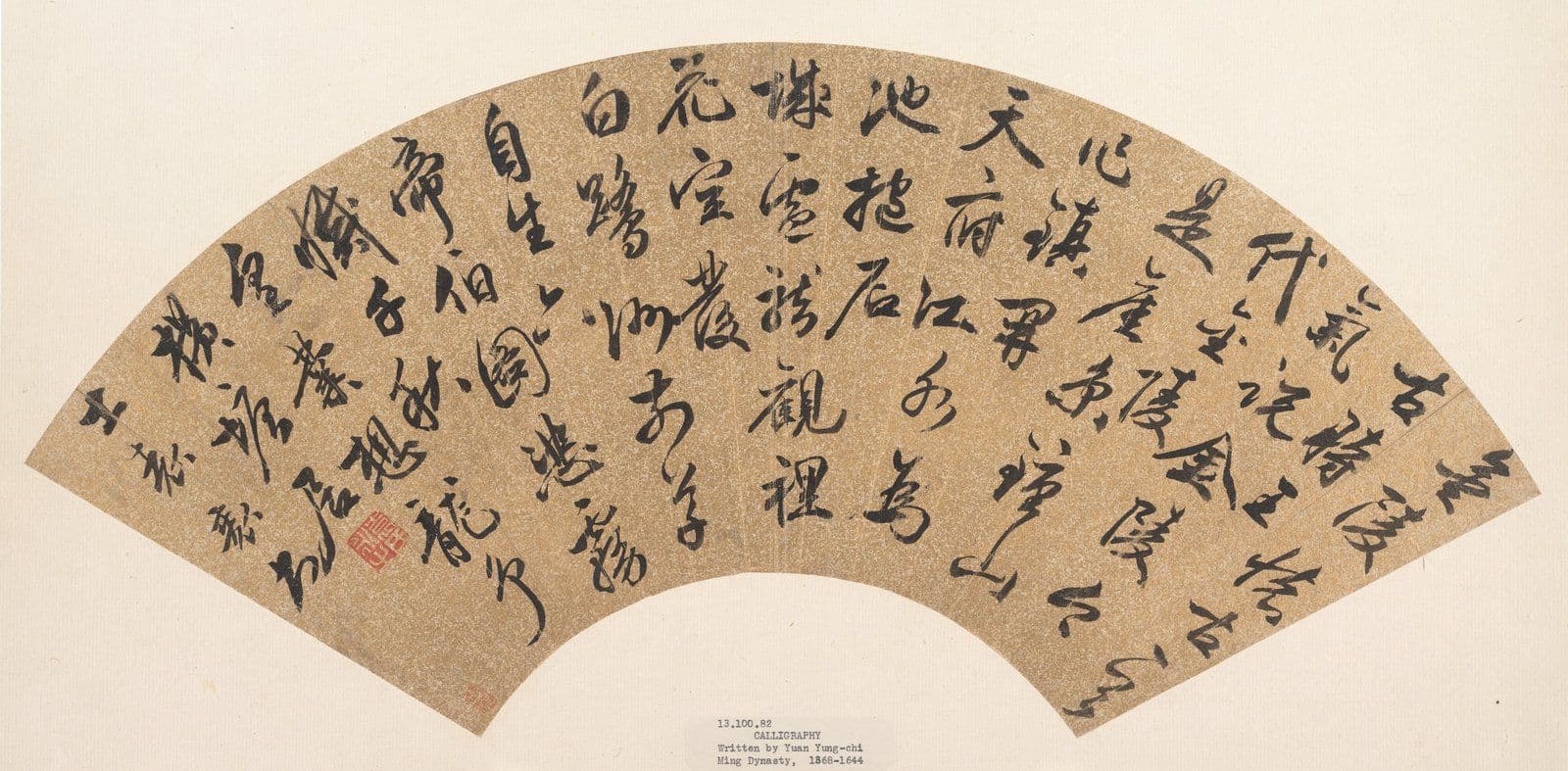
Lu Yanshao was a serious calligrapher, and the landscapes are unintelligible without that fact. The cloud line is a cursive script line: continuous, rotating at the wrist, varying in speed, indifferent to whether the mark describes anything. The rock contours are closer to running script, with clearer starts and stops.
Two practical consequences follow. First, his inscriptions are not decoration bolted on at the end but a continuation of the same handwriting, which is why a weak inscription is a serious warning sign on a painting attributed to him. Second, the brush he used has to be capable of holding enough ink for a long continuous line, which pushes towards a large soft-haired brush rather than a stiff one. Anyone studying the technique should read the inscription and the painting together rather than treating them as separate evidence.
What to check before buying
- Look at the cloud line first, at speed. Genuine work shows acceleration and dry split within single loops. Copies show even pressure throughout, because the copyist is following a shape rather than making a movement.
- Check where the line starts and stops. Forgers lift the brush at the top of each curl, leaving a blunt terminal. Look for a clean entry and a tapering exit that carries into the next form.
- Test the water for parallelism. Slack, wandering water lines are the most common tell in the many workshop copies produced since the 1990s.
- Judge the inscription as calligraphy on its own terms. A hesitant, evenly weighted inscription beside confident painting is a mismatch that cannot be explained away.
- Treat the seals as the last piece of evidence, not the first. Seals are the easiest element to reproduce convincingly, so they confirm a judgement already formed from the brushwork rather than replacing it. The general principles of reading collector and artist seals apply here as everywhere.
- Ask what the mounting has been through. Remounting is normal for twentieth-century Chinese painting, but a scroll that has been trimmed at the edges may have lost signature elements of the composition.
What the market looks like
Lu Yanshao is firmly in the first rank of twentieth-century Chinese landscape painters at auction, generally discussed alongside Li Keran and Fu Baoshi rather than below them. Demand is concentrated in mainland Chinese collections, which means the strongest prices are achieved in Beijing, Shanghai and Hong Kong rather than in Europe or America.
Three factors move the price. Late work with pronounced ink blocks outperforms the more decorative middle-period material. Handscrolls and large hanging scrolls outperform album leaves, because the long formats are where the cloud and water devices have room to operate. And provenance to an early publication or a documented exhibition matters more than usual, because the volume of fakes in this name is high.
Common questions
What is Lu Yanshao's cloud technique called?
The term used in Chinese is gouyun, "drawn cloud" or "hooked cloud", usually paired with goushui, "drawn water". Both describe outlining the form in continuous ink line rather than leaving it as blank paper or building it from wash. In his mature work the two are used together, so the cloud and the river are made of the same kind of mark and read as a single moving system running through the mountains.
How is Lu Yanshao different from Li Keran?
They solve opposite problems. Li Keran built dense, dark, backlit mountain masses from accumulated wet ink and worked from direct observation on sketching journeys. Lu Yanshao worked from line, kept large areas of the paper blank, and treated cloud and water as the active elements with the rock as the container. Put a work by each side by side and Li Keran reads as tonal and Lu Yanshao as graphic.
Are Lu Yanshao paintings widely faked?
Yes. He is among the most heavily forged twentieth-century Chinese painters, and the supply increased sharply as prices rose. The forgeries are usually competent at the level of composition and poor at the level of the individual line, because the cloud and water devices require a physical fluency that cannot be reached by copying an image. Examine the brushwork at close range before considering anything else.
Did Lu Yanshao paint anything besides landscape?
He painted figures, flowers and bamboo, and he was a substantial calligrapher who produced independent works in running and cursive script. The landscapes dominate his reputation and the market, but his calligraphy is collected in its own right and is a useful control specimen when assessing the inscription on a disputed painting.
Further reading
- Lu Yanshao's landscape paintings - the wider survey of his career, formats and market that this technical guide sits inside.
- Huang Binhong's five brush and seven ink methods - the vocabulary of stroke and ink that Lu Yanshao inherited and then simplified.
- Li Keran and the sketching journeys of the 1950s - the other route out of the orthodox tradition, taken at the same moment.
- Fu Baoshi's rain landscape technique - a third solution to the same problem of making weather visible in ink.
Browse the collection
Kiln and Ink publishes limited-edition archival giclee reproductions of the twentieth-century Chinese ink masters, hand-numbered and issued with a Certificate of Authenticity. If the drawn cloud and drawn water have caught your eye, the same graphic clarity runs through much of the modern landscape tradition we reproduce. Browse the full collection to see which of these painters reads best on your wall.
Explore Further