Published July 25, 2026
Who Lu Yanshao was, how his reserved cloud-and-water landscape method works, and what collectors check before trusting a Lu Yanshao painting.
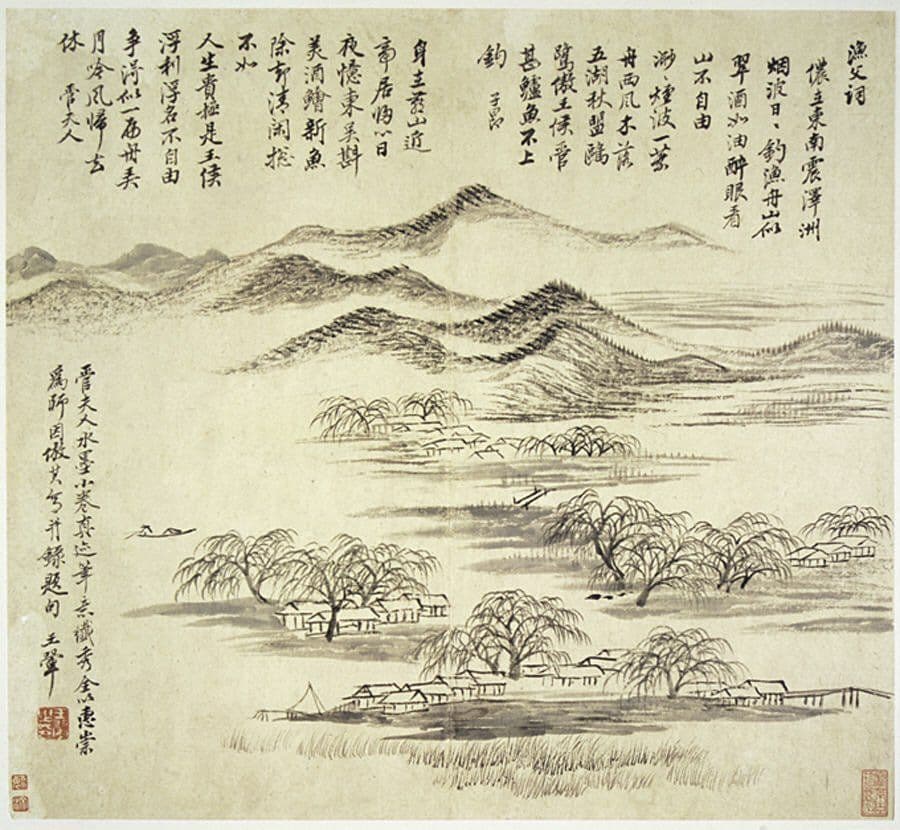
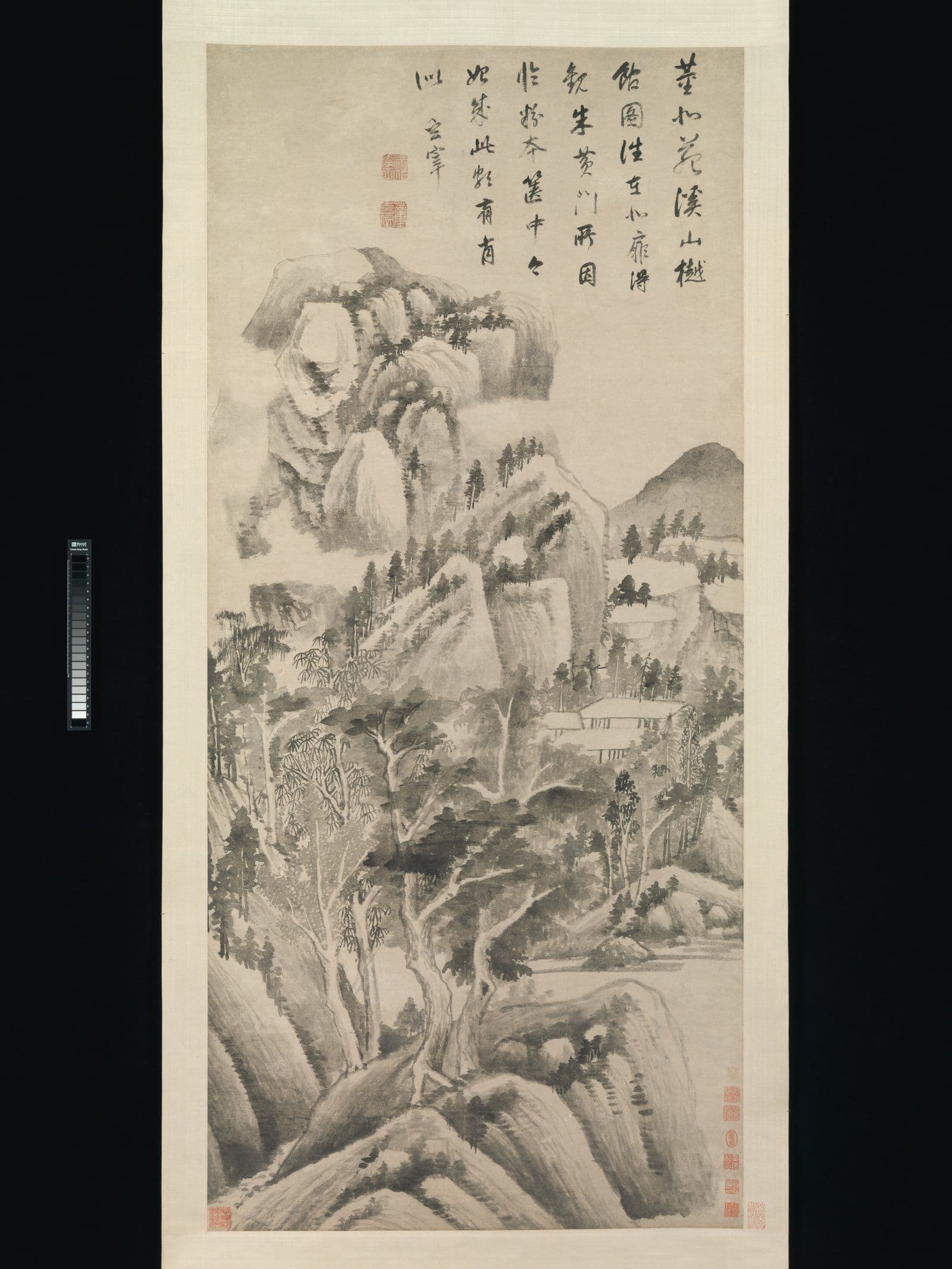
Look at a mature Lu Yanshao (陆俨少, 1909–1993) landscape and the first thing you notice is what he left unpainted. A river does not arrive as blue wash; it arrives as a ribbon of bare paper, curling between banks of dark ink, so that the water seems to move while everything around it holds still. Clouds do the same — pale reserved channels threading through mountains that would otherwise close over them.
This piece explains who Lu Yanshao was, how his cloud-and-water method actually works on the paper, and what a collector weighs when a landscape carrying his name comes up for sale.
The painter behind the brush
Lu Yanshao came out of the Jiangnan tradition — the scholarly, ink-centered painting culture of the lower Yangtze region around Shanghai, where he spent his early life. He trained in the classical manner, copying old masters and absorbing the Song and Yuan landscape canon before he tried to bend it. That grounding matters: his later freedom is the freedom of someone who first learned the rules cold.
The war years bent it for him. Like many of his generation, he spent the Sino-Japanese War displaced in the interior, and his journey back out — down the Yangtze, through the gorges, on turbulent brown water — gave him something no amount of copying could. He watched real water for weeks on end: how it braids, stalls, and boils against rock. Decades later that memory surfaces in almost every scroll. The moving water in a Lu Yanshao painting is observed, not inherited, and that is the single fact that separates him from painters who only quote the old formulas for waves.
He is usually paired with Li Keran in a shorthand collectors still use: "North Li, South Lu" (北李南陆) — Li Keran working in Beijing, Lu Yanshao rooted in the south. The two took modern Chinese landscape in opposite directions, and the phrase is a fair map of the mid-century field. Where Li Keran built dark, monumental, backlit mountains, Lu Yanshao kept the scholar's lightness and made movement his subject. For the other half of the pairing, the piece on Li Keran's red-mountain revolutionary landscapes shows how differently the two men handled ink and mass.
The political campaigns of the 1950s through the 1970s cost him working years, as they did most of his peers. He painted through and past them, and in his later decades taught at the Zhejiang Academy of Fine Arts in Hangzhou — now the China Academy of Art — where his influence on a younger generation of landscape painters ran deep.
How the cloud-and-water method works
The signature is reserve. Instead of painting clouds and water as pale color laid on top of the scene, Lu Yanshao draws them as blank paper that the surrounding ink is shaped around. He outlines a curl of cloud with a fine, live line — the old goule drawing method — then builds dense ink on either side, so the empty channel reads as light, air, motion. Nothing is added where the cloud is; everything is added around it.
Set against that lightness is his other device: the ink block. He would mass wet, dark ink into compact slabs — a shadowed cliff face, a stand of trees — that anchor the composition and give the drifting whites something solid to move past. The tension between the two, reserved white thread and heavy ink block, is the engine of the style. A painting with only the whites goes weak; a painting with only the blocks goes dead. The good ones hold both in balance, and learning to feel that balance is most of what it takes to read him.
His brushwork stays calligraphic throughout. Lines are written, not filled — you can read the speed and pressure of the hand in them, the same way you would in cursive script. Painters who prized heavy, accumulated ink, such as Huang Binhong in his late black landscapes, share that root belief that the brush stroke carries everything; Lu Yanshao simply spent his on movement rather than density. Among his modern peers who painted water and weather, Fu Baoshi's rain-swept landscapes make an instructive contrast — Fu dissolves the scene in atmosphere, while Lu draws the current as a firm, legible line.
Reading a Lu Yanshao landscape
Start with the water and clouds, because that is where a real one lives or dies. In an authentic work the reserved channels have direction and pace — they lead your eye, they turn corners with the terrain, they never sit as mere decorative gaps. In a weak copy they float, evenly spaced and lifeless, because the copyist reproduced the look of the reserve without the underlying grasp of how water moves.
Then read the inscription. Lu Yanshao was a literate painter in the old sense, and many of his landscapes carry poetry — he returned often to the Tang poet Du Fu (杜甫), whose verses about the river and the gorges matched his own subject exactly. The calligraphy should share the painting's energy: a controlled, characterful hand, integrated with the image rather than stamped on afterward. If you are new to reading these, the guide on Chinese painting inscriptions walks through what the columns of text actually say and where the signature and date sit.
Finally, weigh the whole against its claimed date. Early Lu Yanshao is finer and more classical; his late work grows bolder, the ink blocks heavier, the compositions more compressed and near-abstract. Neither period is "better," but knowing where a work should sit in that arc tells you whether its style and its inscription agree with each other.
A quick read-through, in order:
Water and clouds — do the reserved whites move and lead, or just decorate?
Ink blocks — is there real dark mass anchoring the drifting light, or is the whole thing evenly grey?
Line quality — are the strokes written with visible speed and pressure, or traced?
Inscription — does the calligraphy carry the same energy as the painting, and does the poetry fit the scene?
Period fit — does the handling match an early or late date, and does that agree with what the seller claims?
The market, and why it demands caution
Lu Yanshao is firmly established. His paintings have a deep collector base in Taiwan, Hong Kong, and the mainland, and strong examples reach high levels at the major auction houses. That is exactly why caution matters: a name with real money behind it attracts reproductions, later "improvements," and outright forgeries in proportion to its value.
The reserve method is, unfortunately, easy to imitate at a glance and hard to imitate well — which produces a large middle band of plausible-looking fakes. Provenance therefore carries real weight here: earlier publication, exhibition history, or a documented chain of ownership does more to support a modern Chinese painting than any single stylistic tell. For how specialists actually build that case, see the overview of how experts authenticate Chinese paintings.
Buy the best example you can rather than the biggest, favor works with an inscription and seals you can read, and treat a price that seems too gentle for the name as a warning rather than a bargain.
Common questions
How do I tell an authentic Lu Yanshao from a reproduction?
Look first at the reserved clouds and water: in a genuine work they have direction and pace and clearly lead the eye, while copies tend to space them evenly and lifelessly. Check that the inscription's calligraphy shares the painting's energy and integrates with the image. Above all, weigh documented provenance — prior publication, exhibition, or ownership history — because for modern Chinese paintings that paper trail supports an attribution more reliably than any single brush trait.
What does "North Li, South Lu" mean?
It is a collector's shorthand pairing Li Keran, who worked in Beijing, with Lu Yanshao in the south, as the two poles of mid-20th-century Chinese landscape painting. It signals that both are regarded as top-tier modern masters of the genre, working in contrasting directions — Li toward dark monumental mass, Lu toward light and movement.
If a work attributed to him is a print, what do the edition numbers mean?
A fraction such as 28/100 means the 28th impression pulled from a numbered edition of 100. Original works are unique paintings; numbered prints are multiples; and later reproductions — posters, book plates, decorative facsimiles — are not limited at all and hold little collector value. Always separate a hand-painted original from a printed reproduction before you think about price, and treat any "edition number" on what is presented as a unique ink painting as a red flag.
Why is moving water so central to his work?
His firsthand experience of the Yangtze and its gorges during the war years gave him a lifetime's study of how water actually behaves, and he made that motion — rather than static scenery — the true subject of his mature landscapes. It is the through-line from his early classical training to his boldest late scrolls.
Further reading
Li Keran's Buffalo and Herdboy Paintings — the gentler, intimate side of the other "North Li, South Lu" master.
Zhang Daqian's Splashed-Ink Technique — how a contemporary pushed modern landscape toward abstraction from a different starting point.
How to Read a Chinese Painting Inscription — decode the poetry, signature, and date on a scroll.
Chinese Painting Seals and Collector Marks — what the red seals tell you about a work's history.
Browse our ink paintings
Modern hand-painted works in the living Chinese landscape tradition, each honestly described and documented. — a calm way to move from reading about the brush to living with it.
Explore Further