Published September 26, 2026
Huang Binhong's five brush methods and seven inks explained term by term, how they combine, and the four checks that reveal them in a painting.
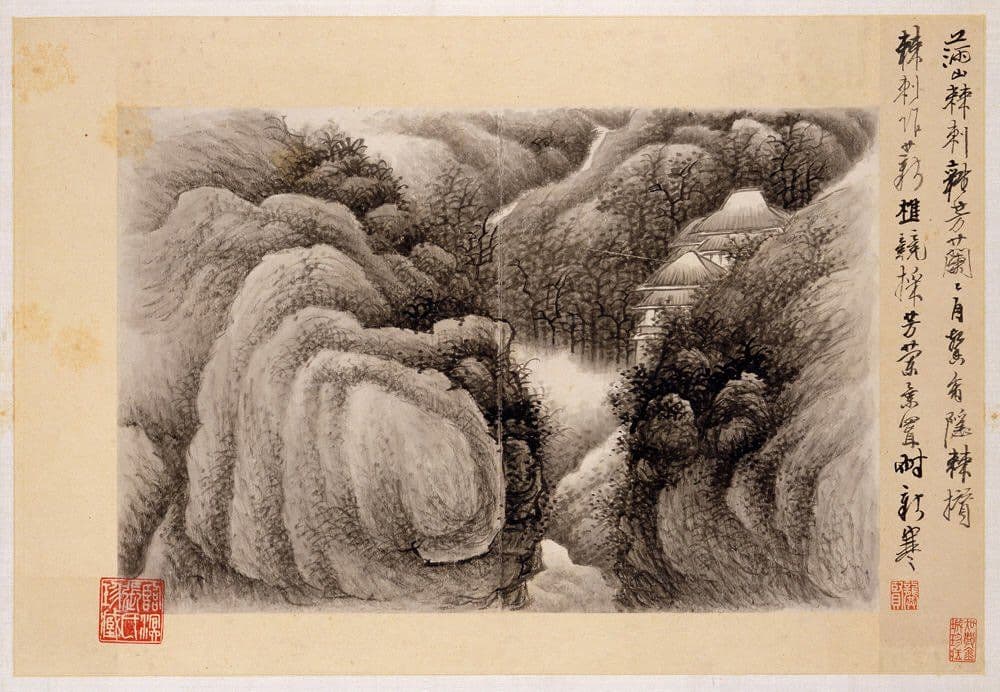
Hold a late Huang Binhong landscape at an angle to the window and for a moment it stops being a picture. You see a deposit instead: layer over layer of ink, some strokes bitten hard into the fibre, others sitting grey and faintly granular on top, and between them pinpricks of bare paper left deliberately unfilled. The mountain has been built rather than drawn. Rake the light across the sheet and you can very nearly count the sittings.
That deposit is what Huang Binhong meant by his two famous lists, the five brush methods and the seven inks. This guide walks you through what each of the twelve terms means, how the two lists combine into a single working system, how to recognise the methods in a finished painting, why they matter most in the dark late landscapes, and what copyists reliably fail to reproduce.
The man who made the lists
Huang Binhong (1865-1955) spent most of his working life as an editor, teacher and art historian as much as a painter. He compiled and edited reference series on Chinese art, taught in Shanghai and later at the academy in Hangzhou, and published criticism steadily for decades. The five brush methods (wubi) and seven inks (qimo) come out of that scholarly habit: they are his attempt to reduce a thousand years of literati practice to a vocabulary a student could hold in the head and a connoisseur could use as a checklist.
Because they are his terms, they are also the terms his market uses. Auction essays, museum labels and Chinese-language monographs all reach for them, usually untranslated. Knowing them is the difference between reading a catalogue entry and skimming it. For the wider career, see our Huang Binhong collector's guide.
The five brush methods, one at a time
The five describe how the brush should behave. They are qualities, not shapes, and a single stroke can satisfy several at once.
- Ping, "even". The brush travels with unvarying pressure, like a spirit level drawn across the paper. Huang compared it to water finding its own surface. The test is that the stroke has no accidental swelling and no thinning at the end.
- Yuan, "round". The tip stays centred inside the stroke so the mark reads as a cylinder rather than a flat ribbon. Round strokes turn corners without a crease. This is the quality that carries over directly from seal script brushwork.
- Liu, "retained". The hand holds something back, moving slowly enough that the ink has time to sink. A retained stroke looks unhurried and slightly resistant, as though the paper were pulling against the brush.
- Zhong, "heavy". Weight comes from the wrist and the whole arm, not from pressing harder. Huang wanted strokes that feel as if they have mass even when they are thin, which is why his hairline contour lines still sit firmly in the picture.
- Bian, "varied". The other four are held in tension and changed continuously, so no two strokes in a passage are the same. Without bian the first four produce competent monotony.
The seven inks, and what each one does
The seven describe the medium rather than the hand. They are tonal and physical states of ink on paper, and Huang treated them as separable materials.
- Nongmo, dark ink. Freshly ground, thick, used for the strokes that must hold the structure of a rock or a trunk.
- Danmo, pale ink. Heavily diluted, laid for atmosphere, distance and the soft body of a hill.
- Pomo, broken ink. Wet on wet: pale ink dropped into dark, or dark into pale, so the two bleed and break each other's edge. The result is a soft frontier rather than a line.
- Jimo, accumulated ink. Layer applied over dried layer, sometimes dozens of times, each one slightly offset. This is the method behind the density of the late work, and the hardest to counterfeit because it needs drying time between passes.
- Jiaomo, burnt ink. Ink ground almost dry, dragged over the surface so it catches only the raised fibres. It reads as black velvet with a broken edge.
- Sumo, stale ink. Ink left standing overnight or longer, by which time the carbon has begun to separate and clot. It dries with a granular, slightly greyish bloom that fresh ink cannot produce. Huang used it more freely than most of his contemporaries dared.
- Pomo, splashed ink. Ink poured or flung in quantity and then steered. Note that "broken" and "splashed" are different characters read alike in pinyin, which is a standing source of confusion in English writing.
Some Chinese sources substitute zimo, "pooled ink", for one of the above, so you will occasionally see a list that does not match this one term for term. The substitution is a matter of lineage, not of error. Ink behaviour of this kind depends heavily on the grinding stock, which is why our note on Chinese ink sticks is worth reading alongside this one.
Why the two lists are one system
Huang's point was that the brush qualities and the ink states are not independent choices. Accumulated ink only works if the underlying strokes were retained rather than rushed, because hurried strokes sit on the surface and the next layer lifts them. Burnt ink only reads as texture if the stroke is round, because a flat stroke drags into a smear. Stale ink needs weight behind it or it looks like dirt.
Read the other way, the ink states are what make the brush qualities visible. A retained stroke in pale ink is nearly invisible; the same stroke in burnt ink shows every hesitation. This is why Huang's teaching insisted on the pair, and why a painting can be technically fluent and still fail his standard: the ink is doing something the brush has not earned.
The vocabulary sits inside a much older frame, the classical criteria for judging a painting at all. Our account of the six principles of Xie He covers that background.
How to see the methods in a painting
Four checks, in this order, on any work offered as Huang Binhong or as a painting in his manner.
- Look for drying boundaries. Accumulated ink leaves faint hard edges where one dried layer ends under another. Under raking light they show as a quiet map of overlapping shapes. A single wet session cannot produce them.
- Find the reserved paper. Huang left small untouched gaps inside dense passages so the dark could breathe. Copyists fill them, because unfilled paper looks like an unfinished area to anyone working from a photograph.
- Test the contour lines. Even under heavy layering, the structural strokes stay round and continuous. If the framework dissolves into tone, the layering was decorative rather than constructive.
- Check the granularity of the darkest passages. Stale and burnt ink dry with visible particles and a broken edge. Uniform, glossy black is a sign of modern ink in solution.
Seals and inscriptions are a separate exercise; our step-by-step on identifying a Chinese artist's seal sets out that side of the work.
Where the system peaks
Huang's late paintings, made largely in Hangzhou in his final decade, push accumulation to the point where the picture reads as near-black at a distance and opens up only close to. Chinese criticism calls this phase "black Binhong", and it divides collectors: the sheets are difficult to photograph, difficult to light and difficult to live with, and they are also where the twelve terms stop being pedagogy and become a style. We treat that phase on its own terms in Huang Binhong's late black landscapes.
The same period explains why so much of his output is unfinished or unsigned. He worked on many sheets at once, because accumulation forces waiting, and a good deal of what survives was still in the queue when he died.
What copies get wrong
Forgers of twentieth-century ink painting usually work fast, and Huang's method punishes speed above everything else. The common failures are a single-session imitation of density, achieved by scrubbing rather than layering; wet edges everywhere, with none of the dried boundaries described above; a suspiciously even blackness; and gaps filled in. A second family of fakes takes a genuine light sketch and darkens it, which produces layering with no structural strokes underneath.
None of this is conclusive on its own. Attribution of modern ink painting rests on brushwork, materials, seals, inscription and provenance together, and the general approach is set out in our guide to how experts authenticate Chinese paintings.
Common questions
What are Huang Binhong's five brush methods?
Ping (even pressure), yuan (a centred, cylindrical stroke), liu (a retained, unhurried stroke), zhong (weight carried from the arm rather than pressure) and bian (continuous variation among the other four). They describe how the brush behaves, not what it draws, and Huang intended them as a single standard rather than five options.
Is it seven inks or eight?
Seven is the standard count: dark, pale, broken, accumulated, burnt, stale and splashed. Some lineages swap one of these for zimo, pooled ink, and a few later writers add an eighth term of their own. Any list you meet in a catalogue is worth reading against this one rather than assumed to match it.
What is stale ink, and why use it?
Ink that has stood long enough for the carbon to begin separating from the binder. It dries granular, slightly grey at the edges, and refuses to blend smoothly. Most painters avoided it as a fault. Huang used it for exactly that roughness, because it gives a dark passage internal texture instead of flatness.
Did Huang Binhong invent these terms?
No. Almost every individual term predates him by centuries, scattered through painting treatises and colophons. What is his is the editing: selecting twelve, defining them against each other, and teaching them as one system. That act of organisation is why the lists carry his name.
How is accumulated ink different from layering in watercolour?
Both build tone in passes, but accumulated ink is opaque carbon on absorbent paper, so each layer partly sits in the fibre rather than over it, and the paper cannot be lifted back. A watercolour wash can be sponged back; an ink layer cannot.
Further reading
- Chinese landscape painting: shanshui - the tradition the twelve terms were built to serve.
- Chinese brushes and the maobi - what tool the five brush methods assume in the hand.
- Literati painting and court painting - why a scholar-painter's vocabulary looks like this at all.
Browse the collection
Kiln and Ink publishes limited-edition archival giclee reproductions of the twentieth-century Chinese ink masters, hand-numbered and issued with a Certificate of Authenticity. Huang Binhong's layered landscapes are among the hardest images to reproduce well, because accumulated ink and stale ink carry their character in surface texture rather than in outline, and a flat scan loses both. Where we can do justice to a sheet we say so, and where we cannot we leave it alone. Browse the artist collections to see which of the ink masters we currently issue.
Explore Further