Published July 12, 2026
Huang Binhong's black, dense late landscapes explained — the accumulated ink technique, the five brushes and seven inks, dating, and authentication basics.
Huang Binhong's Black Landscapes: Reading the Dense Late Style
Walk through an auction preview of modern Chinese painting and the darkest scroll in the room is often the most expensive one. From across the gallery it can look like a wall of wet ink — mountains barely separable from sky, trees swallowed by shadow. Step back three paces and the picture reorganizes itself: ridgelines emerge, a path switchbacks up the slope, a pale house sits in a pocket of light that you would swear was not there a moment ago. That painting is very likely a late-period Huang Binhong.
This guide explains what connoisseurs mean when they praise Huang Binhong's late style as "black, dense, thick, heavy," how the darkness is actually constructed, and what to look at — brush by brush, layer by layer — when you meet one of these landscapes in person or in a catalog.
Who Huang Binhong was, and why the last decade matters most
Huang Binhong (1865–1955) had one of the strangest career arcs in Chinese art. Born in Jinhua, Zhejiang, to a family with ancestral roots in Shexian in the old Huizhou region of Anhui, he spent roughly the first three decades of his working life not primarily as a painter but as a scholar — editing art-historical publications in Shanghai, cataloguing old masters, and writing about brush method with an almost forensic seriousness. He painted constantly, but the painting grew out of the scholarship rather than the other way around.
The consequence is that his art matured astonishingly late. The landscapes of his middle years — often called the "white Binhong" (白宾虹) phase — are pale, orderly, and close to the elegant Anhui tradition he descended from. The works that made his posthumous reputation were painted in his eighties, mostly after he moved to Hangzhou in 1948 to teach at the national art academy there. In that final decade the paintings turn dark, layered, and structurally wild — the "black Binhong" (黑宾虹) phase — and it is this last period that collectors, museums, and auction houses now rank highest.
He reportedly predicted that his painting would not be understood until decades after his death, and the market has behaved almost exactly as he said. Largely unsaleable in his lifetime, his late landscapes climbed steadily from the 1990s onward; his 1955 Tanggou at Mount Huangshan sold in Beijing in 2017 for well over RMB 300 million, one of the highest prices ever paid for a modern Chinese painting.
What "black, dense, thick, heavy" actually means
The four-character verdict on the late style — 黑密厚重, "black, dense, thick, heavy" — sounds like a description of a mood. It is really a description of a method. Each word points at something you can verify with your own eyes:
- Black (黑) — the tonal range is pushed far darker than traditional landscape convention allows. Where a Ming or Qing landscape reserves its darkest ink for a few accents, a late Huang Binhong uses deep ink as the ground of the picture and carves the light out of it.
- Dense (密) — the surface is crowded with marks. Texture strokes, dots, and washes overlap until almost no passage of paper is left untouched — except where it matters. The small reserves of untouched paper read as light: mist in a valley, a house wall, the glint of a stream.
- Thick (厚) — the ink has physical and optical depth. Because the darks are built from many superimposed layers rather than one saturated wash, they have a woolly, breathing quality. Flat black is the mark of a copyist; layered black shimmers.
- Heavy (重) — the brushwork carries weight. Every stroke is planted, not dragged. Even the smallest dots feel like they were pressed into the paper with the whole arm behind them.
The paradox that defines the style: the darker the painting, the more the small areas of light do the compositional work. Connoisseurs often say you should read a late Huang Binhong by its whites, not its blacks — find the paths, roofs, waterfalls, and cloud-gaps first, and the mountain's structure follows.
How the darkness is built: accumulated ink
The engine of the late style is jimo (积墨), "accumulated ink." Instead of stating a mountain in one pass, Huang Binhong built it in many — laying down a scaffold of structural strokes, letting it dry, then returning with another layer of texture strokes, dots, and dilute washes, sometimes over days. Each layer is applied when the one beneath has settled, so the strokes sit on top of one another optically instead of bleeding together into mud.
Done properly, accumulation produces a surface where earlier layers glow up through later ones. Ink that has dried and been painted over reads differently from ink applied wet-into-wet, and a genuine late Binhong shows both: crisp dark accents riding on soft, grainy mid-tones. He also made deliberate use of sumo (宿墨) — "overnight ink" that has partially decomposed in the well, which granulates on the paper instead of spreading evenly. Those slightly gritty, halo-edged blacks are one of the most recognizable fingerprints of the late work, and one of the hardest effects for a forger to counterfeit convincingly, because stale ink is unforgiving: hesitate and it clots.
This is a useful contrast with the other great late-style reinvention of the century — Zhang Daqian's splashed-ink and splashed-color technique, which builds images from broad poured washes steered while wet. Zhang's late style is fast and fluid; Huang's is slow and sedimentary. Both replaced description with process, but from opposite directions.
The five brushes and seven inks: a reading checklist
Huang Binhong was unusual among painters in writing down his own criteria. He distilled brushwork into five qualities and ink handling into seven methods, and the schema — 五笔七墨, "five brushes, seven inks" — doubles as a practical checklist when you stand in front of a work attributed to him.
| Criterion | What he meant | What to look for ||---|---|---|| Even (平) | The stroke is controlled along its full length | No skidding, no weak tails on long contour lines || Round (圆) | The brush tip stays centered; lines feel cylindrical | Strokes look like bent wire, not flat ribbon || Retained (留) | The stroke is held back, never slick | A slightly resistant, "walked" quality, as if drawn against friction || Heavy (重) | Weight without stiffness | Dots and short strokes feel planted, not tapped || Changing (变) | No two strokes mechanically alike | Variety of attack within a single passage |
The seven ink methods — concentrated, pale, broken, splashed, accumulated, scorched, and overnight ink — matter less as vocabulary than as a range test. A genuine late Binhong typically shows most of them cooperating in one picture: scorched-dry accents over accumulated wet layers, pale washes unifying broken texture underneath. A copy tends to reproduce the look of the darkness with two or three ink behaviors at most, because reproducing all seven requires the painter to actually possess the method rather than the image.
His student generation carried the lesson forward: Li Keran's monumental dark landscapes — layered, weighty, carved out of ink — are unthinkable without Huang Binhong's example, a debt Li acknowledged throughout his life.
Dating and authenticating: from white to black to the cataract years
Because the late style is the expensive style, dating matters enormously, and the broad arc is legible once you know it:
- Early and middle years ("white Binhong") — pale, linear, tidy compositions in the Anhui manner. Historically interesting, far less contested, and far less costly.
- Transitional years — progressively denser texture and darker tonality as the accumulated-ink method develops.
- The Hangzhou decade (roughly his last seven to ten years) — full "black Binhong": saturated, layered, structurally daring. This is the core of the market.
- The cataract period — in his very last years Huang's eyesight failed badly before a late operation restored partial vision. Works from the near-blind stretch can be looser, more abstract, and startlingly free; some connoisseurs prize them as his most uninhibited paintings.
Authentication rests on the usual apparatus of inscriptions and seals — worth reading alongside our guides to reading the inscription on a Chinese painting and collector seals — but with one structural advantage: after his death, his family donated the overwhelming bulk of his estate to the state, and it is now concentrated in the Zhejiang Provincial Museum in Hangzhou. That gives scholars an unusually deep reference corpus of unquestioned works, and it means genuinely fresh-to-market late paintings deserve careful provenance scrutiny. Given the prices his name now commands, forgeries are abundant; the granulated overnight-ink surface and the full five-brush repertoire remain the most reliable internal tells.
Common questions
Why do Huang Binhong's paintings look so dark?
Because the darkness is the method, not a mannerism. He built his late landscapes from many superimposed layers of ink — the accumulated-ink (积墨) technique — until the mountain forms sat in deep tonal shadow, then let small reserves of bare paper carry all the light. He believed layered ink conveyed the density and inner structure of real mountains better than outline and pale wash. The result reads as murky up close and architecturally clear at viewing distance, which is exactly the effect he wanted.
What is the difference between "white Binhong" and "black Binhong"?
The nicknames divide his career. "White Binhong" refers to the earlier decades of pale, sparse, linear landscapes descended from the Anhui school tradition. "Black Binhong" refers to the final period — roughly his eighties — when accumulated ink, overnight ink, and dense texture strokes turned the paintings dark, thick, and heavy. The late phase is the one that made his reputation and dominates his auction record.
Are the paintings from his near-blind years less valuable?
Not necessarily. Works from the cataract period can be looser and more abstract because he was painting partly from memory and muscle habit, and some collectors and scholars regard them as the freest statements of his life. They require more careful connoisseurship precisely because the handling is less conventional, but "late and wild" is not a defect in this artist's market the way it might be elsewhere.
How risky are Huang Binhong attributions at auction?
The name is heavily forged, as every nine-figure name is. Two things work in the collector's favor: the Zhejiang Provincial Museum's vast holding of estate works provides a deep comparison base, and the late technique itself — granulated stale-ink passages, the full range of brush and ink behaviors layered dry-over-wet — is genuinely difficult to fake. Insist on documented provenance, compare against published museum works, and treat bargain-priced "late masterpieces" with the suspicion they deserve.
Further reading
- Literati Painting vs Court Painting: Two Traditions, Two Markets — where the scholar-painter lineage Huang Binhong inherited came from.
- Fu Baoshi's Rain Landscapes: The Bao Shi Cun Brush Method — another modern master who turned a personal stroke into a signature.
- Wu Guanzhong's Jiangnan Water Villages — the opposite answer to the same question: subtraction instead of accumulation.
- How to Display a Chinese Scroll Painting: Practical Guide — dark, dense works reward generous viewing distance; here's how to hang them.
Browse our Huang Binhong collection
Explore hand-painted homages in the Huang Binhong tradition on our artist page — layered, honest, and described exactly as what they are.
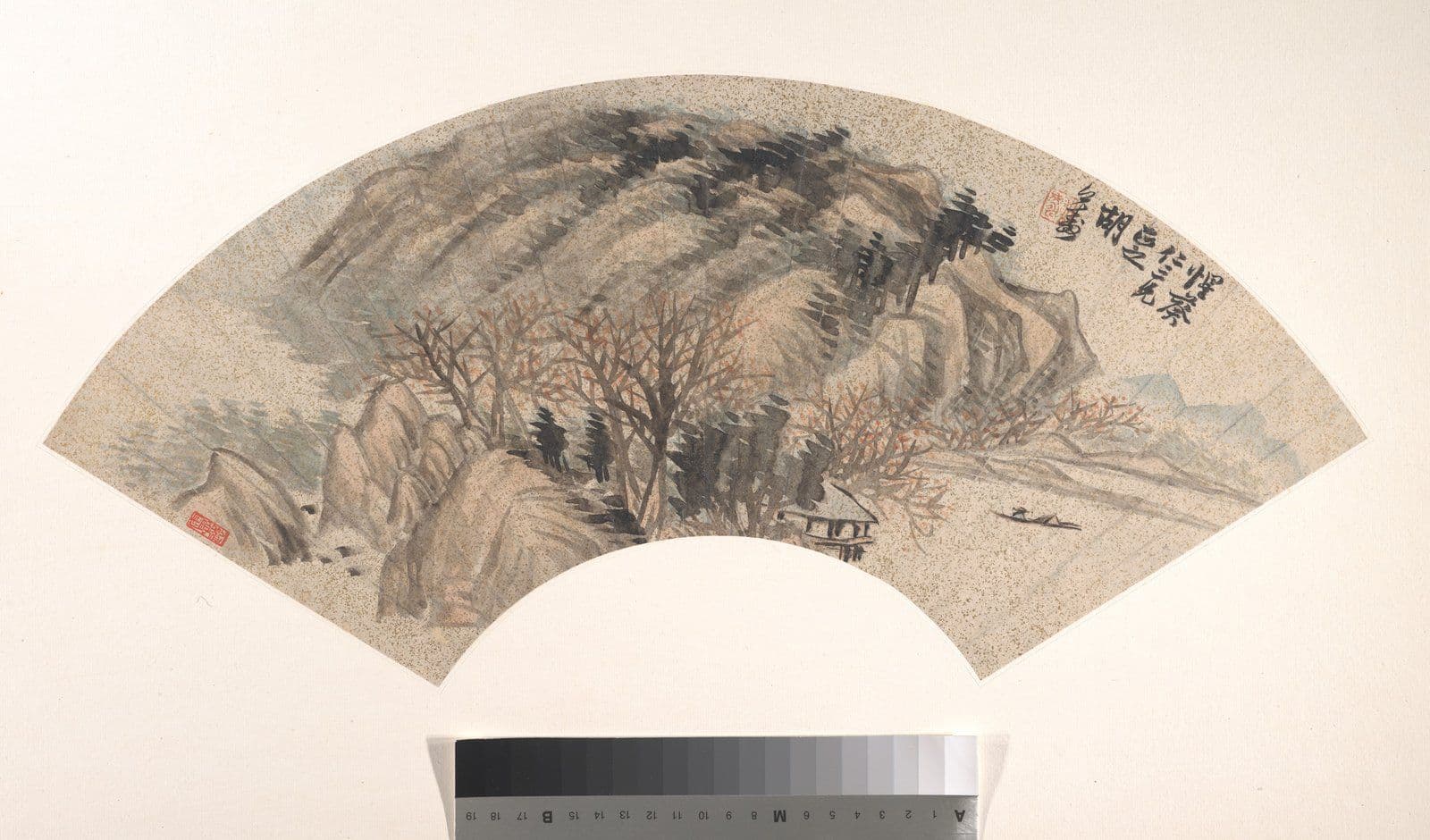
From the Kiln & Ink collection: Scenery of Lakes and Hills, an archival giclée edition after Huang Binhong, hand-numbered on xuan paper with a certificate of authenticity.
Explore Further