Published August 25, 2026
How to read a Chinese landscape painting: where the eye enters, Guo Xi's three distances, what the small figures are for, and how the rock is built.
You have the scroll open on the table, or hung where the afternoon light reaches it. There are mountains, some mist, a river, a few trees bent the same way. And then the looking stops, because nothing in the picture tells you what to do next. Western landscape painting hands you a viewpoint and asks you to stand there. A Chinese landscape does not. It assumes you are going to walk in.
That assumption is the whole subject. The Chinese word is shanshui — literally mountain-water — and it names a genre that treats a painting less as a window than as terrain. Once you know the route the painter built for you, a scroll that looked like scenery turns into something you can spend an hour inside. Here is how the route works, and what to look at while you are following it.
Shanshui is a place, not a view
The single most useful sentence ever written about this genre comes from Guo Xi, the Northern Song court painter who lived roughly from 1020 to 1090. His teachings were compiled by his son Guo Si into a treatise called Linquan Gaozhi, usually rendered as The Lofty Message of Forests and Streams. In it Guo Xi sorts landscapes by what you can do in them. Some can be walked through. Some can only be gazed at. Some can be wandered in. And the best ones can be dwelt in — you could imagine living there.
He is not being poetic. He is describing a design brief. A painter working in this tradition is building a habitable space and judging the result by whether a viewer could plausibly move through it. That is why the paths in a good shanshui always go somewhere, why the bridges connect two banks you can both see, and why a hut placed at the base of a cliff will have a plausible way to reach it.
So the first question to ask a landscape is not "what is this a picture of." It is: could I get from the bottom of this painting to the top? If yes, the painter knew the job. If the mountains are a beautiful wall with no way in, you are looking at decoration.
Where the eye enters, and where it is sent
Chinese landscapes are built to be read in a sequence, and the sequence is physical.
- In a hanging scroll, entry is almost always at the bottom edge, near the middle or slightly off-centre. There is usually a foreground device to receive you — a group of trees, a rock shelf, a stretch of near bank. From there the painter moves you back and up, typically by way of water, a path, or a diagonal of rock, into a middle ground, and finally to the main peak.
- In a handscroll, entry is at the right, and the painting is read section by section as it is unrolled, never opened out all at once. The format has its own etiquette, which is worth knowing before you handle one — we cover it in how to view a Chinese handscroll.
- In an album leaf or fan, there is no journey to speak of. The painter has one moment and takes a fragment: a corner of a lake, one branch, one boat.
The mistake most new viewers make is treating the main peak as the subject and everything else as approach. In practice the approach is where the painting is doing its work. The peak is the destination, and destinations in this genre are usually less interesting than the road.
Guo Xi's three distances
Guo Xi also gave the tradition its spatial vocabulary — the sanyuan, three distances. Almost every classical landscape uses one as its governing structure, and knowing which one you are looking at explains most of what the composition is doing.
- High distance (gaoyuan) — you stand at the foot of the mountain and look up. It produces the towering, vertical, monumental picture. This is the Northern Song mode at its most imposing; Fan Kuan, active around the turn of the eleventh century, is the name most associated with it.
- Deep distance (shenyuan) — you look from the front of the mountains through to what lies behind them, layer receding into layer. It produces depth by stacking and by veiling, and mist is the tool that does the veiling.
- Level distance (pingyuan) — you look out across low ground from a near height. It produces the wide, calm, horizontal picture, and it is the register Guo Xi himself used for some of his most quietly effective work.
None of these is linear perspective, and looking for a vanishing point is a waste of effort. The viewpoint in a shanshui moves. A single scroll will often show you a foreground from eye level, a middle ground from slightly above, and a far peak as though you had climbed to meet it. The inconsistency is deliberate — it is what allows a flat surface to be walked through rather than merely looked at.
The rock is built out of a named stroke
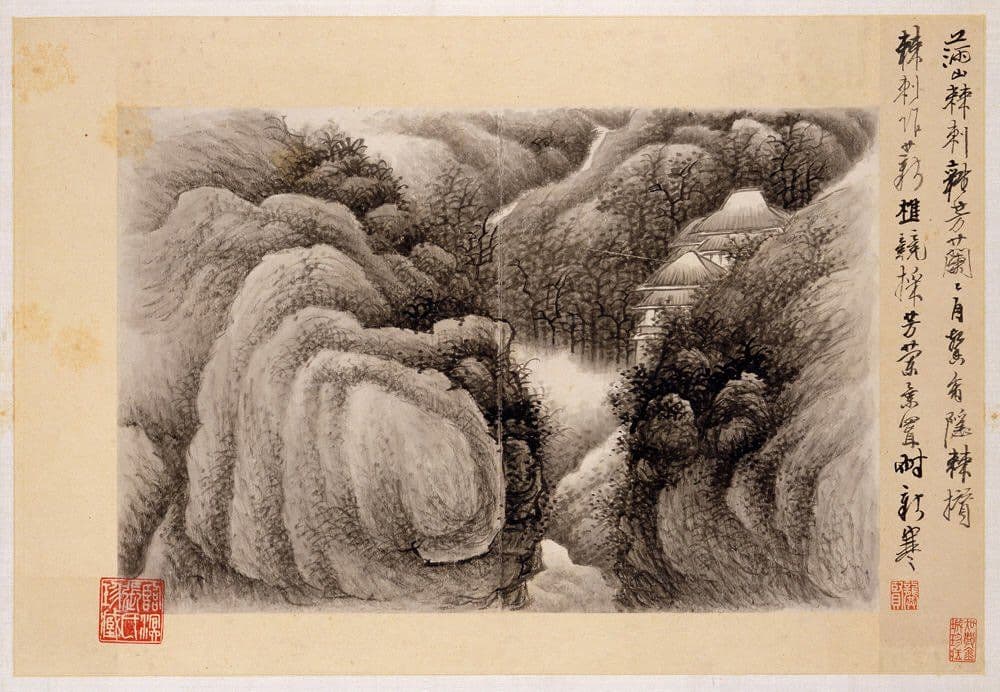
The other half of the craft is texture. After the outline of a rock or ridge is drawn, the painter fills its body with repeated modelling strokes called cunfa, usually translated as texture strokes or wrinkle strokes. These are not shading. They are a described surface, and each named type carries geological and regional meaning.
- Hemp-fibre strokes — long, soft, roughly parallel and slightly wavering, laid down like unravelled rope. They describe the rounded, earthen, vegetated hills of the south, and they anchor the lineage running from Dong Yuan and Juran through the literati painters who took them as a model.
- Axe-cut strokes — broad, flat, angular marks made with the side of the brush, hard-edged and abrupt. They describe fractured, exposed, crystalline rock, and they are the signature of the Southern Song academy manner.
- Raindrop strokes — dense clusters of short, blunt, downward dots massed until the rock face reads as granular and immensely heavy. Fan Kuan's mountains are the canonical case.
This is the level at which connoisseurship actually happens. Subject matter in this genre repeats endlessly; the handling of stroke does not. Two paintings of the same mountain by two painters are two different arguments about what rock is, and the argument is made in the cun.
Colour, when it appears, sits on top of that structure rather than replacing it. Blue-and-green landscape uses mineral azurite and malachite over ink drawing, and the way those minerals age is itself a dating tool — see our guide to mineral pigments in Chinese painting. The support matters too: silk takes a wet, blended, tonal stroke, while paper takes a dry, fibrous, absorbent one, and the difference is visible at arm's length once you know to look, as we set out in silk against paper.
The tiny figures are the instructions
Nearly every classical shanshui contains people, and they are nearly always small enough to miss. A scholar on a donkey. Two figures on a bridge. A fisherman. A servant carrying a qin behind his master. Someone at a window in a hut halfway up.
They are not incidental. They are scale markers and they are stage directions. Find the figure and you have found where the painter expects you to be standing, and usually what he expects you to be doing there — walking, resting, arriving, listening. A landscape with a figure gazing out at the far peak is telling you, plainly, to do the same.
The related habit is the empty area. Unpainted silk or paper in a shanshui is not unfinished. It is water, mist, sky, or distance, and it is doing structural work: separating the near from the far, giving the eye somewhere to rest between dense passages, and making the mountains feel further away than the physical distance on the surface could otherwise achieve. Ni Zan, one of the four great Yuan masters, built entire paintings around a wide empty band of water in the middle with a few trees on the near shore and a low ridge beyond — and left nothing else at all.
What changed, in about four hundred words
The genre matured under the Northern Song, and matured monumentally: a single dominant peak, a strictly ordered ascent, a picture that dwarfs the viewer. Guo Xi's Early Spring, dated 1072, is the textbook case of the mode at its most controlled.
The Southern Song academy inverted it. Painting moved to one corner or one side of the picture, the rest left in mist, so thoroughly that Ma Yuan was nicknamed "one-corner Ma" and Xia Gui "half-side Xia." The mountains stopped being the subject and became an atmosphere around a small, precisely observed human moment.
Under the Yuan, professional polish went out of fashion among the men who mattered. The literati painters — Huang Gongwang, Wu Zhen, Ni Zan and Wang Meng chief among them — painted for each other rather than for a court, using dry brush on paper, quoting earlier masters openly, and treating the landscape as a vehicle for personal temperament. Huang Gongwang's Dwelling in the Fuchun Mountains, worked on around 1347 to 1350, is the monument of that shift; it survived a seventeenth-century fire only in pieces, and remains split between two collections to this day.
The Ming and Qing then spent centuries in productive argument with all of the above, and the twentieth century reopened the whole question. Huang Binhong, who lived from 1865 to 1955, pushed accumulated ink so far that his late mountains read as almost solid black before the light in them resolves — the subject of our study of his late black landscapes. Others answered by importing Western light, atmosphere or scale outright.
What none of them abandoned was the premise. The mountains are still somewhere you go.
Looking at one you actually own
A few habits are worth forming with a scroll in front of you.
- Give it the distance it was made for. Hanging scrolls were built to be read from a few paces back, then approached. Judge the composition first from across the room, the brushwork only afterwards.
- Find the entry point before anything else. Bottom edge, near the middle. Then follow the route once, slowly, without stopping to admire.
- Then go back for the cun. Look at one rock face closely enough to name the stroke type. This is the fastest way to develop an eye, because it forces you to see handling rather than subject.
- Read the inscription and the seals last. They will tell you who painted it, often when, and sometimes for whom — and they are part of the composition, not an appendix to it. Our guide to reading a painting's inscription walks through the conventions.
- Do not hang it permanently. These works were rotated seasonally, and light exposure is cumulative and irreversible.
Common questions
What does shanshui mean, exactly?Mountain-water. The compound names the genre rather than describing a particular scene, and the pairing matters: the two elements are treated as complements, the solid and the yielding, and a landscape with only one of them is rarely considered complete.
Why do Chinese landscapes not use perspective?Because they are not organised around a single fixed observer. The viewpoint shifts through the picture, which is what allows a scroll to be travelled through in sequence rather than taken in at once. It is a different solution to depth, not a failure to arrive at the European one.
Are the places in a shanshui real?Sometimes, and it is usually not the point. Many carry real place names and some are recognisable. But the tradition treats a landscape as a constructed, ideal terrain assembled from studied observation rather than a record of a particular afternoon at a particular spot.
How do I tell a good landscape from a competent one?Two tests, in this order. Can you move through it — is there a coherent route, and does the space hold together as you follow it? Then, is the brushwork alive at close range — do the texture strokes vary in pressure, wetness and direction, or are they repeated mechanically? A picture can pass the first and fail the second, and that combination is the commonest signature of a skilled copy.
Where should a beginner start?With one painting and an hour, rather than a survey. Pick a landscape you can see properly, find the entry point, walk the route, then spend the remaining time on a single square inch of rock.
————————————————————
Explore more in our Huang Binhong artist page, or see the landscape in his own hand in Scenery of Lakes and Hills.
Explore Further