Published June 1, 2026
Fu Baoshi's rain landscapes fuse rock and downpour with a self-named texture stroke, the Bao Shi cun. Learn to recognise the method and spot copies.
Stand in front of a Fu Baoshi (傅抱石) mountain and the first thing you notice is that the rock has no outline. Where a classical landscape draws the contour of a cliff and then fills it with orderly texture strokes, Fu's peaks emerge out of a storm of fast, broken, overlapping marks — as if the mountain and the weather were painted in the same gesture. That tangle of strokes has a name. Collectors and art historians call it the Bao Shi cun (抱石皴), the texture method named after the painter himself.
This article will help you recognise that method on a scroll, separate it from the classical texture strokes it grew out of, and read the market and authenticity signals that come with one of the most forged names in twentieth-century Chinese painting.
Who Fu Baoshi was, and why the wartime years matter
Fu Baoshi was born in Jiangxi in 1904 and became, by mid-century, both a leading guohua (ink painting) master and a serious art historian. He studied in Japan in the early 1930s, where he absorbed the atmospheric, wash-heavy effects of Japanese painting and deepened his scholarship on Chinese art. He was, above all, a student of the early-Qing individualist Shitao (石涛); the name he took for himself, Baoshi — "embrace the stone" — signals that allegiance, since Shitao's own name carries the character for stone.
The style most collectors picture when they hear "Fu Baoshi" crystallised during the wartime years he spent near Chongqing. Living among the wet, fog-bound mountains of the southwest, painting on whatever paper he could get, he stopped drawing mountains and started letting them appear out of the ink. After 1949 he became one of the most decorated painters of the new state, and in 1959 he and Guan Shanyue painted the monumental This Land So Rich in Beauty (江山如此多娇) for the Great Hall of the People in Beijing, after a poem by Mao Zedong. That commission sealed his standing — and is part of why his market is what it is today.
What a cun actually is
To see what Fu invented, you need the thing he broke from. In Chinese landscape painting, cun (皴) — usually translated "texture stroke" — is the repertoire of marks used to model the surface of rock and mountain after the contour is drawn. Over many centuries painters codified named families of them: long, fibrous "hemp-fibre" strokes; hard, faceted "axe-cut" strokes; "raindrop" dots, and more. Learning to read cun is one of the most reliable ways to date and attribute a Chinese painting, because each era and master favoured particular strokes. For collectors coming from oil or watercolour, this is the least intuitive part of Chinese painting: the surface of a mountain is not shaded with tone but spelled out in a coded alphabet of strokes, and the choice of stroke is itself a statement of allegiance to one lineage or another. If the vocabulary of brush-and-ink is new to you, the oldest framework for judging it is laid out in our piece on Xie He's six principles.
The classical assumption is that the outline comes first and the texture fills it. Fu Baoshi inverted that.
The Bao Shi cun: texture without an outline
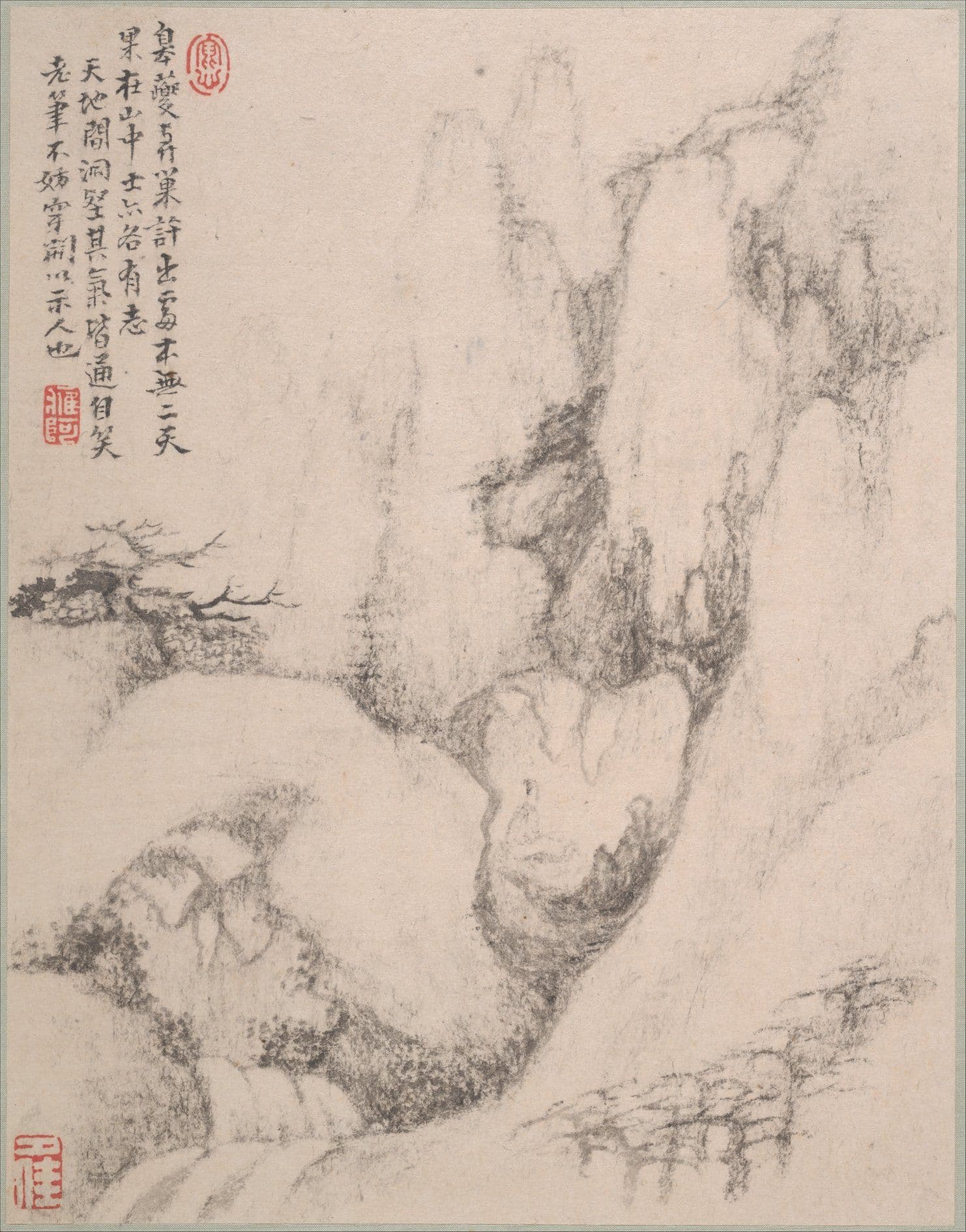
The Bao Shi cun is best understood as controlled disorder. Instead of neat, repeated strokes inside a drawn contour, Fu worked with a worn or split-tip brush — sometimes called a "scattered-tip" brush — dragged on its side at speed, so that a single pass laid down a spray of fine, broken, fibrous lines at once. He often flooded an area with wash first, then drove these scattered strokes through the still-wet ink, so the texture and the rock's form arrived together. The Chinese description, san feng luan cun (散锋乱皴) — "scattered-tip, disordered texture strokes" — captures it better than any English term: the marks look chaotic up close and resolve into a solid, rain-lashed mountain at arm's length.
Here is how the method differs from the classical strokes it grew out of:
| | Classical cun | Bao Shi cun (抱石皴) ||---|---|---|| Order of work | Contour drawn first, texture fills it | Wash and texture laid together; form emerges from the marks || Brush | Controlled tip, repeated strokes | Worn or split "scattered-tip" brush, dragged on its side || Rhythm | Even, deliberate, legible | Fast, broken, overlapping, semi-improvised || Up close | Orderly, nameable strokes | A tangle that looks almost abstract || At a distance | Modelled rock | Rock and weather fused into one atmosphere |
This is also why Fu sits where he does in the modern canon. His radicalism is a cousin of the splashed-ink and splashed-colour experiments of Zhang Daqian — both men pushed the wash itself to the foreground — while remaining rooted in the scholar-painter lineage rather than the court-academy tradition.
Painting the rain
Fu Baoshi's reputation rests above all on rain and mist, and the technique above is what makes the weather convincing. Rather than draw individual raindrops, he suggested a downpour through the diagonal sweep of his scattered strokes and washes — the whole surface tilts in one direction — and by reserving thin, pale streaks of untouched paper that read as sheets of falling water catching the light. Mist is handled the opposite way: broad areas of graded wash that swallow the base of a peak and let only its crown surface.
The result is a landscape that feels meteorological rather than topographical. You don't read a Fu Baoshi mountain as a place so much as a moment of weather. The same diagonal energy organises his compositions: peaks are often pushed to one side and sheared off by cloud, so the empty, wet air carries as much weight as the rock. When small figures appear — a traveller on a path, scholars under a roof — their smallness is doing work, setting the scale that makes the storm feel vast. When the method works, the eye accepts the chaos of marks as rain; when an imitator applies the strokes mechanically, the surface just looks busy, and the rain never falls. That gap between energy and decoration is the single most useful thing to watch for, and it is hard to fake.
Reading the market and the authenticity signals
Fu Baoshi is among the highest-priced twentieth-century Chinese painters at auction. His major landscapes and figure paintings reach the top tier of results at houses such as Poly, China Guardian, Sotheby's and Christie's, and that level of money is exactly why his name is also one of the most forged in the field.
A few signals matter when you look at a piece offered as his. The brushwork should carry genuine speed and pressure — the scattered strokes need to look inevitable, not laboured; copyists tend to slow down, and the energy dies. Figures, when he includes them (often robed scholars set against the mountains), are drawn with a fine, confident line that contrasts deliberately with the wild landscape; weak, hesitant figures are a warning. Fu was also known to paint in a heightened, sometimes inebriated state, and kept a seal reading, roughly, "often, after wine" — but a seal is the easiest thing to copy, so treat seals and signatures as the last layer of evidence, never the first. As always, provenance and a credible exhibition or publication history protect a buyer more than any single visual tell. On a practical level, ask for a condition report before anything else; ink on paper is fragile, and later retouching, heavy restoration, or an aggressive remount can quietly erode both the look and the value of a genuine work. How a scroll is mounted and remounted is part of that story too.
Common questions
How do I recognise a Fu Baoshi landscape at a glance?
Look for mountains that seem to be made of weather. The rock has little or no hard outline; instead it is built from fast, scattered, broken strokes that look almost abstract close up and resolve into a rain- or mist-laden peak at a distance. A diagonal, wind-driven sweep across the whole surface and pale reserved streaks standing in for rain are strong tells. Fine, controlled figures set against that wild landscape are common in his work.
Is the Bao Shi cun a real, named technique or a nickname?
It is a recognised term in Chinese art scholarship for the texture-stroke method associated with Fu Baoshi, built on the scattered-tip, "disordered" brushwork he made his own. Like most named cun, it describes a characteristic look rather than a single fixed recipe, so you will see it applied with some variation across his career.
Why is his work so expensive?
Two factors stack. He is a canonical figure — an innovator in technique and a state-honoured painter who co-created one of the most famous public paintings of the era — and the supply of genuine, well-provenanced works is limited against very strong collector demand in the Chinese market. That combination keeps his best landscapes in the top rank of modern Chinese painting results.
Are there authorised prints or editions of his paintings?
Fu Baoshi's reputation rests on unique, hand-painted ink works, not on a signed limited-edition print program of the kind some Western collectors expect. Reproductions exist — book plates, posters, decorative copies — but they are reproductions, not editioned original prints, and carry no auction value as "a Fu Baoshi". Treat anything described as a "print edition" of his work with care, and insist on knowing exactly what it is.
What should I check before trusting a signature or seal?
Check the brushwork first. Energy, speed, and the convincing fusion of rock and weather are far harder to fake than a seal or signature, both of which copyists reproduce routinely. Only after the painting itself reads right should the seal, signature and inscription be weighed — and even then, documented provenance and exhibition or publication history should carry more weight than any mark on the paper.
Further reading
Wu Guanzhong's Jiangnan Water Villages — another twentieth-century master who rebuilt landscape from a few essential marks.
Qi Baishi's Shrimp: Six Brushstrokes Into an Icon — how a radical economy of brushwork became a market signature.
Chinese Ink Painting vs Watercolor — why wash behaves so differently in the hands of a painter like Fu.
Reading Collector Seals on Chinese Paintings — how the red seals on a scroll record its ownership history.
Browse our ink paintings
Modern hand-painted landscapes and ink works in the scholar tradition, each honestly described and clearly attributed. — for collectors who want to live with the brush, not just read about it.
Explore Further