Published April 10, 2026
Chinese red seal stamps on art explained: artist seals, collector marks and studio seals, where each sits on a painting, and what a seal can and cannot prove.
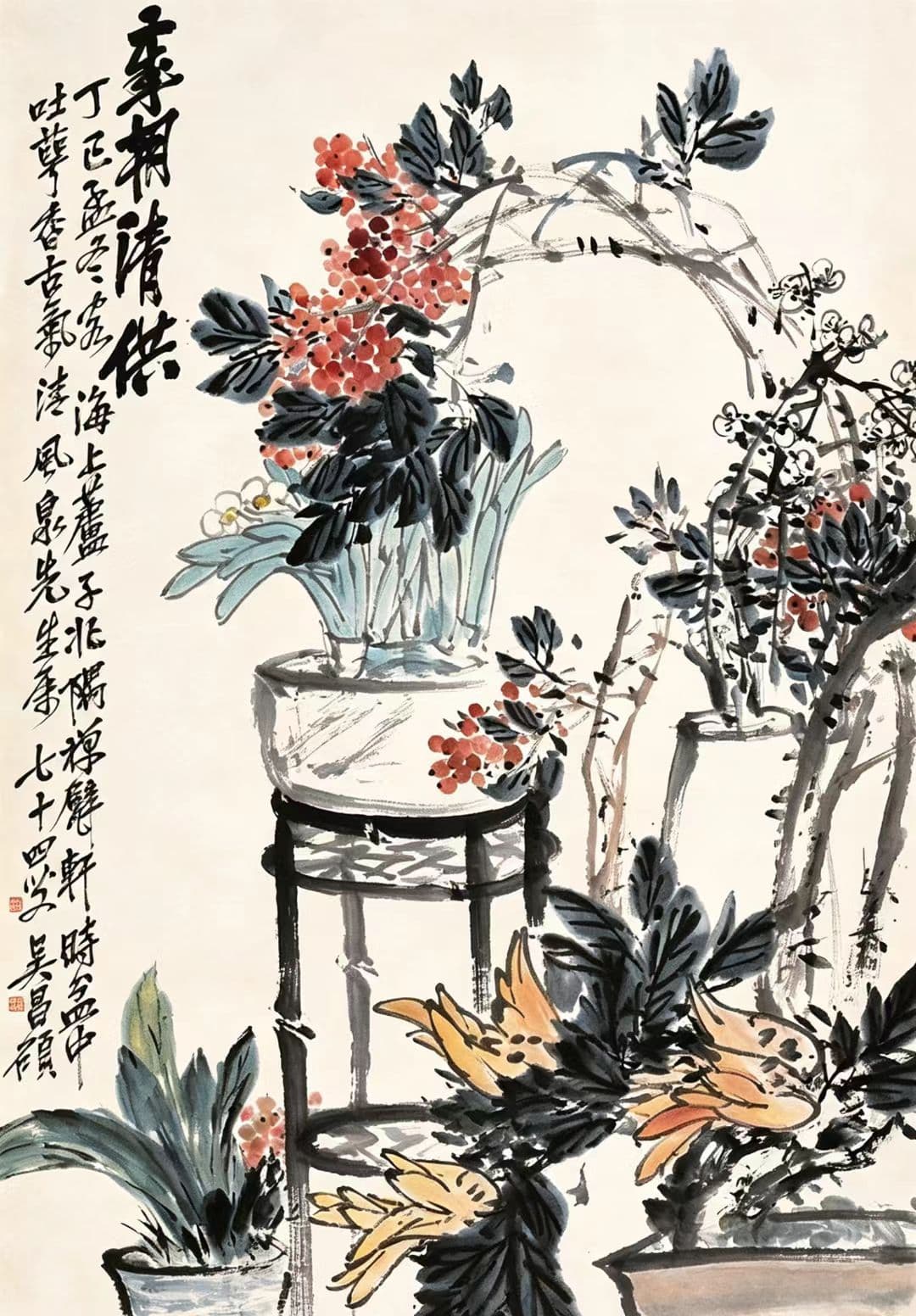
Every authenticated Chinese painting has at least one red seal in a corner. To Western viewers these often read as authentication stamps — bureaucratic markings imposed on the artwork. They are not. They are integral compositional elements, often carved by master seal-carvers who were themselves significant artists, and they are read as part of the painting in the way calligraphic signatures are read in Western art. This is a primer.
What's in a seal
A Chinese painting seal is a small block of stone, jade, or wood, with characters carved in relief on its base, inked with vermillion paste, and stamped onto the painting. The carving is in seal script (篆书), the most archaic of the Chinese script families, derived from bronze-inscription forms used in the Shang and Zhou dynasties (roughly 1500 BCE onward).
The seal's content is one of three things: the painter's name (姓名印), an alias or studio name (字号印, 室名印), or a poetic phrase or motto (闲章). A typical major work carries two of these — usually a name seal and either an alias or motto seal — placed near the signature.
Why multiple seals
Multiple seals serve different purposes. The name seal is the formal authenticator. The alias seal indicates the painter's literary identity at the time of the painting — and since painters often used different aliases at different career phases, the alias seal helps date the work. The motto seal is purely poetic; it might be a phrase the painter loved ("old man of the white stone" was Qi Baishi's; "painting fool" was Pan Tianshou's) and adds a layer of personal meaning to the work.
Some major paintings carry collector seals as well — when a painting passes through a notable collection, the collector often adds their own seal. A famous Song-dynasty work might bear ten or twenty collector seals from the centuries between its creation and now. These add to value rather than detract; they are provenance written directly onto the work.
The seal as composition
This is the part Western viewers most often miss. Painters did not place seals randomly. The placement is part of the painting's composition — usually balancing a heavy area of brushwork on the opposite side, or anchoring an empty corner, or extending a calligraphic stroke into the lower edge of the frame.
Look at any major Qi Baishi painting and you will notice the seal placement is doing real visual work. A horizontal painting of shrimp will have seals at the right end balancing the leftward swim of the figures. A vertical landscape will have seals at the lower right or upper left, completing a diagonal axis. The seal isn't punctuation; it's a closing chord.
Master seal-carvers
Many Chinese painters had their seals carved by friends who were themselves major artists in the seal-carving tradition. Wu Changshuo (1844–1927) is one of the most celebrated seal-carvers in Chinese history, and he carved seals for most of his contemporaries. Qi Baishi was a master seal-carver too — he carved his own seals throughout his life and was famous for the rough, archaic style of his stones.
This means a single painting may carry seals carved by two or three different masters: the painter's own seals, plus seals carved by master friends. The variation in seal style across these is part of what makes inspecting a painting at close range so rewarding — you are looking at multiple artists' work in a single composition.
Cross-tradition: porcelain seals
The same seal-script vocabulary appears on Chinese porcelain. Republic-era artist-signed porcelain panels by the Eight Friends of Zhushan use the same seal conventions you find on twentieth-century paintings. Modern master Jingdezhen porcelain similarly carries name-seal + alias-seal pairs in the same calligraphic style. Yixing teapot seals are again seal-script, though in impressed-clay rather than painted form.
Learning to read painting seals therefore opens up the entire Chinese material-culture universe — porcelain authentication, Yixing teapot collecting, calligraphic appreciation, even contemporary Chinese ink-art appreciation all share the same vocabulary. It is a single skill that pays out across multiple collecting categories.
How to start reading seals
Three practical steps for a Western collector:
First, get a basic Chinese seal-script reference. The standard is Lukas Nickel's Chinese Seal Script: An Introduction or, online, the Smithsonian's seal database. Both let you visually match the characters on a seal you have in front of you against canonical forms.
Second, spend an hour with a single major painter's seal record. Qi Baishi has perhaps thirty distinct seals he used across his career; his catalogue raisonné lists them with date ranges. After working through one painter's seal vocabulary, you will recognise his work by the seals alone.
Third, look at every Chinese painting you encounter as if the seals were the most interesting part. They often are. The technique-and-subject of the painting is what brought you to it; the seals are what tell you whose hand made it, in what year, in what state of mind.
The Kiln & Ink collection of master prints reproduces the signature-and-seal blocks at full archival resolution. Working through the seals of a Qi Baishi or Wu Changshuo print is the fastest way to develop the diagnostic eye — and the same eye, once trained, will read porcelain marks, teapot seals, and contemporary Chinese ink without re-tuning.
From the Kiln & Ink collection: Gourd, an archival giclée edition after Qi Baishi, hand-numbered on xuan paper with a certificate of authenticity.
Explore Further