Published August 1, 2026
Chinese rubbings explained: how ink impressions of stelae and bronzes were made, how collectors date them, and how to spot a printed facsimile.
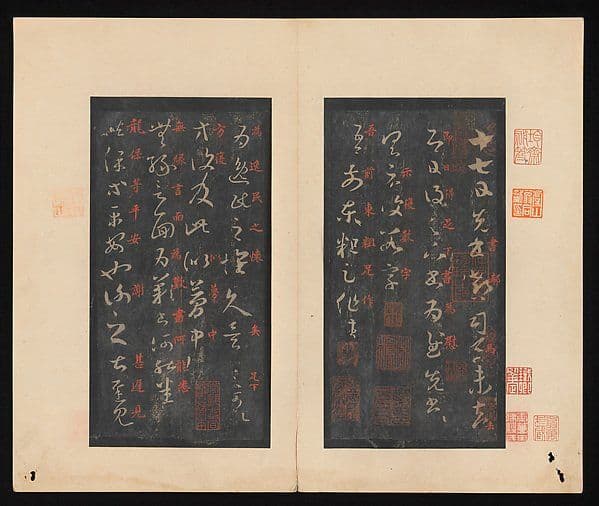
Hold a Chinese rubbing up to raking light and you can see something a photograph never shows: the paper is faintly embossed. Where the stone was carved away, the sheet dipped into the groove and came back holding no ink; where the stone stood proud, the ink pad struck it. The result is white characters on a black ground, and the surface still carries the shape of the object it was taken from.
This article explains what Chinese rubbings are, how they were made and why scholars collected them, how connoisseurs date one impression against another, and what to check before buying — including how to separate a real rubbing from a printed facsimile.
What a rubbing is, and why it mattered
A rubbing — taben in Chinese, sometimes tapian for a single sheet — is a direct ink impression taken from a carved or cast surface. Damp paper is laid on the stone, tamped into every incised line with a pad or brush until it takes the shape of the surface, then dabbed all over with an inked pad once it has dried to the right degree. Ink lands on the raised areas. The carved lines stay white.
Before photography, this was the only accurate way to reproduce writing at full size, and Chinese written culture depended on it. Model calligraphy was studied from rubbings. Classic texts carved on stone were circulated as rubbings. Bronze vessel inscriptions, invisible inside a dark vessel, became readable as flat sheets. The whole scholarly field of jinshi — literally "metal and stone", the study of inscriptions on bronzes and stelae — is built on this technique.
That field had two great moments. It took shape in the Song dynasty, when antiquarian scholars began systematically recording ancient inscriptions, and it revived powerfully in the Qing, when epigraphic study became central to serious scholarship. The Qing revival had a direct effect on art: calligraphers who had learned from smooth, elegant model-letter copies began instead to study the blunt, weathered carving of ancient stelae, and their brushwork changed accordingly. The stele-based manner runs straight through late Qing calligraphy and into the twentieth century — it is the tradition behind Wu Changshuo's stone drum calligraphy, where the artist's whole hand was formed by copying an inscription rather than a brush-written model.
For a collector coming from paintings, the useful reframing is this: a rubbing is neither a print nor a drawing. It is a contact record. Understanding where it sits among the five script types of Chinese calligraphy is often the fastest way into reading one, because the script tells you roughly what period of monument you are looking at.
The main types you will meet
Rubbings vary by technique, by subject, and by how they were mounted. Each affects value.
By ink handling. Two named styles come up constantly in descriptions. Wujin — "black gold" — is a dense, glossy, saturated black, laid on heavily so the characters stand out with maximum contrast. Chanyi — "cicada wing" — is the opposite: an extremely light, even, translucent grey, thin enough that fine surface detail survives. Neither is better; they suit different stones and different purposes, and a skilled rubber chose deliberately.
By subject. Stele rubbings (from upright inscribed stones) are the largest group and the backbone of calligraphic study. Bronze inscription rubbings record the cast texts inside ritual vessels. Tomb-figure and pictorial stone rubbings reproduce carved images rather than text, and are the most immediately decorative to a Western eye. Seal and brick rubbings occupy a specialist corner.
Full-form rubbings. A distinct nineteenth-century speciality is the quanxing or full-form rubbing, in which a three-dimensional bronze vessel is rendered on a single sheet with a sense of volume and perspective, assembled from many carefully positioned impressions. These are technically demanding, comparatively rare, and often carry colophons from the scholars who commissioned them.
By mounting. A rubbing may be mounted as a hanging scroll, kept as a large loose sheet, or — very commonly — cut into columns and remounted into an album for reading and comparison. Cut-and-mounted albums are normal and not a defect, but the cutting is irreversible and the quality of the mounting matters, exactly as it does for paintings. The conventions of Chinese mounting apply to rubbings directly, and a rubbing remounted badly can be flattened, trimmed or stained in ways that cost it value permanently.
How connoisseurs date and rank an impression
Here is the point that surprises most new collectors: with rubbings, the date of the impression matters more than the date of the stone. Two rubbings from the same Tang stele may be separated by six hundred years, and be worth wildly different sums.
The logic is simple. Stone weathers, gets knocked, cracks, is recut, and in the worst cases is destroyed. Every year that passes, the inscription loses a little more. So an early rubbing preserves more of the original carving than a late one, and a rubbing taken before a documented act of damage is the only surviving record of what was there before.
Connoisseurs therefore date rubbings by collation points: specific characters or strokes known to have been intact at one period and damaged by another. Scholarly catalogues record these checkpoints for the famous monuments in exhaustive detail, and a serious description will cite them — this character still complete, this crack not yet present. When a dealer says a rubbing is "early", the honest version of that claim is a checkpoint, not an adjective.
Two other factors rank an impression:
- Quality of the rubbing itself. Even ink, no smudging, no double-strike, characters not choked with ink at the edges, the paper not torn where it was tamped. A clumsy rubbing from an early state is still worth more than a beautiful one from a worn state, but craftsmanship counts.
- Colophons and collectors' seals. Rubbings were passed among scholars, who wrote colophons and stamped their seals on the mounting. A sheet carrying the seals of known collectors has a documented chain of custody. Reading those marks works the same way it does on paintings, and the standard vocabulary of collectors' seals and studio marks transfers without modification.
Rubbings, prints, and reproductions
Because rubbings are black-and-white images on Chinese paper, they get confused with two other things.
The first is woodblock printing. A rubbing is taken from an object that already existed for another purpose; a Chinese woodblock print is pulled from a block cut specifically to be printed, and it prints black lines on white rather than white lines on black. The two traditions overlap in technique and in the workshops that practised them, but they are separate collecting fields.
The second is the modern facsimile, and this is where money is lost. Photolithographic reproductions of famous rubbings have been printed in large numbers since the late nineteenth century, many of them very good, some deliberately aged. Checks that work:
- Relief. A genuine rubbing has slight embossing where the paper was pushed into the carving. Raking light across the surface shows it; a flat printed sheet shows nothing.
- Ink behaviour. Rubbing ink sits on the paper fibres unevenly, with granular texture and softly irregular edges where the pad struck. Printed ink is uniform and may show a regular dot pattern under magnification.
- Verso. On a real rubbing the ink barely penetrates; heavy, even bleed-through can indicate printing.
- Edges. Rubbings show the physical limits of the stone and often the rubber's overruns. A print reproduces those irregularities as part of the image, without the corresponding change in surface.
Separately, there are genuine rubbings taken from replica or recut stones. These are honest objects and often useful study material, but they are not early impressions and should not be priced as such. Many important monuments are now protected and no longer rubbed at all, which is why new impressions of famous stelae should raise a question rather than excitement.
Common questions
Are rubbings originals or reproductions?
Both, in a sense — which is why the field confuses newcomers. Each rubbing is a unique physical object, made by hand in direct contact with the monument, and no two are identical. But its purpose was to reproduce something else. Collectors treat rubbings as originals, value them by their maker's skill and the state of the stone at the time, and describe them by the monument they record.
Why are the characters white instead of black?
Because ink is applied only to the surfaces that stand proud. On a carved inscription, the characters are cut into the stone, so they sit below the surface, the paper never touches ink there, and they come out white. On the rarer relief carvings, where the design stands above the ground, the effect reverses and the image reads black. Seeing which way round a sheet is tells you immediately what kind of carving it came from.
How do I store and display a rubbing?
Treat it as a work on paper, because that is what it is. Keep it out of direct sunlight and away from damp, which is the main enemy of both the paper and the mounting's starch paste. Albums are best kept flat and closed; hanging scrolls should be rolled loosely and not left hanging permanently. If you display one, rotate it. The same handling rules that protect a painting on paper protect a rubbing, and the differences between silk and paper supports are worth understanding before you frame anything.
What is a sensible way to start collecting?
Buy a well-made rubbing of a monument you actually want to read, in decent condition, from a seller who describes its state honestly — rather than a famous name in a late, tired impression. Pictorial stone rubbings and smaller bronze-inscription sheets are usually the most accessible entry point, and they teach you the technique before you spend seriously on the canonical stelae, where the money sits in checkpoint-level distinctions.
Further reading
- Collectors' Seals and Marks on Chinese Paintings — how to read the ownership trail stamped on a mounting.
- Chinese Cyclical Dates and the Ganzhi System — how dated inscriptions record the year.
- How to Read a Chinese Painting Inscription — the same skill applied to colophons on rubbings.
- Chinese Album Leaves and Fan Paintings — the album format that many rubbings were remounted into.
Browse the collection
If you would rather live with these images than only read about them, the Kiln & Ink collection holds limited-edition archival giclée reproductions of the twentieth-century Chinese ink masters — hand-numbered, printed on rice paper, and issued with a Certificate of Authenticity.
Explore Further