Published July 25, 2026
A collector's guide to Chinese woodblock prints: folk nianhua, color-printed manuals, modern editions, and how to read edition numbers before you buy.
The first thing most people do with a print they are thinking of buying is turn to the lower margin and look for a fraction written in pencil — 12/50, or nothing at all. That small number, or its absence, decides a great deal: whether you are holding a limited artist's edition, an open reproduction, or a folk print that was never numbered because it was never meant to be collected in the first place. Chinese woodblock prints run across all three, and telling them apart is most of what careful buying comes down to.
This guide walks through the Chinese woodblock tradition — folk New Year prints, the refined color manuals, and the modern artist editions — and then through how to read an edition number and judge a print before you commit.
A tradition older than the printed book in the West
China printed from carved wooden blocks centuries before movable type reached Europe. The earliest dated printed book that survives — a copy of the Diamond Sutra from 868 CE, recovered at Dunhuang — opens with a woodblock illustration, which makes Chinese woodblock imagery roughly as old as printing itself. For a thousand years afterward, the block print did the everyday work of pictures in China: religious images, book illustration, playing cards, and prints for the home.
Two strands of that history matter most to a collector. One is the popular strand — cheap, bright prints made in enormous numbers for ordinary households. The other is the refined strand, in which printers reproduced the effects of brush painting so faithfully that the line between a print and a painting could blur. Both feed directly into what the tradition sells and reproduces today, and both rest on the same painting culture summarized in the six principles of Chinese painting.
The refined strand had a public face as well. The Suzhou workshops of the eighteenth century produced large, sophisticated pictorial prints — some experimenting with the European perspective then arriving through the port cities — that were admired and exported abroad, and the Chinese water-based color method fed into printmaking across the wider region. A collector meets this tradition, in other words, at every level, from a penny door-god pasted on a gate to a virtuoso color plate meant to rival a painting.
How a Chinese color woodblock is made
A single-color print needs one carved block. A color print needs one block for every color, each carved separately, each inked, and each pressed onto the same sheet in turn — which means the sheet has to line up perfectly under every block, or the reds print outside their outlines. That registration problem is the whole craft.
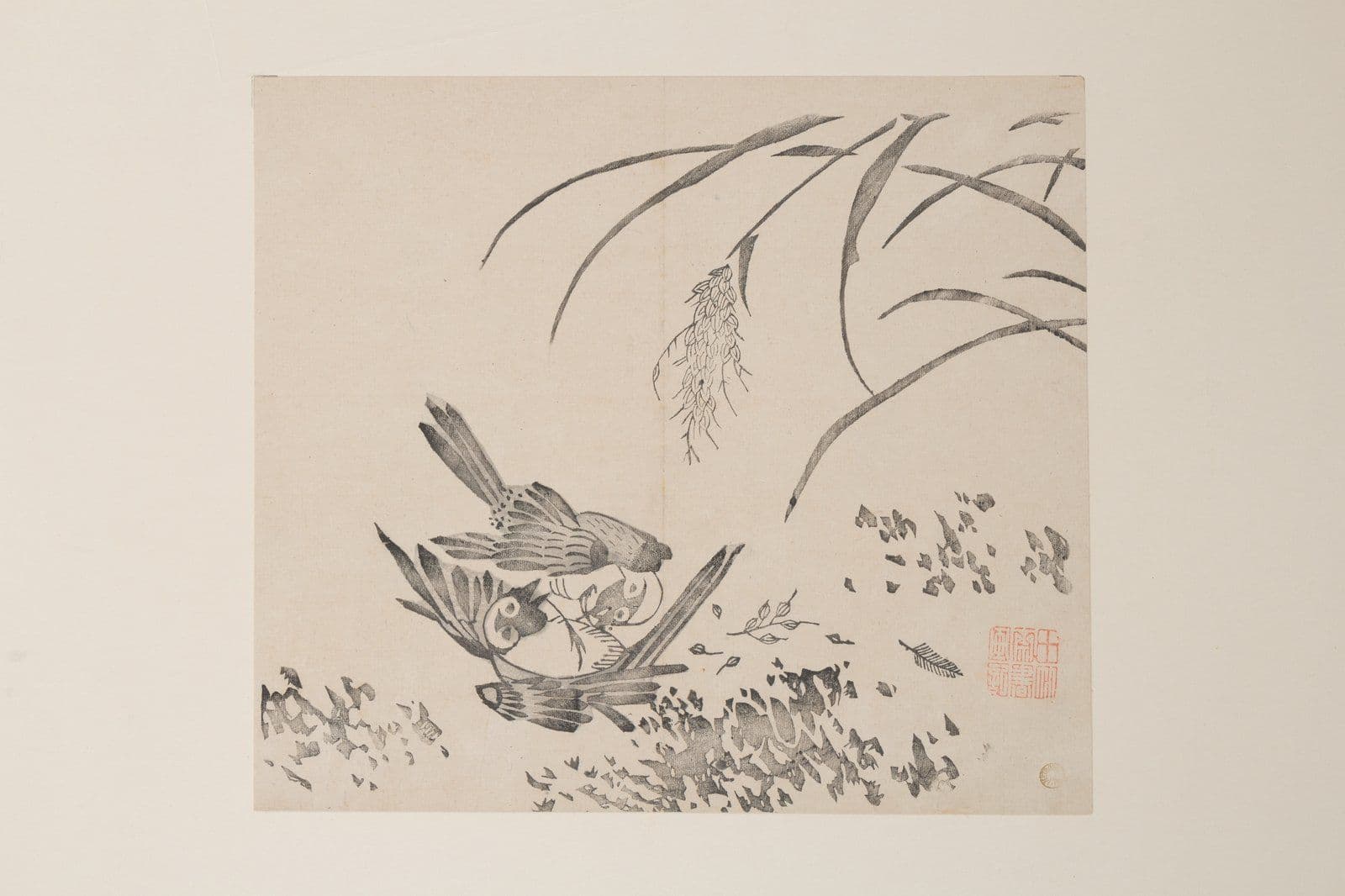
Chinese printers solved it with extraordinary refinement. The polychrome method known as douban — literally assembling the image from many small, separately carved and inked blocks — let printers grade a single petal from deep to pale, imitating a wash. A companion technique, gonghua, embossed unlinked areas of the paper to raise a blind, colorless relief. Two late-Ming manuals show the method at its height: the Ten Bamboo Studio collection of around 1633 and, later in the century, the first part of the Mustard Seed Garden Manual of Painting in 1679. Both were printed to teach and delight, and both are landmarks of color printing anywhere in the world.
The ink itself is the other key difference. Traditional Chinese prints are water-based — the same water-and-ink and mineral pigments used in painting, not the oil-based inks of Western printmaking. That is why a fine Chinese print can look so much like a painting, and why the color sits into the paper rather than on top of it. The pigments involved are the same family described in the guide to mineral pigments in Chinese painting. In the twentieth century the Beijing studio Rongbaozhai carried this water-based method to a peak, producing facsimiles of famous paintings so exact that they are collected in their own right — while never being mistaken, by anyone honest, for the originals.
From folk prints to modern editions
The popular strand is nianhua (年画), the New Year print: door gods, chubby children, gods of wealth and the kitchen, pasted up at the Lunar New Year and replaced the next year. Four production centers became famous for them — Yangliuqing near Tianjin, Taohuawu in Suzhou, Yangjiabu in Weifang, and Zhuxian Zhen in Henan — each with its own palette and character. Antique nianhua were printed in bulk and never numbered; they are collected today for folk-art appeal, regional style, and survival, since paper pasted on a door does not usually last.
The modern strand is different in spirit. In the early 1930s the writer Lu Xun championed a New Woodcut Movement, urging young artists to carve their own blocks rather than hand a design to a craftsman — original prints, often stark black-and-white, socially engaged, and influenced by European printmakers. This is the tradition of the artist's print: designed, cut, and pulled as a deliberate, limited work, signed and numbered by the artist. When a Chinese print carries a pencil signature and an edition fraction in the margin, it belongs to this modern lineage, and the signature and any seals should be read with the same care you would give a painting — the guide to seals and collector marks applies here too.
Between the antique folk print and the modern artist's edition sits a third category the market is full of: fine reproductions. Studios reproduced famous paintings and older prints as water-based woodblock facsimiles, and these can be beautiful and collectible on their own terms — as long as they are sold as what they are. The trouble starts only when a reproduction is presented, by accident or by design, as an original. Keeping these three buckets — folk print, original edition, facsimile — clear in your head is the single most useful habit a print buyer can build.
How to read an edition number and judge a print
An edition fraction is simple once you know the convention. In 12/50, the second number is the size of the edition — 50 impressions authorized — and the first is this sheet's place in it. The number is not a quality ranking; a "3" is not better than a "40." You may also see lettered proofs: A/P or E/A for an artist's proof, pulled outside the numbered run for the artist's own use. An original limited edition is signed and numbered by hand, usually in pencil, in the margin.
Three things then separate a good impression from a poor one:
Impression quality — blocks wear with use, so early impressions in an edition print crisper than late ones. Look for clean, unbroken lines and full, even color.
Registration — in a color print the colors should sit inside their outlines. Colors drifting off their shapes mark a careless or late pull.
Condition — check for foxing (brown spots), fading in the mineral colors, trimmed margins that remove the signature or edition number, and old backing or tape.
And one distinction sits above all of them: is this an original creative print, a numbered facsimile, or an unnumbered reproduction? A signed, numbered artist's print and a fine Rongbaozhai-style facsimile are both legitimate things to own, but they are not the same thing and should never carry the same price. A poster or book plate is a picture of a print, not a print. When in doubt, the general method in how experts authenticate Chinese paintings transfers cleanly to prints.
Common questions
What do the numbers on a print, like 15/50, mean?
The second number is the total size of the edition — here, 50 authorized impressions — and the first is this particular sheet's number within it. It is a record of place in the run, not a grade of quality; 15/50 is neither better nor worse than 40/50. Letters such as A/P or E/A indicate an artist's proof pulled outside the numbered edition.
Is an old Chinese New Year print (nianhua) valuable?
Nianhua were made cheaply in large numbers and were never a limited edition, so most are modest in value and collected for folk-art character, regional style, and rarity of survival rather than for edition status. Age, condition, a strong center's style, and vivid original color matter far more than any number, since there is no number to find.
How do I tell an original print from a reproduction?
Look for a hand signature and edition number in the margin, the crisp line and inset water-based color of a genuine pull, and consistent age in the paper. A photomechanical reproduction — a poster or book plate — typically has a dot pattern under magnification, no plate or block impression, and no hand signature. A fine woodblock facsimile, such as those made in the Rongbaozhai manner, is a legitimate object but should be described and priced as a reproduction, never as the original.
Are woodblock facsimiles worth collecting?
Yes, on their own terms. A skilled water-based woodblock facsimile of a famous painting is a real feat of craft and is collected as such — but it is a reproduction, not the original work, and should always be described and priced that way. Judge it by the printing itself: crisp registration, fresh mineral color, good paper, and honest labeling. The only real problem is a facsimile that has quietly lost its label and drifted toward being sold as an original.
Further reading
How to Buy Chinese Art at Auction — reading condition reports and setting a limit before you bid.
How Experts Authenticate Chinese Paintings — a method that carries straight over to prints.
The Five Scripts of Chinese Calligraphy — for reading the inscriptions and colophons that appear on many prints.
Browse our collection
Hand-pulled and hand-painted works in the living Chinese tradition, each honestly described and, where editioned, clearly numbered. — the difference between an original and a reproduction, stated plainly.
Explore Further