Published July 20, 2026
Chinese art is dated with two ganzhi characters, not a number. How the 60-year cycle works, and how to convert a cyclical date into a Western year.
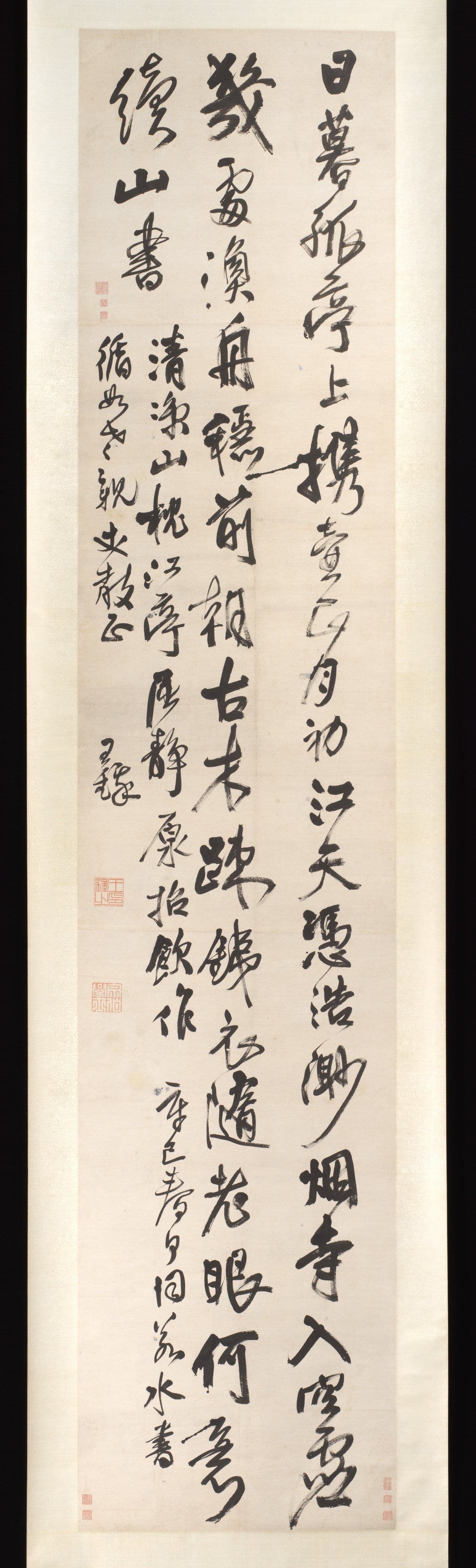
Near the end of the inscription on a Chinese painting, just before the artist's signature, you will often find two characters that are neither a name nor a poetic flourish. They are the date — written in a system that repeats every sixty years, names no century, and assumes the reader can supply the missing information from context. A dealer glances at those two characters and says "1924"; the catalog says "dated jiazi year"; and the beginner wonders how anyone got a Western year out of either.
This is the ganzhi (干支) cyclical dating system, and it is one of the highest-return skills a collector of Chinese painting and calligraphy can learn. The mechanism takes ten minutes to understand. This guide covers how the cycle works, how to convert a cyclical date to a Western year, and what the date can tell you about authenticity.
How the sixty-year cycle works
The system combines two old counting sequences. The first is the ten "heavenly stems" (天干): jia 甲, yi 乙, bing 丙, ding 丁, wu 戊, ji 己, geng 庚, xin 辛, ren 壬, gui 癸. The second is the twelve "earthly branches" (地支): zi 子, chou 丑, yin 寅, mao 卯, chen 辰, si 巳, wu 午, wei 未, shen 申, you 酉, xu 戌, hai 亥 — the same twelve that map onto the zodiac animals, rat through pig.
Each year takes one stem and one branch, and both sequences advance together: jiazi 甲子, yichou 乙丑, bingyin 丙寅, and so on. Because ten and twelve advance in lockstep, only sixty distinct pairs occur before the combination returns to jiazi and the cycle begins again. A ganzhi date therefore tells you exactly where a year falls within a sixty-year wheel — and nothing at all about which turn of the wheel you are on. That second piece of information has to come from somewhere else, which is where connoisseurship enters.
Converting a cyclical date: anchors and lifetimes
In practice nobody computes stems and branches from scratch. You read the two characters, look up the pair in a table, and get a year ending in a fixed offset — then choose among candidates sixty years apart. A few anchor pairs, fixed in memory by well-known historical events, cover a surprising amount of ground:
| Cyclical pair | Recent occurrences | Memory anchor ||---|---|---|| jiazi 甲子 | 1864 · 1924 · 1984 | First pair of the cycle — "cycle restart" years || jiawu 甲午 | 1894 · 1954 | The 1894 war with Japan is called the Jiawu War in Chinese || wuxu 戊戌 | 1898 · 1958 | The 1898 Hundred Days' Reform (Wuxu Reform) || gengzi 庚子 | 1900 · 1960 | The Boxer year 1900 || xinhai 辛亥 | 1851 · 1911 | The 1911 Xinhai Revolution that ended the empire |
The disambiguation step is usually trivial once you know the artist. Take a painting with an inscription dated jiazi 甲子 and a signature of Qi Baishi, who lived from 1864 to 1957. The candidates are 1864 — the year he was born — and 1924, when he was in his Beijing prime. The date reads 1924, no arithmetic required. This is why a cyclical date is genuinely informative rather than circular: the artist's documented lifetime, together with style and subject, selects the cycle for you. It is the same layered reasoning that runs through all of how experts authenticate Chinese paintings — independent clues that either converge or collide.
Artists frequently make it even easier by writing their age into the inscription — "at age eighty-five" alongside the cyclical year. One caution here: traditional Chinese age counting (sui 岁) starts a person at one at birth, so a stated age typically runs one or occasionally two years ahead of the Western count. A stated age that disagrees with the cyclical date by one is convention; a disagreement of ten is a problem.
When the date pins the exact year
Cyclical characters do not always stand alone. On imperial objects and older paintings, the ganzhi pair often follows a reign name — "Qianlong yiwei" 乾隆乙未 reads as "the yiwei year of the Qianlong reign," and since only one yiwei falls within Qianlong's reign (1736-95), the date is exactly 1775. Reign-plus-cycle dates are self-contained: no lifetime reasoning needed. This is the painting-and-calligraphy cousin of the reign-mark system on porcelain — if you collect across both, the master guide to porcelain reign marks covers how era names work on ceramics.
Twentieth-century works add one more convention: dating by the Republic. An inscription reading "the 25th year of the Republic" (民国二十五年) counts from 1912, giving 1936. Modern and contemporary artists sometimes simply write Western years, but the cyclical habit never died — plenty of paintings made in the 1980s and 1990s carry ganzhi dates, usually alongside enough context to place them.
The rest of a traditional date, when present, refines the season: terms like "mid-spring" (仲春) or "autumn month" name lunar seasons and months. These rarely change your attribution reasoning, but they add texture — and they follow the lunar calendar, so a "first month" date falls in late January or February, not January 1.
What cyclical dates mean for authentication
A date is a checkable claim, and forgers have to get it right in several directions at once:
- Date versus lifetime. A cyclical year that lands outside the artist's documented working life — or in their childhood — is disqualifying unless there is an innocent reading. This is the first arithmetic every specialist runs.
- Date versus style. Artists evolve. A work dated to an artist's early cycle but painted in their unmistakable late manner invites hard questions; the inscription and painting must belong to the same moment of the career.
- Date versus script and formula. Inscription conventions changed over time, and each artist had habits — how they phrased dedications, which studio names they used in which decades, how they wrote their age. A date embedded in the wrong formula is a subtle but real warning. The scripts themselves carry period information too, as covered in our guide to the five scripts of Chinese calligraphy.
- Date versus seals. Artists' seals changed across their careers, and specialists track which seals were in use when. A 1920s date sharing paper with a seal the artist only adopted in the 1940s is a collision — one of the classic tells discussed in reading collector seals.
None of this makes a right date proof of authenticity — copyists can do arithmetic. But dates create opportunities for internal contradiction, and contradictions are how attributions fail.
A worked routine for the collector
Faced with an inscribed and dated work, the practical sequence looks like this: find the cyclical pair (usually immediately before or after a season term, near the signature); look the pair up in any ganzhi table to get the candidate years; bracket the candidates against the artist's dates; check any stated age, remembering the sui convention; and note whether a reign name, Republic year, or dedication narrows it further. Ten minutes with a reference table turns "dated jiazi year" from catalog mystery into a fact you can verify — and verifying small facts yourself, rather than outsourcing all judgment, is how a collector's eye actually gets built. For the fuller anatomy of inscriptions — dedications, titles, studio names, and where the date sits among them — see the companion guide in the reading list below.
Common questions
Why did Chinese artists use a repeating cycle instead of a running count?
A continuous era count existed — years were officially recorded by reign name plus year number — but the sixty-year cycle was the shared cultural clock: it named a person's birth year, structured the calendar, and carried associations the way "the sixties" does in English. For a literati painter, the cyclical date placed a work inside a human timescale — a sixty-year cycle approximates a lifetime — and assumed exactly the kind of informed reader the whole inscription tradition assumes.
What if the artist's dates don't resolve the ambiguity?
Occasionally a long-lived artist has two plausible candidates sixty years apart within one career — or the work is unsigned. Then the other evidence decides: paper and silk, mounting, style, seals, subject, and provenance. In practice a sixty-year gap is stylistically enormous, and specialists rarely find the choice genuinely difficult; when they do, catalogs will honestly give both readings.
Do porcelain marks use cyclical dates too?
Sometimes. While imperial porcelain overwhelmingly used reign marks, cyclical dates appear on some scholarly and privately commissioned wares, and inscribed Republic-period porcelain plaques frequently carry full ganzhi dates in their painted inscriptions — the same reading skills transfer directly.
Is there an easy way to look up a ganzhi pair?
Yes — any printed or online conversion table lists all sixty pairs against Western years, and searching the romanized pair (for example "renyin year") returns the candidates instantly. The skill worth internalizing is not the table; it is the habit of bracketing candidates against the artist's lifetime and then testing the date against style, seals, and script.
Further reading
- How to Read the Inscription on a Chinese Painting — the full anatomy the date sits inside.
- Qi Baishi's Shrimp: Six Brushstrokes Into an Icon — the master whose 1864 birth year makes him the classic conversion example.
- Wu Changshuo: The Seal Carver Who Reinvented Flower Painting — an artist whose epigraphic inscriptions reward exactly this kind of close reading.
- Literati Painting vs Court Painting — why the scholarly tradition wrote for readers who could supply the missing century.
Browse the collection
The same tradition, on a wall rather than a page: our collection of archival giclée reproductions after Qi Baishi, Xu Beihong, Wu Guanzhong and Zhang Daqian, each hand-numbered and supplied with a Certificate of Authenticity.
Explore Further