Published August 20, 2026
Pine soot ink explained: how pine and oil soot sticks differ, what the glue does, why aged ink is prized, and the tests for a stick worth grinding.
Pick up a Chinese ink stick and the first thing you notice is that it is heavier than it looks and colder than your hand. Tap it against a fingernail and a good one rings rather than thuds. Neither observation tells you much on its own, but both are things collectors have been doing for centuries, and they are doing them because an ink stick is a manufactured object with a quality range as wide as any other — and unlike a painting, it announces almost nothing about itself on the outside.
This guide covers what an ink stick is actually made of, the real difference between the two soot families, how age changes the material, and what to look at when you are deciding whether a stick is worth grinding or worth keeping.
What an ink stick is made of
Chinese ink is two ingredients and a great deal of process. The two ingredients are soot and animal glue.
Soot is collected by burning something under a controlled draught and scraping the deposit off the collecting surface. Glue — rendered from hides or bones — binds the soot into a solid and, when the stick is later ground into water, holds the carbon particles in suspension so they flow off the brush instead of settling.
The process is where the quality lives. The soot is sieved and graded; finer, lighter fractions collected further from the flame are the premium material. Soot and glue are kneaded, sometimes for hours, sometimes with additives, then pressed into carved wooden moulds and dried slowly over weeks or months. Dry an ink stick too fast and it cracks or warps, which is why the drying schedule is the part of the process makers were most secretive about.
Additives vary by workshop and period, and this is where most published descriptions become unreliable. Musk, camphor, various plant extracts and gold leaf all appear in historical accounts, some of them functional and some of them marketing. Treat any specific recipe claim about a specific stick with the scepticism you would apply to any other unverifiable provenance story.
Pine soot and oil soot
Almost every meaningful distinction between ink sticks starts here.
Pine soot ink (songyan) is made by burning resinous pine. It gives a black that reads cool and slightly blue-grey, with a matte, light-absorbing surface when dry. The particles tend to be less uniform.
Oil soot ink (youyan) is made by burning oil in lamps — tung oil most classically, also rapeseed and sesame — and collecting the lamp black. It gives a warmer, denser black with a visible sheen when applied heavily, and the particle size is generally finer and more even.
- Tone — pine soot reads cool, matte and slightly grey-blue; oil soot reads warm and dense, with a sheen in the heaviest passages.
- Particle character — pine soot is coarser and more variable; oil soot is finer and more uniform.
- Traditional preference — pine soot for landscape, texture strokes and dry-brush work; oil soot for calligraphy, fine detail and glossy accents.
- Behaviour in dilution — pine soot separates readily into distinct grey steps; oil soot holds a smoother gradient.
Neither is better. They are different materials for different intentions, and painters have historically kept both. The tonal separation of pine soot is exactly what a landscape painter wants when building texture in layered dry strokes; the depth and evenness of oil soot is what a calligrapher wants for a character that must read as one continuous weight.
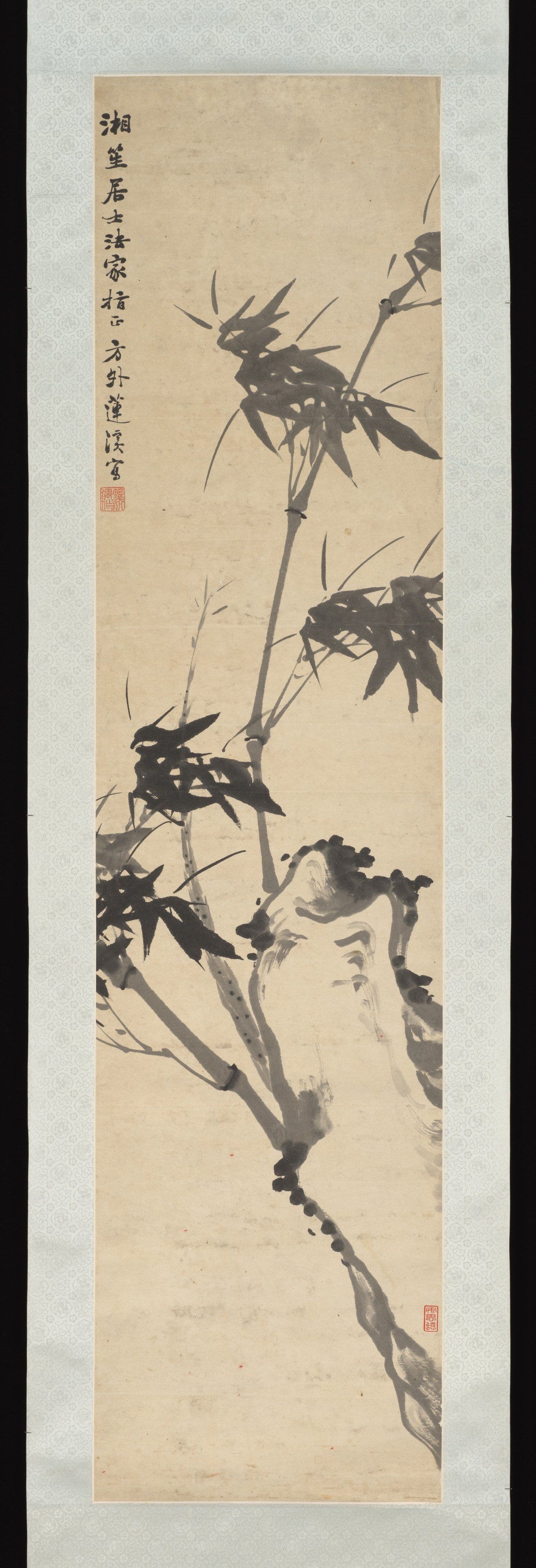
This range is what the old phrase about ink dividing into five shades points at — the idea that a single black material yields a full scale from near-dry grey to saturated black. Accounts differ on what the five are named and how they are counted, and that disagreement has been running for a very long time, so treat any confident list of them as one tradition among several. The underlying observation is not in dispute: ink is a tonal medium, not a single colour.
Anyone painting in a mode that depends on that tonal range will care about which soot they are grinding. Huang Binhong's late landscapes are the extreme case — his work is built from accumulated layers of ink where the difference between one wash and the next is the entire structure of the picture.
Where ink was made, and what collectors collect
The historic centre is Huizhou in what is now Anhui province, and Hui ink remains the name that carries weight. She county and Xiuning were the principal producing towns, and the trade there was organised, competitive and signed: makers put their names on their sticks, which is why ink is collectable at all.
By the late Ming the leading Huizhou workshops were publishing illustrated catalogues of their own designs — Fang Yulu and Cheng Junfang are the two names that survive most strongly, and their printed compendia of ink-cake designs are studied today as much for the woodblock illustration as for the ink. That is the moment ink stops being purely a consumable and becomes a luxury object with a maker's reputation attached.
What this means practically is that a large share of surviving Ming and Qing ink sticks were never intended to be ground. Presentation sets, moulded with landscapes, dragons, inscriptions and gilding, were made as gifts and as display objects. A collector buying an ink stick today is usually buying one of two quite different things:
- Ink to use, judged on how it grinds and how it behaves on paper.
- Ink as an object, judged on the moulding, the inscription, the maker's mark, the condition and the box.
Confusing the two is the most common way to overpay. A beautifully moulded presentation stick may grind poorly; a plain, unglamorous stick from a good workshop may be superb ink.
Ink sits inside the larger set of scholar's equipment, and it is the only one of the group that is consumed by use — the four treasures of the scholar's studio covers how the four objects were understood as a set.
Age, and why old ink is prized
The traditional view is that ink improves with age. The mechanism usually offered is that the glue mellows over decades, losing some of its initial stickiness, so aged ink grinds more smoothly and flows off the brush with less drag.
There is a real limit to this, and it is not usually mentioned in the sales copy. Glue degrades as well as mellows. A very old stick can become brittle, crack along its length, or lose enough binding strength that the ink no longer holds properly in suspension. Some antique sticks are effectively unusable, which is one reason so many survive — nobody could grind them.
So "old" is not a quality grade by itself. What collectors are actually looking for is a stick that has aged well, and the traditional tests are all about condition:
- Sound. Tapped, a sound stick gives a clear, slightly high ring. A dull or dead sound suggests internal cracking.
- Surface. Look for warping, hairline cracks, and any softening or tackiness, which indicates the stick has been stored damp.
- Fracture. On a broken or chipped stick, the fresh surface should be fine, even and glassy rather than granular.
- Weight and feel. Dense and cool. Lightness for the size is a bad sign.
None of this is conclusive on its own, and old ink is faked like everything else in this market — moulds are reused, and an old mould can press a new stick. The same authentication logic that applies to paintings applies here: how specialists actually build an attribution is a matter of accumulating independent signals rather than trusting any single one.
Grinding, and how it differs from bottled ink
Ground ink and bottled ink are not the same product.
Grinding is done with water on an inkstone, in a steady circular or figure-of-eight motion, with light pressure and patience. Pressing hard grinds faster and produces coarser, grittier ink. The concentration is controlled by how long you grind and how much water you started with, which is the point: a painter grinds the ink they want for that session, and can grind more, or dilute what they have, as the picture demands.
Bottled ink is formulated for convenience and shelf life, which means preservatives and additives that keep it from settling or spoiling. It is consistent and it is fast, and it behaves differently on raw paper — usually flatter, with less of the granular separation that gives ground ink its tonal life. For practice and for scale, bottled ink is entirely sensible. For work that depends on subtle greys, it is a compromise.
Two practical rules that matter more than they sound:
- Grind fresh, and only what you need. Ground ink begins to change within hours as the glue behaves differently in solution; day-old ink is generally considered spent.
- Dry the stick after use. Wipe the ground end and stand it dry. An ink stick left standing in water on the stone will soften and eventually fail. This is the single most common way good ink is ruined.
The stone matters as much as the stick — grinding is an interaction between two surfaces, and a stone that is too smooth or too coarse will defeat good ink. Choosing and reading an inkstone is the necessary companion to this subject.
Ink is also not the only thing that goes on the paper. Mineral colours have entirely different working properties, and the two are often used in the same picture — mineral pigments in Chinese painting covers that side.
Common questions
How do I store ink sticks?
Somewhere with stable, moderate humidity, out of direct sun, and not in an airtight plastic box. Very dry conditions cause cracking; damp conditions soften the glue and can encourage mould. Traditional storage wraps the stick in paper or silk and keeps it in a fitted box, which buffers short-term humidity swings rather than sealing the stick away. If a stick has been ground, make sure it is completely dry before it goes back.
Is an expensive ink stick worth it for a beginner?
For grinding practice, no. A mid-range stick teaches you the motion, the water ratio and the feel of the stone just as well, and you will grind through a lot of it while learning. Where the money starts to matter is when you can already see the difference between one grey and the next — at that point the finer particle grade and the smoother grind are doing something you can actually use. Buying an expensive antique stick as a first purchase usually means buying an object you cannot judge.
Can I tell pine soot from oil soot by looking at a finished painting?
Sometimes, with experience, and not reliably from a photograph. The cues are surface sheen in the darkest passages and the character of the tonal steps in diluted areas. But paper, sizing, brush and the painter's water discipline all affect the same cues, and many painters mixed or switched. It is safer to treat it as one observation among several rather than as a diagnostic.
Why does my ink look grey no matter how long I grind?
Almost always too much water. Grinding does not reduce the water volume, it only adds carbon to it, so a stone flooded at the start will produce dilute ink for a very long time. Start with a small amount of water in the well, grind to a concentrate that looks too dark, then dilute deliberately to the tone you want. A worn or overly polished stone surface will also slow the process badly.
Further reading
- Chinese Inkstone Collecting Guide — the surface that does half the work, and the most collected of the four treasures.
- Xuan Paper: How Chinese Painting Paper Is Made and Behaves — sizing determines what the ink does the moment it lands.
- Chinese Ink Painting vs Watercolor — why a medium built on carbon and glue behaves unlike a Western water-based one.
- Chinese Calligraphy Collecting Guide — the discipline where ink quality is least forgiving.
Browse the collection
Ink sticks are a subject we write about rather than one we stock. What Kiln & Ink sells is the result: limited-edition archival giclée reproductions of the twentieth-century Chinese ink masters, printed on rice (xuan) paper or museum-grade cotton rag, hand-numbered and issued with a Certificate of Authenticity. The tonal range described above is exactly what the reproduction process has to carry, and it is the reason the paper choice is not incidental.
Explore Further