Published May 13, 2026
Chinese ink painting and Western watercolor look similar at a glance but solve opposite problems. A material-by-material, technique-by-technique comparison for collectors.
Chinese Ink Painting vs Watercolor: What's Actually Different
Stand a Song-dynasty landscape next to a 19th-century English watercolor and most people see two things made from the same kit: a brush, some water, a sheet of paper, a few muted washes. The materials line up; the visual register feels related. The shared shorthand even bleeds into auction catalogs, where Chinese hanging scrolls are sometimes filed under "watercolors and works on paper" for inventory convenience.
That filing convention obscures the real story. Chinese ink painting (水墨画, shuǐmòhuà) and Western watercolor are pointed in opposite directions, even when the gesture on the surface looks similar. This guide walks you through where the two diverge — material by material, technique by technique, and finally at the level of what each tradition wants a painting to be. By the end you will know what you are looking at when a dealer hands you a scroll, and what that means for what you collect.
Why the side-by-side comparison breaks down
Western watercolor in its mature form is a representational medium. Its goal is to render light, atmosphere, and three-dimensional space onto a flat surface, using transparent pigment layered over white paper. The white of the paper does the work of light. The artist plans in stages: pale washes first, darker glazes on top, fine detail at the end. Across the canon — Turner, Cotman, Sargent — watercolor solves a depictive problem.
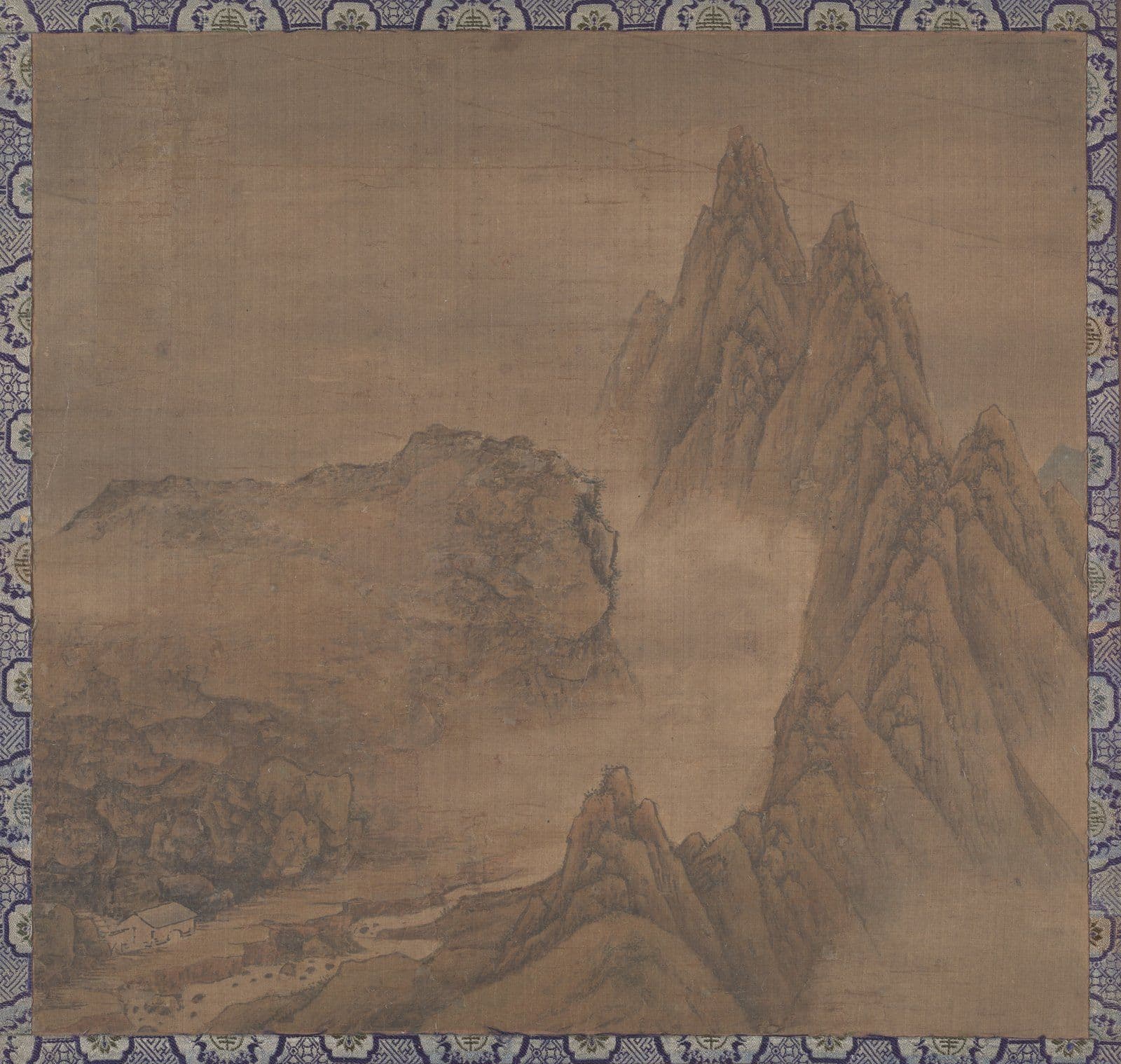
Chinese ink painting in its mature form is not principally a depictive medium. It is a record of brushwork. A landscape (shānshuǐ, 山水) is not trying to show what a mountain looked like on a Tuesday in spring; it is trying to embody, through the discipline of brush and ink, what a mountain is. Same brush, same paper, same water — entirely different problem.
One tradition asks "how do I render this scene?" The other asks "how does my disciplined hand inscribe this idea?"
The materials feel similar — until you look closely
Both traditions use water-based pigment on absorbent paper applied with a soft brush. But each component is built differently, and the differences are not cosmetic.
Paper. Chinese paintings are made on xuan paper (宣纸), traditionally produced in Jing County, Anhui, from qingtan (青檀) bark mixed with rice straw. It is sized lightly or not at all; water spreads instantly across the fibers in a halo whose shape depends on humidity, brush load, and dwell time. Western watercolor paper is typically wood-pulp or cotton, surface-sized with gelatin, and pressed to a controlled texture. Sizing slows absorption deliberately, so the artist can lift, scrub, and re-wet without damaging the surface.
Ink. Chinese ink (墨) is solid until use — a stick of pine or oil soot bound with animal glue, ground on an inkstone with a measured amount of water to produce ink of a chosen density. The grinding itself is part of the practice. Western watercolor uses pre-mixed pigments in pans or tubes, each tuned for predictable color and transparency.
Brush. A Chinese brush (毛笔) is a tapered bundle of animal hair shaped to hold and release a large volume of liquid through pressure alone. It is springy and capable of producing line widths from a hair's breadth to several centimeters in a single stroke. A watercolor brush is engineered to deliver a controlled wash; it stores water but is not used as a calligraphic instrument.
Color. Chinese painting can use color — many Tang court paintings, Ming bird-and-flower works, and Qing imperial commissions are richly colored. But color in the literati tradition is a supplement, never the carrier of the picture. Western watercolor treats color and value as inseparable: the medium is color.
| Material | Chinese ink painting | Western watercolor ||---|---|---|| Paper | Xuan paper, unsized; water spreads freely | Sized cotton/wood paper; water flow controlled || Pigment | Solid ink stick ground fresh; color optional | Pre-mixed transparent pigments; color is the medium || Brush | Tapered upright brush; calligraphic instrument | Mop or round brush; wash instrument || Surface | Mounted to scroll after the work is finished | Worked and reworked while taped to a board |
The materials look similar at a glance; in use they reward opposite reflexes.
The technique is opposite, even when the gesture looks the same
Watercolor is built. The painter lays down the lightest values first, dries the sheet, then layers darker washes. The technique is corrective: a wash that goes wrong can be lifted with a damp brush, scrubbed back, sometimes scraped. Skilled watercolorists develop an editorial eye for what to leave alone — the untouched paper, the reserved highlight — and what to push.
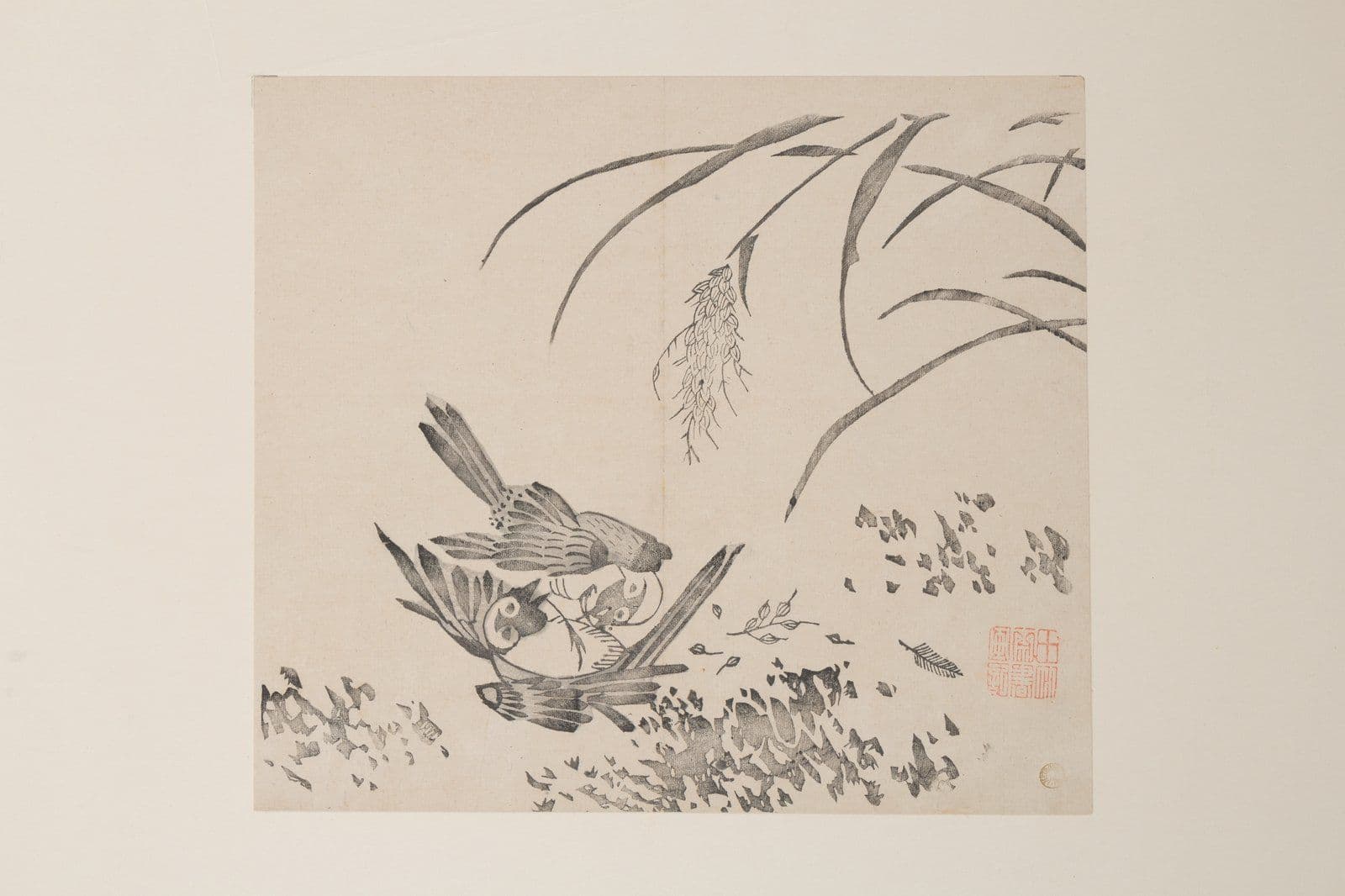
Chinese ink painting is committed. The brush touches the paper, ink spreads through the fiber, and the mark is permanent within a fraction of a second. You can add to a stroke; you cannot subtract from it. Practiced ink painters spend years building muscle memory because by the time you can see the stroke, the negotiation is over.
This is why the line in a Chinese landscape carries information about the painter's body — the breathing, the wrist, the moment of hesitation or release — in a way that a watercolor wash does not. The Six Principles set out by Xie He in the 5th century placed qìyùn shēngdòng (spirit resonance) and gǔfǎ yòngbǐ (the bone method of using the brush) above representation; for a tradition built around an irreversible instrument, this priority makes practical sense. For the framework that still underwrites the connoisseur's eye, see Xie He's Six Principles.
The opposite priorities show in how each tradition handles error. A watercolorist who makes a heavy-handed wash can usually save the painting; the technology was designed to be forgiving. An ink painter who makes a slack or unconvincing stroke usually throws away the sheet. The economy of cheap xuan paper and quick disposal of failed attempts is part of the practice, not a sign of waste.
The aesthetic goals point in different directions
Watercolor in its dominant European form is descriptive. The painter looks at something — a town, a coast, a figure — and asks the medium to render that thing with as much economy and freshness as possible. The brushwork serves the depicted subject; the more invisible the technique, the more successful the painting.
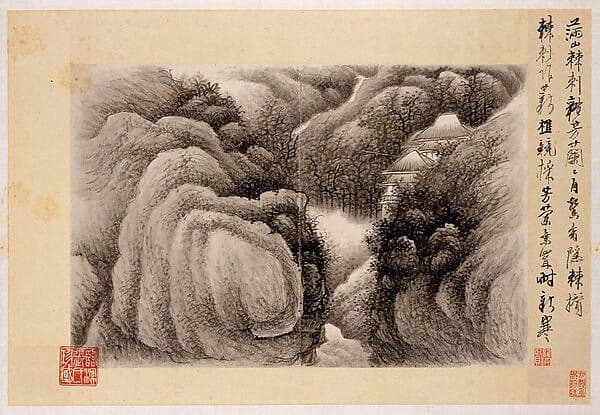
Chinese ink painting is expressive in a precise old meaning: a record of the painter's cultivated mind moving through brush and ink. A Yuan-dynasty landscape is not a topographically accurate place; it is a synthesis of mountain-feeling carried out through a specific brush vocabulary inherited from named masters. A cūn (皴, texture stroke) is named and identifiable. The connoisseur can usually trace the lineage of a painter's cūn repertoire back through teachers, just as a musician's phrasing carries the lineage of a school.
This makes provenance, attribution, and the artist's biography load-bearing in Chinese painting in a way they are not in most watercolor markets. A small watercolor sketch by Sargent is valuable because it is by Sargent and because it is fresh; a hanging scroll attributed to a Yuan master is valuable because the brushwork can be read as carrying that master's hand. Chinese painting collectors learn to read this lineage citation in brushwork the same way porcelain collectors learn to read apocryphal reign marks on the base of a vase: the older mark is not a forgery but a deliberate citation, and reading it as homage rather than fraud is part of being a literate collector.
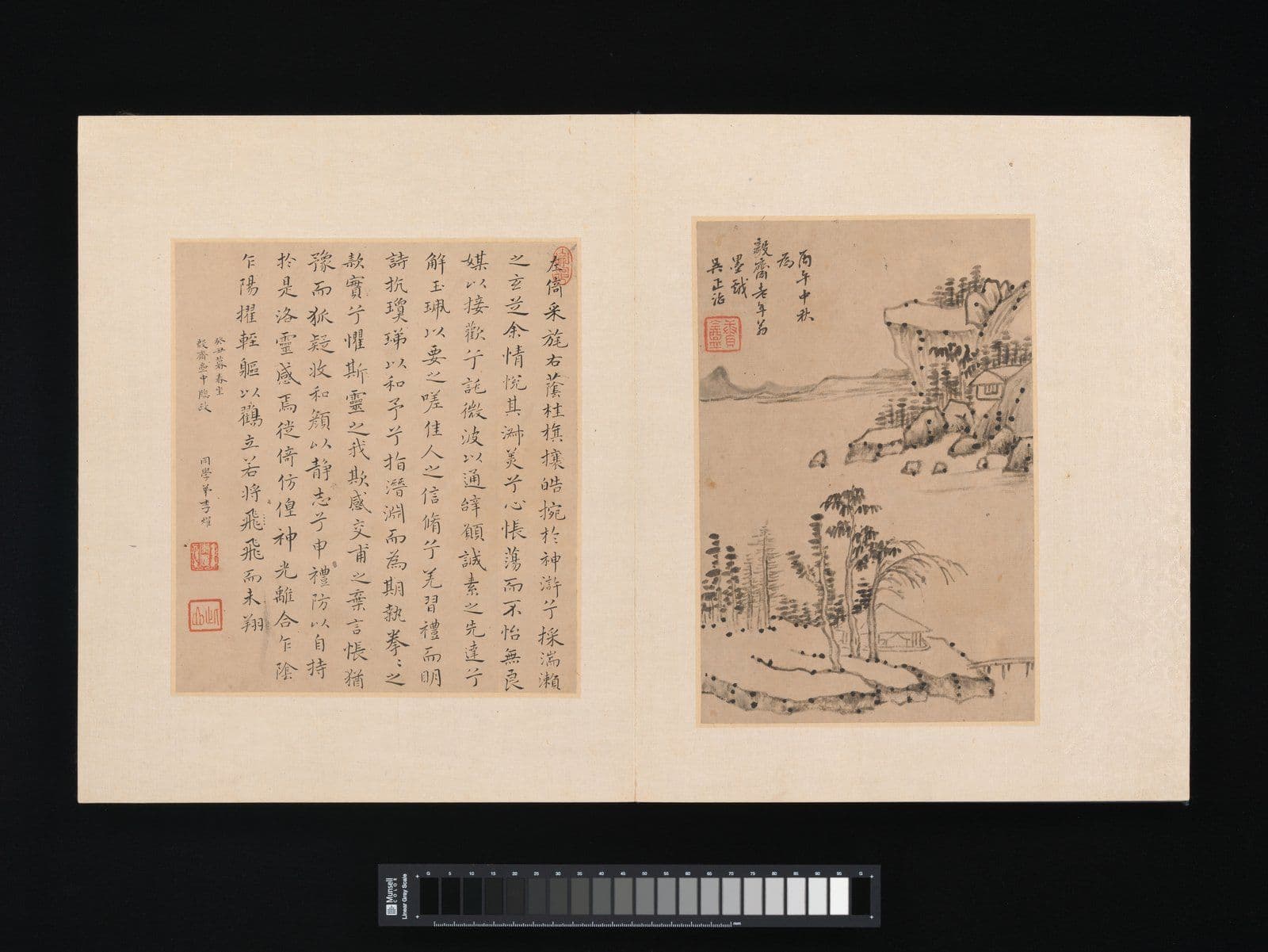
This is also why so much Chinese painting — even when it shows landscape — contains an inscription, a date, sometimes a dedication, and a stack of red seals. The text and seals are part of the painting's argument; even the painter's studio name often appears, in the same way imperial patrons inscribed studio names on porcelain (堂名款) as signals of taste and intent. Our Republic-period porcelain notes touch on the same literati instinct as it crossed into ceramics in the early 20th century — painters signing porcelain plaques as if they were paper.
Why the comparison persists despite the differences
If the two traditions are pointed in opposite directions, why does the comparison keep getting made? The surface vocabulary is similar enough that someone new to East Asian art uses the familiar Western category as a bridge. Several 20th-century painters — Xu Beihong, Lin Fengmian, Wu Guanzhong — trained in Paris and brought European drawing into Chinese-paper work; their hybrid output complicates the clean separation. The global art market also favors sale-ready categories: "Chinese watercolor" is a phrase that moves catalogs.
The conflation produces real misreads. Western collectors used to watercolor often value Chinese paintings for the wrong things — atmospheric mood, pleasant subject, skillful color — and miss the brushwork lineage the work was actually built around.
How collectors should treat each, practically
If you are buying watercolor, the relevant questions are condition of the paper (foxing, mat burn, fading), permanence of pigments, attribution and provenance, and whether freshness has survived a century of light exposure. Watercolor pigments are among the most light-sensitive of all painting media, so storage away from direct sun and UV-filtering glazing matters.
If you are buying Chinese ink painting, the questions partly overlap and partly diverge. You are reading the brushwork itself for lineage and conviction, the inscription for date and dedication, the seals for ownership history, and the mounting (zhuāngbiāo, 装裱) to see whether the silk borders are original, replaced once, or recently rebuilt. A poorly remounted scroll can lose much of its value even when the painting is fine; the mount is part of the work's body.
Display also diverges. A watercolor is framed and hung, often for years at a time. A traditional Chinese scroll is rolled when not on view and rotated by season or occasion; permanent display damages the paper and silk. Collectors who treat scrolls as fixed wall art are imposing a watercolor's life on an ink painting's body.
When in doubt, ask which set of questions the dealer is leading with. A serious specialist in Chinese painting will talk about cūn strokes, seal sequences, and mounting history. A specialist who only talks about subject matter and color is selling decorative work — which is fine, but should be priced and stored accordingly.
Common questions
Can the same artist make both?
A few have. The cross-trained 20th-century figures — Xu Beihong, Lin Fengmian, later Wu Guanzhong — moved between Western drawing and Chinese ink with intent, and their work sits on the seam. But for most painters in either tradition, switching is not casual. The reflexes, the planning rhythm, and the relationship to error are all different. A serious watercolorist who picks up a Chinese brush usually produces something that looks like a watercolor done with the wrong tool, and the reverse is also true.
Are Chinese ink paintings less colorful than watercolors?
Not necessarily. The literati tradition prizes monochrome ink because it puts the brushwork in plain view, but Chinese painting overall has a rich color tradition — Tang court figures, Song bird-and-flower painting, Ming and Qing decorative work all use color generously. What is true is that color is treated as a supplement to brushwork rather than as the carrier of the picture, which is the opposite of watercolor's instinct.
Is one harder than the other?
They are hard at different things. Watercolor's difficulty is editorial: knowing when to stop, judging value, building atmosphere out of translucent washes. Ink painting's difficulty is athletic: years of practice to produce a confident, lineage-aware brushstroke that cannot be corrected once made. Neither is easier; they reward different temperaments.
Should I buy contemporary Chinese ink painting if I am new to the field?
It is one of the better entry points. Contemporary work is more affordable than period scrolls, attribution is less contested, and you can build a relationship with a living artist or the gallery that represents one. The risk of a sophisticated forgery drops to near zero. The disadvantage is paying current market prices rather than discovering a sleeper, but for someone learning to read brushwork, that is a fair trade.
How should I store a Chinese scroll at home?
Roll it when not on view. Keep it in a cool, dry place away from direct sunlight and heat sources. Avoid plastic — it traps humidity — and use acid-free wrapping. Unroll slowly, never crease, and let it acclimate to room conditions before hanging if it has been in storage. Rotate display every few weeks rather than hanging permanently.
Further reading
Reading Chinese Porcelain Marks — a tutorial in reading inscriptions on the back of porcelain, written for non-Chinese readers; the same close-reading habit pays off in painting.
Iron-Red vs Underglaze Blue Marks — how the same hand behaves differently when given two different pigments on a fired surface.
Chinese Vase Stamps: A Complete Reference — a single-page reference for marks and stamps you will see on the base of Chinese ceramics, useful when a painter has crossed into ceramic decoration.
Browse our ink paintings
Hand-painted ink works on xuan paper, in the literati tradition — faithfully described, with provenance noted where known. Quiet pieces for collectors who want to read brushwork rather than buy decoration.
Explore Further