Published August 19, 2026
A guide to xuan paper: what it is made from, how raw (sheng) and cooked (shu) sizing changes the brush, and how to store works on paper safely.
Lay a loaded brush on a sheet of raw xuan paper and the ink does not stay where you put it. It travels outward into the fibre for a second or two after the brush has lifted, spreading further where the stroke was wet and barely at all where it was dry. Nothing can be corrected and nothing can be gone over. The paper is not a passive surface; it is the second half of the technique.
This guide covers what xuan paper is made from, how the sizing that separates raw from cooked paper changes what a brush can do, why painters hoard old sheets, and how to store paper and works on paper without ruining them.
What it is made from
Xuan paper takes its name from Xuanzhou, the prefecture in what is now Anhui province through which it was historically traded. The papermaking itself has long been centred on Jing County, in the hills to the south, and the specificity is not incidental — the trees, the straw and the water all come from the same landscape.
The defining fibre is the bark of Pteroceltis tatarinowii, the blue sandalwood or wingceltis, a small tree native to those hills and known in Chinese as qingtan. Its bast fibres are long, fine and strong, and they are what allow a very thin sheet to survive being soaked, brushed, mounted and remounted. Blended with the bark is rice straw, which is shorter and softer and gives the sheet its absorbency and its slightly uneven, cloudy texture. The proportion between the two is the grade: more bark makes a tougher, more resilient paper, more straw a softer and thirstier one.
The manufacture is famously slow. Stripped bark is limed and steamed, then spread on open hillsides for months — through sun, rain, dew and frost — to bleach naturally rather than chemically. It is cooked, washed, beaten to pulp, and formed sheet by sheet on a bamboo screen dipped into the vat, a motion that distributes the fibres in the crossed pattern visible when a sheet is held to the light. Sheets are couched into a wet stack, pressed, then peeled apart one at a time and brushed onto heated walls to dry. UNESCO added the craft to its Representative List of the Intangible Cultural Heritage of Humanity in 2009.
Paper is one of the four objects a Chinese scholar's desk was defined by, alongside brush, ink and inkstone. Our guide to the four treasures of the studio covers the set, and the inkstone guide takes up the stone that grinds what the paper receives.
Raw, cooked, and half-cooked
The single most useful thing to know about xuan paper is that it comes in three states, and they are not interchangeable.
Sheng xuan — raw or "unripe" paper — is the sheet as it comes off the drying wall, unsized and fully absorbent. Ink spreads into it, tones bleed into one another, and the record of the brush's speed and pressure is preserved exactly. This is the surface that makes xieyi, the freehand mode, possible at all. It is also unforgiving: a moment's hesitation shows as a dark pool.
Shu xuan — cooked or "ripe" paper — has been sized, traditionally with a solution of alum and animal glue brushed or dipped onto the sheet. The sizing fills the spaces between the fibres so that ink and colour sit closer to the surface and spread very little. This is the paper for gongbi, the meticulous mode, where a fine outline has to hold its edge and colour is built up in many thin transparent layers.
Ban shu — half-cooked — is lightly sized and behaves between the two. It allows a little movement without losing control, and a great deal of twentieth-century painting sits on it.
There is a conservation consequence to sizing that collectors should know. Alum is acidic, and over decades it can embrittle and yellow the sheet it was meant to improve. Heavily sized paintings from the past century are among the more fragile things in a collection, and they should not be flexed, rolled tightly, or exposed to swings in humidity. Once a work is mounted its long-term behaviour is as much about the mounting as about the original sheet — the mounting process, zhuangbiao, determines how a painting can be handled for the rest of its life.
Why age matters
There is a traditional claim about xuan paper, zhi shou qian nian — "paper lives a thousand years" — and while it is a saying rather than a measurement, it points at something real: a well-made, unsized bark-and-straw sheet is chemically stable in a way that wood-pulp paper is not.
Painters also prize aged paper for a different reason. A freshly made sheet is comparatively harsh and takes ink fast and a little raw. Left to rest for years in a dry, stable place it mellows — the absorbency evens out, the surface softens, and ink sits with a warmth new paper does not give. Painters of the twentieth century hoarded good old stock accordingly, and paper laid down decades earlier was treated as a material worth saving for important work. When you read that a painter used "old paper", that is what is meant.
The practical consequence for a collector is that paper is dateable evidence. A sheet whose fibre, thickness and tone do not match the period claimed for the painting on it is a problem no signature can solve. For the wider question of what a support tells you, our comparison of silk and paper as painting grounds takes up the other half of the material question.
Living with works on paper
Paper's enemies are light, moisture and movement, in that order.
- Light. Ultraviolet degrades cellulose and fades any colour that is not pure carbon ink. Display away from direct sun, and glaze framed works with UV-filtering acrylic or glass.
- Humidity. Stability matters more than any particular level. Repeated wetting and drying cycles cockle the sheet, loosen mounts and encourage mould; a steady moderate room beats an ideal number that swings.
- Handling. Support a scroll along its length, never let it hang from a grip at one end, and roll it loosely — a tight roll creases and, on sized paper, cracks. Unmounted sheets should be stored flat and interleaved with acid-free tissue.
- Neighbours. Wood, cardboard and ordinary paper release acids. Anything in contact with a work on paper should be acid-free and lignin-free.
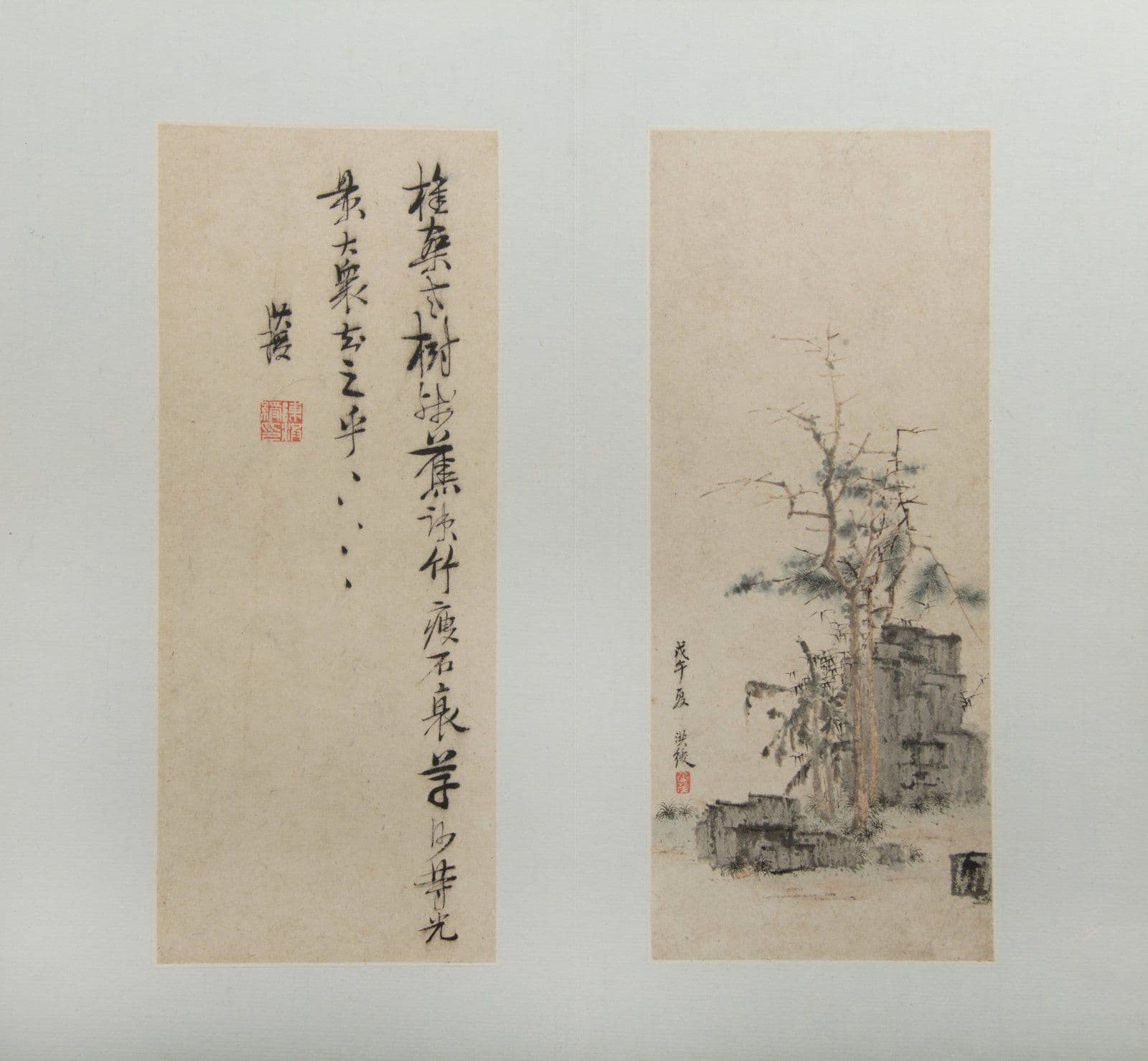
The painters on the Kiln & Ink roster worked almost entirely on this material. Qi Baishi's shrimp are a demonstration of what raw xuan does with a graded ink load — the translucency of the bodies is the paper's contribution as much as the brush's.
Common questions
Is xuan paper the same as rice paper?
"Rice paper" is an English catch-all covering several unrelated materials, and it misleads in both directions. Xuan paper contains no rice: its fibres are tree bark and rice straw, the stalk left after harvest rather than the grain. The name persists in the trade and on product listings, so you will see genuine xuan paper sold as rice paper, and you will also see cheap wood-pulp sheets sold the same way. Ask about fibre content rather than relying on the label.
How can I tell raw xuan from cooked?
Put a small drop of water on a corner. On raw paper it soaks in almost immediately and spreads into an irregular disc with a soft edge; on cooked paper it beads and sits, spreading slowly if at all. Half-cooked paper does something in between. Held to the light, raw paper also tends to show the cloudy, uneven fibre distribution more clearly, because sizing evens out the surface.
Why do painters say old paper is better?
Because resting changes how it takes ink. New sheets absorb fast and unevenly; years of storage in stable conditions relax the fibre and the residual processing chemistry, and the paper gives a softer, more even response. It is a preference founded on handling rather than a measurable standard, but it is close to universal among painters who work on unsized paper.
Does the paper affect what a painting is worth?
Indirectly but genuinely. Quality of support is one of the things specialists read when assessing a work, because a serious painter used serious paper for serious paintings, and because the sheet has to be consistent with the claimed date. It is rarely the deciding factor on its own, and it is frequently the detail that unravels a wrong attribution.
Can xuan paper be used for printing?
Yes, and it is — both in the traditional woodblock workshops and in modern fine-art printing, where its softness and absorbency give a very different surface from cotton rag. It has to be handled differently from a machine-made sheet at every stage, which is why not every printer will work with it.
Further reading
- The four treasures of the scholar's studio — brush, ink, paper and inkstone as a working set.
- Collecting Chinese inkstones — the stone that grinds the ink this paper receives.
- Silk versus paper in Chinese painting — how the two supports differ, and what each does to a brushstroke.
- Zhuangbiao: Chinese painting mounting — what happens to a sheet after the painting is finished.
Browse the collection
Xuan paper is not something Kiln & Ink sells by the sheet — it is what we print on. The catalogue is limited-edition archival giclée reproductions of the twentieth-century Chinese ink masters, issued on xuan paper or museum-grade cotton rag, hand-numbered and accompanied by a Certificate of Authenticity, at roughly $300 to $1,200.
Explore Further