Published August 18, 2026
Chengni inkstone explained beside Duan, She and Tao stone: how the four differ, what grinding wear proves, and how to spot a resurfaced inkstone.
Tilt an old inkstone toward a window and look at the grinding surface rather than the carving. If the stone has been used properly for a century or two, there will be a shallow, slightly off-centre depression where the ink stick travelled, worn smooth and a shade darker than the rest. That worn patch tells you more about the object than any inscription on the back.
This guide covers what an inkstone is for, the four stone traditions collectors actually encounter, how to read carving and condition, and where the reproductions in this market come from.
What the object has to do
An inkstone grinds a solid ink stick into liquid ink. You add a little water to a shallow well, hold the stick upright, and work it in slow circles until the water thickens. Everything valued in an inkstone follows from that job.
The stone has to be fine-grained enough to cut the ink stick without scratching the brush that will later be loaded from it. It has to be dense enough not to drink the water — a porous stone leaves you regrinding constantly. And it should feel slightly resistant rather than glassy: a surface too polished skids, and the ink never thickens. Collectors describe good stone as having "tooth."
This is the fourth of the Four Treasures of the Scholar's Studio, alongside brush, ink and paper, and it is the only one of the four that survives use. Brushes wear out, ink sticks are consumed, paper is written on. The inkstone outlasts its owner, which is why so many of them carry inscriptions from several generations of them.
The four stone traditions
Chinese connoisseurship recognises four classic sources. Knowing which one you are holding is the first sorting task.
- Duan. Quarried near Zhaoqing in Guangdong, and the most celebrated. Duan stone is dense, fine and typically purple-brown, and it carries natural markings that collectors name and prize — most famously the "stone eye," a round inclusion with concentric rings that carvers often leave standing proud or work into a design. The oldest and most reputed pits, including the one known simply as the Old Pit, have been closed or tightly restricted in recent decades, which is the main reason genuinely old Duan material has climbed in price.
- She. From the Longwei mountain area on the Anhui–Jiangxi border. She stone is generally darker and harder than Duan, and it is identified by patterning rather than inclusions: fine parallel striations called eyebrow markings, rope-like grain, and small bright flecks known as gold star and gold halo.
- Tao. From the Tao river region in Gansu, characteristically green and comparatively scarce. Genuine old Tao material is uncommon enough that attributions should be treated carefully.
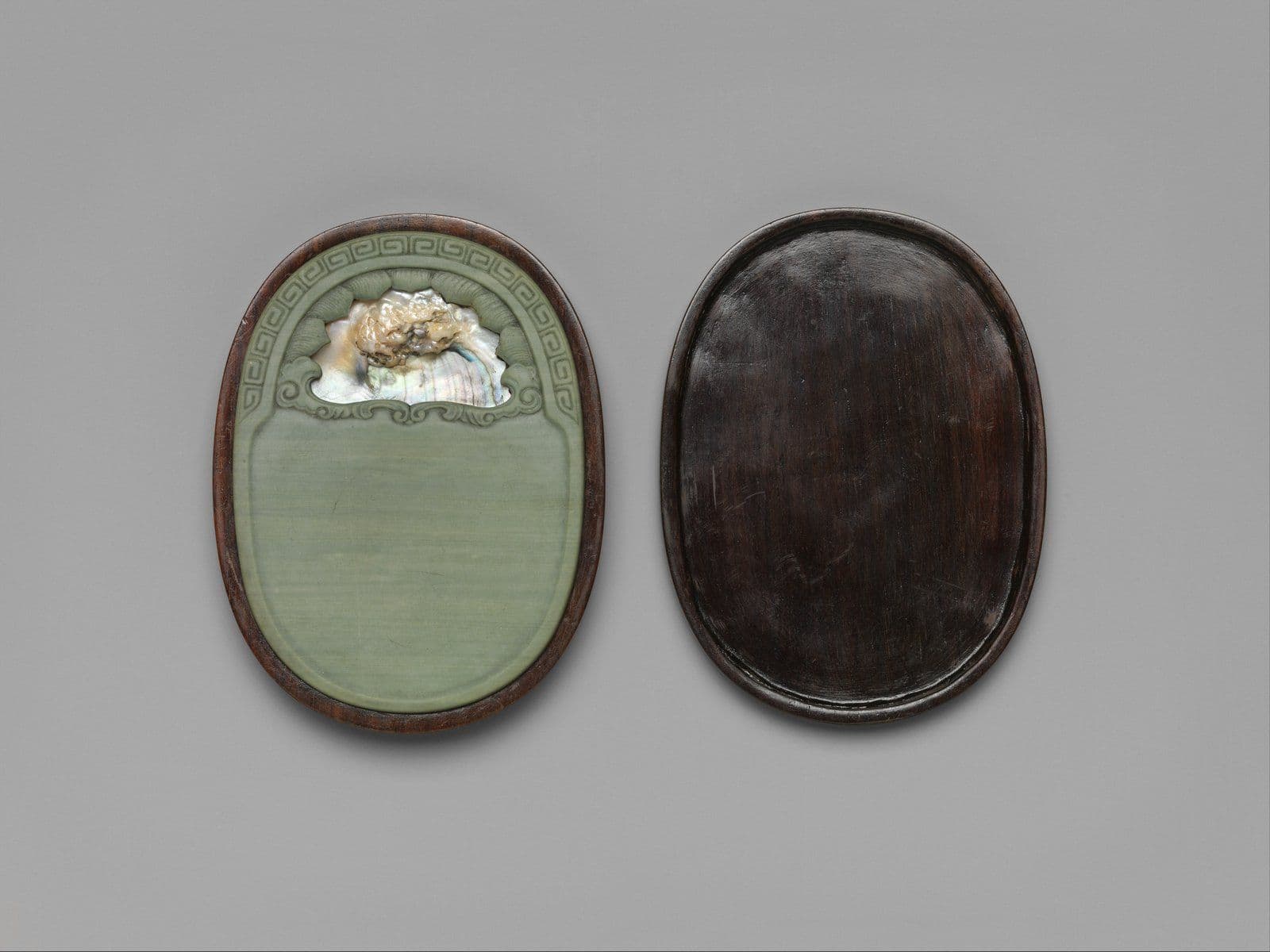
- Chengni. The outlier — not quarried stone at all, but levigated river silt, shaped and fired like ceramic. A well-made chengni inkstone performs seriously well and can be difficult to distinguish from stone at a glance, so check the edges and any chip for a ceramic body rather than a mineral fracture.
Plenty of perfectly good inkstones come from none of these sources. Local stone was worked everywhere, and a competent regional stone with honest wear is a better object than a poor example of a famous one.
Reading the carving
Inkstone carving runs from almost nothing to extremely elaborate, and more is not better. The working surface must stay flat and open; carving belongs on the borders, the back, and around the water well.
Ming-period taste generally ran plain — a good stone, a clean rectangular or oval form, minimal ornament, on the reasoning that the material speaks. Qing taste, especially from the eighteenth century, ran considerably more decorative: pierced borders, dragons and clouds, landscape scenes on the reverse, and elaborately fitted boxes. The imperial inkstone catalogue compiled under the Qianlong emperor is a monument to that later taste, and imperial workshop pieces of the period are correspondingly ornate.
Three things worth examining closely:
- The relationship between carving and flaw. The best carvers worked around the stone's natural features, siting a stone eye as the pupil of a carved creature or letting a band of discoloration become a cloud. Decoration that ignores the stone entirely is usually later or lesser work.
- The water well. It should make sense hydraulically — a reservoir that actually holds water and feeds the grinding surface. Wells that are purely decorative suggest an object made to be sold rather than used.
- Inscriptions. Many good inkstones carry a poem, a studio name or a collector's note, sometimes several added across generations. They are part of the object's interest and also the easiest thing to add later. Read them as claims requiring support, in the same way you would read collector seals on a painting.
Condition, wear and what devalues a stone
Condition standards here differ from most collecting fields, because this is a tool.
Honest grinding wear is not damage. A shallow, smooth, slightly asymmetric depression is evidence the stone was used by someone who knew what they were doing, and it does not hurt value. What does hurt:
- Resurfacing. A worn stone can be ground flat again to look unused. It usually leaves the walls of the ink well too thin, the proportions slightly off, and the tool marks too uniform. Compare the depth of carving at the border with the depth you would expect — a resurfaced stone has lost a layer everywhere.
- Cracks through the grinding surface. A crack in the border is tolerable. One crossing the working area affects both use and value.
- Aggressive cleaning. Old ink residue in the corners is normal and, to most collectors, desirable. Stones that have been scrubbed to bare mineral look wrong and can be etched by whatever did the scrubbing.
- Married boxes. Fitted boxes are common and add value when original. A box that does not quite fit, or whose wear pattern does not match the stone's, is a marriage — worth knowing about before you pay for it as original.
What the fakes look like
The reproduction problem in inkstones is mostly about age and source rather than outright forgery, since new inkstones are made openly and legitimately today.
The common misrepresentations: new stone from a working quarry sold as old-pit material; artificial patination, usually a waxy or oily darkening that sits on the surface rather than in it; inscriptions added to a genuine but plain old stone to attach it to a famous name; and chengni pieces sold as Duan. A carved-to-death surface with crisp, machine-even tool marks and no wear anywhere is a modern decorative object, whatever the seller's story.
The practical defence is the same as in seal carving and calligraphy collecting: buy the object, not the attribution. A modest, genuinely old, well-used stone with no famous name attached is a sounder purchase than a spectacular one whose entire value rests on an inscription nobody can corroborate.
Common questions
Does grinding wear reduce an inkstone's value?
No — normal use wear is expected and often welcomed, because it demonstrates the stone was good enough to be used. What reduces value is resurfacing to disguise wear, cracks crossing the grinding area, and cleaning aggressive enough to strip the surface. A stone with a soft, shallow, slightly off-centre worn patch is behaving exactly as it should.
How can I tell Duan from She stone?
Look at how the stone is marked. Duan tends toward purple-brown with discrete inclusions, above all the round, concentric "stone eye." She tends darker, harder and more linear, patterned with fine parallel eyebrow striations, rope-like grain and small bright gold-star flecks. Duan reads as spotted; She reads as grained. Neither test is absolute, and a stone with no diagnostic markings at all may simply be good plain material.
Are new inkstones worth collecting?
Yes, on their own terms. Contemporary carvers work the traditional quarries and some are extremely skilled, and a new inkstone sold honestly as new is a legitimate object — often a better grinding tool than a fragile antique. The problem is never that a stone is new. It is a new stone sold as old.
What is chengni, if it is not stone?
Levigated clay: fine river silt, settled, shaped and fired, producing a body that behaves much like fine stone. It is one of the four classic inkstone traditions and was historically prized rather than treated as a substitute. Check a chip or edge — chengni fractures like ceramic, not like mineral.
Should I actually use an old inkstone?
If the stone is sound and not a rare documented piece, using it is entirely reasonable and does no harm — that is what it was made for. Grind with clean water, never leave ink to dry hard on the surface, and wash gently without abrasives or detergent. What you should not do is take a stone with an important inscription or a documented history into daily service.
Further reading
- The Four Treasures of the Scholar's Studio — where the inkstone sits among brush, ink and paper.
- Chinese Scholar's Rocks: A Collector's Guide — the other stone object on the scholar's desk, judged by an unrelated set of criteria.
- Chinese Seal Carving: A Collector's Guide — the same appetite for worked stone, and the same authentication problems.
- Chinese Calligraphy: A Collector's Guide — what all of this equipment was ultimately in service of.
Browse the collection
Inkstones are a subject we write about rather than one we stock. What Kiln & Ink sells is paper: limited-edition archival giclée reproductions of the twentieth-century Chinese ink masters, printed on rice paper or museum-grade cotton rag, each hand-numbered and issued with a Certificate of Authenticity.
Explore Further