Published August 6, 2026
Chinese bird-and-flower painting explained: the huaniao tradition, gongbi vs xieyi technique, what the recurring subjects mean, and what to check before buying.
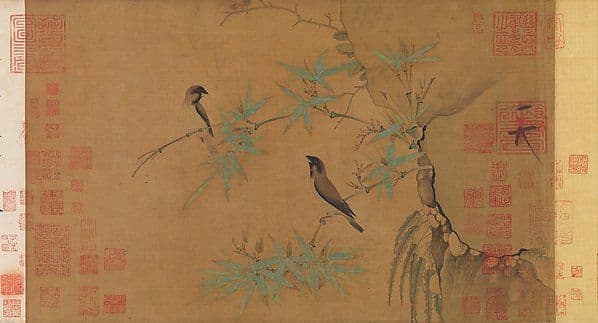
A Song album leaf of a single sparrow on a bare branch and a Qi Baishi sheet of ink shrimp look like they belong to different art forms. One is silk, meticulous, coloured, the size of a book page. The other is paper, fast, monochrome, and painted in less time than it takes to read this sentence. They belong to the same category — huaniao hua, bird-and-flower painting — and the thousand years between them is the most interesting thing a collector in this field can learn to see.
This guide sets out what the genre covers, the two technical traditions that run through it, what the recurring subjects mean, and what to look at when you are deciding whether a particular bird-and-flower work is worth your wall.
What counts as bird-and-flower painting
Chinese painting was classified by subject long before it was classified by style, and the three great divisions are figures, landscape, and bird-and-flower. The last is broader than its name suggests. It takes in flowers and birds, but also insects, fish, crustaceans, fruit and vegetables, grasses, rocks and bamboo — anything living that is neither a person nor a mountain.
Two traditions were already distinct by the tenth century, and Chinese connoisseurship has contrasted them ever since. Huang Quan, working at the Sichuan court, painted richly coloured, carefully outlined birds and flowers of the sort a palace would commission. Xu Xi, working outside court circles, painted with ink and a looser hand, the untrammelled manner of a man pleasing himself. The formula that grew up around them — the Huang family's opulence against Xu Xi's wildness — is the oldest stylistic axis in the genre, and it still describes most of what you will encounter.
Gongbi and xieyi: the two hands
Nearly every bird-and-flower painting sits somewhere on a line between two techniques, and knowing which you are looking at governs everything about how you judge it.
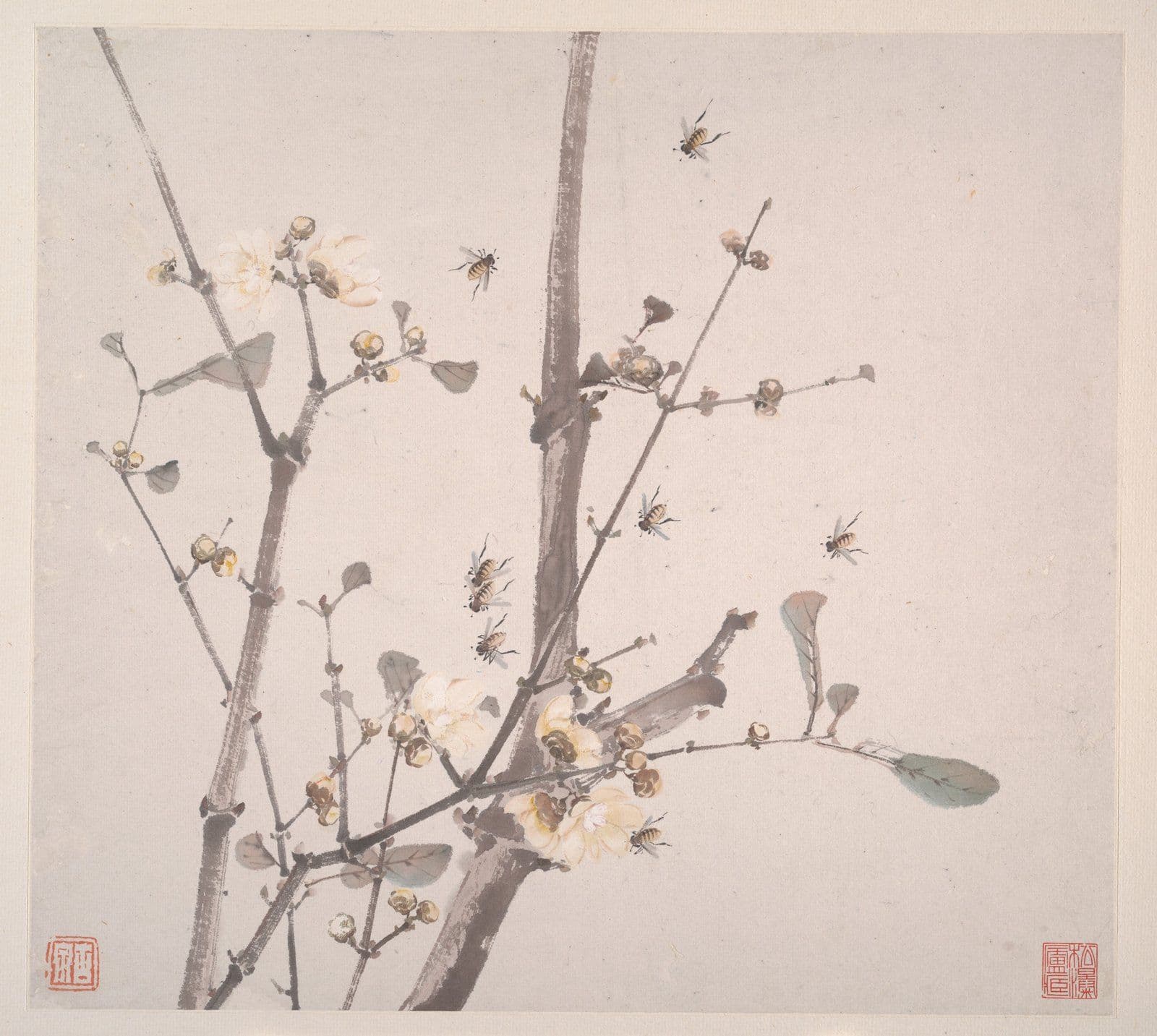
Gongbi — "meticulous brush" — builds the image from a fine outline filled with layers of thin colour, usually on silk or on sized paper that resists absorption. It rewards patience and punishes hesitation: the outline has to be unwavering and the washes have to build without muddying. This is the manner of the Song imperial painting academy, where bird-and-flower painting reached a level of observational precision that still startles. Album leaves and fan paintings from that tradition repay looking at under a glass, and those small formats carry a great deal of it.
Xieyi — "writing the idea" — abandons outline for direct strokes of loaded ink and colour on absorbent paper. There is no correction. The brush touches, the paper takes it, and the mark is final. Its rise is bound up with literati painting: for scholar-painters, the point was never accurate description but the character revealed in the handling. The distinction between that outlook and the court's is the subject of literati painting versus court painting.
A third technique sits between them. Mogu, the "boneless" method, lays down washes of colour with no outline at all, so the form is defined entirely by the edge of the wet mark. Yun Shouping made it the basis of a whole flower-painting tradition in the early Qing, and it remains the most technically unforgiving thing in the genre — nothing holds the shape but the water.
The subjects, and what they are saying
Almost nothing in a bird-and-flower painting is chosen for looks alone. The genre runs on a shared code of symbolism and wordplay that any educated viewer would once have read automatically, and the meanings are stable enough to be useful.
| Subject | Conventional reading ||---|---|| Plum, orchid, bamboo, chrysanthemum | The Four Gentlemen — four virtues of the scholar; plum for endurance, bamboo for integrity || Lotus | Purity; rising clean from mud || Peony | Wealth and honour || Magpie | Joy — the bird's name puns on the word for happiness || Mandarin ducks | Marital fidelity, given in pairs || Pine, crane, peach | Longevity || Fish | Abundance — the word puns on "surplus" |
The puns are the part Western viewers most often miss. Chinese has a large stock of homophones, and painters exploited them constantly: a lotus and a fish together are not a pond scene but a wish for continuous surplus, year after year. A painting handed over as a birthday or wedding gift was expected to say something specific, and it usually did.
From the Song academy to the modern masters
The genre's centre of gravity moves over time, and the shift is worth holding in mind because it explains why the market prices different eras so differently.
Song court painting set the standard for observation. Ming painting split, with academy professionals continuing the coloured tradition while scholar-painters pushed ink flowers toward gesture — Xu Wei's ink grapes and vines are the extreme case, painted with a violence that still looks modern. The early Qing produced two poles: Yun Shouping's boneless flowers at one end, and at the other Bada Shanren, whose birds and fish, drawn with a few strokes and a famously hostile stare, remain the most psychologically loaded images in the genre.
By the nineteenth century the energy had moved to Shanghai, where a commercial art market supported painters selling directly to merchants rather than to a court. Ren Bonian brought a fluent, bright figure-and-bird style to that audience; Wu Changshuo brought something else entirely — a lifetime of seal carving and stone-drum calligraphy, applied to flowers. His stems have the compressed force of carved script, and the connection between his brush and his chisel is covered in Wu Changshuo, flower painter and seal carver.
That Shanghai inheritance runs directly into the twentieth century and into the artists most collectors first encounter. Qi Baishi turned close observation of insects, shrimp, and garden vegetables into a body of work that is both technically exacting and immediately legible — the fine-brush insects set against loose ink foliage in his insects and grasses paintings are the clearest demonstration of what gongbi and xieyi can do on one sheet. Li Kuchan pushed the ink eagle to monumental scale in his eagle paintings. Pan Tianshou built compositions of birds and rocks with an architect's sense of structure, holding enormous areas of empty paper in tension.
What to look at before you buy
Bird-and-flower painting is easy to like and hard to judge, because the subjects are charming enough to distract from the brushwork. A working sequence:
- Read the composition against the empty paper. In xieyi work the blank areas are compositional, not leftover. If the image would survive being moved an inch in any direction, the placement was probably not considered.
- Follow a single stroke from start to finish. A confident loaded stroke changes tone along its length as ink is deposited. Uniform, evenly grey strokes usually mean a hesitant hand — or a printed one.
- Check that the technique is internally consistent. A gongbi bird with a xieyi branch can be a deliberate and very effective choice, as Qi Baishi's insects show. It can also mean two different hands, or a repaired and repainted picture.
- Ask whether the symbolism holds together. Traditional pairings are conventional. A combination that fits no known wish is not automatically wrong, but it is worth asking about.
- Look at the inscription and seals as part of the picture. Placement matters; a poorly sited inscription damages a composition that the painting itself got right.
- Establish what you are buying. Original ink on paper, a period reproduction, and a modern giclée are three different objects at three different prices. Any seller should say plainly which one is on offer.
The theoretical framework behind most of these judgements is older than any of the paintings: Xie He's six principles of Chinese painting, which put spirit resonance first and formal likeness well down the list. Bird-and-flower painting is the genre where that ranking is most visible, because a painter can get every feather right and still produce a dead bird.
Common questions
Is bird-and-flower painting considered lesser than landscape?
It has sometimes been ranked below landscape in literati criticism, which prized landscape as the vehicle for philosophical expression. That hierarchy has not held up in the market or in modern scholarship. Several of the twentieth century's most significant painters worked primarily in the genre, and the best bird-and-flower painting carries as much of the artist's hand as any mountain.
Which format should I start with?
Album leaves and fans are the most approachable — small, historically rich, and made to be looked at closely rather than hung across a room. A hanging scroll asks more of a wall and more of a budget. Consider where the work will actually live before you commit, since a large ink composition needs distance to resolve.
How do I recognise a printed reproduction?
Look at the ink at the edge of a stroke. On original work the ink has entered the paper fibres and the boundary is slightly irregular, with tone varying inside the mark. A print has a flat, even film and a mechanically consistent edge, and under magnification often reveals a regular dot pattern. Colour is another giveaway: mineral pigments have a physical presence on the sheet that printed colour does not reproduce.
Do the symbolic meanings still matter when buying?
They matter if the picture is a gift, and they matter for understanding why a composition is put together as it is. They do not determine value — brushwork, artist, condition, and provenance do that. But a buyer who can read the wish in a painting is reading it the way it was made to be read.
Further reading
- Album Leaves and Fan Paintings — the formats that carry most surviving early bird-and-flower work.
- Pan Tianshou's Monumental Bird-and-Rock Paintings — structure and empty paper at the largest scale in the genre.
- Silk versus Paper in Chinese Painting — why the gongbi tradition lives on silk and the xieyi tradition on paper.
- Reading a Chinese Painting Inscription — signature, date, dedication, and seal.
Browse the collection
Kiln & Ink sells limited-edition archival giclée reproductions of the twentieth-century Chinese ink masters, bird-and-flower work among them — Qi Baishi's Lotus and Dragonfly sets a fine-brush insect against loose ink leaves, which is the whole gongbi-and-xieyi argument on one sheet. Each print is on rice (xuan) paper or museum-grade cotton rag, hand-numbered, and issued with a Certificate of Authenticity.
Explore Further