Published July 12, 2026
Li Kuchan's big-freehand eagle paintings explained: the Qi Baishi apprenticeship, the composite raptor, the symbolism, and a collector's checklist.
Li Kuchan's Eagles: Big-Brush Freehand in the Qi Baishi Line
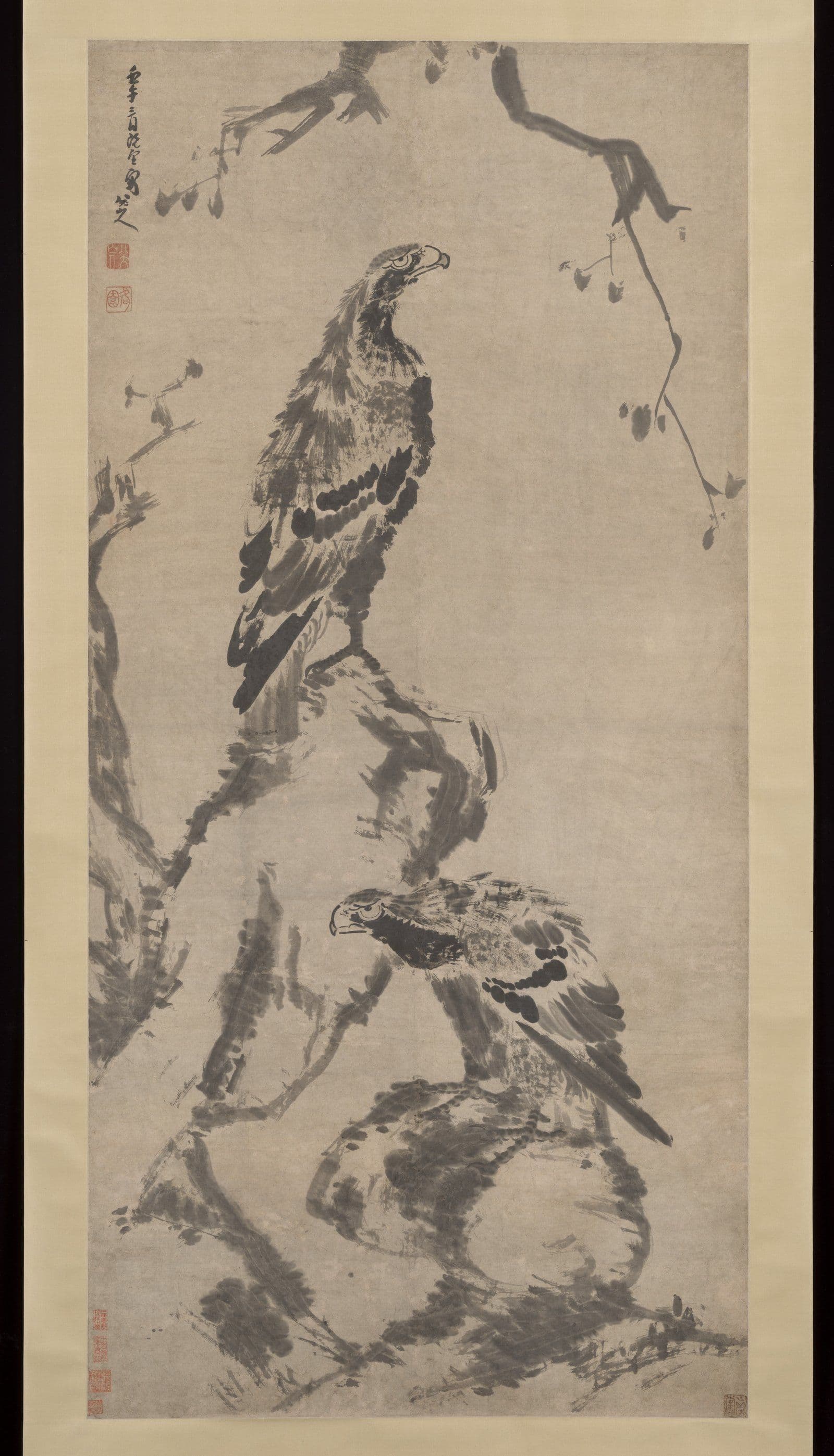
Look closely at the bird in a Li Kuchan painting and you will notice something odd: it is not, strictly speaking, an eagle. The eye is squared off like a carpenter's joint. The beak is too massive, the shoulders too architectural, the whole silhouette assembled from block-like masses of wet ink rather than feathers. No field guide contains this raptor — and that is precisely the point. Li Kuchan spent half a century distilling the idea of the eagle into a few monumental strokes, and the result became one of the signature images of twentieth-century Chinese painting.
This guide covers who Li Kuchan was, how his big-brush freehand style works, what his eagles meant to the audiences of his time, and what to look for when you encounter his work — or work claiming to be his — as a collector.
From rickshaw handle to brush: an unlikely apprenticeship
Li Kuchan (1899–1983) was born into a poor farming family in Gaotang County, Shandong. He reached Beijing in the early 1920s with almost nothing, studied Western painting — charcoal, oils, perspective — and famously supported himself by pulling a rickshaw at night while attending classes by day. The name he adopted, Kuchan (苦禅), pairs "bitter" with a character associated with the Chan (Zen) strain of expressive painting: a self-description, in two characters, of a hard life devoted to spontaneous art.
The turning point came in 1923, when he became one of the earliest formal students of Qi Baishi. The old master's affection for the penniless Shandong student is well documented, and the apprenticeship set the axis of Li's entire career: he absorbed Qi Baishi's dawenyi (大写意), "big freehand," approach — maximum expression from minimum strokes, grounded in calligraphic force — and then spent decades pushing it toward greater scale and structural weight than his teacher ever sought. Qi Baishi's famous dictum held that those who learn from him live, while those who merely imitate him die; Li Kuchan is the textbook case of a student who lived, transforming shrimp-tank intimacy into raptor monumentality. He went on to teach for decades, ultimately as a professor at the Central Academy of Fine Arts in Beijing, where generations of flower-and-bird painters passed through his studio.
For the contrast with his teacher's most famous subject, see our guide to Qi Baishi's shrimp paintings — six translucent strokes per shrimp, where Li's eagle demands slabs of ink laid on with the whole arm.
The composite raptor: why the eagle looks "wrong"
Li Kuchan's eagle is deliberately not ornithological. He synthesized his bird from several raptors, exaggerating whatever served expression: the squared, geometric eye that gives the bird its stern, almost bronze-vessel gaze; the oversized hooked beak rendered in two or three angular strokes; wings and back massed into broad wet-ink blocks; talons gripping rock like structural anchors.
The composite approach solved an artistic problem. A naturalistic eagle is a portrait of a bird; Li's synthesized raptor is a vessel for character — vigilance, endurance, unbowed pride. In Chinese, the word for eagle (鹰, ying) is a homophone of the ying in yingxiong (英雄), "hero," and painted eagles had long carried heroic and patriotic overtones. In Li's hands, especially in the decades of war and upheaval he lived through, the perched eagle scanning the horizon became a national self-image: battered, alert, waiting.
This use of the animal as coded statement places Li Kuchan in a specific twentieth-century lineage — the same one that produced Xu Beihong's lions, where the animal is nationalism in ink rather than zoology. The difference is temperament: Xu's cats surge with Romantic movement, while Li's eagle holds still and withstands.
How big-brush freehand actually works
"Big freehand" is easy to mistake for looseness. It is closer to the opposite: because each image is built from very few strokes, every stroke is load-bearing, and nothing can be corrected afterward.
- Calligraphy is the engine. Li Kuchan held that painting at this level is calligraphy — the same centered-tip discipline, the same commitment to a stroke once launched. The contour of a wing or the edge of a rock in his work reads like a character written large: entry, pressure, turn, release.
- Ink does the modeling. Instead of outline-and-fill, the big wet masses of the eagle's back and wings are laid directly, with tonal variation inside a single loaded brushstroke doing the work that shading does in Western drawing. Watch for the way one stroke dries from charcoal-dark to silver-grey along its length — that gradient is the mark of a loaded brush handled decisively, and it is what copyists find hardest to fake.
- Composition is structural. Bird, rock, pine, and empty paper are balanced like members of a truss. Li favored massive foreground rocks and high perches that push the eagle against open space; the emptiness is not background but counterweight.
- Speed with preparation. A work might take minutes to paint and decades to prepare. The big-freehand painter rehearses form until execution can be trusted to the arm — which is why authentic works feel inevitable, while imitations feel assembled.
The same lesson — that a lifetime of discipline underwrites a few minutes of apparent spontaneity — runs through the whole modern master generation, from Guan Shanyue's monumental plum blossoms to Li's own late, wall-sized birds.
Reading a Li Kuchan: subjects, inscriptions, and the collector's checklist
Beyond eagles, Li Kuchan's repertoire centered on the classic big-freehand cast — cormorants and herons, lotus in every season, gourds, pines, banana leaves, rock-and-bird groupings — almost always animated by the same block-ink construction and angular energy. But the eagle anchors his identity and his market, and works featuring it attract both the strongest demand and the most forgery attention.
A practical checklist when evaluating a work attributed to him:
- Test the eye and beak geometry. The squared eye and angular beak should be decisive, integral strokes — not carefully drawn-then-filled shapes. Hesitation lines here are a warning.
- Look inside the ink masses. Genuine wet-ink blocks show internal tonal life: gradients, granulation, the trace of the brush's path. Flat, even darkness suggests a copy of the shape without the stroke.
- Read the inscription and seals as a package. Li's calligraphy carries the same blunt, weighty energy as his painting; a delicate or slick inscription over a powerful bird is incoherent. Our guides to reading inscriptions apply directly.
- Mind the dates. His career spans six turbulent decades, including years during the Cultural Revolution when he painted little that circulated. Late works — from the late 1970s until his death in 1983 — include some of his largest and most celebrated birds, and late-dated works are correspondingly attractive to forgers.
- Weigh provenance. As with every major twentieth-century name, exhibition history, publication, and credible chain of ownership matter more than any single connoisseurship tell.
Common questions
Why do Li Kuchan's eagles look square and blocky?
Because he built the bird from calligraphic strokes and structural ink masses rather than from observation of feathers. The squared eye and angular beak are deliberate abstractions — he composited features from several raptors into an idealized bird whose job is to express character: sternness, vigilance, endurance. The blockiness is the style's engineering; each mass is a single committed stroke, not an outline filled in.
What do the eagles symbolize?
Vigilance, heroism, and national resilience. The Chinese word for eagle is a homophone of the "hero" syllable in yingxiong, and the perched raptor gazing into distance carried patriotic resonance through the war years and after. Li's eagles are usually still — perched on rock or pine, scanning — which reads as endurance rather than aggression. Like Xu Beihong's lions, they are animals doing the work of political and moral statement.
How is Li Kuchan related to Qi Baishi?
He became one of Qi Baishi's earliest formal students in 1923, shortly after arriving in Beijing, and remained closely associated with the master throughout his life. Artistically he is Qi Baishi's most consequential heir in the big-freehand flower-and-bird tradition — he kept the economy of stroke but scaled the format up, replacing intimacy with monumentality. The teacher-student pair is a standard case study in inheriting a method without imitating a manner.
Are Li Kuchan paintings heavily forged?
Yes — his auction profile and the apparent simplicity of the style make him a favorite target. The style's economy cuts both ways: there are few strokes to copy, but each one must carry loaded-brush tonal life and calligraphic force, which is very hard to counterfeit. Inspect the internal gradients of the ink masses, the decisiveness of eye and beak, and the coherence of inscription, seals, and painting as one hand's work.
Further reading
- Zhang Daqian's Splashed-Ink Technique: Reading His Late Period — a very different route to late-career monumentality.
- Li Keran's Red Mountains: When Chinese Landscape Painting Went Political — a fellow Beijing academic master navigating art and politics.
- Reading Collector Seals on Chinese Paintings — the provenance layer on any twentieth-century work.
- How to Display a Chinese Scroll Painting: Practical Guide — big-freehand works want viewing distance; hang them accordingly.
Browse our Li Kuchan eagle collection
Hand-painted homages in Li Kuchan's big-freehand eagle tradition — faithfully described, honestly attributed, ready to hang.
Explore Further