Published July 15, 2026
Qi Baishi's grass-and-insect paintings pair meticulous gongbi insects with freehand plants. How the double technique works, what it meant, and how to judge one.
Look closely at the dragonfly in a Qi Baishi painting and you will find something that seems to contradict everything else on the paper. The gourd vine beside it is a few wet, careless-looking sweeps of ink; the dragonfly's wings are drawn vein by vein, so finely that they read as transparent. The loosest famous hand in twentieth-century Chinese painting was also, when he chose to be, one of the most exacting miniaturists in the tradition — and the two modes sit an inch apart on the same leaf.
If you are looking at one of these grass-and-insect works — in a sale catalogue, a dealer's inventory, or a family collection — this article will help you understand what the genre is, how the double technique works, why these pieces occupy a special place in Qi Baishi's output, and what to check before trusting an attribution.
A carpenter's eye for small things
Qi Baishi (1864–1957) came to painting from craft. Born into a farming family near Xiangtan in Hunan province, he spent his early working life as a carpenter and wood-carver, and the habits of that trade — close observation, patient handwork, respect for material — never left him. He was largely self-trained as a painter, working his way through the traditional curriculum of copying and portrait work before finding his own subjects.
And his subjects, famously, were small ones. Where the literati tradition prized mountains and rivers, Qi Baishi painted what he had actually lived with: shrimp, crabs, chicks, frogs, gourds, cabbages — and insects. Grasshoppers, cicadas, dragonflies, katydids, crickets, mantises, bees, butterflies, moths. By his own telling he had watched these creatures since childhood in rural Hunan, and the affection shows. The insects in his paintings are never specimens; they climb, feed, land, and fly like things he had spent decades watching.
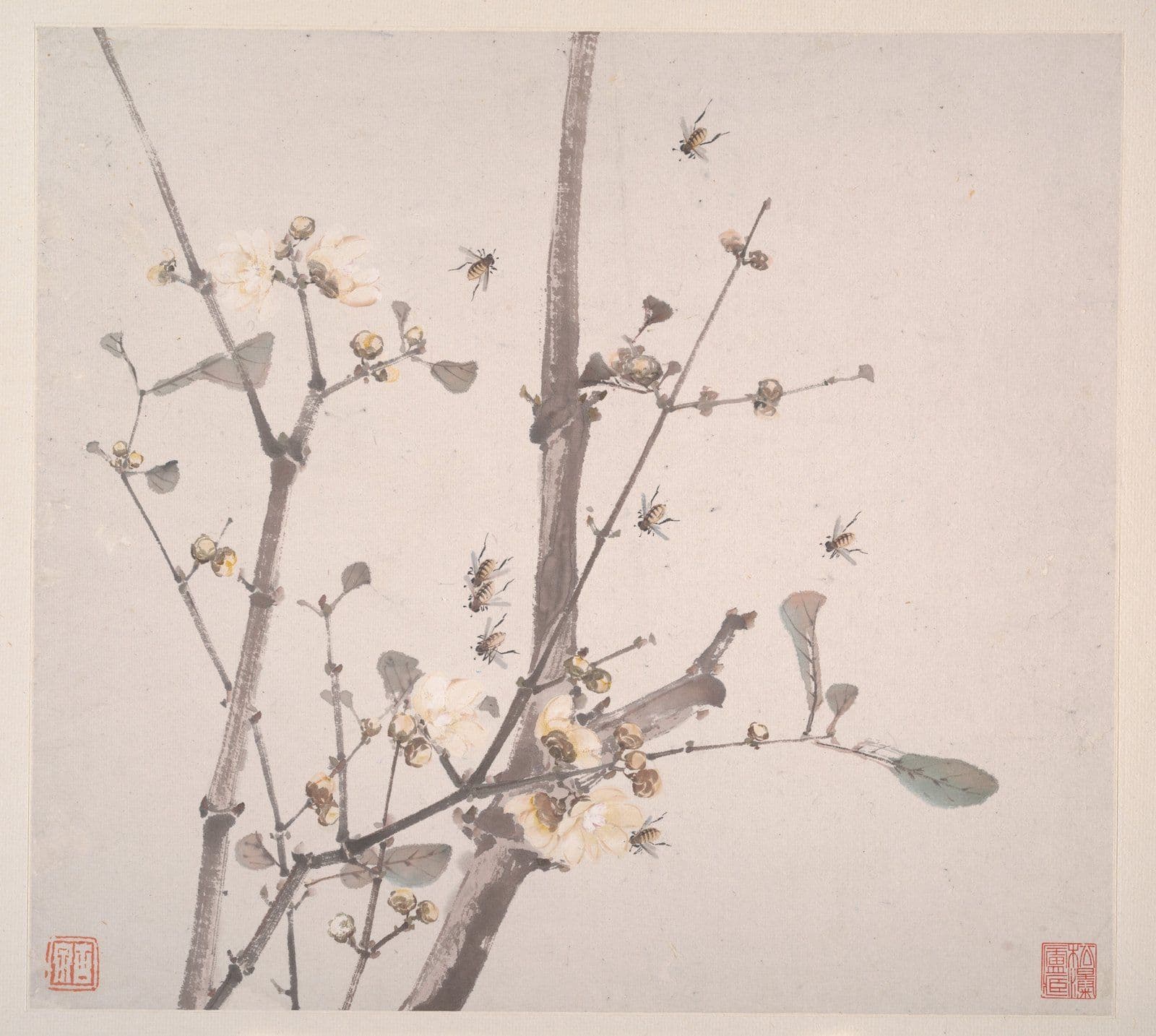
The genre he worked in has a name: caochong — "grass-and-insect" painting. It is an old, modest category in Chinese art, a branch of bird-and-flower painting that reaches back through Ming and Qing album painting. A nineteenth-century album like the Met's Insects and Flowers (dated 1865) shows the convention Qi Baishi inherited: small leaves, intimate scale, close attention to living things most painters ignored. What he did with the convention is what makes his versions unmistakable.
The double technique: gongbi insect, xieyi plant
Chinese painting distinguishes two broad modes of brushwork. Gongbi — "工笔, meticulous brush" — is the fine-line, layered, descriptive manner of court and academy painting. Xieyi — "写意, sketching the idea" — is the abbreviated freehand manner of the literati, where a gourd is three strokes and a leaf is one. Most painters commit to one register within a single work.
Qi Baishi's signature grass-and-insect works do both at once, and that collision is the whole point:
- The insect is painted gongbi: wing venation drawn filament by filament, leg joints articulated, the segmentation of a grasshopper's abdomen counted out, the translucency of a cicada's wing achieved by letting washes overlap. The precision rewards a magnifying glass.
- The plant is painted xieyi: broad wet strokes for gourd leaves, a few springing lines for grass stems, seed pods dropped in with single presses of the brush.
- The tension between the two is deliberate. The freehand plant makes the meticulous insect look more alive, not less; the insect's precision makes the plant's looseness read as confidence rather than haste.
This is far harder than working in either mode alone. The gongbi insect must sit convincingly in xieyi space — its weight on a bending grass stem has to make sense, the scale has to hold, and the ink tones of the two registers have to belong to the same atmosphere. When a forger fails, this junction is usually where.
There is also a practical dimension to the two modes, and it is one of the most human details in his working life. By the accounts of his family and students, Qi Baishi painted many of his fine-brush insects in middle age, while his eyesight was at its sharpest, and kept them in reserve — adding the freehand plants, inscriptions, and signatures years later, in old age, when his eyes could no longer manage filament-fine wing veins but his broad brush was stronger than ever. Scholars generally accept this practice, and it means a single leaf can contain work from two different decades of the artist's life. For collectors, it is also a reminder that a late signature date on an insect painting is not a contradiction.
What the insects meant
It is tempting to read the grass-and-insect works as pure charm, and charm is certainly part of their market appeal. But the genre carried real weight for the painter and his audience.
First, the insects were autobiography. Qi Baishi left rural Hunan for Beijing, and the shrimp, crickets, and gourd vines of his mature work are the remembered furniture of a farm childhood, painted for an urban audience that had left the same world behind. The nostalgia is explicit in many of his inscriptions.
Second, they were a statement about what deserved attention. In the inherited hierarchy of subjects, a cricket was trivial. Qi Baishi's insistence that a cricket observed honestly outranked a mountain painted from convention was of a piece with the artistic reform currents of his era — and it is why a painter of cabbages and grasshoppers was embraced by modernizers like Xu Beihong, who championed him when conservative circles dismissed him — the same conviction that ink painting renewed itself by looking at life.
Third, the works sit inside a recognizable lineage. The big-freehand flower painting of Wu Changshuo shaped Qi Baishi's plants; the close observation of the Ming-Qing album tradition stands behind his insects; and his own students carried the manner forward — Li Kuchan's block-ink eagles come out of the same Beijing studio culture, scaled up from crickets to raptors.
The market, and the forgery problem
Qi Baishi is one of the most expensive Chinese artists at auction — a set of his landscape screens set the record price for a work of twentieth-century Chinese art when it sold in Beijing in 2017 — and he is also, by common expert reckoning, one of the most forged names in the entire market. The two facts are related, and the grass-and-insect works sit at a particular angle to both.
The insect paintings are, in one specific way, self-defending: the gongbi insect is genuinely difficult to fake. A forger with a fluent freehand manner can produce a passable loose shrimp or wisteria far more easily than a convincing dragonfly wing, because the wing exposes draftsmanship directly — there is nowhere for a weak hand to hide inside "spontaneity." Specialists looking at a doubtful grass-and-insect work tend to go straight to the insect: dead, stiff, or anatomically confused insects are the common tell, along with a junction between insect and plant that doesn't quite hold together in scale or tone.
That said, no category is safe. Genuine-looking insects have been cut from minor works and remounted with fabricated plants and signatures; workshop copies exist; and the sheer volume of material attributed to a long-lived, prolific artist means attribution rests on the whole layered argument — brush manner, inscription, seals, paper, and provenance together, never one feature alone. His seals and inscription habits are well documented, which helps; reading the seals on a Chinese painting is a sensible first check on anything carrying his name. And as with his shrimp paintings, the confident market position of the subject is precisely why optimistic attributions cluster around it.
For most collectors, the realistic route to living with these images is prints and reproductions honestly sold as such — the original album leaves are auction-house territory, and priced accordingly.
Common questions
What insects did Qi Baishi paint most often?
Dragonflies, cicadas, grasshoppers, katydids, crickets, mantises, bees, and butterflies recur constantly, usually paired with the plants they actually live on — gourd vines, grasses, beans, lotus, chrysanthemums. The pairing is observational, not decorative: the insect is doing something real (feeding, climbing, alighting), which is one of the quiet marks of his hand. Moths and flies appear as well, subjects almost no earlier painter thought worth the trouble.
Why are the insects so detailed when everything else is loose?
Deliberate contrast. The meticulous (gongbi) insect against the freehand (xieyi) plant lets each mode do what it does best — precision reads as life, looseness reads as air and atmosphere. There is also a biographical reason: by his family's and students' accounts, he painted stocks of fine-brush insects while middle-aged and sharp-eyed, and completed the leaves with plants and inscriptions in old age, when his eyesight had faded but his broad brush had not.
How can I tell an authentic Qi Baishi insect painting from a copy?
Treat the insect as the test. Genuine examples show anatomical conviction — believable joints, weight, and wing structure — and a seamless scale relationship with the freehand plant. Stiff or lifeless insects, confused anatomy, and an insect that seems pasted into the composition are the common failures. Then apply the standard layered checks: inscription calligraphy, documented seals, paper and mounting, and provenance. Given the volume of forgeries, an undocumented work deserves specialist review before money changes hands.
Are Qi Baishi's grass-and-insect works good value compared with his shrimp?
Both subjects are blue-chip within his market, and single album leaves in either category are typically more attainable than large hanging scrolls or screen sets. The grass-and-insect leaves carry a technical distinction the shrimp do not — the double gongbi-xieyi manner — and complete albums of them are treated as major works. As always, condition, inscription quality, and provenance move price more than subject alone.
What does "caochong" mean?
Caochong (草虫) translates literally as "grass insects" and names the traditional genre of painting insects among plants — a modest branch of bird-and-flower painting with a long album-format history. Qi Baishi did not invent the genre; he raised it from a minor charm category to a signature of one of the most valuable names in Chinese art.
Further reading
- Xu Beihong's Galloping Horses and Their Symbolism — the modernizer who championed Qi Baishi, and his own signature subject.
- Pan Tianshou's Monumental Bird-and-Rock Paintings — a contemporary who took bird-and-flower painting in the opposite direction: architectural scale.
- How to Read the Inscription on a Chinese Painting — decoding the dates, dedications, and signatures that anchor an attribution.
- Edition Numbers on Prints: A Buyer's Guide to Authenticity — what the numbers mean if you collect his work in print form.
Browse our Qi Baishi collection
Qi Baishi is one of the masters in our gallery — see his artist page and available works, each honestly described and clearly attributed.
From the Kiln & Ink collection: Gourd, an archival giclée edition after Qi Baishi, hand-numbered on xuan paper with a certificate of authenticity.
Explore Further