Published May 10, 2026
Xie He's six principles of Chinese painting, written around 500 CE, remain the working framework collectors are judged by. Here is what each one means.
Xie He's Six Principles: The Framework Behind Chinese Painting
When a senior curator stands in front of a Chinese painting for the first time, she is rarely thinking about what it depicts. She is asking, in some private internal order, the same six questions that a court official named Xie He wrote down around the year 500 CE. The categories she uses to praise it, fault it, or hesitate over it are his categories. The painting may be modern, the subject may be a tractor, but the questions are the same.
This piece walks through Xie He's six principles (六法 liù fǎ) in plain English, with notes on what each principle actually meant in his context, what it became, and how to use it as a Western collector reading a Chinese painting today.
Who Xie He was, briefly
Xie He (謝赫) was a court painter and critic active in the southern courts of the early 6th century. His one surviving text, the Gu Hua Pin Lu (古畫品錄, "Record of the Classification of Old Painters"), opens with a short preface that lists six standards by which a painting can be judged. He then ranks twenty-seven painters of his era against those standards.
The text is short. The six principles occupy two lines. The painter rankings have been argued about for fifteen centuries. The principles themselves were absorbed so completely into Chinese painting theory that by the Tang dynasty no one found it necessary to argue with them — only to reinterpret them. Modern scholarship still circles back to Xie He's framing because no later writer ever fully replaced it.
You will see his principles translated several different ways. The translations below are conservative.
The six principles, one by one
1. Spirit Resonance (氣韻生動 qì yùn shēng dòng)
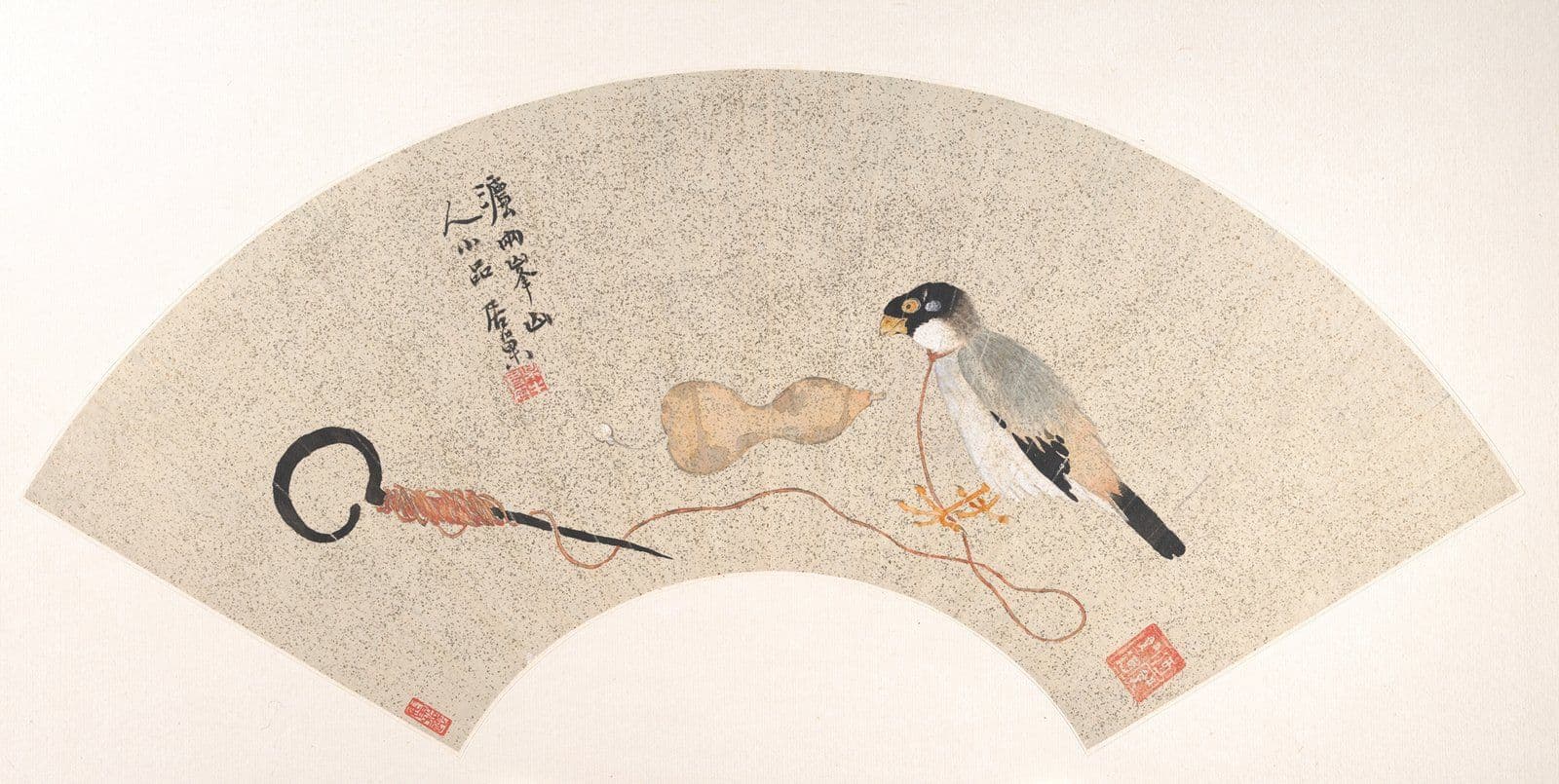
Often translated as "spirit resonance, life-motion." A painting must convey the inner vitality of its subject — not merely a likeness but an animating quality. A horse should look as if it could move; a scholar's portrait should suggest his temperament; a landscape should breathe.
This first principle is the only one that cannot really be taught. Centuries of commentators agreed that the other five could be learned, but spirit resonance either appeared or it did not. It is the principle most often cited when a critic dismisses a technically accomplished but lifeless work. When you hear a connoisseur say a painting is "dead" or "flat," they are invoking this category, whether they name it or not.
2. Bone Method, or Brushwork (骨法用筆 gǔ fǎ yòng bǐ)
The structural use of the brush — the literal bones of the painting. This refers to the tensile quality of every line: its strength, its rhythm, the pressure applied to the brush, the speed of the stroke. In Chinese painting, the brushstroke is not a means to an end; it is the end. A connoisseur reads each stroke the way a calligrapher reads a piece of writing.
This principle is why connoisseurs spend so much time looking at hands, bamboo leaves, and the outlines of robes. Those areas show the brushwork most clearly. A masterful painter's bamboo leaf carries the trace of the wrist that made it; a copyist's leaf is symmetrical, hesitant, or both. The same logic applies on the surface of a porcelain dish: the way a Jingdezhen artisan handles iron red versus underglaze blue is itself a reading of brushwork, in a different medium with the same rules.
3. Correspondence to Form (應物象形 yìng wù xiàng xíng)
The principle of likeness — the painted form should correspond to its real-world referent. A horse should be recognizable as a horse, with proportions that read as equine.
It is significant that this principle sits third in Xie He's list, not first. Western art before modernism placed this question first; Chinese theory subordinated it to spirit and brushwork. A correct horse with no spirit is a worse painting than an unmistakably alive horse with imperfect proportions. This ordering is one of the most important things to absorb. It explains why so much Chinese painting can look "stylized" or "flat" to Western eyes trained on Renaissance illusionism — the painter is not failing at the third principle; he is succeeding at the first two and refusing to subordinate them.
4. Suitability of Color (隨類賦彩 suí lèi fù cǎi)
Color should be appropriate to the subject — the right color for the right type of thing. In practice, this principle ratified a fairly conservative palette in classical painting: tile-roof reds, leaf greens, the muted ochres of the literati landscape. In ink-only landscape painting, where pigment is replaced by ink tones, the principle is read as the tonal range of black: how thinned, how saturated, how layered.
Western collectors often misread the restraint of classical Chinese palettes as decorative timidity. It is the opposite — it is the deliberate exercise of this principle. When color is loud, it is loud for a reason.
5. Composition, or Placement (經營位置 jīng yíng wèi zhì)
Literally "managing placement." This is composition in the broadest sense — the arrangement of objects on the silk or paper, the negative space, the sense of foreground and depth, the grouping of figures, the placement of the inscription and seals.
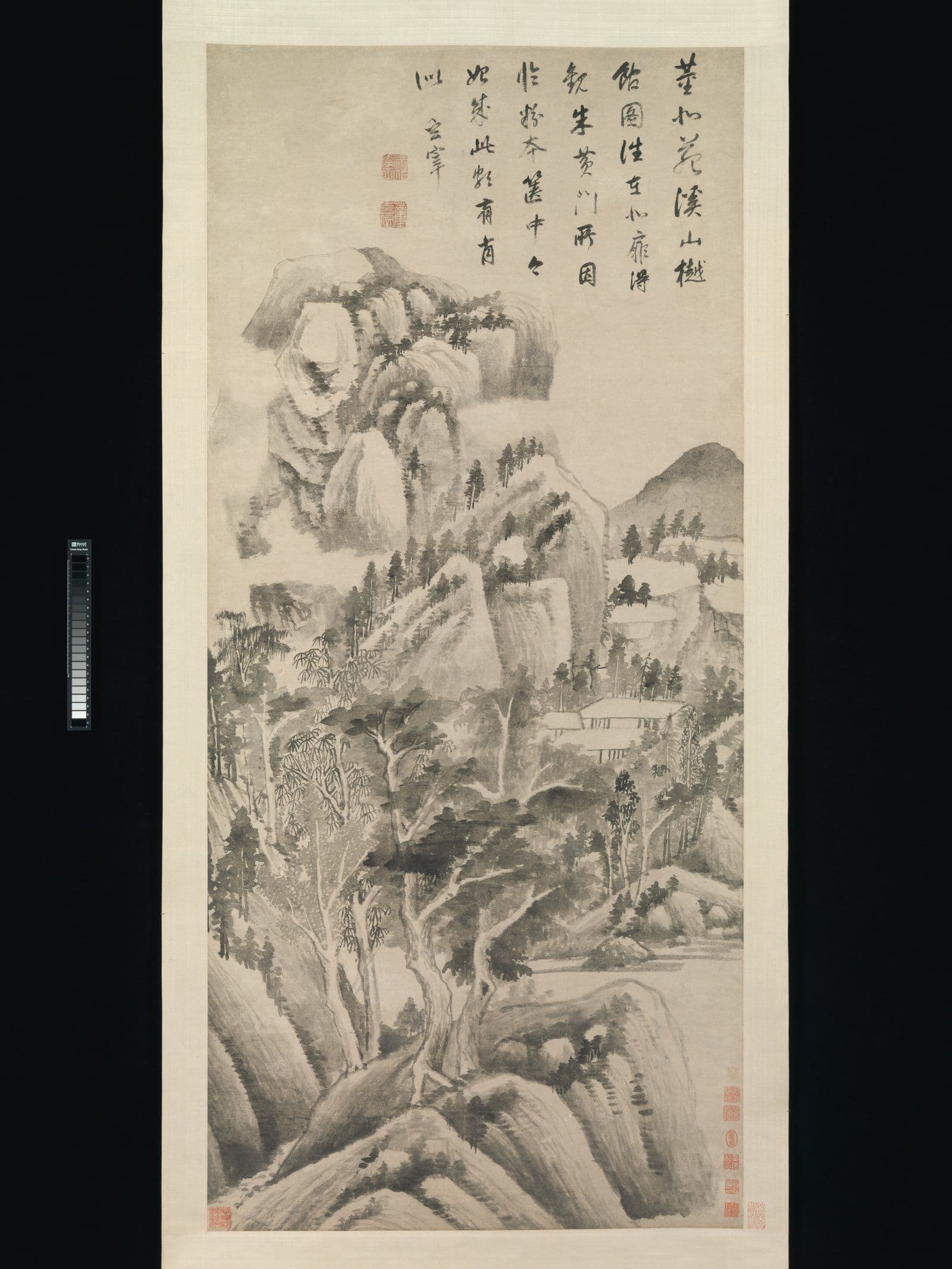
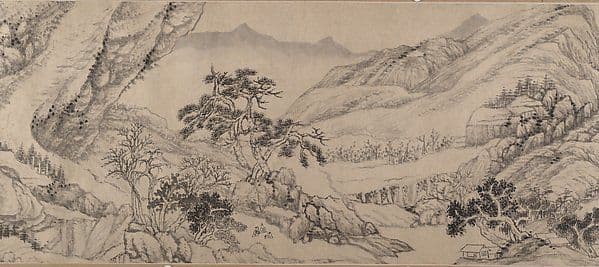
Chinese composition does not follow Renaissance one-point perspective. It uses what art historians sometimes call shifting perspective: the eye is led from one zone to the next, the way it would travel through a real landscape on foot. Negative space is not an absence; it is a positive element. Mountains float above mist not because the painter could not draw mist, but because the void carries weight.
6. Transmission by Copying (傳移模寫 chuán yí mó xiě)
The faithful copying of older masters. This is the principle most foreign to Western art education and most important for understanding the Chinese art market.
In Western traditions after the Renaissance, copying is for students; original work is the standard of value. In Chinese painting, copying was a lifetime practice — masters copied masters, signing their own work openly as "after" the older painter. A copy by a great painter of an earlier great painter could itself become a treasured work, sometimes more valuable than the original. The tradition of apocryphal reign marks on Chinese porcelain draws from the same logic, where a Qing potter would honestly inscribe a Chenghua mark as a tribute, not a forgery.
This sixth principle also explains why authentication in Chinese painting is so difficult. There are layers of legitimate copies between the modern collector and the original. The framework that produced this density of copies is the same framework that demands experts for navigating it.
How collectors actually use the six principles
Few collectors today consult the principles by name when looking at a painting. The internalised order is more like:
| What the eye does first | Xie He's principle ||---|---|| Look for life in the subject | 1 — spirit resonance || Read the brush quality | 2 — brushwork || Check the proportions | 3 — form || Notice the palette | 4 — color || Step back for the whole | 5 — composition || Place the work in lineage | 6 — transmission |
In practice these are not sequential — an experienced viewer absorbs all six in seconds. But when the eye stalls, when something feels off, the diagnosis tends to come back to one of the principles being weak.
When you read auction catalog entries from the major Asian Art sales, you will see this vocabulary in indirect form. "Vigorously brushed," "spirited line," "after the manner of," "sensitively composed" — each phrase points at one of the six. Catalogs also use cross-medium vocabulary: a dealer evaluating the painted decoration on a famille-verte vase will use the same brushwork standards used for a paper painting. The same connoisseur eye that reads a Chinese porcelain mark stroke by stroke reads a painting the same way, only without the inscription.
Where the framework breaks (or seems to)
The six principles were written largely with figure painting in mind. Landscape painting, which became the dominant mode after the Tang dynasty, sits awkwardly in some categories — what is the "form likeness" of a mountain? Later writers stretched the principles to cover landscape, but the fit is imperfect.
Modern Chinese painting raises the same question. A 20th-century master or a contemporary ink painter is still evaluated against Xie He's vocabulary, but the categories are doing different work. Spirit resonance now sometimes means the painter's individual signature; suitability of color sometimes means the courage to break the classical palette.
The framework persists not because it answers every question but because it provides a shared vocabulary. When Chinese critics, dealers, and collectors disagree about a painting, the disagreement is usually inside the framework, not against it. The same is true on the porcelain side: when an expert checks a base mark, the question is not whether the mark is "real" in some absolute sense but where it sits in the lineage. The companion piece on spotting fake Chinese porcelain marks lays out that lineage logic, and the same habit of mind transfers cleanly to painting.
Common questions
Why are Xie He's six principles still relevant after fifteen centuries?
Because no later framework has fully replaced them. Tang and Song writers added refinements, but they argued within Xie He's six categories. The principles persist because they describe what trained eyes actually do when looking at a painting — not what they should do in theory. A framework that tracks practiced perception does not become obsolete in the way a theory of perspective might.
How do the six principles apply to ink painting versus colored painting?
The principles are universal across media. In ink painting, the fourth principle (color) becomes about ink tones — how the painter modulates dilution and saturation. The first three principles apply identically: the brushwork principle in particular tends to be more visible in pure ink work because there is no pigment to hide it. Many connoisseurs argue that ink painting tests Xie He's framework most strictly.
Is the order of the six principles meaningful?
Yes. Spirit resonance comes first because, in classical Chinese theory, a painting without it has failed regardless of how it scores on the other five. Brushwork comes second because it is the technical foundation of every other achievement. Form likeness comes third — significantly subordinated. Western viewers often invert this hierarchy, leading to misreadings of "stylized" Chinese work that is in fact succeeding at higher-priority categories.
Did Xie He invent these principles?
He almost certainly codified ideas already in circulation among painters and critics of his time. What he did was give them a memorable formula, and that formula proved durable. Most innovations attributed to single figures in Chinese cultural history work this way: a synthesis given a name.
How can I use this framework as a non-specialist collector?
Slow down. When looking at a painting, give yourself a deliberate beat to ask each question: does it feel alive, are the brushstrokes confident, are the proportions right, is the color appropriate, is the composition working, where does it sit in the lineage? Even imperfect answers will sharpen your eye over time. The framework is most valuable not as a checklist but as a vocabulary for what you are already noticing.
Further reading
Reading Chinese Porcelain Marks: A Tutorial — the same character-by-character attention applied to a different medium.
Apocryphal Marks on Chinese Porcelain — the sixth principle (transmission by copying) made tangible.
How to Spot Fake Chinese Porcelain Marks — authentication methodology that runs in parallel to painting connoisseurship.
Chinese Porcelain Studio Marks (堂名款) — how a painter's identity gets encoded in another medium.
Browse our ink paintings
Hand-painted Chinese ink works in the literati tradition, faithfully described and properly attributed. — A small, curated selection that lets the framework above meet actual objects.
Explore Further