Published May 25, 2026
Literati painting vs court painting: the connoisseurial divide that still defines Chinese painting valuation, with a side-by-side reading guide for collectors.
At a serious Chinese painting auction preview, you can usually tell within ten seconds whether a piece comes from the literati tradition or the court-academy tradition. The literati landscape is sparser, drier, more text-heavy, and often inscribed by the painter himself. The court painting is denser, more colored, more polished, and usually anonymous on the work's surface even when the artist is recorded elsewhere. The difference is two parallel painting cultures with different patrons, different aims, and, today, two distinct markets.
This piece is for collectors who want to read a Chinese painting the way a Chinese curator reads it: starting with which tradition produced it, then judging it against the standards that tradition set for itself.
The two traditions in one sentence each
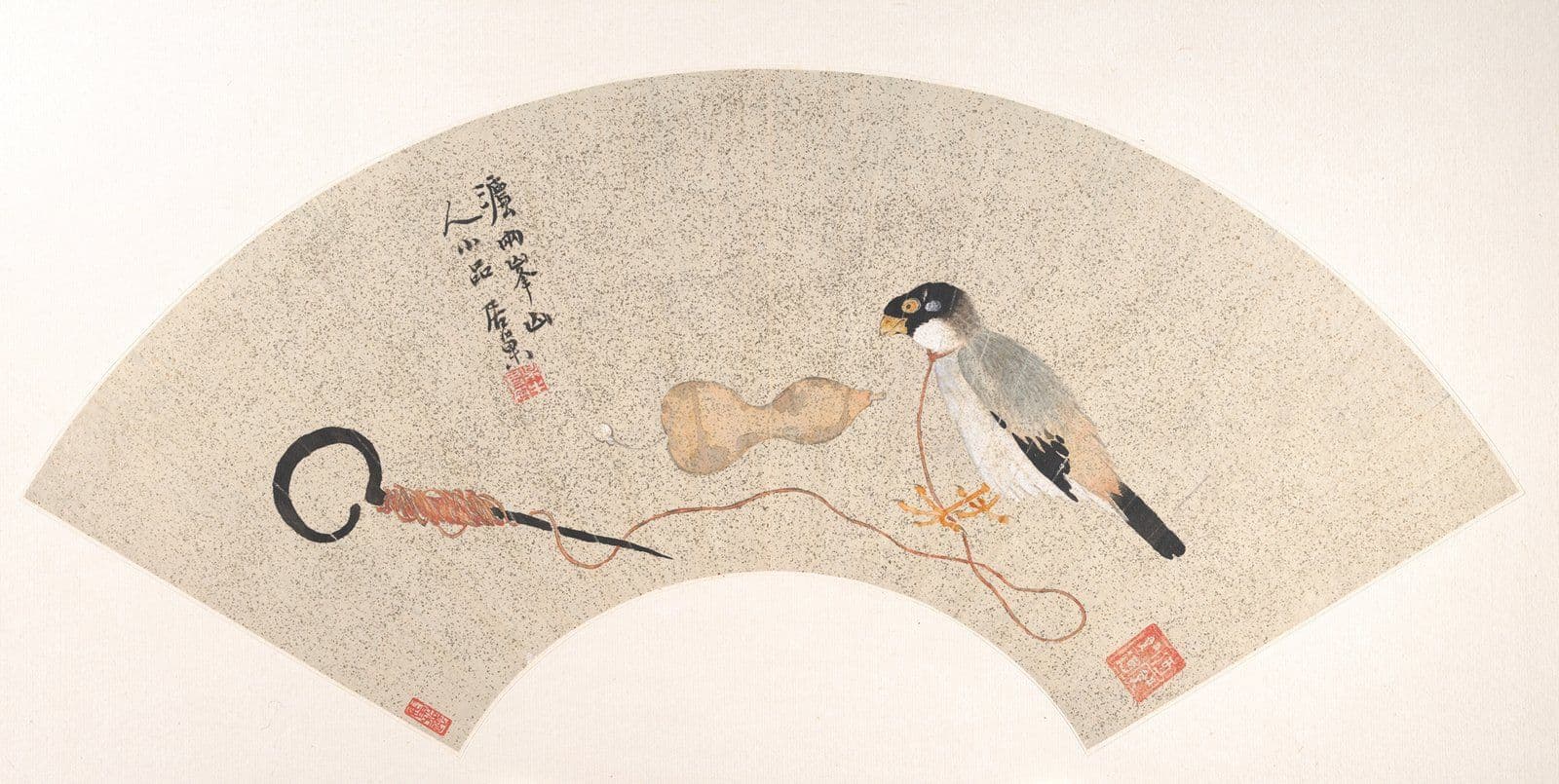
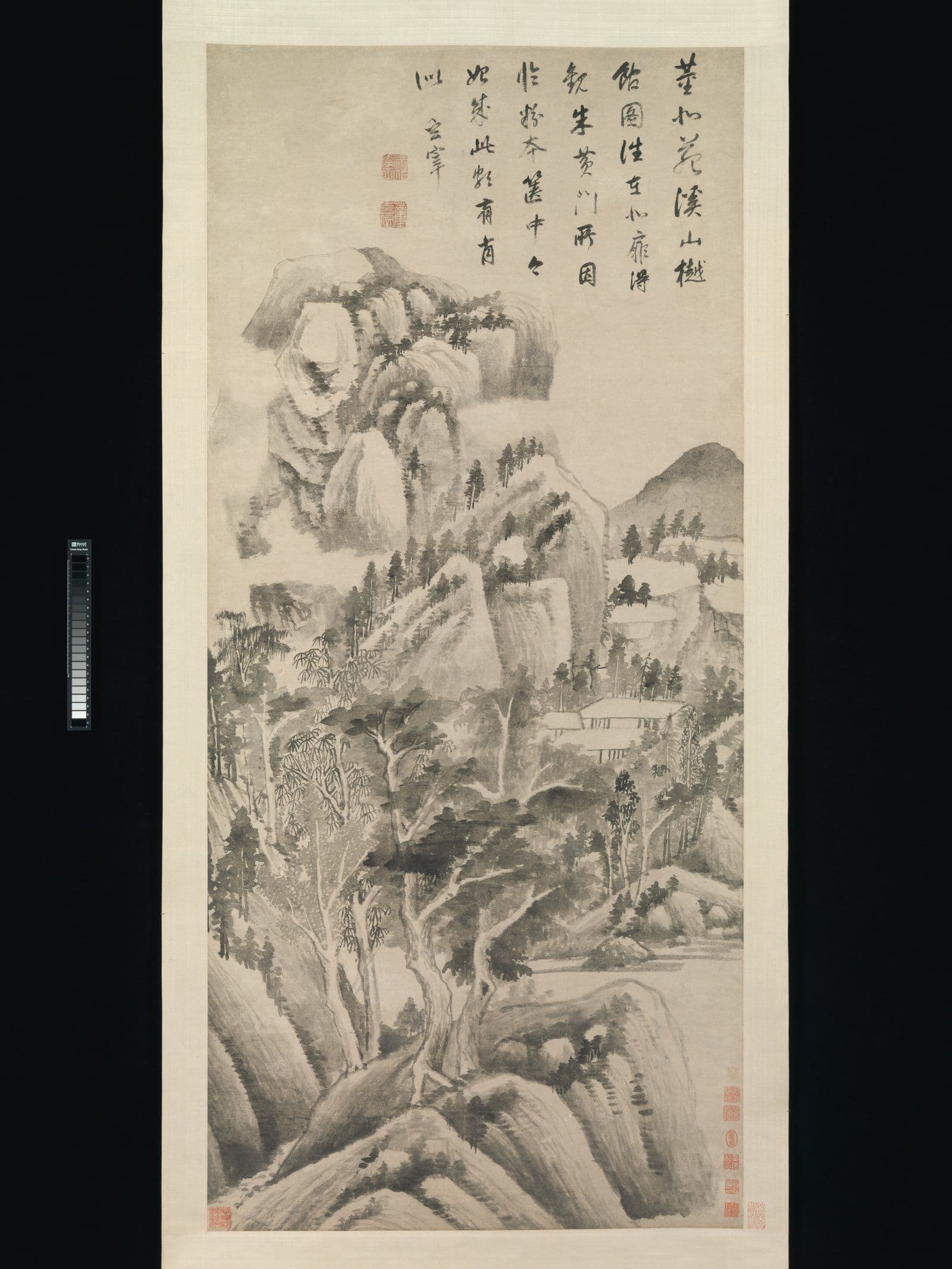
Literati painting (文人画, wenrenhua) is amateur painting by educated officials, scholars, and retired gentlemen, produced for themselves and circulated within their peer networks. It values restraint, brush quality, calligraphic line, and the painter's cultivated personality more than likeness.
Court (or academy) painting (院体画, yuantihua) is professional painting by trained specialists working for the imperial household, regional courts, or wealthy patrons. It values precision, refined color, technical command, and faithfulness to the subject. The Northern Song imperial Painting Academy is the institutional reference point, but academy-style work continued through the Qing.
A scholar who painted bamboo on the back of a letter to a friend was a literatus. A salaried court painter who recorded an imperial procession in full color was an academician. The same person occasionally did both; read the work by which mode it sits in, not by who the painter was.
Where the split begins
By the Northern Song (960–1127), the boundary was already being drawn explicitly. Su Shi and his circle of scholar-poets argued that the value of a painting lay in the cultivation of the person who made it, not in how convincingly the painted bamboo resembled real bamboo. This was a deliberate break from the academy's prevailing standard, which was precisely formal likeness.
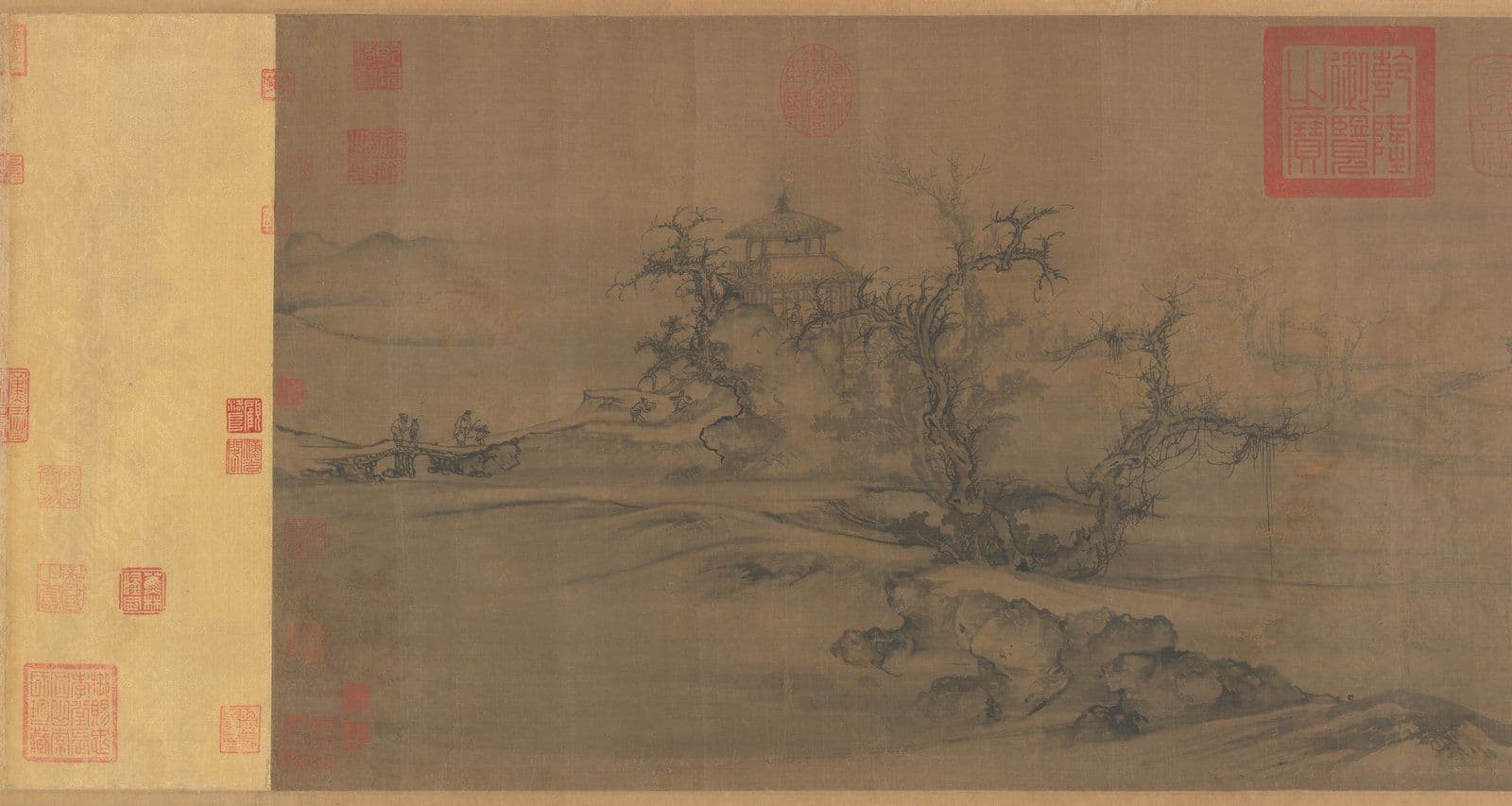
The Yuan dynasty (1271–1368), with its Mongol rulers and displaced Han scholar-officials, hardened the split. Many literati refused to serve the new court and turned to painting as a way of holding a private cultural line. Ni Zan, Wu Zhen, Huang Gongwang, and Wang Meng — the Four Masters of the Yuan — codified the literati landscape: dry brush, ink monochrome or near-monochrome, generous empty space, inscribed poetry. Their work became the template that Ming and Qing literati would reference and refine.
Court ateliers, meanwhile, regrouped under each new regime and continued to produce dense polychrome bird-and-flower compositions, portraits, narrative handscrolls, and ceremonial documentations. By the Qing, the academy tradition absorbed Western shading and perspective without abandoning Chinese ink protocols.
How to tell them apart in front of the painting
You can usually read the tradition from across the room. Up close, a few specific tells confirm it.
| Aspect | Literati | Court / academy ||---|---|---|| Subject | Landscape, bamboo, plum, rocks, orchid (the "four gentlemen" repertoire) | Bird-and-flower, figures, narrative, ceremonial, portraits, dense landscapes || Color | Ink monochrome or pale color | Full polychrome, mineral pigments, gold accent || Brushwork | Calligraphic line; visible, individual strokes | Refined outline plus careful color fill; brush hidden in service of form || Support | Often paper, which rewards dry brush | Often silk, which holds color and fine line || Inscription | Long, by the painter and by later viewers; integral to composition | Minimal on the painting surface; signature small, sometimes only a seal || Format | Handscroll, hanging scroll, album leaf, fan | Hanging scroll, handscroll, album leaf, large-format album || Stated intent | Self-expression, gift to a friend, "after the manner of" an admired predecessor | Commission for a patron or imperial occasion || Who made it | A literatus painting between official duties | A professional, often unnamed on the work itself |
None of these are absolute. A Qing court painter could paint a literati-style ink bamboo on his day off. A Ming literatus could occasionally take a commission. But the cluster of tells, taken together, almost always points clearly in one direction. The connoisseurial vocabulary used to make this reading is largely the one mapped out in the six principles framework that has guided Chinese painting criticism since the 5th century.
Why this matters for the market
The literati-academy divide is not just a curatorial classification. It shapes pricing, attribution risk, and the kind of due diligence a collector needs to do.
Literati paintings are priced on attributed authorship, on the chain of seals and colophons added by later owners, and on the work's relationship to canonical models. A small ink-bamboo album leaf attributed to a major Ming literatus, with seals of two Qing scholar-collectors, can clear seven figures at a top auction. The same composition painted equally well by an unrecorded Qing follower might bring four. The market here pays for the named person and the lineage, not for the square inches of painted surface. Authentication revolves around brushwork analysis, seal study, and the credibility of the collector seals that constitute the work's recorded ownership history.
Court paintings are priced on quality, subject, condition, imperial association, and — when present — documentary historical interest. A polychrome court bird-and-flower hanging scroll from a known Qing reign can be priced on the strength of its workmanship and the appeal of its subject without a famous name on the surface. When an imperial inscription, a court archive reference, or an attribution to a documented court master is present, prices rise sharply, but the baseline pricing logic is different: closer to decorative art, further from autograph-driven fine art.
In practical terms, this means a collector building a literati holding is buying authorship and provenance and should accept that authentication will dominate every purchase decision. A collector building a court-painting holding is buying craft and condition and should weight pigment freshness, silk stability, and the integrity of the silk mounting heavily.
The two markets also overlap less than newcomers expect. Specialist literati buyers pay heavy multiples for Yuan and early Ming literati names that Western decorative-art collectors barely recognize, while specialist court-painting buyers pay heavy multiples for high-Qing imperial polychrome works a literati specialist might find ostentatious.
How to look at a literati landscape
If you want to learn one mode well first, start with the literati landscape, because it is the mode that founded the connoisseurial vocabulary. Read it in this order:
Compositional armature. Where is the empty space? The literati landscape uses unpainted paper as half the picture; the negative space is doing work. If the empty zones feel arbitrary, the picture is weak.
Brush types. Identify the texture strokes used to render rocks (cun) — long hemp-fiber, axe-cut, raindrop, and others. Each is a learned vocabulary item with a lineage. A confident painter uses two or three; a confused one mixes seven.
Ink layers. Dry brush over wet wash, dark over light, the order of layering. The painter's control of ink dilution is the closest visible analogue to brush quality.
The relationship between the painted area and the inscription. A long inscription that looks pasted onto a finished composition is usually a later addition. A composition that breathes around its inscription was planned with the text in place.
The seals. The painter's seal is the closing line. Subsequent collector seals — and the way they have been placed without disturbing the composition — tell you whether the picture has lived through serious collections or has been knocked around.
A well-executed literati landscape rewards twenty minutes of looking. A weak one tells you everything it has within five seconds.
How to look at a court painting
The court painting asks a different question of you: not "does the painter have a cultivated personality?" but "how much technical command and material refinement is on display?"
Pigment quality. Are the mineral blues and greens deep and stable, or chalky and faded? Are gold passages still legible? Quality court pigments were expensive; their presence and condition matter.
Outline-and-fill discipline. In gongbi (meticulous) court work, the outline is laid down with controlled ink first, then filled with color. Slack outlines or color spilling outside them suggest a workshop hand or later imitation.
Silk condition. Court paintings on silk are vulnerable to splits, foxing, and remounting damage. The silk's tone, the visibility of warp and weft, and the integrity of the mounting are central to value.
Subject precision. A court bird-and-flower painting should get the species correct. The Northern Song academy was famously demanding about ornithological accuracy.
Imperial markers. Reign-period imperial seals, court archive notations, and named inventory references all add value sharply. Their absence is normal; their presence is a multiplier.
The court painting can hold up to magnification. Read its details under good light; the literati landscape often reads better from a step or two back.
The wandering middle: where the categories soften
Two zones complicate the picture and reward extra attention.
The first is the Ming Zhe school — professional painters working in a forceful, ink-heavy style that drew on Southern Song court traditions. They were neither pure literati amateurs nor strict academy bureaucrats, and the market sometimes prices them on a literati template, sometimes on a craft template.
The second is the late Ming and Qing professional literati — artists who lived by selling paintings while painting in the literati mode for an expanding merchant patronage. The works are often beautifully made, but their patronage logic is closer to the court tradition than to the Yuan masters they reference. Look at the specific work in your hand rather than the artist's reputation.
A collector's framework
A practical way to approach the divide as a buyer:
If you are drawn to brush, ink discipline, and intellectual lineage, build toward the literati tradition. Expect to spend more time on authorship and provenance than on visual triage, and budget for expert opinion before any significant purchase.
If you are drawn to color, fine detail, narrative subject matter, and decorative arts, build toward court and academy work. Spend more time on condition, pigment evaluation, and mounting integrity than on authorship. A clean, well-mounted Qing court hanging scroll is a more transparent buy than an undocumented literati attribution.
Many collectors eventually build both wings, and many learn that what they thought was preference is actually familiarity.
Common questions
Is one tradition considered "higher" than the other in Chinese art history?
Within the Chinese connoisseurial canon as it crystallized from the Song onward, literati painting is treated as the more elevated mode — it is the tradition the canonical art-historical writing was produced about, by literati themselves. But this is partly self-reporting; literati wrote the history. Court painting was, and remained, technically more demanding in many respects. The honest position is that they pursue different goals and should be judged against the standard each tradition set for itself.
Can the same painter work in both modes?
Yes, especially in the Qing dynasty when the line softened. Court painters frequently worked in literati ink modes for personal pieces, and literati occasionally produced color-rich pieces that lean toward academic precision. When you find a work that crosses modes, read the specific work rather than the painter's reputation.
How does this affect what I should pay for a painting?
It affects what you are paying for. A literati work is largely a payment for attributed authorship and recorded provenance; budget your due diligence around authentication. A court work is largely a payment for craft, condition, and pigment quality; budget around physical inspection. The same headline price means very different risk exposure.
Why do some literati paintings look "unfinished" compared to court work?
The apparent unfinish is intentional. The literati aesthetic prizes the unpainted area, the dry stroke, and the moment when the brush lifts. Restraint is the technical achievement, not lack of skill. A court painting that looked equivalently sparse would be considered unfinished; a literati painting that looked equivalently dense would be considered overworked.
Where does ink-only landscape fit between the two?
From the Yuan dynasty onward, ink-only landscape sits firmly inside the literati tradition. Earlier ink landscapes belong to a moment when the split was still hardening; many Northern Song masters did not see themselves as belonging to either side of a divide that had not yet been fully named.
Further reading
Chinese Ink Painting vs Watercolor: What's Actually Different — why the literati commitment to ink monochrome is the opposite intention from Western watercolor.
Apocryphal Marks on Chinese Porcelain — the "honest homage" tradition that runs through both painting and porcelain, and why later attribution is not always forgery.
Republic-Period Porcelain Marks (民国) — the moment when professional artisan signatures took over from imperial reign marks, a parallel to late-Qing professional literati painters.
Chinese Export Porcelain Marks: Kraak, Swatow, and Other Trade Wares — how a parallel professional-versus-imperial split played out in the porcelain market.
Browse our ink paintings
Modern hand-painted homages in the literati and academy traditions, all faithfully described and grounded in the conventions each tradition set for itself.
Explore Further