Published July 16, 2026
Wu Changshuo (1844–1927) came to painting late, through seal carving and Stone Drum calligraphy, and made wisteria and plum monumental. How to read his epigraphic brush line, and why nearly every modern master painted in his shadow.
Before he was a painter, Wu Changshuo was a man with a knife. For most of his working life he earned his reputation cutting seals — pressing a blade through stone in the disciplined, archaic script of the Zhou dynasty — and copying, over and over for decades, the inscriptions on a set of ancient carved stones known as the Stone Drums. When he finally turned that hand to painting flowers, the line that came out was unlike anything else in the ink tradition: blunt, weighty, carved rather than drawn.
This article walks you through how that happened and what it means when you stand in front of one of his paintings — the late start, the calligraphic engine underneath the flowers, the subjects and colour habits to recognise, the students who carried his manner into the twentieth century, and the practical points a collector should check before trusting an attribution.
A late start, by way of stone
Wu Changshuo was born in 1844 in Anji, a hill county in Zhejiang province, under the name Wu Junqing. His youth was torn apart by the Taiping civil war, which swept through Zhejiang in the early 1860s; the family was displaced and several of its members did not survive the upheaval. The experience left him with a lifelong habit of describing himself in hard, mineral terms — one of his favourite sobriquets was Kutie, "Bitter Iron."
What he trained in, through those unsettled years and after, was not painting but the scholar's older disciplines: poetry, calligraphy, and above all seal carving. He worked minor clerical posts to stay fed, and his one taste of real office was famously brief — appointed magistrate of Andong county in 1899, he resigned after roughly a month, and then cut a seal reading "Magistrate of Andong for one month" to commemorate the episode. The joke tells you where his loyalty lay: the knife, not the yamen desk.
By the time he settled into the Shanghai art world in his final decades, his standing as a carver was unmatched. When the Xiling Seal Society — still China's most prestigious society for seal arts, founded in Hangzhou in 1904 — chose its first president, it chose Wu Changshuo. Painting was the last art he added, and he was frank about it: the serious painting begins in his middle years and the defining work comes after fifty.
The Stone Drum line: how calligraphy became painting
The single most useful thing you can know about Wu Changshuo's painting is what his hand was doing every morning before he painted. For decades he copied the Stone Drum inscriptions — texts in an early form of seal script cut into drum-shaped granite boulders in the Zhou period. Daily practice of that one archaic source gave him a line with very particular properties: centred brush-tip, even pressure, rounded entries and exits, and enormous contained strength. Nothing whips or trails. Every stroke looks like it weighs something.
Critics of his own era already had a name for this quality: jinshi qi, the "spirit of metal and stone" — the aesthetic of bronze inscriptions and carved stone imported into brush painting. When Wu painted a hanging vine of wisteria, he was not sketching a plant; he was writing it, in cursive-inflected seal script, letting the vine twist with the same torque as an archaic character. He said as much himself, and the paintings bear it out: cover the blossoms in a good Wu Changshuo and the stems alone still read as calligraphy.
This is also what separates him from the generations of ink-flower painters before him. The literati flower tradition prized elegance, thinness, restraint — the cultivated amateur's touch. Wu's line is deliberately heavy, rustic, almost clumsy on first meeting. It traded refinement for structural power, and that trade is precisely what the twentieth century wanted.
Reading a Wu Changshuo: subjects, colour, and the diagonal
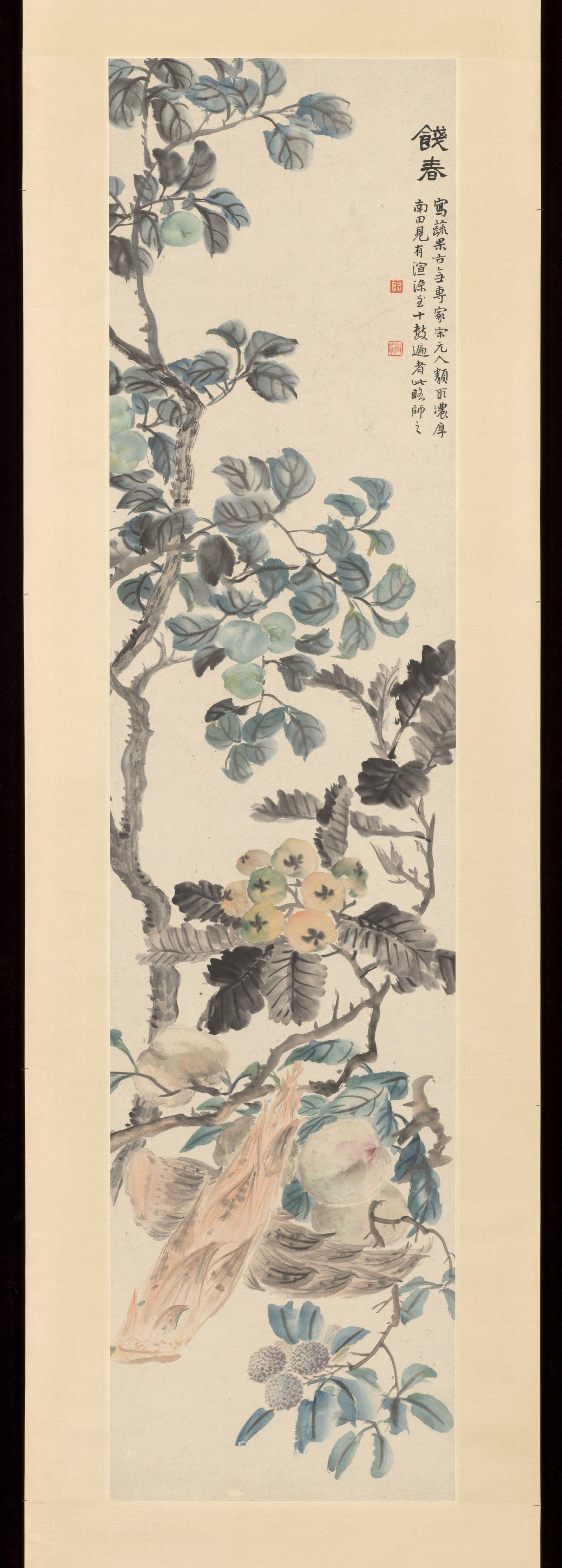
Wu's subject range is narrow and repetitive by design, which is convenient for the collector learning to read him. The core repertoire: wisteria, plum blossom, chrysanthemum, peony, pine, bamboo, gourds, grapes, peaches — the last often painted for birthday commissions — plus garden rocks to anchor the composition. He was, first to last, a flower-and-plant painter; pure landscape and figure subjects are comparatively rare.
Three habits are worth fixing in your eye:
- The diagonal spine. Wu built compositions on a strong diagonal — a branch or vine entering from one corner and driving toward the opposite edge, with the calligraphic inscription deliberately placed to counterweight it. The result feels architectural rather than decorative. If a work attributed to Wu floats its subject politely in the middle of the sheet, look harder.
- Colour used like ink. He adopted the intense imported red pigment of his day — the so-called yanghong, "Western red" — for plum blossoms and peaches, and used strong yellows and greens elsewhere. What makes it his is that the colour is applied with the same blunt, loaded brush as the ink: petals are struck, not filled in. The saturation shocked conservative taste at the time, and it still reads as startlingly modern.
- Inscription as a load-bearing wall. The long inscriptions in his running-cursive hand are not captions; they are structural members of the picture, and he often dated them and recorded his age (in his last decade the paintings frequently announce him in his eighties). A Wu Changshuo with a timid, spatially irrelevant inscription is a warning sign.
His seals matter more than most painters', for the obvious reason: he cut them himself. The recurring names to know are Changshuo, Foulu ("Hut of the Pot" — he was fond of an ancient pottery jar he owned), and Kutie. On a genuine work, seal placement participates in the composition the way the inscription does — as reference material, the layered red marks on Chinese paintings are covered in our guide to collector seals.
The teacher of the twentieth century
Wu Changshuo spent his last fifteen years in Shanghai as the acknowledged head of what is now called the Shanghai School, and his influence on what came after is hard to overstate. It was the figure painter Ren Bonian who had encouraged him, back in the 1880s, to paint at all — reportedly telling him that a man with that calligraphic line had no business not painting. Two generations down, the debt runs the other way.
Qi Baishi — whose own reinvention in old age produced the shrimp paintings that now anchor his market — wrote a famous poem declaring that he would gladly serve as a "running dog" at the gates of three masters: Xu Wei, Bada Shanren, and "Old Fou," meaning Wu Changshuo. Qi's mature manner — blunt epigraphic line, drastically simplified subjects, saturated colour against black ink — is unthinkable without Wu's example. The young Pan Tianshou, later the most architectural composer among the modern masters, met the elderly Wu in Shanghai and received both praise and a pointed warning against facility; Pan kept the diagonal discipline visibly in mind for the rest of his career.
That lineage is worth remembering when you look at pricing and importance: Wu is not simply one more late-Qing flower painter. He is the hinge between the literati tradition and the twentieth-century masters this gallery focuses on — the man who proved the old scholarly disciplines could generate a modern pictorial language rather than merely ornament it.
The market, and the forgery problem
Wu Changshuo has been consistently among the strongest-selling names of his generation in the Chinese painting sales in Beijing, Hong Kong, and Shanghai, with his large late wisteria and plum compositions leading. He was also prolific, famous within his lifetime, and widely imitated from the moment he became fashionable — which means the attribution problem is serious and always has been.
Practical checks, in the order a specialist would apply them:
- Judge the line first. The centred-tip, evenly weighted Stone Drum stroke is genuinely difficult to fake at speed; copyists' vines go thin, whippy, or hesitant in the turns. This is the same layered method described in our guide to how experts authenticate Chinese paintings — brush manner outranks every other test.
- Compare the seals against published impressions. Because Wu cut his own seals, documented impressions exist in quantity; a mismatched or freshly-cut-looking seal is close to disqualifying.
- Read the inscription critically. Dates, cyclical years, and stated ages should be internally consistent and consistent with his biography.
- Weigh provenance. Works with early publication or exhibition history, or with a documented chain back to pre-war Shanghai collections, carry a premium for good reason.
None of these alone settles a case, but together they filter out the bulk of the market's optimistic attributions.
Common questions
Why do people call Wu Changshuo a seal carver first?
Because that was the reputation he built for most of his life, and it is the technical foundation of everything else. His seal carving and Stone Drum calligraphy were celebrated decades before his painting was, and he became the first president of the Xiling Seal Society in his late sixties. The painting is, in a precise sense, an extension of the carving: the same archaic line, transferred from knife and stone to loaded brush and paper.
What subjects did Wu Changshuo paint most?
Flowers and plants, overwhelmingly: wisteria, plum blossom, chrysanthemum, peony, pine, gourds, grapes, and birthday peaches, usually anchored by garden rocks and a long calligraphic inscription. He painted very little pure landscape or figure work. The narrow repertoire was deliberate — each subject became a vehicle for the calligraphic line rather than a botanical study.
How can I tell a genuine Wu Changshuo from a copy?
Start with the brush line: genuine Wu has a blunt, centred, evenly weighted stroke derived from seal script, with no whippy or trailing passages, and compositions organised on a strong diagonal. Then compare seals against published impressions (he cut his own, so the reference base is good), check that dates and stated ages in the inscription are consistent, and ask for provenance. Copies most often fail in the vine stems and branch turns, where the archaic line is hardest to sustain.
Was Wu Changshuo really Qi Baishi's teacher?
Not formally — they never had a master-disciple relationship, and the two barely met. But Qi Baishi openly modelled his mature manner on Wu's epigraphic style and said so in verse, naming Wu alongside Xu Wei and Bada Shanren as the three painters he most revered. In terms of visible influence, Qi is Wu's greatest heir, and the modern "red-flowers-black-ink" manner descends directly from Wu's colour-against-ink formula.
Further reading
- Qi Baishi's Insects: The Meticulous Miniatures Inside the Freehand Master — the other side of the epigraphic lineage: Wu's greatest heir at his most exacting.
- Huang Binhong's Black Landscapes: Reading the Dense Late Style — a contemporary who took the "metal and stone" aesthetic into landscape instead of flowers.
- Li Kuchan's Eagles: Big-Brush Freehand in the Qi Baishi Line — the Wu-to-Qi line carried one more generation forward.
- Literati Painting vs Court Painting: Two Traditions, Two Markets — the scholarly tradition Wu inherited, and transformed, from the inside.
Browse our collection
Prints from the modern masters who carried Wu Changshuo's line forward are available in our collection.
From the Kiln & Ink collection: Flower Basket with Dragonfly, an archival giclée edition after Wu Changshuo, hand-numbered on xuan paper with a certificate of authenticity.
Explore Further