Published October 23, 2026
Zhao Shao'ang explained: the Lingnan second generation, how a bird is built in one loaded stroke, reading his inscriptions, and four tests that catch copies.
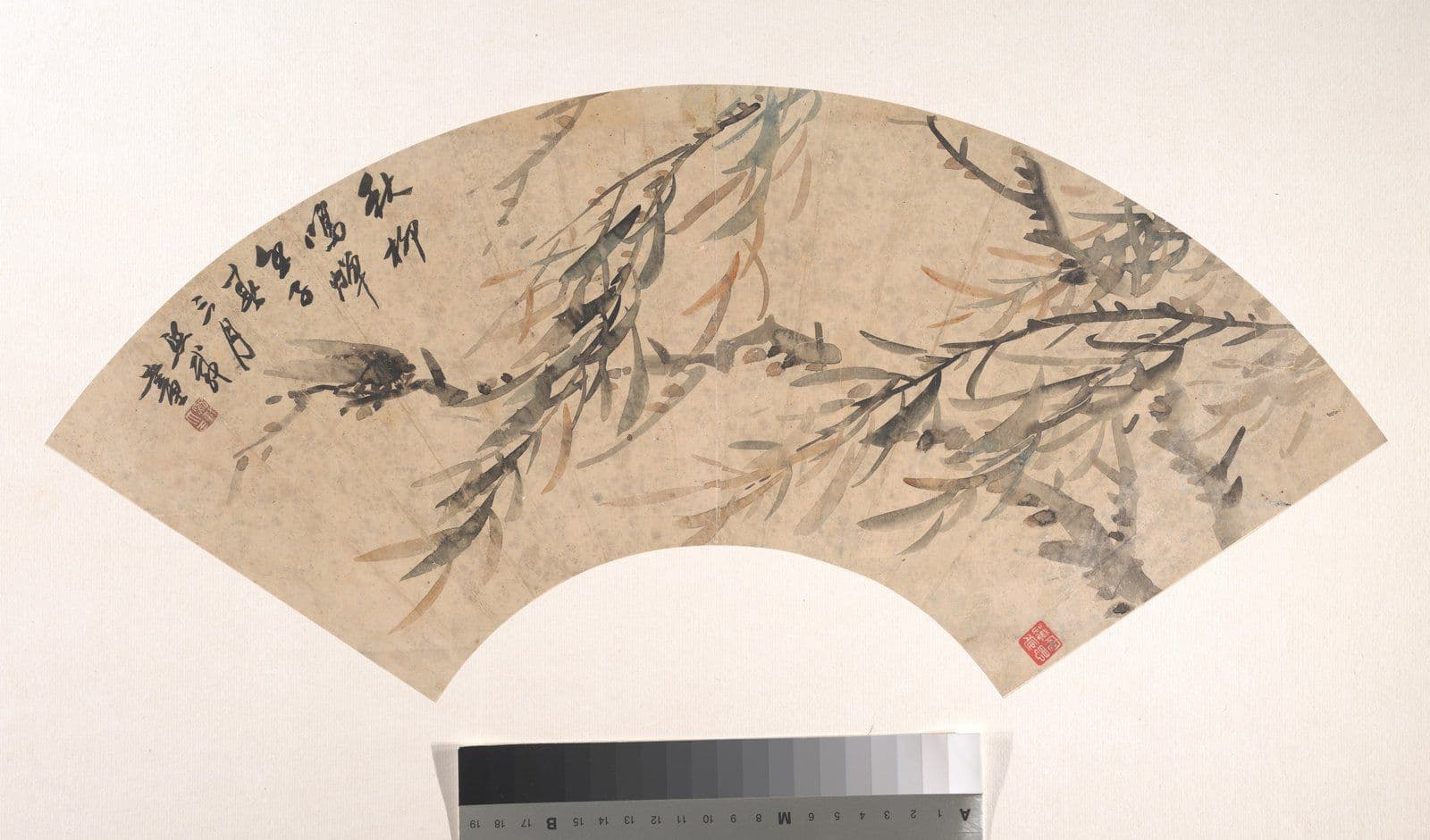
The album leaf is small enough to hold in one hand. A cicada clings to a willow twig, its wings two transparent washes with the veins left as fine dry lines, the body a single dark stroke that swells where the brush was pressed down and thins where it lifted clear. Tilt the leaf towards a window and the wash over the willow leaves shifts from grey-green to almost colourless: pigment sitting in the paper rather than on it. Nothing in the picture announces a date. Everything in it says Guangdong, the middle of the twentieth century, and one pair of hands.
This guide walks you through the second generation of the Lingnan school by way of its most prolific member: what Zhao Shao'ang took from Gao Qifeng's studio, how a bird is built in one loaded stroke, how to read his inscriptions and seals, what paper and mounting tell you, and the four tests that separate his work from copies.
The second generation, and why it is a separate problem
The Lingnan school is usually described through its founders, Gao Jianfu, his younger brother Gao Qifeng and Chen Shuren, who argued that Chinese painting had to absorb what Japan and the West had done with light and observation without surrendering brush and paper. That argument is the subject of Lingnan school painting and Gao Jianfu's generation. The men who studied under them inherited a technique rather than a quarrel, and that changes what a collector is looking at.
Zhao Shao'ang (1905–1998) was born in Panyu, on the edge of Guangzhou, and studied under Gao Qifeng. Where Gao Jianfu spent his career making a case, Zhao spent his making pictures. He taught in Guangzhou, moved to Hong Kong in 1948, and painted there for the next fifty years, taking the school's manner into the Chinese communities of Southeast Asia, North America and Australia.
Three consequences follow. The output is very large, because he worked for seven decades and ran a teaching studio. Quality tracks date, so the album leaves and fans of the 1930s to 1950s are usually tighter than the big late scrolls. And his manner was taught to hundreds of students, which means the question is rarely whether a sheet is Lingnan school, but whether it is Zhao.
Gao Qifeng's studio and the animal subject
Gao Qifeng (1889–1933) died young, and the smallness of his output is part of why his students matter so much to the school's survival. What he painted best was animals and birds, handled with a precision that came out of Ju Lian's Guangdong studio and a theatrical sense of light that came from somewhere else.
Two habits passed straight into Zhao's hand. The first is the wet technique the school inherited from Ju Lian: a wash of colour is laid and clear water or opaque white is dropped into it while it is still wet, so the two liquids push against each other and dry into a gradation no brush could stroke in. The second is the willingness to paint one bird, one insect, one branch, and leave the rest of the sheet empty.
That emptiness is not laziness. On a Lingnan leaf the blank paper does the work a background would do in a Western picture: it is the air the bird sits in, the humidity, the light. Zhao's pictures read as though the subject has been caught in a particular afternoon, and you can date much of his work by how much paper he was willing to leave alone.
How a bird is built in one stroke
The body of the bird is usually one stroke. The brush is loaded with ink and colour together, pressed at the shoulder, dragged along the body and lifted at the tail, so the back comes out dark, the belly pale, and the mass holds a single direction of movement. Nothing is corrected afterwards. A body built from three or four separate strokes looks different: the tone is even, the edges are stacked, and the bird loses the slight asymmetry a loaded stroke leaves behind.
The rest is assembled in an order set by drying. Wing feathers go in with a drier brush while the body is still damp, so their tips soften into it. The eye is a hard dark dot placed while the head is wet, which is why it often bleeds a fraction into the surrounding wash. The beak is two short strokes meeting at a point. Legs and claws come last, with a fine brush held upright, each toe a separate dark line ending in a small hooked nail.
The branch is where copies fail. In Zhao's own leaves the twig is a wet wash with dry-brush passages for the bark, and the feet are painted over it, so the claws sit on the branch rather than behind it. Look at the junction with a loupe. A copyist working from a photograph, or painting the bird before the branch, gets the overlap wrong: the claw disappears into the twig, or the twig stops short of the foot.
The cicada, the willow and the seasons
Zhao painted the cycle of the year, and certain subjects recur often enough to be treated as signatures: cicadas on willow, kingfishers over water, egrets in rain, peonies, orchids, banana leaves, and the small insects that Ju Lian's studio had made a Guangdong speciality. The cicada is the one collectors look for, and the one that shows most clearly whether a painter could handle a transparent wing, which is a matter of leaving paper bare inside a wash rather than drawing veins on top of it.
The readings behind these subjects are conventional, and worth knowing because they explain why a picture was made. The cicada, which spends years underground and emerges to drink dew, stands for purity and renewal. Willow stands for parting, so a cicada on willow is a summer picture with a small elegy inside it. The egret reads as integrity, the bird that keeps its white plumage in muddy water. None of this needs spelling out on the sheet; it is the vocabulary the painter expected a buyer to bring.
Reading the inscription
Zhao's inscriptions are short: two characters of signature, a cyclical date, sometimes a place, occasionally a dedication to a named person, and nothing else. He signed 少昂, Shao'ang, in running script, usually at the left edge or lower left, sized to the empty space rather than to the picture as a whole. On works made in Hong Kong he often noted the place of painting; on earlier Guangzhou works the same information appears in a more angular hand.
The date is the part collectors misread. He used the sixty-year cycle, so a cyclical pair gives you a year only in combination with something else, and the same pair recurs twice in a long career. How cyclical dates work is worth learning before you accept a date at face value; the same two characters can put a painting in the 1930s or the 1990s, and the difference in value is considerable.
Then compare the inscription to the painting. A genuine late work has a relaxed, slightly hurried hand in both. A copy often carries a signature more careful than the picture beneath it: the painter signed hundreds of sheets without thinking, and the copyist signed one with great attention.
Seals, paper and the Hong Kong climate
He used a small name seal, sometimes two, placed close under the signature, and occasionally a leisure seal at a lower corner. The impressions are small and usually a little off-square, because they were stamped by hand on paper that was not perfectly flat. A perfectly aligned, evenly inked, bright vermilion impression on a painting of the 1940s is a warning rather than a comfort. Reading Chinese painting seals covers the seal script and the paste.
The support is usually xuan paper, sometimes a sized sheet that takes a sharper edge, and album leaves and fans are common enough that a collector can build a representative group without ever buying a hanging scroll. What the paper tells you is condition. Hong Kong humidity produces foxing, the small brown spots that bloom from the sizing, and tide marks after a damp episode. Thin washes lift where the sheet has been rubbed.
The mount dates the presentation, not the painting. Silk replaced in the 1970s is normal and not a defect; what matters is whether the paper was trimmed at the same time. Look under the silk at the edges of the sheet for margins cut back, and at the top and bottom strips for replacement. How Chinese paintings are mounted explains what a restorer does and what it costs you in originality.
Four tests against copies
- The body stroke. One loaded stroke, swelling and thinning, with a direction. Several even strokes, or a wash with a hard edge where the copyist stopped, means a copy.
- The claw on the branch. Feet painted over the twig, nails visible, each toe separate. If the claw vanishes into the branch, put it down.
- Surface and reverse. A printed reproduction shows a dot screen under a loupe, a uniform sheen, and no ink penetration on the back of the sheet. Genuine washes sink in and read through the paper.
- The seal against the painting. A crisp, bright, perfectly squared seal on a weak picture is the commonest forgery pattern, and the commonest honest explanation is that a student's work received the master's seal.
That last category catches experienced buyers. Zhao taught in Hong Kong for decades, and sheets that left his studio as student exercises, or as collaborations, exist with his signature or seal added later. The drawing of the eye and the feet is where the difference shows, because those are the parts a student has not yet learned to place in one movement. How artist signatures are identified sets out the same method across other twentieth-century painters.
Where the market sits
Supply is the defining fact. Zhao painted for seventy years and taught throughout, so his work is available in Hong Kong auction rooms and dealers continuously, with a secondary flow through Guangdong and through overseas Chinese collections. That supply keeps prices moderate relative to the first-generation masters and makes him one of the more accessible entry points into the school.
Within that supply the market is not flat. Album leaves and fans with insects or a single bird, in good condition, carry a premium over large late hanging scrolls, which are the works most often used as decoration and most often damaged. Condition moves value more than usual here, because thin washes and humid storage are unforgiving.
Buy the sheet, not the name. Framed works should be seen out of the frame, or with the backing board off, so that you can look at the reverse and the margins.
Common questions
Who was Zhao Shao'ang's teacher?
Zhao Shao'ang studied under Gao Qifeng, the younger of the two Gao brothers who founded the Lingnan school, and through him inherited the Guangdong wet-wash technique developed in Ju Lian's studio. He is counted among the school's second generation, alongside contemporaries such as Guan Shanyue, who studied with Gao Jianfu.
How can you tell a Zhao Shao'ang painting from a copy?
Start with the bird's body: one loaded stroke that swells and thins, not several even ones. Then the feet, painted over the branch with separate toes and visible nails. Then the reverse of the sheet, which should show ink sunk into the paper rather than sitting on it. Finally compare the signature to the painting; a signature more careful than the picture is usually a later addition.
What did Zhao Shao'ang paint most often?
Birds, insects and flowering plants, in the Guangdong bird-and-flower tradition: cicadas on willow, kingfishers, egrets, peonies, orchids, banana leaves. He also painted landscape and figures, but the bird-and-flower sheets are the core of his market and the works on which his reputation rests. The bird-and-flower tradition explains the conventions he worked inside.
Is a Zhao Shao'ang painting a good investment?
That depends on the sheet, not the name. The volume of his output is large and continuous, which limits scarcity, and the strongest prices go to early album leaves and fans in clean condition. Treat him as an affordable way into the Lingnan school rather than as a store of value.
Further reading
- The copy tradition in Chinese painting — why copying was a legitimate practice, and how that complicates the question of forgery.
- How to care for Chinese ink paintings — storage, light and humidity, and what foxing does once it starts.
- Archival inks and paper longevity — what actually fades, and why a reproduction can be mistaken for a painting.
Browse the collection
Zhao Shao'ang is a subject we write about rather than one we stock. The artists we publish are the twentieth-century ink masters whose work survives best in reproduction, Guan Shanyue among them, who came out of the same Lingnan milieu. Browse the collection for the group whose brushwork rewards close looking at the original. Every reproduction is a limited-edition archival giclée, hand-numbered and issued with a Certificate of Authenticity.
Explore Further