Published August 22, 2026
Lingnan school painting explained: Gao Jianfu's argument, the wet-collision technique behind it, and the six signs that identify a Lingnan picture.
Sometime in the 1930s, Gao Jianfu put an aeroplane into a Chinese landscape. Not as a joke, and not as a symbol tucked into a corner: the machine sits in the sky above ink-washed hills, painted with a brush, on paper, in a format that had carried pine trees and hermits for eight hundred years. Traditionalists in Shanghai and Beijing thought it was vandalism. Gao thought it was the only honest thing a Chinese painter could do in a country being bombed.
This article is about the man who made that argument and the school that formed around it. By the end you should be able to look at an unsigned twentieth-century Chinese painting from the south and say, with reasons, whether it belongs to the Lingnan tradition — and understand why the question was politically loaded for most of the century.
The teacher: Ju Lian's Guangdong studio
Gao Jianfu (1879–1951) was born in Panyu, on the edge of Guangzhou, and trained under Ju Lian (1828–1904), the last great master of the Guangdong flower-and-insect manner. Ju Lian is worth understanding first, because everything the Lingnan School later did to atmosphere and colour starts in his studio.
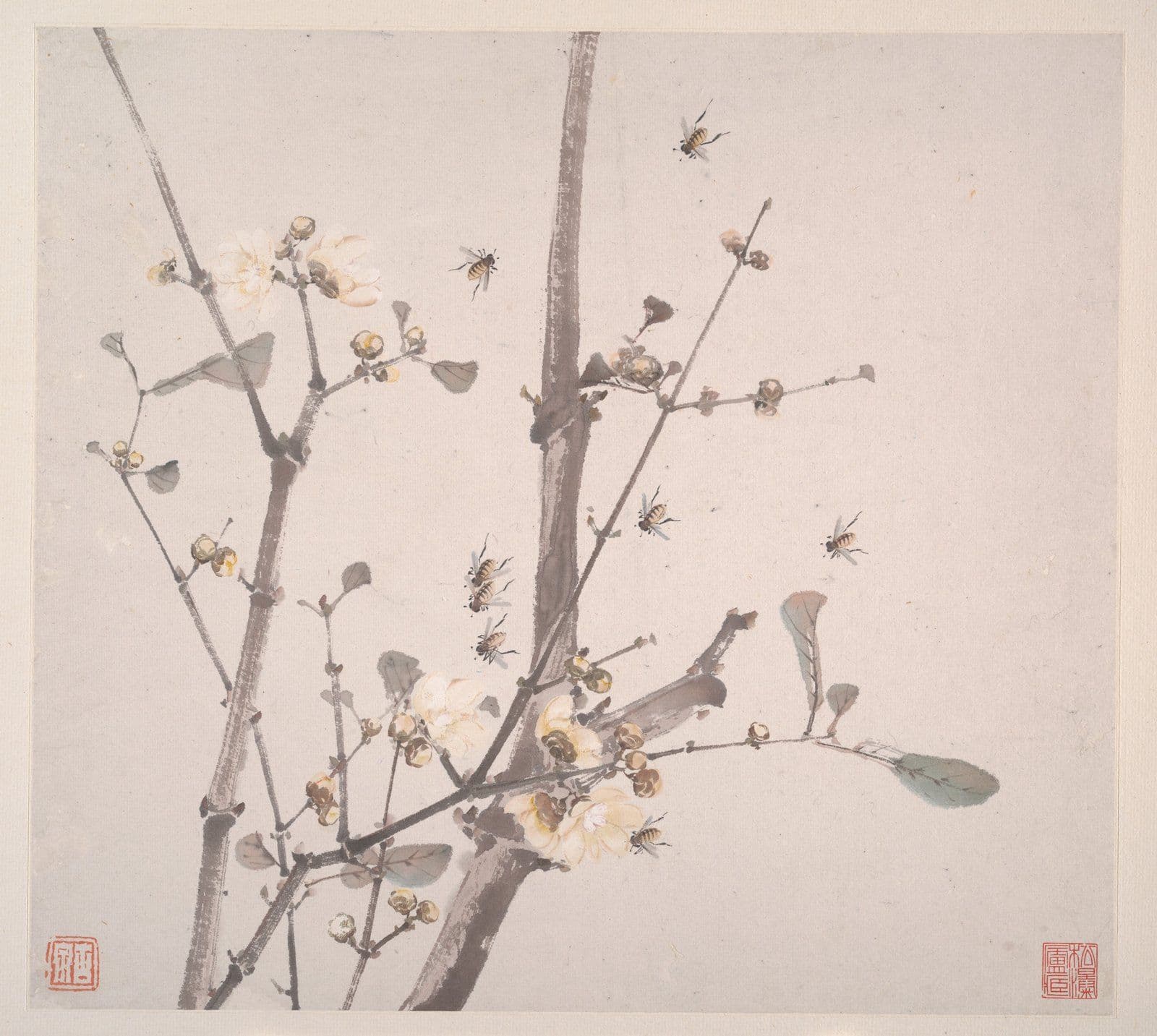
Ju Lian worked in a mode that had little to do with the dry, monochrome brush the literati mainstream prized. He painted insects, flowering branches and garden plants in colour, from close observation, and he built his surfaces with two devices his students named zhuang shui and zhuang fen — "colliding water" and "colliding powder". The painter lays a wash of colour and, while it is still wet, drops in clear water or opaque white pigment. The two liquids push against each other on the paper and dry into a gradation no brush could stroke in: a petal that is dense at the edge and luminous at the centre, a leaf that fades without a visible transition.
That technique is the genetic marker of the whole school. It is also why Lingnan pictures often read as wetter than orthodox work, and why they sit awkwardly in the usual xieyi versus gongbi division — they have the observational care of fine-line painting and the wet freedom of the sketch, at the same time.
Japan, and what Gao Jianfu brought back
In the first years of the twentieth century Gao Jianfu went to Japan. This is the fact that made the Lingnan School controversial for fifty years, so it is worth being precise about what he found there.
Japanese painters had spent the late nineteenth century working through the same problem the Chinese would face: what to do with a native brush tradition once European painting was in the room. The Nihonga movement's answer was neither surrender nor refusal. Keep the brush, the paper, the mineral colours; take from the West what actually helps — recession, cast light, weather, the modelling of solid form — and drop what does not.
Gao brought that answer home. In practice it meant three additions to the Guangdong manner he already had: atmospheric perspective, so that distance dissolves rather than simply sits higher on the page; consistent light, so that a picture can be at dusk or in rain rather than in the neutral daylight of tradition; and enough tonal modelling that a rock reads as a mass rather than a contour.
He was also, in these years, a revolutionary in the ordinary political sense. Gao was involved in the Tongmenghui, the alliance that worked to bring down the Qing, and the founding generation of the school — Gao Jianfu, his younger brother Gao Qifeng, and Chen Shuren, the "two Gaos and a Chen" — came out of that milieu. The painting argument and the political argument were the same argument: an inherited form that cannot describe the present has stopped being a living form.
The New National Painting argument
Gao's programme had a name: xin guohua, New National Painting. The claim was not that Chinese painting should become Western. It was that Chinese painting had confused its subject matter with its identity — that pines, plum branches and scholar-recluses were a set of habits, not the essence of the tradition, and that the essence was the brush.
So the Lingnan painters kept the brush and changed the world it described. Gao painted aircraft, motor vehicles, telegraph poles, and the ruins left by bombing. He painted skulls and broken walls in a country at war. To a Shanghai connoisseur raised on the Shanghai School's reworking of figure painting, which had modernised the market and the subject without touching the picture's fundamental grammar, this looked like a step too far — and the standard insult was that Lingnan work was simply Japanese painting with Chinese seals on it.
That charge stuck for decades and it was not entirely unfair as description, only as judgement. The debt to Nihonga is real and visible. What the critics missed is that the borrowing ran through a Guangdong technique that was already unorthodox before any of them went abroad.
How to recognise a Lingnan picture
Attribution to the school, as distinct from attribution to a named artist, is one of the more tractable problems in twentieth-century Chinese painting, because the visual signature is consistent. Look for these in combination — any one alone proves nothing.
- Gradation without a stroke edge. Wash that shifts from dense to pale with no brush mark at the transition, most often in petals, cloud, water and mist. This is the zhuang shui and zhuang fen inheritance and it is the single most reliable sign.
- Weather as a subject. Rain falling, mist rising off a valley floor, late afternoon light on a slope. Orthodox landscape has seasons; Lingnan landscape has conditions.
- Saturated colour used structurally. Not colour laid over a finished ink drawing, but colour doing the drawing. Mineral pigments carry much of this: stone colours behave differently from vegetal dye when they are floated wet into wet.
- Solid form. Rocks, tree trunks and animal bodies modelled with tonal shift so they read as three-dimensional, rather than described by outline alone.
- Modern or reportorial subject matter, especially in the founding generation: machines, war damage, working boats, coastal industry.
- Southern flora and light. Banana leaves, lychee, bamboo in humid air, plum in a warm winter. The school is regional in the literal sense — Lingnan means the country south of the mountain ranges.
One caution on signatures. The founders were prolific and widely imitated, and the school's manner is easier to copy than a distinctive personal hand, because the wet-in-wet effect does part of the work. Treat the inscription and seals as evidence to be tested rather than as a conclusion, and read them the way you would on any other Chinese work — the logic of dating an inscription applies here unchanged.
Chunshui Studio and the second generation
Gao Jianfu taught. He ran a studio in Guangzhou known as Chunshui — the Spring Slumber Studio — and the painters who came through it carried the school into the second half of the century, which is the reason Lingnan is a living tradition rather than a historical episode.
The best known of those students is Guan Shanyue, who trained under Gao and then spent sixty years extending the argument. Guan travelled and sketched constantly, took the school's atmospheric handling into large public commissions, and worked at a scale his teacher rarely attempted — including the monumental landscape he painted with Fu Baoshi for the Great Hall of the People. If you want to see what the Lingnan method looks like once it is fully mature and no longer arguing with anyone, the Guan Shanyue collector's guide is the place to start, and his plum branches are the clearest single demonstration: the wet gradation in the blossoms is Ju Lian's device, three generations on.
Li Xiongcai, another Chunshui student, took the same handling into monumental pine and mountain subjects. Between them the second generation removed the polemical edge and left the technique, which is why post-1950 Lingnan work often reads as simply a very good, very wet, very southern kind of Chinese landscape — the fight having been won quietly enough that no one remembers it happened.
Common questions
Is Lingnan painting really just Japanese painting?
No, though the influence is genuine and the founders never denied travelling to study it. The wet-collision technique that defines the school's surfaces comes from Ju Lian's Guangdong studio and predates any of the Japanese study trips. What Japan supplied was a way of organising a picture — atmosphere, consistent light, modelled form — not the brush handling itself. The accusation was polemical in origin, made during a period when any Japanese association carried a political charge, and it should not be taken as a technical description.
How do I tell a Lingnan work from an orthodox literati landscape?
Look at how the transitions are made. Literati landscape builds with discrete, legible brushstrokes — you can count them, and connoisseurship largely consists of judging them. A Lingnan passage often has no countable strokes at all in its key areas, because the effect was produced by liquids meeting on wet paper. Add the presence of weather and consistent light, and the two traditions separate quickly.
Are the Lingnan founders' works available to collectors?
Original work by Gao Jianfu, Gao Qifeng and Chen Shuren appears at auction but is scarce and heavily faked, and the market for the founding generation is a specialist one that rewards documented provenance above everything else. The second generation, Guan Shanyue in particular, is better documented and far more often seen.
Why is the school named after a region rather than a person?
Because it was a regional argument before it was a personal style. Lingnan — the land south of the ranges — was the part of China with the longest exposure to foreign trade and foreign ideas, and the painters who made this case were working in the one place where such a case could be made without seeming eccentric. The name records where the thinking was possible.
Further reading
- Guan Shanyue's Plum Blossom Paintings — the school's wet gradation at full maturity, in its most recognisable subject.
- Pu Ru: The Imperial Painter — the opposite pole of the same generation, and a useful contrast to Gao's argument.
- The Four Gentlemen in Chinese Painting — the traditional subject set the Lingnan painters were accused of abandoning.
- Chinese Ink Painting and Watercolour Compared — useful if the wet handling above sounds like Western watercolour to you.
Browse the collection
Kiln & Ink sells paper: limited-edition archival giclée reproductions of the twentieth-century Chinese ink masters, printed on rice (xuan) paper or museum-grade cotton rag, hand-numbered and issued with a Certificate of Authenticity. Guan Shanyue is on the roster, and his plum blossoms for spring is the Lingnan technique described above in a form you can hang.
Explore Further