Published October 4, 2026
Ming interregnum porcelain rarely carries a reign mark. Learn how to date Zhengtong, Jingtai and Tianshun blue-and-white by painting, cobalt and foot rim.
Turn a Chinese blue-and-white jar over and look for the reign mark, and in most Ming collections you will find one. Turn over a jar from the late 1430s to the early 1460s and you will usually find nothing at all. The base is glazed, perhaps a little greyish, and there is no six-character line to rescue you from judgement. That silence has given the period its collectors' nickname, the interregnum, and it is the reason these porcelains are among the hardest in the Ming sequence to date with confidence.
This guide walks you through the three reigns that fill the gap, Zhengtong, Jingtai and Tianshun, and shows you how to do five things afterwards: place the period in the Ming timeline, recognise the main stylistic habits of its blue-and-white, understand why marks are so rare, avoid the most common misattributions, and judge a piece sensibly when the evidence is thin.
What the interregnum is
The Xuande reign ended in 1435, and the Chenghua reign began in 1465. In between lies a stretch of roughly thirty years that is covered by three reign names but only two emperors. The Zhengtong Emperor came to the throne as a child in 1436 and reigned until 1449. After he was captured during a military campaign, his brother ruled as the Jingtai Emperor from 1450 to 1457. The first emperor then returned to power and reigned again under a new reign name, Tianshun, from 1457 to 1464.
Porcelain historians use "interregnum" for this period because the imperial kilns at Jingdezhen produced very little that carries a reign mark, and what survives is thinner on documentation than the wares of the reigns on either side. Our guide to the Ming dynasty reign marks gives the wider sequence, and the interregnum is the gap in it.
The word "interregnum" is therefore a convenience, not a political description. The court did not stop; the kilns kept firing. What changed was the relationship between the court and the potteries, and the habits of marking and recording.
Why marks disappear
Several explanations are offered, and a careful collector holds them loosely.
- Changes in imperial practice. Reign marks on porcelain had become common in the Yongle and Xuande periods, as our guide to Hongwu and Yongle marks explains. In the following decades the practice seems to have been relaxed, and many wares were left unmarked.
- Reduced court demand. The court's orders for imperial porcelain fell away at times, and kilns relied more on other markets.
- Shifts in production. Private kilns and official kilns overlapped more than later writers admit, so the line between imperial and commercial work is blurred.
- Later restoration of the practice. When reign marks returned under Chenghua, they came back with a distinct style, which is why Chenghua marks are comparatively easy to recognise.
Whichever explanation you prefer, the practical consequence is the same. You cannot read the date from the base. You have to infer it from the shape, the painting, the glaze and the foot, and the inference will often be a range rather than a point.
How the blue-and-white looks
The blue-and-white of these years sits between the polished confidence of Xuande and the delicate, pale manner of Chenghua. Collectors describe it with a handful of recurring traits, and each deserves a caution.
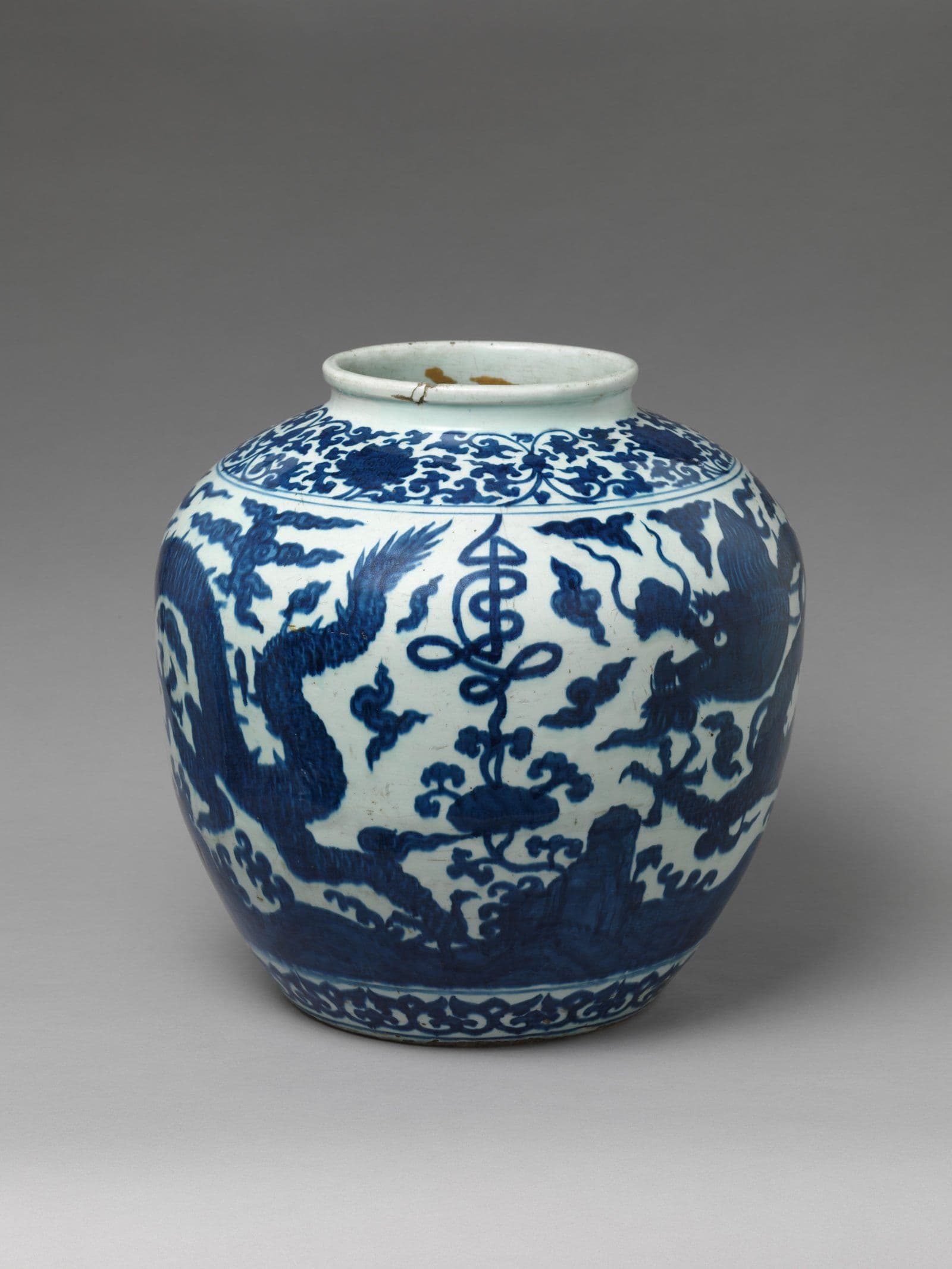
The painting tends to be freer and less formal than Xuande work. Figure subjects are popular: scholars under pines, immortals crossing water, and scenes from stories and legends drawn from the culture of the literati. The brushwork often looks quick, as if the painter were working to a different rhythm from the court's studio. Lotus scrolls, dragons and floral designs persist, but the drawing can be looser and the spacing more generous.
The blue itself changes. The vivid, saturated cobalt that made Xuande work famous, discussed in our history of cobalt in blue-and-white porcelain, gives way to a softer, greyer tone. Specialists link this to changes in the supply of cobalt and in how it was prepared, although the details are still debated.
The glaze often looks slightly thick and cloudy, and the surface can show small bubbles. Our guide to glaze bubbles and wear as dating clues shows how to read this, and the same page warns against treating any single trait as proof.
The foot and the base
Because the base is silent, the foot becomes the main source of evidence. Look at how the foot rim is cut, how the glaze runs up to it and what the unglazed clay looks like where it is visible. Our article on foot rims as a dating tool sets out the vocabulary.
On interregnum pieces the foot often shows a thick, slightly uneven rim with firing marks that look more casual than on Xuande work. The base glaze may be slightly greenish or greyish. Some wares show small traces of sand or kiln grit on the foot. None of this is diagnostic alone, but a consistent set of signs across shape, painting and foot is what gives a confident attribution.
Treat a base that has been tidied or polished with suspicion. A suspiciously clean foot on a piece that is meant to be five and a half centuries old suggests either later grinding or a later copy.
Shapes and types
The range of shapes is narrower than in the reigns around it, partly because less has survived. The most commonly encountered types include large jars and covered jars, bowls and dishes, small vases, and incense burners made for temple use. Many of the pieces that survive were made for ritual or domestic use rather than for the palace.
Dated inscriptions occasionally appear on temple wares, written by hand under or over the glaze rather than as a formal reign mark. Where they exist, they are valuable anchors, because they give scholars a dated point in a sequence that otherwise floats. A piece with a convincing early inscription and a consistent body is worth more attention than one with a modern-looking mark.
Common misattributions
The period is a favourite resting place for pieces that nobody can place. Three confusions come up repeatedly.
- Xuande pieces without marks. An unmarked Xuande-style jar is often called interregnum when it is simply an unmarked Xuande piece, or a later copy. Our guide to Xuande blue-and-white shows what the true Xuande manner looks like.
- Chenghua precursors. Early Chenghua wares with transitional features can be pushed backwards into the interregnum. Compare against the Chenghua collecting guide.
- Later reproductions. Jingdezhen has made Ming-style wares for centuries. Our warning about modern Jingdezhen reproductions applies with particular force to a period that is poorly documented.
Apocryphal marks add another layer. Later potters often added earlier reign marks as a gesture of respect, as the article on apocryphal marks explains, so a mark that looks right is not by itself evidence of date.
Judging a piece with thin evidence
When the base gives you nothing, work through the object in a fixed order. Start with the shape and ask whether it belongs to a known family. Then look at the painting and decide whether the drawing is Xuande in manner, Chenghua in delicacy or something between. Look at the cobalt and ask whether the colour and its behaviour in the glaze are consistent. Finally, examine the foot and the base for wear and firing characteristics.
Use the authentication checklist for Chinese porcelain as a discipline, and be ready to accept an honest attribution of "mid fifteenth century" rather than forcing one of the three reign names. A cautious label is a sign of competence, not weakness, and the better auction houses use exactly this kind of language.
Common questions
Why do Zhengtong, Jingtai and Tianshun porcelains lack reign marks?
Imperial marking practice was less consistent in these years, and demand from the court was uneven. The exact reasons are still argued over. What is clear is that most surviving blue-and-white from the period is unmarked, so attribution rests on shape, painting, glaze and foot rather than on a base inscription.
Is Tianshun the same emperor as Zhengtong?
Yes. The same emperor reigned twice, first as Zhengtong from 1436 to 1449 and again as Tianshun from 1457 to 1464. Between those reigns his brother ruled as the Jingtai Emperor. That arrangement is why three reign names cover the period but only two emperors.
How can I tell interregnum blue-and-white from Xuande?
Look at the cobalt and the drawing. Xuande blue is usually richer and more saturated, and the painting more controlled. Interregnum work tends to be greyer and freer, with a looser rhythm. The foot is often less refined. No single feature settles it, so compare several together.
Are interregnum porcelains valuable?
Rarity and condition drive the market, and secure attribution matters a great deal. Pieces with good painting, sound condition and a documented history command attention, while unattributed or restored examples are priced much more cautiously. Treat any strong claim of date without evidence as a reason to ask for more.
Further reading
- Ming dynasty reign marks: a guide — the full sequence into which the interregnum fits.
- Hongzhi to Zhengde: mid-Ming marks — the reigns that follow Chenghua and the marks they carry.
- Reading Chinese porcelain marks: a tutorial — the basic vocabulary for anything on a base.
Browse the collection
The interregnum is a subject we write about rather than one we stock, since our work centres on the twentieth-century Chinese ink masters. If you want to see how we handle numbering and provenance for what we do sell, our collections offer limited-edition archival giclée reproductions, hand-numbered with a Certificate of Authenticity.
Explore Further