Published August 20, 2026
How to care for Chinese ink paintings and works on paper: safe light levels, humidity targets, acid-free mounting, handling and when to call a conservator.
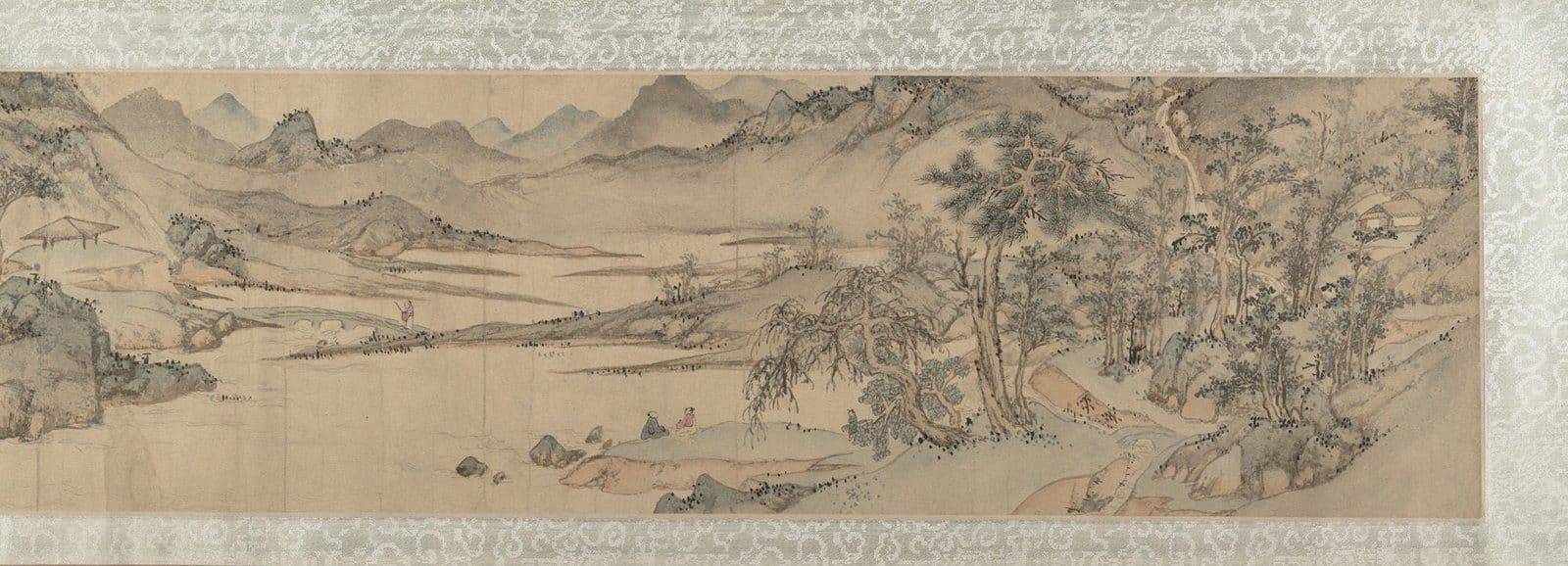
The Metropolitan Museum holds a handscroll landscape by Wen Boren dated 1558. It is ink and colour on paper, and it is still legible — the washes still read as distance, the inscription is still sharp enough to be transcribed. Nothing about paper makes that inevitable. It survived because for most of those centuries it was rolled up in the dark, opened rarely, and kept somewhere with a stable climate.
That is the whole of paper conservation, and everything below is a footnote to it. This guide covers what actually damages works on paper, what you can control at home, what the numbers mean when a museum quotes light levels or humidity, and the point at which you should stop and call a conservator instead of trying to fix something yourself.
The four things that damage paper
Damage to works on paper comes from a short list, and three of the four are environmental rather than accidental.
- Light — fades pigments, yellows the sheet and makes it brittle. Cumulative and permanently irreversible.
- Humidity swings — cockling, planar distortion, delamination of mounts, and eventually mould. Sometimes correctable, always at cost.
- Acidity — browning, brittleness, tide lines and burn marks transferred from mounts. Partly treatable by a conservator.
- Handling — tears, creases, skinning, fingerprints and adhesive stains. Rarely reversible, and never invisibly.
The order matters. People worry most about the fourth, because it is dramatic and you can see it happen. The first three are what actually consume most works on paper, because they operate continuously and nobody notices them working.
Light is the one you cannot undo
Light damage is cumulative and it does not repair itself. A sheet that has spent twenty years opposite a south-facing window has spent its budget, and no treatment brings the original tone back. Ultraviolet is the most aggressive part of the spectrum, which is why UV-filtering glazing is worth the money, but visible light fades pigments too. Filtering UV buys you time; it does not make a work light-safe.
Museums handle this with a lux figure. Highly light-sensitive material — which includes works on paper, and certainly includes ink and colour on paper — is typically displayed at around 50 lux, which is much dimmer than a normally lit room and looks it. The practical translation for a home is simpler than installing a light meter:
- Never hang a work on paper where direct sun falls on it at any hour, in any season.
- Keep it off the wall opposite a large window, which is where reflected daylight is strongest.
- Rotate what you display. A work that hangs for three months and rests for nine ages at a quarter of the rate.
Rotation is the single most effective habit in this list, and it is also the traditional Chinese one. Hanging scrolls were made to be changed with the season and returned to their boxes, not to occupy a wall permanently. The hanging scroll format is a storage format as much as a display one.
Humidity, and why stability beats any particular number
Paper and silk are hygroscopic: they take up and release moisture as the air changes, and they expand and contract as they do it. A mounted scroll is a laminate of several papers and a textile border, all moving at slightly different rates. Cycle that enough times and the layers begin to separate.
Aim for moderate relative humidity — somewhere in the region of 45 to 55 per cent — and a moderate temperature, cooler rather than warmer. But the target number matters less than people expect. A collection sitting steadily at 60 per cent is in far less danger than one oscillating between 35 and 65 every week. Swings are the damage mechanism.
Above roughly 65 per cent sustained, you are in mould territory, and mould on paper is a conservation problem rather than a cleaning problem. Foxing — those scattered rust-brown spots — is associated with damp conditions acting on mould and on metal impurities in the sheet. It is very difficult to remove and it usually indicates that the storage environment needs fixing before anything else does.
This is why the standard advice is to avoid attics, basements, exterior walls and anywhere near a radiator, a fireplace or an air-conditioning vent. Those are the places where temperature and humidity move the most.
Mounting, framing and the acid problem
A great deal of the damage that arrives at conservation studios was introduced by whoever framed the work.
The mount and backing board sit in contact with the paper for decades. If they are ordinary wood-pulp board, they are acidic, and that acidity migrates: the classic sign is a brown line burned into the sheet exactly where the window mount overlapped it. Insist on acid-free materials throughout — mount, backing, and any hinges.
Two specifics worth knowing:
- Never use pressure-sensitive tape. Ordinary adhesive tape stains, and the adhesive migrates into the fibres. The stain is often worse than the tear it was meant to fix. Traditional hinges use Japanese or Chinese tissue with wheat starch paste, which is reversible with moisture.
- Ask before using buffered board with silk. Alkaline-buffered board is the default for paper, but conservators are generally more cautious about putting it in direct contact with protein-based materials such as silk. If your work is on silk or has silk mount borders, say so to the framer and let a conservator decide.
Glazing should filter UV and should not touch the surface of the work — that is what the mount's depth is for. If a work is already cockled, pressing it flat against glass is not the solution; it traps moisture and can transfer media to the glazing.
Traditional Chinese mounting is a separate craft with its own logic, and it is worth understanding before you decide to Western-frame a scroll. The paste is wheat starch, chosen partly because it is reversible; the layered backing is designed to be taken off and replaced. If you own a mounted scroll, the structure of that mounting is part of the object, and cutting a scroll down to fit a frame destroys it as surely as a tear would.
If you are framing modern editions rather than antique scrolls, the constraints are the same but the stakes are lower and the choices are more open — framing Chinese art prints covers that case in detail.
Handling and storage
Most handling damage happens in the few seconds when a work is moving between two places.
Before you touch anything: clean, dry hands. Cotton gloves are traditional but many paper conservators now prefer bare hands for paper, because gloves reduce grip and sensitivity and gloved fingers catch and tear more often than clean ones do. Gloves remain right for metal, photographs and gilded surfaces.
Support the whole sheet. Never lift an unmounted work by one edge or one corner; the weight of the sheet concentrates at the grip point. Slide a piece of stiff board underneath and carry the board.
Rolling a scroll: roll it evenly and not tightly, keep the roll supported along its length rather than gripped at one end, and tie the cord snugly without cinching it. A scroll rolled too tight develops horizontal cracks along the painted surface; a scroll rolled unevenly develops diagonal ones. Unrolling is the same operation in reverse and deserves the same care — how a scroll is meant to be opened and viewed is not just etiquette, it is mechanics.
Storage: flat, in an acid-free box, in an interior room. Scrolls go back in their boxes. Unmounted sheets are interleaved with acid-free tissue. Nothing is stored in plastic sleeves in a humid climate, because plastic traps moisture against the sheet.
Insects: silverfish and booklice are drawn to the starch paste in traditional mounts, and they graze the surface. Check stored works once or twice a year. The traditional practice of airing scrolls periodically — opening them briefly in dry weather — exists for exactly this reason.
The substrate itself is part of this story. Raw xuan paper is soft, absorbent and unforgiving of moisture, and it behaves differently from sized paper or from silk; if you want to understand why your particular work responds the way it does, start with what xuan paper is and how it behaves.
When to call a conservator
The line is simple: anything involving water, solvent, adhesive or pressure is a conservator's job.
Call one for tears, losses, active mould, foxing, staining, flaking media, insect damage, planar distortion that will not relax, and any work that has been taped. Call one before an old scroll is remounted — remounting is a major intervention, historically undertaken only once in several generations, and a bad remounting is not recoverable.
What you can do yourself: control the light, control the climate, use acid-free materials, handle the object carefully, and check on it once a year. That list looks modest and it accounts for most of the difference between a work that lasts a century and one that does not.
Choose a conservator who specialises in East Asian paintings if the work is a mounted scroll. The materials, the paste and the mounting structure are specific, and a Western paper conservator without that training will say so.
Common questions
Can faded colours be restored?
No. Light damage is a chemical change in the pigment, not a layer of dirt, and there is nothing to reverse. A conservator can clean surface grime, reduce some staining, and improve the appearance of a discoloured sheet, but faded pigment is gone. This is why the advice about light is so insistent — it is the only one of the four damage agents where prevention is the entire treatment.
Should I keep a valuable scroll rolled or hang it permanently?
Rolled, in its box, and displayed in rotation. Permanent display accumulates light exposure continuously and exposes the work to whatever the room's climate does. The traditional Chinese practice — hang for a season or an occasion, then return it to storage — is the better conservation regime, and it also restores something the format was designed for: the scroll is meant to be an event rather than furniture.
Is glass or acrylic better for glazing?
Both work if they filter UV. Acrylic is lighter, does not shatter, and is preferable for large pieces and for anything that will be moved. Glass is more scratch-resistant and does not carry a static charge. Static is the deciding factor for anything with loose or powdery media, such as charcoal or pastel — acrylic can lift particles off the surface, so glass is safer there.
How often should I check works in storage?
Once or twice a year is enough for a stable environment, and it should be a real inspection: open the box, look at the surface in raking light for new cockling or flaking, check for insect grazing and for any spotting that was not there before. The point is to catch a climate problem in its first year rather than its fifth. If you find live insect activity or mould, isolate that item from the rest of the collection immediately.
Does hanging a modern reproduction need the same care?
The physics are identical — it is pigment on paper, and light and humidity treat it the same way. An archival giclée on cotton rag or xuan paper is made with pigment inks chosen for stability, so it starts with more tolerance than a nineteenth-century work coloured with fugitive dyes, but it still fades under direct sun. UV-filtering glazing, acid-free mounting and a wall that never sees direct sunlight cover almost all of it.
Further reading
- The Chinese Hanging Scroll Format — why the format assumes rotation and storage rather than permanent display.
- Silk vs Paper in Chinese Paintings — the two substrates age differently and want different handling.
- How to Care for Chinese Porcelain — the equivalent guide for the hard materials, where the risks are almost entirely mechanical.
- Chinese Painting Mounting and Zhuangbiao — what is actually underneath a mounted scroll, and why remounting is a serious decision.
Browse the collection
The care regime above is what we would give our own inventory, because it is the same material: what Kiln & Ink sells is paper. Our limited-edition archival giclée reproductions of the twentieth-century Chinese ink masters — Qi Baishi among them — are printed on rice (xuan) paper or museum-grade cotton rag, hand-numbered, and issued with a Certificate of Authenticity. Keep one out of direct sun behind UV-filtering glazing and it will outlast the wall it hangs on.
Explore Further