Published October 5, 2026
Yu Fei'an rebuilt gongbi bird-and-flower painting on silk in twentieth-century Beijing: materials, method, calligraphy, copies and what to check before buying.
Hold a Yu Fei'an bird-and-flower painting up to a window and the silk stops behaving like paper. Light passes through the weave, the mineral whites sit on the surface rather than sinking into it, and the deepest greens and cinnabar reds hold their edge even after the silk has aged to the colour of weak tea. Turn the scroll and the colophon on the right margin is often a small pleasure of its own: seal script written with the same care the painter gave the bird's claws. That combination — meticulous colour on silk, plus calligraphy a collector would frame by itself — is what makes Yu Fei'an one of the twentieth century's most recognisable names in Chinese bird-and-flower painting.
This guide walks you through who Yu Fei'an was and what he was trying to restore; how gongbi bird-and-flower painting is actually built up on silk; the pigments, grounds and brush habits that distinguish his work; how to read a finished sheet from the bird backwards to the colophon; what copies and later school pieces look like; and what to check before you buy.
Who Yu Fei'an was
Yu Fei'an worked in Beijing in the first half of the twentieth century, at a moment when the city's painting culture was pulled between the expressive ink-play of the literati and the commercial demand for decorative colour. He chose neither pole cleanly. He went back to the Song dynasty bird-and-flower painting tradition — court-adjacent, meticulously observed, silk-mounted — and rebuilt it for a modern audience.
He was a working journalist and editor as well as a painter, which shows in his habit of documenting. His colophons name subjects, record seasons, and occasionally describe the pigments or ground he was working on. He also practised calligraphy seriously, especially in the seal and clerical scripts, and treated the inscription as part of the painting rather than as a signature bolted on afterwards.
In the Beijing art world he became a reference point for the gongbi revival. Students and later imitators copied his birds, his hibiscus, his wagtails on snow-covered branches — the very subjects catalogued in the bird-and-flower symbolism decoder. That is useful for collectors: a large body of work exists under or near his name, and the question is never whether Yu Fei'an bird-and-flower paintings exist in quantity, but which of them are his.
What gongbi bird-and-flower painting actually is
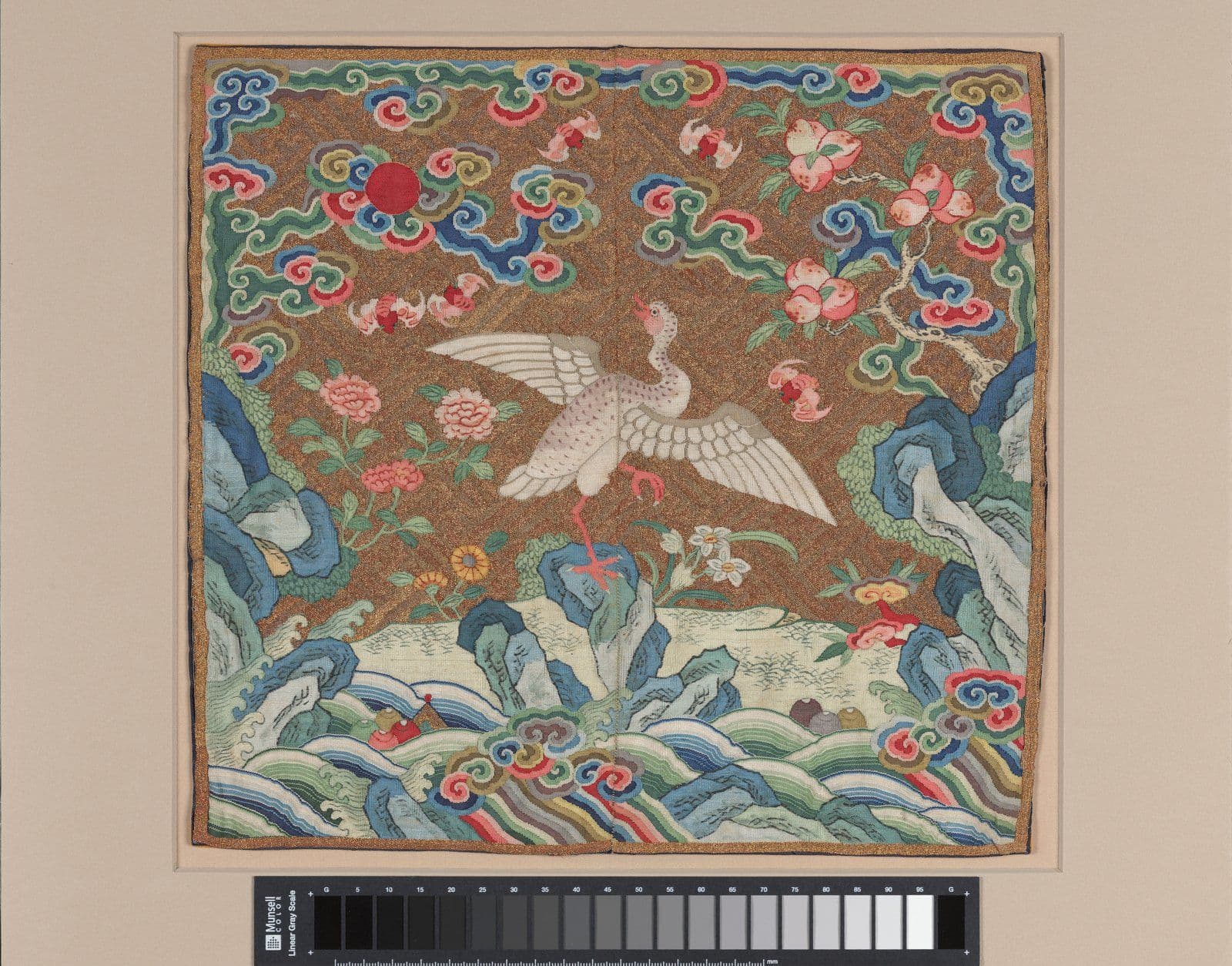
Gongbi (gongbi, "meticulous brush") is a method, not a mood. The design is transferred or drawn in fine outline first, colour is laid in thin washes and built up in several passes, and the outline is either absorbed into the colour or kept as a dark defining edge. The subject is observed closely — feather tracts, the way a petal curls as it dries, the scaly grip of a bird's foot on a branch — but it is also idealised into a pattern the eye can read at scroll distance.
Yu Fei'an's version of gongbi had three commitments. First, silk rather than paper as the ground: silk accepts mineral colour differently, holds a crisp outline longer, and gives the finished sheet a surface collectors of the Song tradition expect. Second, mineral and animal-based pigments rather than modern tube colours: azurite and malachite for blues and greens, cinnabar and carmine for reds, clam white for the body of flowers and birds. Third, a compositional habit of placing one or two strong vertical elements against an open field of silk, so that the coloured subject floats in a space that is itself part of the design.
How he rebuilt the technique
The twentieth century did not inherit Song gongbi ready-made. Pigment recipes had been lost or degraded, silk production had changed, and painters still working in meticulous colour were often producing for a commercial market that rewarded speed. Yu Fei'an's contribution was a reconstruction: he went back to old paintings, old recipes and the physical behaviour of materials until the method worked again.
- Silk sizing. Unsized silk drinks pigment unevenly and loses the crispness of the outline. A properly sized silk — alum and animal glue in the traditional manner — lets colour sit on the surface and keeps fine lines intact through several washes. Look at his outlines: they stay decisive even where the colour is heaviest.
- Mineral pigment handling. Mineral colours are ground particles, not dyes. They need to be ground fine enough to stay in suspension but coarse enough to keep colour strength, and bound with animal glue that will hold them without darkening. His greens and whites retain body; later school pieces often look chalky.
- Layering order. Gongbi colour is built light to dark in passes, with drying time between them. His whites are opaque and sit above the outline in lit areas; his darks are laid thinly so the silk texture still shows. When the order is wrong, white looks grey and darks look muddy.
- Ink outline quality. The outline is drawn with a soft hair brush, usually in several strokes per form rather than one continuous wire. It should vary slightly in weight around the form. Uniform dead-parallel outlines are a warning sign.
How to read a finished sheet
Work from the bird backwards rather than from the signature forwards. Start with the subject that carries the colour: is the feather structure legible, does the eye have a highlight placed with intention, does the petal have a visible change of plane where it curls? Then look at the branch that supports the subject: is it drawn with the same attention, or is it a decorative afterthought? Then read the empty silk. Yu Fei'an's open areas are not blanks; they are the counterweight to the coloured subject.
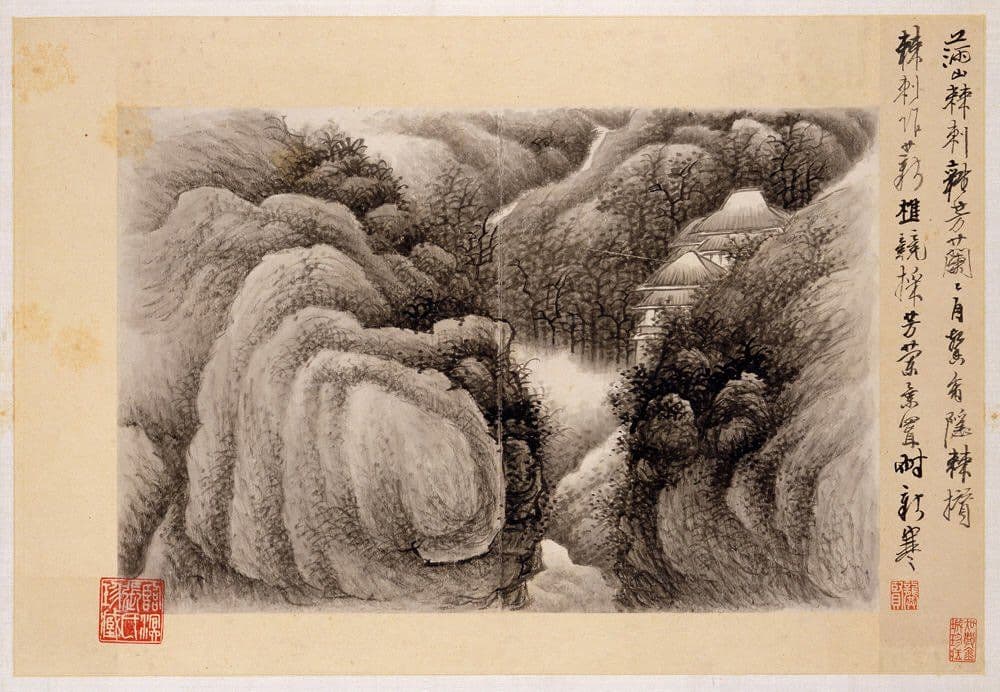
Next, the colophon and seals. His inscriptions are typically in a careful archaising script, often with a date in the cyclical calendar and a studio name or dedication. The seals should match the ink of the inscription rather than looking freshly stamped over old silk. Compare seal impressions across authenticated examples: the edges of a seal cut in the same decade tend to behave the same way.
Finally, the mount. Original mounts from the mid-twentieth century are rare, but a remounted painting is not thereby a fake. What matters is that the silk of the painting itself shows consistent age — even yellowing, no modern bright whites that have not been painted on, no fresh crackle patterns painted in to imitate age.
Distinguishing his work from copies and school pieces
Because he was widely copied in his lifetime and afterwards, the practical tests are material and calligraphic rather than thematic. Hibiscus, pigeons, wagtails, lotus and peony appear constantly; the subject alone tells you nothing.
- Calligraphy first. Yu Fei'an was an accomplished calligrapher. School pieces often get the bird roughly right and the inscription wrong: hesitant strokes, incorrect stroke order in the seal script, spacing too even or too slack. If the colophon does not convince you, stop.
- Pigment body under raking light. Hold the silk at an angle to the light. His mineral whites and greens have a slight relief and a matte quality. Flat, glossy or plasticky colour suggests modern materials or a reproduction.
- Edge of the colour field. Where a wash meets the outline, his transitions are controlled: the wash stops inside the line or is absorbed into it. Washes that ignore the outline, or that are clumsily edged with a second outline, are not his habit.
- Silk weave and age. The weave should be even and period-appropriate; the yellowing should be even too. Localised bleaching or aggressive cleaning shows up as patches under raking light.
- Provenance and exhibition history. A painting in one family since the mid-century, with photographs or earlier catalogues, is more credible than one that appears from nowhere with a stack of recent certificates.
His place in twentieth-century painting
Yu Fei'an matters because he made meticulous colour on silk respectable again at a time when the dominant narrative of Chinese painting was ink and spontaneity. He did it without turning gongbi into a museum exercise: his paintings are decorative in the best sense, designed to be looked at closely and hung in a room, and they carry Song observational discipline into a modern Beijing context.
He also forms a useful pair with the expressive ink masters of the same generation. Where an ink painter suggests a bird with three wet strokes, Yu Fei'an shows the bird's structure and then gives you the empty silk to rest in. Collectors who already hold twentieth-century ink work often find that a gongbi piece by him changes how they read their own scrolls.
The market has priced that contrast for decades. Well-documented paintings with clear colophons have held their position, while weakly attributed work in his style has been harder to sell. The gap is a useful signal: the name is being tested rather than taken on trust.
What to check before buying
- The inscription and seals. Read them before you read the marketing note. If the colophon is in the wrong script, or the seals do not match known impressions, the painting is not for you regardless of how good the bird looks.
- The silk itself. Condition, weave, ageing pattern and repairs. A heavily repaired painting can still be authentic, but the price should reflect the conservation history.
- Colour originality. Later overpainting is common on popular subjects. Under magnification, look for colour that sits on top of an older colour layer, especially whites and greens.
- Mount quality. A good remount protects the painting; a poor one damages it. Mount silk newer than the painting is normal; crude fittings can stress the silk.
- Documentation. Exhibition catalogues, collection seals, photographs from earlier decades and a clear chain of ownership matter more for this artist than for many contemporaries, precisely because the school production is large.
Common questions
How much is a Yu Fei'an painting worth?
Values range widely by size, subject, condition and documentation. A small, well-colophoned album leaf from a known collection is a different proposition from a large hanging scroll with gaps in its history. The market rewards the documented piece over the visually impressive one: expect to pay a meaningful premium for a clear colophon, matching seals and an unbroken provenance chain.
Is Yu Fei'an a good entry point for a new collector of Chinese painting?
Yes, if you want to learn how meticulous colour works on silk. His paintings are legible — you can see the method, the layering and the structure of the subject — and they sit comfortably in a modern room. The risk is the size of the school production: buy slowly, read the calligraphy first, and prefer a smaller documented work over a large undocumented one.
What subjects did he paint most often?
Birds and flowers dominate: hibiscus, lotus, peony, pigeons, wagtails, kingfishers, insects against foliage. Seasonal pairings are common — spring blossom with a single bird, autumn grasses with an insect. He also painted figure and landscape subjects, but the bird-and-flower work is what collectors mean when they say his name.
How can I tell a reproduction from an original?
Colour and calligraphy are the fastest tests. A reproduction often has flat colour fields, uniform outlines and an inscription that looks mechanically copied rather than written. Raking light, magnification at the edges of colour fields, and comparison of seal impressions against published examples are more reliable than photographs alone. If you cannot inspect the silk in person, buy only from a seller who will.
Does he still matter to the market today?
He is one of the twentieth-century names that has held collector attention rather than drifting into specialist-only territory. His work appears regularly in the market and in museum displays of modern Chinese painting, and the gongbi revival he led continues to shape how bird-and-flower painting is taught and collected.
Further reading
- Chinese Bird-and-Flower Painting Guide — the longer tradition Yu Fei'an was working inside.
- Bird and Flower Symbolism Decoder — how to read the subjects he painted most often.
- Chinese Ink Painting Six Principles of Xie He — the classical framework gongbi painters still measure themselves against.
- Chinese Painting Mineral Pigments Guide — the materials behind his colour.
Browse the collection
Kiln & Ink sells limited-edition archival giclée reproductions of twentieth-century Chinese ink masters, hand-numbered and supplied with a Certificate of Authenticity. Yu Fei'an's gongbi bird-and-flower tradition is one we write about closely; when a reproduction of a related ink master suits the way you live with painting, the collections page is where to start.
Explore Further